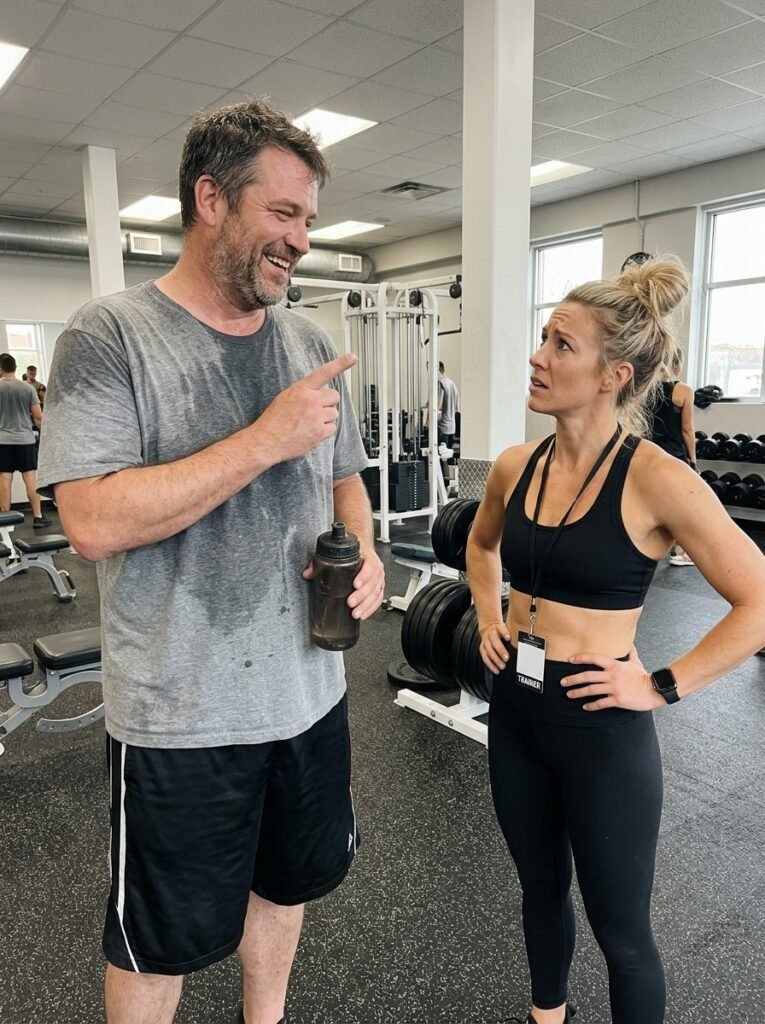
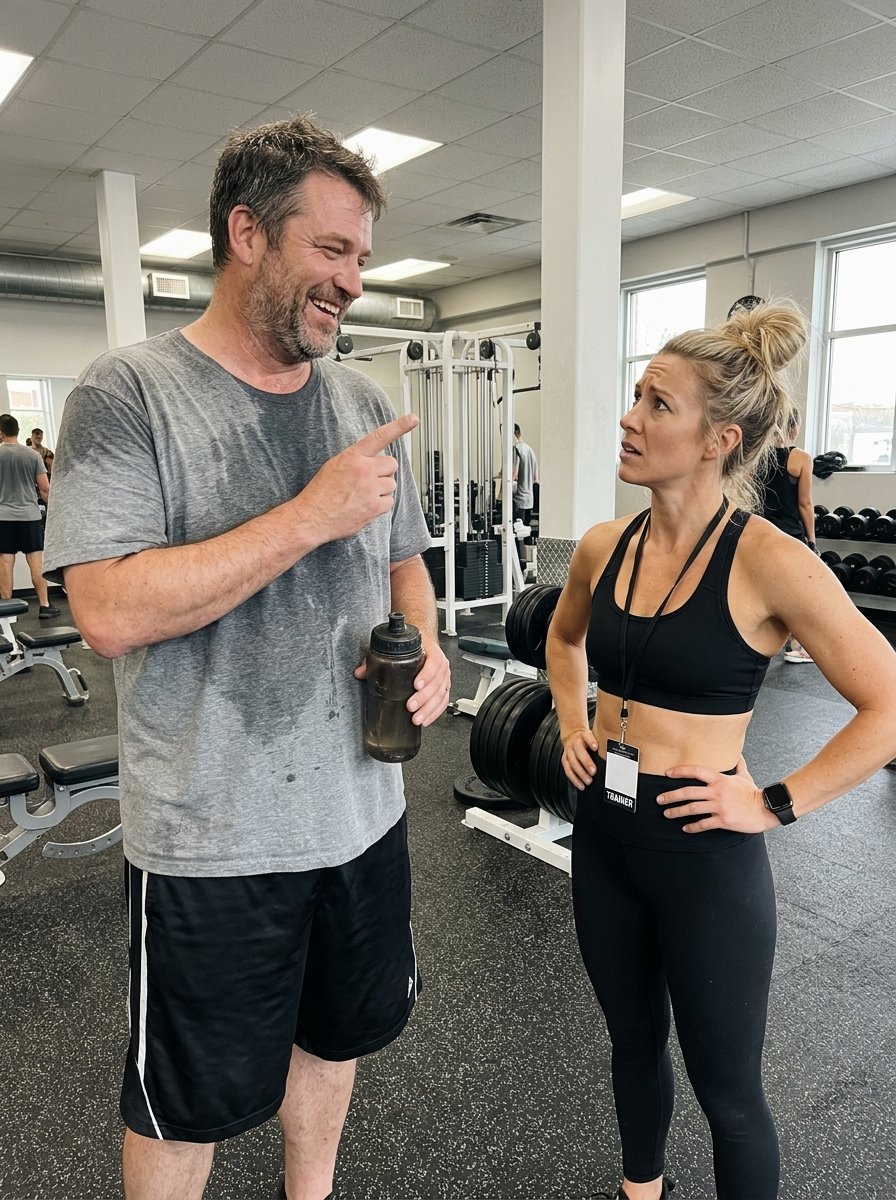
He called me “Barbie,” refused to let me train him, and insisted he knew better. Less than half an hour later, the qualifications he mocked were suddenly the only thing that mattered.
The scream came from the weight area.
I dropped my coffee and ran.
A woman near the cable machines was pointing toward the floor.
“He’s not breathing right!”
Then I saw him.
Brian.
The same man who had spent the first few minutes of my shift calling me “little girl,” “Barbie,” and asking whether I knew anything beyond taking selfies.
He was lying flat on his back beside a bench.
His face had gone gray.
For half a second, I just stared.
Then training took over.
“Call 911!” I shouted.
Someone already had a phone out.
I dropped beside him. “Brian?”
No response.
I tapped his shoulder hard. “Brian, can you hear me?”
Nothing.
His breathing was strange.
Not normal breathing. A few gasping sounds.
Then silence.
I looked at the woman beside me.
“Get the AED.”
“What?”
“The defibrillator. Front desk. Red case. Go.”
She ran.
Another staff member, Marcus, came sprinting over.
“What happened?”
“I don’t know yet. Help me.”
I checked again.
No normal breathing. No meaningful response.
I started chest compressions.
Hard. Fast. Center of the chest.
Brian was a large man, over 300 pounds, and I could already feel the effort in my shoulders.
People backed away.
Someone was crying.
Someone else kept saying, “Oh my God, oh my God.”
I ignored all of it. “Marcus, clear space.”
He turned around. “Everybody back up! Give her room.”
I kept counting.
“Twenty-seven, 28. 29, 30.”
Then rescue breaths. Then compressions again.
My name is Megan. I’m 28, and last Monday was supposed to be a simple first day at a new gym.
I had spent six years working as a personal trainer.
I had trained teenagers, retirees, amateur runners, new mothers, men recovering from injuries, people with diabetes, people who had not exercised in 20 years, and people who could deadlift twice my body weight.
I knew how to write programs.
I knew how to modify movements.
I knew how to recognize when somebody needed to stop.
I also maintained CPR and AED certification because every decent trainer should.
I never expected to need it 20 minutes after being insulted by my first client.
Brian had walked in just after nine.
He was in his 40s.
Big guy. Broad shoulders. Heavy stomach.
Probably around 310 pounds.
He carried himself like somebody who expected people to move when he entered a room.
I approached him with a smile.
“Hi, I’m Megan. I’ll be working with you today.”
He looked me up and down.
Then laughed.
“You’re kidding.”
I thought he was joking.
“I’m sorry?”
“They assigned me a little girl?”
There were people nearby.
A few heads turned.
I forced a professional smile.
“I’m 28, and I’m a certified trainer with six years of experience.”
He smirked.
“Sweetheart, I weigh three times what you do.”
“Not quite.”
That slipped out before I could stop it.
He looked at me.
I said, “But your size isn’t really the issue.”
“What exactly are you going to teach me? How to take selfies?”
A man on a rowing machine looked over.
I felt my face getting hot.
Still, I tried.
“Why don’t we start with your goals and health history?”
“My goal is to get a real workout.”
“Good. That’s what I’m here for.”
He shook his head.
“I came here because my doctor said I need to lose weight. I didn’t come here to have some Barbie tell me how to lift.”
At that point, I stopped trying to win him over.
“Brian, if you can’t speak to me respectfully, I’m not going to train you.”
He laughed.
“Perfect.”
Then he picked up his gym bag.
“I’d rather train myself anyway. At least I know what I’m doing.”
I said, “That’s your choice.”
What I wanted to say was very different.
Instead, I walked away.
I went into the staff room, sat down, and made coffee I never got to drink.
Twenty minutes later, I was on the floor performing CPR on him.
The AED arrived.
The woman holding it looked terrified.
“I’ve never used one.”
“That’s okay.”
I took it.
“Marcus, keep compressions going.”
He moved into position while I opened the case.
The machine started giving instructions immediately.
I cut Brian’s shirt open with the scissors inside the kit.
Marcus stopped while I placed the pads.
One high on the right side of his chest.
One lower on the left.
The AED began analyzing.
Everyone moved back.
“Clear!”
The machine advised a shock.
That was when the room became very quiet.
I pressed the button.
Brian moved a bit.
Then the AED told us to continue CPR.
So we did.
Marcus took one round. I took the next.
Time gets strange during something like that.
Later, somebody told me paramedics arrived in less than seven minutes.
It felt like half an hour.
At one point Brian coughed.
I stopped long enough to reassess.
He was breathing.
Weakly.
But breathing.
“Brian?”
His eyes fluttered.
“Stay still.”
He tried to move.
“Don’t sit up.”
His face looked confused. Then scared.
“What happened?”
“You collapsed.”
He stared at me.
Recognition slowly appeared.
“You?”
There was no time to enjoy the irony.
“Yes. Don’t talk.”
The paramedics arrived seconds later.
They took over immediately.
Oxygen. Monitor. IV. Questions.
One of them asked me, “Was he pulseless?”
“I couldn’t find a reliable pulse, and he wasn’t breathing normally.”
“Shock advised?”
“Yes.”
“One?”
“One.”
The paramedic nodded.
“Good work.”
That was the first moment my hands started shaking.
Not during CPR.
After.
Marcus touched my shoulder.
“You okay?”
“Yeah.”
I wasn’t.
Brian was loaded onto a stretcher.
Before they wheeled him away, he looked at me.
He opened his mouth.
I shook my head. “Don’t.”
For once, he listened.
After the ambulance left, the gym felt wrong.
Music still playing.
Treadmills still moving.
People whispering.
Someone handed me water. I drank half of it without tasting anything.
Our manager, Denise, came over.
“You need to sit down.”
“I’m fine.”
“You’re shaking.”
I looked at my hands.
She was right.
I sat.
“What happened before he collapsed?” I asked.
A man nearby said, “He was doing heavy presses.”
“What kind?”
“Bench.”
“How heavy?”
He told me.
It wasn’t an insane amount of weight for everyone.
But for someone whose doctor had apparently just told him to lose weight and who had refused even a basic assessment?
It was far too much to jump into cold.
Another man said, “He was breathing weird before he went down.”
“What do you mean?”
“Like really winded. He sat up, grabbed his chest, then fell.”
That mattered.
Denise wrote everything down for the incident report.
I gave a full statement.
Then I went into the bathroom and cried.
Not dramatically. Just quietly.
Adrenaline had nowhere else to go.
I kept thinking about how angry I’d been at Brian.
Twenty minutes earlier, I had wanted him to leave.
Then suddenly I was kneeling over him, trying to save his life.
That emotional shift was hard to process.
I didn’t forgive the way he’d spoken to me.
But once he was on the floor, none of that mattered.
He wasn’t “the rude guy.”
He was a person in cardiac arrest.
That was enough.
I learned later that Brian had suffered a serious heart rhythm problem.
His family eventually told us he’d had warning signs for months.
Shortness of breath. Pressure in his chest. Fatigue.
He had blamed all of it on being out of shape.
His doctor had apparently ordered additional testing, but Brian had not completed it yet.
I am not his doctor, so I won’t pretend I know exactly what caused everything.
What I know is that the AED delivered a shock because it detected a shockable rhythm.
Paramedics transported him.
He was admitted.
And he survived.
Two days later, Denise called me into her office.
“I got a phone call.”
I immediately thought I’d done something wrong.
“From who?”
“Brian’s wife.”
My stomach tightened.
“Is he okay?”
“He’s awake. Stable.”
I exhaled.
Then Denise smiled slightly.
“She wants to talk to you.”
“I don’t know if I can tell her anything useful.”
“She mostly wants to say thank you.”
I hesitated. Then agreed.
Her name was Lisa.
She called that afternoon.
The moment I answered, she started crying.
“I’m sorry.”
“You don’t need to apologize.”
“I told myself I wasn’t going to cry.”
“That’s okay.”
She took a breath.
“Brian told me what happened before he collapsed.”
That made me uncomfortable.
“What part?”
“The part where he acted foolish.”
I didn’t know what to say.
Lisa continued.
“He said he insulted you.”
“He did.”
“And then you saved his life.”
I corrected her automatically.
“The AED, CPR, paramedics, everyone working together helped save him.”
She laughed through tears.
“He said you’d say something like that.”
That surprised me.
“He’s awake enough to complain already?”
“Unfortunately.”
That made me laugh.
Then Lisa became serious.
“His doctor said those first minutes mattered.”
I looked down.
“That’s what CPR training is for.”
“I know.”
Her voice broke.
“But thank you for doing it anyway.”
That sentence hit me.
Because people imagine trained professionals always feel brave.
We don’t. I was scared.
I just knew what to do while scared.
I said, “You’re welcome.”
She hesitated.
“Would you be comfortable visiting him?”
I almost said no.
Not because I was angry. Because the idea felt strange.
Then I thought about Brian waking up and realizing the person he had dismissed had been the one who tried to save his life.
Maybe he needed to sit with that.
“Okay.”
I went to the hospital the next afternoon.
Brian looked smaller in the bed.
Hospital gowns do that to people.
No expensive gym clothes. No swagger.
Just wires, blankets, and a very tired man.
Lisa was sitting beside him.
She stood. “I’ll get coffee.”
That was not subtle.
When she left, Brian looked at me.
“Hey.”
“Hi.”
His voice was weak. He pointed at the chair.
I sat.
For several seconds, neither of us spoke.
Then he said, “I remember you telling me not to talk.”
“You were surprisingly cooperative.”
He smiled faintly.
Then his face changed. “I’m sorry.”
I knew what he meant.
But I made him say it.
“For what?”
He looked embarrassed.
“For the way I talked to you.”
I waited.
He continued.
“I acted foolish.”
“Yes.”
“I thought…”
He stopped.
“What?”
“I thought you couldn’t possibly know what I needed.”
“Because I’m a woman?”
He winced.
“Partly.”
“Because I’m smaller than you?”
“Yeah.”
“Because I’m younger?”
“Yeah.”
I nodded.
“Anything else?”
He almost smiled.
“No, I think you’ve covered the reasons I’m an idiot.”
I didn’t smile back immediately.
“Brian, I don’t need you to call yourself an idiot.”
He looked at me.
“I need you to understand why what you did was a problem.”
He nodded.
I continued.
“You came in because your doctor told you to exercise.”
“Yeah.”
“My first job would’ve been to ask about your health history.”
His expression changed.
“You tried.”
“Yes.”
He looked toward the blanket.
I said, “I would’ve asked about medications, symptoms, previous injuries, what your doctor cleared you for, whether you were having chest pain or unusual shortness of breath.”
He was quiet.
“Instead, you decided I couldn’t help you because of what I looked like.”
He swallowed.
“I know.”
“That could’ve mattered even before you collapsed.”
That part seemed to hit him hardest.
He rubbed his face.
“I’ve been getting chest pressure.”
“Lisa mentioned warning signs.”
“Yeah.”
“Did you plan to tell your trainer?”
His silence answered.
“Probably not.”
“Why?”
He sighed.
“Because I didn’t want somebody treating me like I was fragile.”
I understood that.
Not agreed. Understood.
“So instead, you tried to prove you weren’t.”
“Pretty much.”
“And ended up in cardiac arrest.”
“When you say it like that, it sounds bad.”
“It is bad.”
He laughed once, then winced.
“Don’t make me laugh. My ribs hurt.”
“CPR will do that.”
He looked at me.
“Did you break them?”
“Maybe. That’s common.”
“Great.”
“You’re welcome.”
Advertisement
That finally made both of us smile.
Then Brian said, “I called you Barbie.”
“You did.”
“My daughter is furious with me.”
“How old is she?”
“Nineteen.”
“Smart kid.”
“She said if I’d died after saying that, she’d have put it in my obituary.”
I laughed.
“Okay. I like her.”
He smiled. Then his eyes filled.
Father-in-Law Kept Packing up Food Scraps and Calling Them Leftovers – His Snarky Excuse Gave Her an Idea He Hadn’t Expected
Woman’s Boyfriend Kept Giving Her Fake Jewelry, Claiming It Was Real Gold and Diamonds – She Gave Him What He Deserved
Man Never Forgave Himself for Missing His Mother’s Last Call – Then a Woman Arrived with a Recording She Had Kept for 15 Years
“I have two daughters.”
I waited.
“I kept thinking about how I’d feel if some guy talked to either of them the way I talked to you.”
I said, “You shouldn’t need daughters to know women deserve respect.”
He nodded.
“You’re right.”
That was the point where I believed his apology.
Not because he cried.
Because he didn’t argue.
Brian stayed in the hospital several more days.
After discharge, he spent weeks under medical supervision before he was cleared to begin a structured exercise program.
Then one morning, Denise walked over to me at the gym.
“Someone requested you.”
I looked at the schedule.
Brian.
I actually laughed. “No.”
Denise grinned.
“He specifically asked.”
“Tell him I’m a little girl.”
“He said you’d say that.”
Eventually, I agreed to train him.
With conditions.
Full medical clearance. No improvising. No ignoring symptoms.
No comments about my size, gender, hair, makeup, selfies, dolls, salads, or anything else that could get him removed from my schedule.
He said, “Fair.”
Our first real session was almost comically gentle.
Walking. Mobility work. Very light resistance.
He looked at the tiny dumbbells I handed him.
“You are enjoying this.”
“A little.”
“I knew it.”
“Keep walking.”
But Brian changed.
Not overnight.
He still complained. He still wanted to do too much.
He still occasionally said, “I used to be able to—”
And I would interrupt, “We are training the body you have today.”
He hated that sentence.
Which is why I used it often.
Six months later, he’d lost 38 pounds.
More importantly, his endurance improved.
His blood pressure was better controlled.
He followed up with his medical team.
He stopped trying to turn every workout into a test of masculinity.
One afternoon, a new member watched me correcting Brian’s form and said, “She’s tough on you, huh?”
Brian replied, “You have no idea.”
Then he looked at me.
“This woman kept me alive long enough to annoy me professionally.”
I rolled my eyes.
“Finish your set.”
He did.
People at the gym love telling the story now.
They usually tell it as karma.
Guy mocks female trainer.
Twenty minutes later, the female trainer saves him.
Perfect little moral.
I understand why.
But that’s not really how I see it.
Brian didn’t collapse because he insulted me.
The emergency wasn’t punishment.
And I didn’t help him because I wanted to prove a point.
I helped him because he needed help and I knew what to do.
The lesson came afterward.
Brian had looked at me and decided what I was capable of before I asked him a single question.
Then, when he lost the ability to help himself, the qualifications he’d mocked were suddenly the only thing about me that mattered.
I don’t bring that up to embarrass him.
I don’t need to.
He remembers.
Last week marked one year since my first day at that gym.
Brian brought me a card.
Inside, he had written, “One year ago, I thought strength was about who could lift the most weight. Thanks for teaching me otherwise.”
Underneath, his daughter had added, “And thanks for not letting my dad die before I had time to fix his personality.”
I laughed so hard I had to sit down.
Brian said, “She gets that from her mother.”
“Sure she does.”
Then he pointed toward the weights.
“Are we training or reading greeting cards all day?”
I handed him a pair of dumbbells.
“Careful.”
He looked at the weight.
“These are heavier than last week.”
“Thought you wanted a real workout.”
He stared at me for a second.
Then started laughing.
“Okay,” he said. “I deserved that one.”
Yes. He absolutely did.