PART 1 — THE GIRL ON THE COURTHOUSE STEPS
Judge Rebecca Mercer had spent twenty-six years learning not to run toward screaming.
Inside a courtroom, screaming usually meant rage, grief, or one final attempt to delay the inevitable. Her job required her to remain calm, listen carefully, and separate fear from fact.
But the scream outside the Franklin County Courthouse that Monday morning was different.
It sounded young.
Then came the unmistakable sound of a body striking stone.
Rebecca had just stepped out of the courthouse parking garage when she saw a teenage girl collapse near the security barriers.
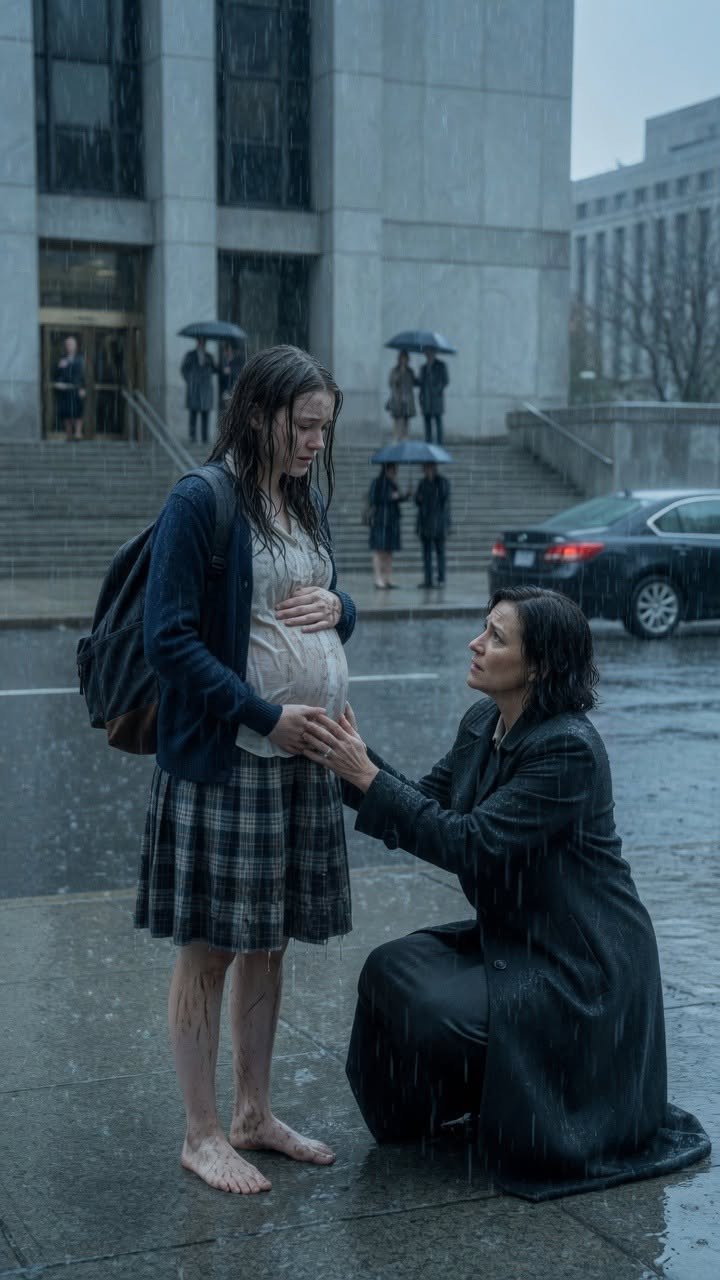
The girl wore a navy school cardigan over a white blouse, both soaked by the cold November rain. A backpack hung from one shoulder. Her plaid skirt was dark with water, and one of her sneakers was missing.
She could not have been more than seventeen.
The girl curled around her stomach and cried out again.
“Somebody call an ambulance!” Rebecca shouted.
A court officer ran toward them. Two attorneys stopped beneath the entrance awning. Several bystanders raised their phones, unsure whether they were witnessing a medical emergency or the beginning of a crime.
Rebecca dropped to her knees beside the girl.
“Can you hear me?”
The girl opened her eyes.
They were gray.
For one disorienting second, Rebecca forgot where she was.
Her daughter had been born with gray eyes.
Most newborns’ eye colors changed. Rebecca had been reminded of that countless times during the eighteen years since her baby disappeared. Gray eyes meant nothing. Thousands of people had them.
Still, the sight hit her with enough force to steal her breath.
The girl gripped Rebecca’s sleeve.
“Don’t let them take him.”
“Who?”
“My baby.”
Another contraction seized her, making her entire body go rigid.
Rebecca looked toward the courthouse doors.
“Where are the paramedics?”
“Four minutes away,” the officer answered.
Rebecca looked back at the girl.
“She doesn’t have four minutes.”
A woman in a dark suit rushed down the steps and crouched beside them. She introduced herself as a public defender who had delivered two children of her own.
Together, she and Rebecca tried to keep the girl calm.
“What’s your name?” Rebecca asked.
“Sophie.”
“Sophie what?”
The girl’s lips trembled.
“Keller.”
Rebecca knew that name.
Daniel Keller was a prominent family-law attorney who specialized in private adoptions and sealed custody cases. He had appeared in Rebecca’s courtroom twice, though not recently.
“How far along are you?”
“Thirty-six weeks. Maybe thirty-seven.”
“You need to breathe.”
“I need you to listen.”
“I’m listening.”
Sophie looked past Rebecca toward the street.
A black sedan idled across from the courthouse. Its windshield was too dark for Rebecca to see the driver.
Sophie tightened her grip on Rebecca’s sleeve.
“They know I came here.”
“Who knows?”
“The people in the files.”
Before Rebecca could ask what she meant, Sophie screamed again.
The baby arrived on the courthouse steps three minutes before the ambulance.
He was small, blue around the lips, and frighteningly quiet.
The public defender wrapped him in her coat while Rebecca cleared mucus from his mouth as carefully as she could.
For several terrifying seconds, the infant made no sound.
Then he released a thin, angry cry.
The sound silenced everyone around them.
Sophie began sobbing.
But not with relief.
With terror.
The paramedics reached the steps and immediately took over. They placed an oxygen mask near the baby’s face, clamped the umbilical cord, and prepared to transfer him into a portable warmer.
Sophie fought them.
“No! Give him to her.”
One paramedic tried to reassure her.
“Your baby needs treatment.”
“Treat him. But she holds him.”
Rebecca leaned closer.
“Sophie, I’m a judge. I’m not a doctor, and I’m not your family.”
“That’s why it has to be you.”
The paramedic placed the wrapped infant against Sophie’s chest for a few seconds.
Sophie kissed his forehead once.
Then, with shaking arms, she pushed him toward Rebecca.
Rebecca instinctively accepted the child.
He weighed almost nothing.
Sophie looked directly into her eyes.
“You’re the only person who can keep my son alive.”
“What are you talking about?”
“They took one child from you already.”
Rebecca stopped breathing.
Sophie lowered her voice to a whisper.
“Don’t let them take another.”
Her eyes rolled back.
The paramedics caught her as she went limp.
Rebecca held the newborn against her chest while the courthouse steps erupted into motion. Officers cleared a path. Cameras continued recording. The public defender climbed into the ambulance with Sophie.
Before the doors closed, Rebecca noticed something around the girl’s wrist.
A narrow silver bracelet.
It was old, scratched, and far too small for an adult wrist. A jeweler had added extra links to make it fit.
Rebecca knew the original clasp.
She knew the tiny heart engraved beside the initials.
R.M.
Eighteen years earlier, Rebecca had fastened that bracelet around the wrist of her newborn daughter, Claire.
It had vanished with Claire from the hospital nursery.
The ambulance pulled away.
Rebecca stood motionless in the rain, holding Sophie’s crying baby against her chest.
Across the street, the black sedan was gone.
Rebecca used her judicial authority to request an immediate emergency protective hold on the newborn until hospital security and child-welfare officials could determine whether a credible threat existed.
She did not seek custody.
She did not name herself as guardian.
Within thirty minutes, another judge approved the temporary hold.
Rebecca then filed a written notice recusing herself from every proceeding involving Sophie Keller or her baby.
She knew the rules.
The moment she recognized that bracelet, she could no longer act as a judge.
She could only act as a witness.
At the hospital, Sophie was taken into emergency surgery because of severe bleeding. Her son was transferred to the neonatal intensive care unit.
Hospital staff registered the baby under a security alias and restricted access to the floor.
Rebecca sat outside the operating room, holding the bracelet inside a clear evidence bag.
Detective Marcus Hale arrived shortly before noon.
He worked for the state’s public corruption unit. He was a quiet man in his mid-forties who rarely displayed surprise.
He looked surprised now.
“Where did she get that?” he asked.
“I don’t know.”
“Are you certain it belonged to your daughter?”
“I have photographs. The jeweler may still have the original order. There’s also a repair mark beneath the clasp.”
Marcus sat beside her.
“Judge Mercer, Sophie Keller was supposed to meet with my unit this morning.”
“About what?”
“I can’t tell you everything yet.”
“She nearly died on the courthouse steps.”
“I know.”
“She said the people in some files were coming for her.”
Marcus looked toward the operating-room doors.
“She was our primary witness in an investigation involving falsified adoption records, illegal payments, and sealed family-court cases.”
Rebecca stared at him.
“Who is being investigated?”
Before Marcus could answer, a man’s voice rang through the hallway.
“Where is my daughter?”
Daniel Keller approached with two hospital administrators behind him.
He was tall, silver-haired, and dressed in an expensive charcoal suit. His face showed concern, but his eyes went first to the evidence bag in Rebecca’s hand.
Only for a second.
Then he looked away.
“My daughter is a minor,” Daniel said. “I want immediate access to her and my grandson.”
Marcus stood.
“Mr. Keller, your daughter is in surgery.”
“I’m aware of that. I was informed by a reporter instead of the hospital.”
“The hospital has placed temporary restrictions on visitors.”
“On whose authority?”
“A judge from another county,” Rebecca answered. “Not mine.”
Daniel turned toward her.
“You had no right to interfere with my family.”
“A girl gave birth on the courthouse steps and said someone intended to take her child.”
“My daughter has experienced severe anxiety throughout her pregnancy. She has become paranoid and unstable.”
Marcus watched him carefully.
“When did you last see Sophie?”
“This morning.”
“What time?”
“Just before seven.”
“At home?”
“Yes.”
“Did you know she was coming to the courthouse?”
“No.”
A security officer entered the hallway carrying a tablet.
“Detective Hale, you asked for the exterior footage.”
Marcus took it.
Rebecca moved beside him.
The video showed Sophie reaching the courthouse plaza at 8:11 a.m. She was already in labor and kept looking over her shoulder.
At 8:13, the black sedan stopped across the street.
Marcus enlarged the image.
The resolution was poor, but the camera captured the driver when he lowered his window.
Daniel Keller sat behind the wheel.
For twelve minutes, he watched his pregnant daughter collapse in the rain.
He never stepped out of the car.
PART 2 — THE WITNESS WHO WAS SUPPOSED TO DISAPPEAR
Daniel did not deny being inside the sedan.
Instead, he claimed Sophie had run away after a family argument and that he had followed her to make sure she was safe.
He said he remained in the car because Sophie had accused him of controlling her and threatened to scream if he approached.
“I was waiting for her to calm down,” Daniel told Marcus.
“She was in labor,” Marcus replied.
“I didn’t realize that.”
“You watched her collapse.”
“I thought she had fallen.”
“You drove away before the ambulance left.”
“My wife called and said Sophie had taken something important from my office.”
Marcus paused.
“What did she take?”
Daniel realized his mistake.
“Personal documents.”
“What kind of documents?”
“I’m not answering any further questions without counsel.”
Daniel was escorted from the restricted floor.
He was not arrested.
Watching his daughter give birth from across the street was cruel, but cruelty alone was not enough to prove a crime.
The hospital assigned Sophie and her baby to a protective-security team.
Visiting Judge Elena Ruiz took control of all emergency legal decisions and made it clear that Rebecca would have no role in the case beyond providing evidence about the bracelet.
Rebecca agreed.
It was the correct decision.
It was also almost unbearable.
She had spent her adult life believing the law could create order inside catastrophe.
Now the law required her to remain outside Sophie’s hospital room while strangers decided who could enter.
Marcus met Rebecca inside a private family lounge.
“Judge Malcolm Voss is the central subject of our investigation,” he said.
Rebecca knew him well.
Voss had served on the county bench for more than thirty years. He was respected, politically connected, and considered nearly untouchable.
He had mentored younger judges, raised millions for children’s charities, and frequently lectured the public about protecting vulnerable families.
“What do adoption records have to do with Voss?” Rebecca asked.
“We believe he accepted payments to seal cases that should never have been sealed. He also approved emergency custody transfers based on fabricated evidence.”
“Daniel Keller filed those cases?”
“Many of them.”
Marcus explained that Sophie had worked in Daniel’s office after school. She scanned files, organized digital records, and prepared closed cases for storage.
Six months earlier, she found a box that did not appear in the office database.
Inside were adoption files containing duplicate birth certificates, unsigned consent forms, and handwritten payment notes.
Several biological mothers were listed as dead or legally incapacitated, yet Sophie discovered evidence that they had continued searching for their children.
She photographed the documents.
Then she found a file bearing her own name.
“Sophie’s birth certificate says she was born seventeen years ago in Missouri,” Marcus said. “But a handwritten note in Daniel’s records refers to a female infant transferred from St. Matthew’s Hospital eighteen years ago.”
Rebecca’s daughter had vanished from St. Matthew’s Hospital.
Her mouth went dry.
“Did Sophie know about Claire?”
“We don’t know how much she knew. She contacted my office anonymously three months ago. Eventually, she agreed to meet in person, but she kept postponing because she was afraid we had people loyal to Voss inside law enforcement.”
“Was she right?”
“Yes.”
Marcus did not elaborate.
“What happened this morning?”
“She called at 6:42 and said Daniel had discovered she copied the files. She told us she was leaving the house. Our officers went to the meeting point, but she never arrived.”
“She came to the courthouse instead.”
“She must have decided the courthouse cameras made it safer.”
Rebecca looked toward the NICU hallway.
“She knew who I was.”
“She may have found your old case in Daniel’s files.”
“Or Daniel told her.”
“He claims she has become delusional.”
“Daniel also watched her give birth from a parked car.”
The operating-room doors opened shortly after two.
Sophie had survived.
She remained unconscious and was expected to be sedated for several more hours.
Her baby was stable but still needed respiratory support.
The bracelet was photographed, logged, and sent for forensic examination.
Rebecca provided photographs from Claire’s baby book and the name of the jeweler who had made it.
That evening, Daniel filed an emergency petition claiming Sophie lacked the mental capacity to make medical or custodial decisions.
He asked the court to grant him temporary authority over both Sophie and her baby.
Judge Ruiz denied the request pending an independent evaluation.
Daniel immediately appealed.
Judge Voss did not handle the appeal, but one of his longtime colleagues was assigned to review it.
The speed of the filing alarmed Marcus.
“He was prepared,” Rebecca said.
“He may have expected Sophie to reach a hospital,” Marcus replied. “Just not this publicly.”
At nine that night, a woman entered the hospital through the employee entrance.
She wore a long wool coat over her pajamas. Her hands shook so badly that security had to help remove her identification from her wallet.
Her name was Evelyn Keller.
Sophie’s mother.
Or, at least, the woman who had raised her.
“I need to speak to Judge Mercer,” Evelyn said.
Rebecca found her in a consultation room with Marcus and a hospital attorney.
Evelyn’s eyes were red.
“Is Sophie alive?”
“Yes,” Rebecca answered.
“And the baby?”
“Stable.”
Evelyn covered her mouth and began to cry.
Marcus waited until she regained control.
“Mrs. Keller, do you know why Sophie came to the courthouse?”
“She found the files.”
“What files?”
“The ones Daniel kept hidden.”
Marcus placed a recorder on the table and informed Evelyn that she was not under arrest, but anything she said could become evidence.
Evelyn nodded.
“Eighteen years ago, Daniel brought home a baby girl.”
Rebecca’s hands went cold.
“He said the birth mother had changed her mind after signing the surrender papers. He said there had been complications and that the agency wanted the placement handled privately.”
“Which agency?” Marcus asked.
“He never named one.”
“And you accepted that?”
“I wanted a child so badly that I accepted anything that allowed me not to ask questions.”
Rebecca said nothing.
Evelyn looked at her.
“The baby was wearing that bracelet.”
“Did you know where she came from?” Rebecca asked.
“Not then.”
“When did you learn?”
“I never learned everything. Not until Sophie found the files.”
“That isn’t an answer.”
Evelyn flinched.
“When Sophie was six, I found a newspaper clipping inside Daniel’s desk. It was about your missing daughter. The photograph showed the same bracelet.”
Rebecca could hear her own heartbeat.
“You knew for twelve years.”
“I suspected.”
“You knew.”
“Daniel told me the resemblance was a coincidence. He said that if I went to the police, I would be arrested and Sophie would be placed in foster care. He also said you had already accepted that your daughter was dead.”
“I never accepted that.”
“I know.”
“Did you ever come to me?”
“No.”
“Did you ever make an anonymous call?”
“No.”
“Then don’t tell me you know what I accepted.”
Evelyn lowered her head.
“You’re right.”
The room fell silent.
Marcus asked, “Why come forward now?”
“Because Daniel knows Sophie copied the records. He took her phone and locked her inside her bedroom last night. He said he was sending her to a private psychiatric facility in the morning.”
“You helped her escape?”
Evelyn nodded.
“I left the laundry-room door unlocked. I put cash inside her backpack and gave her the bracelet.”
“Why the bracelet?” Rebecca asked.
“Sophie saw your name in the files. She believed you might be her mother.”
Rebecca’s voice broke despite her effort to remain calm.
“What do you believe?”
Evelyn looked directly at her.
“I believe Sophie is the child who was stolen from you.”
Rebecca sat across from the woman who had tucked her daughter into bed, packed her school lunches, taken her to the dentist, and taught her how to drive.
The woman who had also kept her hidden.
Evelyn wiped her face.
“I didn’t steal your daughter, Judge Mercer.”
“No,” Rebecca said quietly. “You only decided not to give her back.”
PART 3 — TWO MOTHERS AND ONE LIE
Sophie woke shortly before dawn.
Her first word was not “baby.”
It was “Evelyn.”
A nurse allowed Evelyn into the room under supervision.
Rebecca remained outside.
Through the narrow glass panel, she watched Evelyn lean over the bed and take Sophie’s hand.
Sophie began crying.
Evelyn rested her forehead against their joined hands.
Whatever Evelyn had done, the love between them was not false.
That made everything harder.
Marcus interviewed Sophie later that morning with a prosecutor, a child advocate, and Sophie’s appointed attorney present.
Because her legal birth record still identified her as seventeen, she was treated as a minor until the court determined otherwise.
Sophie asked Rebecca to attend.
Rebecca sat near the wall, away from the bed.
Sophie looked exhausted. Her skin was pale, and her hair had been tied loosely behind her head.
Without the bracelet, her wrist appeared bare and strangely small.
“Is my baby okay?” Sophie asked.
“Your son is stable,” the child advocate answered. “You can see him as soon as your doctors approve it.”
“No one can move him?”
“Not without Judge Ruiz’s permission.”
Sophie looked at Rebecca.
“Thank you.”
Rebecca wanted to cross the room and hold her.
She did not move.
Marcus began gently.
“How did you find the records?”
Sophie explained that she had started working in Daniel’s office because she needed money for the baby.
Daniel often told her that pregnancy had already damaged her reputation and that no one else would hire her.
One night, while scanning archived cases, Sophie noticed that the same physician’s signature appeared on several infant death certificates.
The physician had supposedly certified deaths in different hospitals and counties on the same dates.
“That wasn’t possible,” Sophie said. “So I searched the old storage cabinets.”
She found photographs of babies, altered birth certificates, and notes recording payments from adoptive families.
Some families may not have known the children were taken illegally.
Others had paid Daniel to ensure that biological parents could never challenge the adoptions.
Judge Voss’s initials appeared beside dozens of sealed cases.
“What made you search for your own file?” Marcus asked.
“Daniel always said my birth mother abandoned me at a bus station. But Evelyn once told me I still had my hospital blanket when I came home. I asked how both stories could be true.”
“What did she say?”
“That she remembered it wrong.”
Evelyn sat in the corner with tears running silently down her face.
“I searched for Keller, then for my birth date,” Sophie continued. “I found two files.”
One listed Sophie Keller as being born seventeen years earlier in Missouri.
The other referred to an unidentified baby girl removed from St. Matthew’s Hospital eighteen years earlier.
The transfer note had been signed by Daniel Keller.
“What made you connect that baby to Judge Mercer?” Marcus asked.
“There was a copy of an old police report. It mentioned the bracelet and Rebecca’s initials.”
Sophie looked toward Rebecca.
“I searched for you online. I found interviews where you talked about missing children. You never mentioned Claire by name, but I found older articles.”
“Why didn’t you contact me?” Rebecca asked.
“I didn’t know whether any of it was true.”
“Why did you come to the courthouse?”
“Because Daniel discovered I had copied the files. And because I heard him talking to Judge Voss.”
The room became still.
“You heard Voss?” Marcus asked.
“Daniel had him on speakerphone. Voss said the documents could be explained, but I could not.”
“What exactly did he say?”
Sophie closed her eyes.
“He said, ‘Records can be corrected. Witnesses create problems.’”
“Did he threaten you directly?”
“No.”
“Did Daniel?”
“He said I was sick. He said I was confused and that after the baby was born, I would go somewhere to recover.”
“A psychiatric facility?”
“Yes.”
Sophie began picking at the hospital blanket.
“I knew that if they had me declared unstable, no one would believe me. They could take my baby and claim I was dangerous.”
“So you went to Rebecca.”
“I knew there would be cameras at the courthouse. I knew she couldn’t make the baby disappear without everyone seeing.”
Rebecca absorbed the painful logic of Sophie’s answer.
Sophie had not trusted her.
She had trusted public scrutiny.
That was different.
And entirely reasonable.
“Where are the copies you made?” Marcus asked.
“Not on my phone. Daniel searched it.”
“Where are they?”
“I uploaded them through the school media-club account. We store photographs and videos on a private server.”
“Can you access it?”
“The password was changed after Daniel took my laptop. But I created a scheduled email. If I didn’t cancel it by noon today, the login instructions would be sent to a reporter and to you.”
Marcus checked his phone.
No message had arrived.
Sophie’s expression changed.
“It should have been sent.”
“Could someone have canceled it?”
“Only from my email account.”
“Did Daniel know your password?”
“He knew all my passwords.”
Marcus stepped into the hallway to contact his technical team.
Sophie watched him leave.
“They’re gone, aren’t they?”
“We don’t know that,” her attorney said.
“They’ll say I made everything up.”
Rebecca moved closer to the bed.
“The bracelet still exists. Evelyn’s statement exists. The courthouse video exists.”
“None of that proves what they did to the other children.”
“No.”
Sophie’s eyes filled with tears.
“And DNA might prove you’re my mother, but it won’t prove Daniel knew I was stolen.”
Rebecca sat beside her.
“Then we find something that does.”
Sophie stared at her.
“You say that like you’re still the judge.”
“I’m not the judge in this case.”
“What are you, then?”
Rebecca could have said the word she had waited eighteen years to say.
Instead, she answered honestly.
“I don’t know yet.”
Sophie looked away.
After several seconds, she whispered, “Evelyn is my mother.”
Rebecca felt the sentence like a blade, but she kept her voice steady.
“She raised you. You love her.”
“She stayed.”
“Yes.”
“And you didn’t.”
Rebecca inhaled slowly.
“I searched for you until the police department closed the active investigation. Then I hired private investigators. I followed false leads. I identified children who weren’t mine. I destroyed my marriage because I couldn’t stop searching.”
Sophie’s expression tightened.
“That doesn’t feel like staying to me.”
“No,” Rebecca said. “It probably doesn’t.”
She stood.
“You don’t owe me a relationship because we may share DNA. You don’t have to call me your mother. Right now, you only need to recover and decide whether you want to help stop the people who did this.”
Sophie glanced toward Evelyn.
“And if stopping them destroys her?”
Evelyn answered before Rebecca could.
“Then you tell the truth anyway.”
Sophie’s face crumpled.
Evelyn moved beside the bed.
“I loved you every day,” she said. “But love doesn’t make what I did right.”
“You helped me escape.”
“Eighteen years too late.”
Evelyn touched Sophie’s cheek.
“Don’t protect me by becoming part of my lie.”
PART 4 — THE CORRUPT JUDGE FIGHTS BACK
By noon, the story had become national news.
Video of Sophie placing her newborn son into Rebecca’s arms played repeatedly across television networks.
Commentators speculated about the bracelet, the sealed investigation, and Rebecca’s missing daughter.
Judge Voss issued a public statement calling the allegations “a politically motivated attack built around the trauma of a vulnerable young woman.”
Daniel’s attorneys claimed Sophie had stolen confidential records, fabricated evidence, and developed an unhealthy obsession with Rebecca’s missing-child case.
They produced medical reports suggesting Sophie had experienced paranoia, mood instability, and episodes of self-harm.
The records appeared convincing.
Until Marcus checked the dates.
Every psychiatric evaluation had been created during the three months after Sophie discovered her file.
The psychologist who signed them admitted that Daniel had provided most of the information and had been present during every session.
Judge Ruiz ordered an independent examination.
The new psychiatrist found Sophie frightened, traumatized, and exhausted—but not delusional.
Daniel then attempted another strategy.
He produced a letter supposedly written by Sophie in which she agreed to place her baby for adoption with a couple selected by the Keller family.
Sophie’s signature appeared at the bottom.
“I signed a blank page,” she said. “Daniel told me it was permission for prenatal insurance.”
The proposed adoptive couple had donated more than two hundred thousand dollars to Judge Voss’s children’s foundation.
That connection became the first clear financial link between Sophie’s baby and the corruption investigation.
Marcus’s technical team recovered part of Sophie’s scheduled email from the provider’s backup system.
The login instructions had been deleted eleven minutes before she reached the courthouse.
The deletion came from Daniel’s home computer.
The school media server, however, had been wiped remotely.
Most of the copied files were gone.
One folder remained because a student adviser had duplicated it during a routine backup.
It contained photographs of payment notes, but none of the original documents or audio recordings.
It was evidence.
But it was not enough.
On the third night, a nurse named Tara Coleman entered Sophie’s room and noticed a medication bag connected to her IV line.
The label authorized a powerful sedative Sophie had never been prescribed.
Tara stopped the infusion before the medication entered Sophie’s bloodstream.
The electronic order appeared under the name of Sophie’s surgeon.
The surgeon denied entering it.
Security footage showed a hospital records supervisor entering the medication room shortly before the bag appeared.
The supervisor had previously worked for an adoption agency represented by Daniel Keller.
Marcus arrested her for tampering with medical treatment.
She refused to speak.
The incident changed Sophie.
Until then, she had remained uncertain whether Daniel truly intended to harm her or merely frighten her into silence.
Now she asked for an armed officer outside both her room and the NICU.
Rebecca found Sophie sitting beside her son’s incubator the following afternoon.
The baby had been removed from respiratory support.
Sophie had named him Theo.
“He has his father’s nose,” Sophie said.
Rebecca sat beside her.
“Does Theo’s father know he was born?”
“Probably not.”
“Who is he?”
“Lucas Reed. He goes to my school.”
“Was he involved in any of this?”
“No. Daniel hated him because his family didn’t have money. He told Lucas I had decided to give Theo up and didn’t want to see him anymore.”
“Did you tell Lucas that?”
“No.”
With Sophie’s permission, Marcus contacted Lucas.
Lucas arrived at the hospital with his mother.
He was eighteen, frightened, and visibly angry.
He showed investigators messages he believed Sophie had sent, ending their relationship and ordering him to stay away.
The messages had been sent from Sophie’s account while Daniel controlled her phone.
Lucas did not demand custody or present himself as a heroic rescuer.
He sat beside the incubator and cried quietly.
“I thought you hated me,” he told Sophie.
“I thought you gave up.”
“I kept calling.”
“I never received the calls.”
Their conversation gave Rebecca a clearer understanding of Daniel’s methods.
He did not rely only on forged court orders.
He isolated people until his version of events became the only version anyone could hear.
Two days later, the forensic jeweler confirmed that the bracelet matched the one Rebecca had purchased eighteen years earlier.
A repair mark beneath the clasp and a manufacturing flaw visible in old photographs established that it was the same object.
But the bracelet proved only that Sophie possessed Claire’s bracelet.
It did not prove Sophie was Claire.
The DNA results were still pending.
Rebecca stood outside the hospital laboratory when Marcus approached.
“We found something in Daniel’s financial records,” he said. “Payments to a company owned by Voss’s brother-in-law. They line up with sealed adoption cases.”
“That connects Daniel to Voss.”
“Financially, yes. But Voss will claim they were legitimate consulting fees.”
“What about the conversation Sophie heard?”
“Her word against theirs.”
Rebecca looked through the window at Sophie holding Theo.
“Then Daniel is the weak point.”
“He knows that.”
“Which means he’ll either run or make a deal.”
Marcus shook his head.
“Men like Daniel don’t think they’re the weak point. They think everyone else will break first.”
End Part Here: THE CHILD WHO WAS STOLEN