
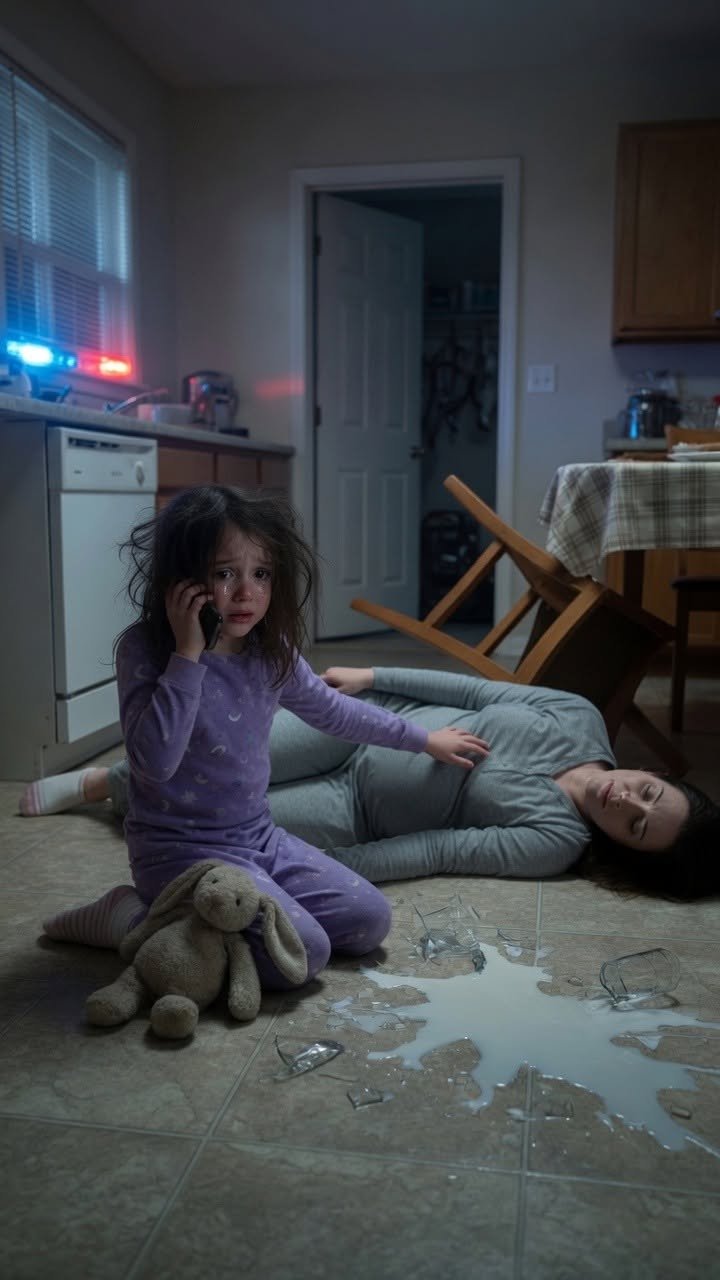
THE LITTLE GIRL WHO SAVED HER MOTHER
Part 1 — The Broken Glass
The first thing five-year-old Sophie Carter noticed was the broken glass.
It lay in glittering pieces across the kitchen floor, surrounded by a pale puddle of milk.
The second thing she noticed was her mother.
Natalie lay beside the breakfast table with one arm trapped beneath her body. Her cheek rested against the cold tile, and her eyes were partly open.
But they did not move when Sophie called her name.
“Mommy?”
Sophie stood in the doorway wearing purple pajamas and only one sock. She held her stuffed rabbit tightly against her chest.
Her mother was eight months pregnant. Her belly looked enormous beneath her gray nightshirt.
“Mommy, you dropped your milk.”
Natalie did not answer.
Sophie carefully stepped around the broken glass and crouched beside her.
She touched her mother’s shoulder.
“Wake up.”
Nothing happened.
She shook harder.
“Mommy, I’m hungry.”
Natalie’s lips parted slightly, but the sound that came out was not a word.
It was a thin, rough breath.
Sophie began to cry.
Her teacher, Mrs. Dalton, had once explained what children should do if a grown-up fell down and would not wake up.
Find a phone.
Call three numbers.
Do not hang up.
Sophie found Natalie’s phone beneath one of the kitchen chairs. The screen was cracked, but it lit up when she pressed the side button.
Her hands shook so badly that she entered the wrong numbers twice.
On her third attempt, the call connected.
“911. What is your emergency?”
Sophie pressed the phone against her ear with both hands.
“My mommy is sleeping on the floor.”
The dispatcher’s voice immediately softened.
“My name is Rachel. What’s your name?”
“Sophie.”
“How old are you, Sophie?”
Sophie held up five fingers before remembering the woman could not see her.
“Five.”
“All right, Sophie. I’m going to help you. Is your mommy breathing?”
Sophie looked at Natalie’s chest.
She could not tell.
“I don’t know.”
“Put your hand near her nose. Can you feel air?”
Sophie leaned over her mother.
A faint breath touched her fingers.
“A little.”
“That’s good. Don’t try to move her. Is anyone else in the house?”
“My baby brother.”
“Where is he?”
Sophie placed one hand against Natalie’s stomach.
“He’s inside Mommy.”
There was a brief silence on the line.
“How far along is your mommy?”
Sophie did not understand the question.
“He’s supposed to come after Halloween.”
Rachel’s voice remained calm, but Sophie could hear typing in the background.
“Do you know your address?”
“No.”
“Do you know the name of your street?”
Sophie shook her head.
“Our house has a blue door.”
“That’s helpful. What can you see outside?”
Sophie ran toward the front window.
“There’s a red truck. And Mr. Ellis’s dog. And our swing is broken.”
Rachel continued asking questions, slowly narrowing down the house’s location using the phone signal and Sophie’s descriptions.
Then she asked, “Did your mommy eat or drink anything?”
Sophie looked back toward the kitchen.
“Daddy made her milk.”
“When?”
“Before he left.”
“Did you see him make it?”
Sophie’s lower lip trembled.
“Yes.”
“What did he put in it?”
“He said it was vitamins for the baby.”
Rachel paused.
“What did the vitamins look like?”
“White candy.”
“Did your mommy take any other medicine?”
“I don’t know.”
From the living room, a clock ticked loudly.
Then Sophie heard the garage door.
The mechanical rumble filled the house.
Her whole body went still.
“Someone’s coming,” she whispered.
“Who is it?”
“I think Daddy.”
“Sophie, listen to me. The police and ambulance are very close. Stay on the phone.”
Sophie stared at the door connecting the garage to the kitchen.
The handle moved.
She backed away from her mother.
“Daddy told me not to touch his things.”
“You’re not in trouble,” Rachel said. “Go to the front door and unlock it for the paramedics.”
The garage door opened.
Sophie screamed.
But it was not her father.
Mr. Ellis, the elderly neighbor from across the street, stepped into the kitchen.
He had heard Sophie crying through an open window and had seen Natalie lying on the floor.
Within seconds, sirens filled the street.
Paramedics rushed through the blue front door carrying medical bags and a stretcher.
One lifted Sophie away from the broken glass while another knelt beside Natalie.
“She’s barely breathing.”
“Pregnant, approximately thirty-four weeks.”
“Pulse is weak.”
A paramedic picked up the fallen cup and smelled the milk.
“Take this with us.”
Sophie clung to Mr. Ellis as the medical team placed an oxygen mask over Natalie’s face.
A fetal monitor began producing rapid beeps.
Then one paramedic looked sharply at his partner.
“The baby’s heart rate is dropping.”
They lifted Natalie onto the stretcher and rushed her out of the house.
Sophie followed them onto the porch.
Her mother’s hand hung over the side of the stretcher, pale and motionless.
“Mommy!” Sophie screamed.
Natalie did not move.
Rachel was still speaking through the phone in Sophie’s hand.
“You did a very brave thing, Sophie.”
Sophie watched the ambulance doors close.
“I don’t want to be brave,” she cried.
“I just want my mommy to wake up.”
Part 2 — The Devoted Husband
Dr. Lena Ortiz was examining another patient when the emergency alert arrived.
Thirty-one-year-old pregnant woman.
Thirty-four weeks.
Unresponsive.
Suspected overdose.
Severe respiratory depression.
Fetal distress.
By the time Natalie reached St. Matthew’s Medical Center, an obstetric emergency team was waiting.
Her blood pressure had fallen dangerously low. Her oxygen level was unstable, and the baby’s heart rate continued to slow.
Lena shone a light into Natalie’s pupils.
“Pinpoint response.”
“Possible opioid?” a resident asked.
“Maybe. Order a full toxicology panel—opioids, benzodiazepines, sedatives, everything.”
The team stabilized Natalie’s breathing and began treating her blood pressure.
An obstetrician moved an ultrasound probe across her abdomen.
“The placenta still appears attached. No active bleeding.”
“Can we avoid delivery?” Lena asked.
“For now. But if the fetal tracing worsens, we move immediately.”
Lena studied Natalie’s face.
There was no vomit around her mouth.
No pill fragments between her teeth.
No empty medicine bottle had been found nearby.
Her stomach was almost empty.
Yet the early blood tests suggested a dangerous level of a powerful sedative.
“That doesn’t fit,” Lena murmured.
A nurse looked at her.
“What doesn’t?”
“If she swallowed a large number of tablets recently, we should find residue in her stomach.”
“She could have taken them earlier.”
“Possibly.”
But Lena remained uneasy.
Forty minutes later, Ethan Carter rushed into the emergency department.
He wore dark trousers and a wrinkled dress shirt. His hair was damp from the rain, and his face appeared drained of color.
“Where is my wife?”
A nurse attempted to slow him down.
“Sir, you need to wait—”
“My wife is pregnant. My daughter called me crying. Where is Natalie?”
Lena stepped into the hallway.
“I’m Dr. Ortiz. Your wife is alive, but she is in critical condition.”
Ethan covered his face with both hands.
“Oh, God.”
“Do you know what medication she may have taken?”
Ethan hesitated.
“She’s been struggling.”
“With what?”
“Depression. Anxiety. She hasn’t been sleeping.”
“Was she prescribed a sedative?”
Ethan reached inside a leather bag and removed an amber prescription bottle.
The label carried Natalie’s name.
Lena examined it.
It contained a mild anti-anxiety medication prescribed at a low dose.
“This medication does not match what we’re seeing,” Lena said.
Ethan swallowed.
“She may have taken something else.”
“What?”
“My mother died six months ago. We still have some of her medication in storage. I thought I had thrown everything away.”
His eyes filled with tears.
“I should have checked.”
“Did Natalie ever talk about harming herself?”
Ethan looked toward the treatment room.
“Not directly. But she said things.”
“What things?”
“That she couldn’t do this anymore. That she wanted everything to stop.”
He unlocked Natalie’s phone and showed Lena several messages.
I can’t keep pretending I’m okay.
I just want to sleep.
Sometimes I wish I wouldn’t wake up.
The messages had supposedly been sent to Ethan during the previous few weeks.
Lena read them twice.
“Did she see a psychiatrist?”
“I tried to get her help. She kept refusing.”
A detective arrived soon afterward.
Marcus Reed had worked domestic violence cases for almost twelve years. He was accustomed to frightened spouses, angry relatives, and stories that changed every time they were repeated.
Ethan’s story did not change.
He claimed Natalie had become forgetful during the pregnancy.
She had wandered outside at night.
She had left the stove burning.
She had accused Ethan of moving objects around the house.
“She wasn’t herself,” Ethan said. “I was terrified she might hurt Sophie by accident.”
“Did you report these concerns to anyone?” Marcus asked.
“Our family doctor. Natalie denied everything.”
“Where were you this morning?”
“At work. I left around six forty-five.”
“Did you prepare the milk Sophie mentioned?”
Ethan’s jaw tightened slightly.
“Yes. Warm milk helps Natalie sleep.”
“Did you put medication in it?”
“Her prenatal vitamins. She has trouble swallowing pills, so sometimes I crush them.”
“What kind of vitamins?”
“Calcium. Iron. Whatever her doctor recommended.”
“Your daughter described white pills.”
“Many vitamins are white.”
Ethan’s answers sounded reasonable.
Then Marcus asked, “Why did your wife collapse less than an hour after drinking it?”
Something changed in Ethan’s expression.
Only for a second.
But Marcus noticed.
“You think I did something to her?”
“I’m gathering information.”
“I’ve spent months holding this family together while she fell apart.”
His voice rose.
“And now you’re treating me like a criminal because a five-year-old doesn’t understand medicine?”
A nurse appeared at the end of the hallway.
“Dr. Ortiz, the patient is waking up.”
Ethan immediately moved toward the room.
Lena blocked his way.
“We need to examine her first.”
“I’m her husband.”
“And she is still medically unstable.”
For the first time, Ethan’s carefully controlled expression slipped.
What Lena saw was not fear.
It was frustration.
Part 3 — She Could No Longer Trust Her Memory
Natalie awakened beneath harsh white lights.
Her throat hurt, her limbs felt heavy, and a monitor beeped beside her bed.
She tried to lift her head.
“Easy,” Lena said. “You’re in the hospital.”
Natalie’s eyes widened.
“The baby.”
“His heartbeat is stable for now.”
“Sophie?”
“She’s safe. She called 911.”
Natalie stared at her.
“Sophie called?”
“She found you on the kitchen floor.”
Natalie closed her eyes.
“I don’t remember falling.”
“What is the last thing you remember?”
Natalie’s breathing quickened.
“Ethan made me milk.”
“Did you see him put anything into it?”
“No. I don’t know.”
She rubbed her forehead.
“My memory has been terrible lately.”
“Has that happened often?”
Natalie nodded.
“I lose pieces of time. I wake up and things have moved. Ethan says I moved them.”
“What kinds of things?”
“Leaving doors unlocked. Sending strange messages. Once, he found me sitting inside the car in the garage.”
“Do you remember going there?”
“No.”
“Do you remember sending messages saying that you wished you would not wake up?”
Natalie turned sharply toward Lena.
“What messages?”
Lena did not answer immediately.
Alarm spread across Natalie’s face.
“I never said that.”
“Your husband showed them to us.”
“No.”
Her voice was weak but certain.
“I told him I was tired. I told him I was afraid I would not be a good mother to two children. But I never said I wanted to die.”
Before Lena could respond, the door opened.
Ethan entered before anyone could stop him.
“Natalie.”
She flinched.
The reaction was small enough that most people might have missed it.
Lena did not.
Ethan hurried to the bed and took Natalie’s hand.
“I thought I had lost you.”
“They said there was medicine inside me.”
His eyes softened.
“You’ve been struggling. Maybe you don’t remember taking it.”
“I didn’t take anything.”
“You haven’t been yourself.”
He spoke gently, like a man explaining something to a frightened child.
“You’ve forgotten things before.”
Natalie looked down.
“I know.”
“You were confused last week. You accused me of hiding your keys, and then we found them in the freezer.”
Natalie’s face turned pale.
“I don’t remember putting them there.”
“That’s what I mean.”
He touched her cheek.
“You need help, Nat. Real help.”
Lena stepped closer.
“Mr. Carter, she needs to rest.”
Ethan ignored her.
“I’m not angry with you,” he told Natalie. “Whatever happened, we’ll get through it.”
Natalie’s fingers trembled inside his hand.
“I didn’t try to die.”
“I believe that you don’t remember.”
The sentence seemed to hollow something out inside her.
When Ethan finally left the room, Natalie stared at the closed door.
Lena pulled a chair beside the bed.
“Are you afraid of your husband?”
Natalie did not answer.
“You can speak privately here.”
Her eyes filled with tears.
“I don’t know what is real anymore.”
“Tell me what you mean.”
“Every time I remember something, Ethan says it happened differently.”
She looked toward the fetal monitor.
“Two months ago, I woke up on the bathroom floor. He said I fainted because I had skipped breakfast.”
“Did you believe him?”
“At the time.”
“Has anything else happened?”
“Last month, I found a bruise on my shoulder. Ethan said I walked into a door.”
“Did that seem believable?”
“At the time.”
“And now?”
Natalie swallowed.
“I remember him carrying me to bed.”
“After you fainted?”
“I don’t know.”
Her voice broke.
“I don’t know because everything is foggy.”
Lena rested one hand against the bedrail.
“Your toxicology results show that you had a sedative in your system at a level much higher than anything prescribed to you.”
Natalie stared at her.
“The drug also leaves the bloodstream quickly. That means evidence from earlier incidents may already be gone.”
“What are you saying?”
“I’m saying your symptoms may have another explanation.”
Natalie glanced toward the door.
“You think Ethan was giving it to me?”
“I don’t know yet.”
Natalie shook her head.
“He wouldn’t.”
But she did not sound convinced.
Across the hospital, Marcus met with a child welfare interviewer named Grace Holloway.
Sophie sat at a small table drawing with crayons. Her stuffed rabbit rested beside her.
Grace smiled gently.
“Can you tell me about the milk your daddy made?”
Sophie colored the roof of a house blue.
“It was for Mommy.”
“Did he make it every day?”
“Almost.”
“What did he put inside?”
“White vitamins.”
“Did you ever see the bottle?”
Sophie nodded.
“Where was it?”
“In his work bag.”
“Did your mommy know?”
Sophie shook her head.
“Daddy said she forgets.”
“Did you ever touch the pills?”
Sophie stopped coloring.
“No.”
Grace waited silently.
Sophie pressed the blue crayon so hard that it snapped.
“Daddy gets angry when people touch his things.”
“You’re not in trouble.”
Sophie looked first at Marcus and then at Grace.
Her voice became very quiet.
“I took one.”
Marcus leaned forward.
“When?”
“Yesterday.”
“Where is it now?”
Sophie looked down at her drawing.
“I hid it.”
“Can you show us?”
She shook her head.
“Daddy will know.”
Marcus lowered his voice.
“Your daddy won’t be there.”
Sophie stared at the broken crayon in her hand.
“I put scary things in my castle.”
Part 4 — The Castle Box
The Carter house was silent when Marcus returned with Sophie, Grace, and a forensic officer.
A uniformed police officer waited outside.
Ethan had agreed to allow a brief welfare search after being told Sophie needed clothes.
Marcus suspected Ethan believed there was nothing important to find.
Sophie climbed the stairs slowly.
Her bedroom was decorated with paper stars and drawings of animals.
A plastic castle sat on a shelf beside her bed.
Sophie pointed toward it.
“That one.”
Grace lifted the castle down and placed it on the carpet.
Inside were several small objects wrapped in tissues.
A broken necklace clasp.
A bent house key.
A piece of blue ceramic.
A button from Ethan’s coat.
And one white pill.
The forensic officer photographed everything before sealing the tablet inside an evidence bag.
“Why did you take it?” Grace asked.
Sophie hugged her rabbit.
“Mommy was sleeping too much.”
“Did you think the pill made her sleepy?”
Sophie nodded.
“I wanted to ask Mrs. Dalton if it was really a vitamin.”
Marcus looked toward the doorway.
“What else did you see your father do?”
“He put it in the cup.”
“Did he crush it?”
“With the little bowl.”
“What little bowl?”
“The black one Mommy uses for spices.”
Investigators found the mortar and pestle in a kitchen cabinet.
It had recently been washed.
Chemical swabs detected residue from the same class of sedative found in Natalie’s blood.
More traces were discovered inside the lid of Ethan’s travel coffee grinder.
The pill Sophie had hidden was identified as clonazepam, prescribed to Ethan’s late mother.
One tablet alone could not prove that Ethan had repeatedly drugged Natalie.
He maintained that she had found the old prescription herself.
“She has been suicidal for weeks,” he told Marcus. “You’re building a case based on a child’s imagination.”
“The medication was in your work bag.”
“Because I planned to dispose of it.”
“Why was there residue inside the grinder?”
“Natalie used it.”
“She told us she did not know the medication existed.”
“She lies when she is embarrassed.”
Marcus leaned back in his chair.
“Did she also create the text messages?”
Ethan’s eyes narrowed.
“What are you talking about?”
“We’re checking the activity on her devices.”
“That phone belongs to my wife.”
“Several messages were sent while Natalie was attending a prenatal appointment without her phone.”
For the first time, Ethan fell silent.
Investigators had obtained security footage from the obstetric clinic.
During one appointment, Natalie had left her phone at home.
At the exact time she was speaking with her doctor, a message was sent from her account to Ethan.
I’m scared of what I might do.
Digital records showed that the message had been sent through a web-linked account from Ethan’s laptop.
Investigators found even more.
Natalie’s signature appeared on two loans totaling eighty-seven thousand dollars.
Both loans had been taken against a property she inherited from her father.
Natalie said she had never signed the documents.
The lender had received the electronic forms from Ethan’s office computer.
Police also found a preliminary petition saved on his laptop requesting emergency custody of Sophie and the unborn baby.
The petition described Natalie as mentally unstable, suicidal, and dangerous.
It had been drafted three weeks before she collapsed.
“You weren’t reacting to an emergency,” Marcus said during the second interview. “You were preparing for one.”
Ethan’s attorney advised him not to answer.
At the hospital, Natalie listened while Marcus explained what investigators had discovered.
She sat upright in bed, one hand resting against her stomach.
“He borrowed money in my name?”
“Yes.”
“For how long?”
“At least eight months.”
Natalie looked toward the window.
“I found a letter from a bank.”
“When?”
“About three weeks ago.”
“What did you do?”
“I asked Ethan about it.”
“What did he say?”
“That I was confused. He said the letter concerned refinancing the house.”
“Did you believe him?”
“I wanted to.”
Her eyes filled with shame.
Marcus closed his notebook.
“This is not your fault.”
“I kept allowing him to explain everything.”
“You were being drugged.”
“I still should have known.”
“No.”
Marcus spoke firmly.
“That is exactly what he needed you to believe. If you blamed yourself, you would never look at him.”
Natalie wiped her face.
“Sophie knew.”
“She noticed that something was wrong.”
“My five-year-old knew before I did.”
“She didn’t understand everything. She only knew her mother kept disappearing.”
Natalie’s expression crumpled.
“I missed bedtime stories. I missed her school performance.”
Marcus remained silent.
“She asked why I slept all the time,” Natalie continued. “Ethan told her the baby made me tired.”
A nurse entered carrying a set of forms.
“Mrs. Carter, your husband has requested authorization to transfer you to Briarwood Behavioral Center.”
Natalie stared at her.
“What?”
“He says it is for specialized psychiatric care.”
“I did not request that.”
“The transfer cannot occur without your consent unless a physician determines that you are an immediate danger.”
Marcus stood.
“Where is Ethan now?”
The nurse glanced toward the hallway.
“He’s speaking with hospital administration.”
Natalie’s monitor began beeping faster.
“He’s still here?”
Lena entered moments later.
“He cannot remove you from this hospital.”
“But he can enter my room.”
“I’ll ask security to restrict his access.”
Natalie looked down at her hands.
“He’s going to tell everyone I’m crazy.”
“He already has,” Marcus said. “Now we have evidence showing why.”
Natalie shook her head.
“It won’t matter. He is good at making people believe him.”
Raised voices came from the hallway.
Ethan had arrived with his attorney.
And he was demanding to see his wife.
End Part Here: THE LITTLE GIRL WHO SAVED HER MOTHER