
Part 6 — Behind the Glass
Blackridge had never been designed to protect a newborn.
But it had locks, cameras, controlled entrances, and officers whose identities could be verified.
For the next forty-eight hours, the prison infirmary became the most secure maternity ward in the state.
Mara was given a private medical room. Grace slept in a clear bassinet beside her bed.
Eleanor remained under a temporary emergency-care contract while Ruth requested a pediatric nurse through the Department of Corrections.
Silas arrived at Blackridge before sunrise.
He came with his attorney, the custody order, and two sheriff’s deputies who had been told that Mara had unlawfully removed a child from court-authorized placement.
Ruth met them at the outer gate.
“The child is in state custody with her biological mother,” she said.
“The mother is an inmate,” Silas’s attorney replied.
“For ten more days.”
“The court order places the infant with Hopewell.”
“We have filed an emergency challenge based on evidence of fraud and attempted interference with hospital care.”
Silas stepped forward.
“I want to see my daughter.”
Ruth nearly laughed.
“You mean the daughter you never asked about until she stopped you from taking her baby?”
Silas maintained his composure.
“Mara is ill. She manipulated hospital employees into committing crimes.”
“The baby is safe.”
“She belongs with a proper family.”
Ruth noticed the word he had used.
Belongs.
Not should live with.
Not deserves.
Belongs.
By noon, state investigators had begun examining Hopewell’s finances.
Several large transfers had been made to the foundation during the previous month. One had come from a private trust connected to a wealthy couple whose names had appeared in old adoption complaints.
But the evidence remained circumstantial.
Silas had protected himself carefully.
No payment directly named Grace.
No document used the word purchase.
No witness was willing to admit that Silas had arranged illegal adoptions.
Ruth proposed a controlled visit.
Mara would meet Silas in the prison’s secure visitation room. They would speak through reinforced glass while investigators recorded the conversation.
Mara did not want to go.
“He’ll know.”
“Let him believe he’s in control,” Ruth said.
“He always knows when people are trying to trap him.”
“Then don’t trap him. Make him angry.”
Mara looked at Grace sleeping beside her.
“What if he doesn’t say anything?”
“Then we continue investigating.”
“And if the court enforces the order before you find proof?”
Ruth had no answer.
That afternoon, Mara entered the visitation room carrying Grace.
Silas sat on the opposite side of the glass.
For the first time since arriving at the hospital, he looked tired.
Mara picked up the telephone.
Silas did the same.
Neither of them spoke at first.
His eyes remained fixed on the baby.
“She looks like your mother,” he said.
“Don’t talk about her.”
“You know very little about what your mother did.”
“She tried to stop you.”
“She lost perspective.”
“She found the ledger.”
Silas’s gaze sharpened.
Mara had guessed.
His reaction told her she was right.
Silas leaned toward the glass.
“Where is it?”
“I don’t know.”
“You were always a poor liar.”
“I learned from you.”
Silas smiled faintly.
“You think these people will protect you? The hospital staff will be charged. The warden will lose her position. You’ll leave prison with no home, no job, and no money.”
“I’ll still have her.”
“Not for long.”
Mara tightened her hold on Grace.
“Who did you promise her to?”
Silas did not answer.
“A family from Boston?” Mara continued. “New York? Somewhere far enough away that I can’t find her?”
“You are in no position to raise a child.”
“That isn’t what I asked.”
“I gave children better lives.”
“You stole them.”
“I removed them from instability.”
“You told mothers their babies were dead.”
“Some of those women could not remember their own names after a week.”
“They remembered their children.”
Silas’s controlled expression hardened.
“You signed the forms.”
“I was seventeen.”
“You were old enough to understand money.”
“You told me the families were approved.”
“And they were.”
“You changed birth certificates.”
“So did you.”
Mara stared at him through the glass.
“I’ve already been punished.”
Silas’s fingers tightened around the telephone.
“You think prison was punishment? Prison was protection. I kept prosecutors from charging you with conspiracy and trafficking.”
“You were protecting yourself.”
“We are the same, Mara.”
“No.”
Grace stirred.
Mara looked down and gently touched her cheek.
When she raised her head again, Silas was staring at the baby with cold calculation.
“The receiving family has already paid half,” he said.
Behind the observation wall, Ruth and two investigators exchanged a glance.
Mara kept her voice steady.
“How much?”
“That is not your concern.”
“You sold your own granddaughter before she was born.”
“I arranged a future for her.”
“What happens to the money now?”
Silas realized what he had revealed.
His eyes moved toward the corner of the room.
There was no visible camera, but he understood.
He dropped the telephone.
The plastic receiver struck the metal shelf.
Then he stood and walked out.
Investigators moved to detain him, but his lawyer blocked them.
Silas’s statement was incriminating, but the attorney argued that it referred to lawful adoption expenses.
Without financial records or supporting witnesses, an immediate arrest might not survive judicial review.
Silas left the prison grounds.
That night, shortly after two in the morning, smoke began pouring from the prison laundry building.
The fire alarm sounded.
Officers rushed to evacuate the lower wing while the suppression system activated.
The infirmary was housed in a separate secured section, but emergency procedures required patients to be moved if smoke entered the ventilation system.
Mara woke to alarms and flashing lights.
Eleanor lifted Grace from the bassinet.
“What’s happening?” Mara asked.
“There’s a fire in the laundry building.”
Mara looked toward the door.
“No.”
“It may already be contained.”
“This is him.”
Ruth arrived with two officers.
“We’re moving you to the secure intake area.”
“Don’t open that door.”
“We may have no choice if the ventilation system fails.”
A maintenance worker appeared in the hallway wearing a respirator and carrying a metal toolbox.
“I need access to the vent controls,” he told an officer.
The badge clipped to his uniform displayed the name Paul Mercer.
Eleanor recognized him.
He was the man she had seen leaving the hospital elevator.
The same man who had worn Silas’s ring.
She stepped in front of the infirmary door.
“He isn’t a maintenance worker.”
The man froze.
Then he reached inside the toolbox.
Eleanor slammed the door and locked it.
A second later, something heavy struck the other side.
Mara clutched Grace against her chest.
The man hit the door again.
Ruth grabbed her radio.
“Security breach in the infirmary. Lock down all exits.”
The lights flickered.
Smoke began entering through the ceiling vent.
The man outside had not come merely to take the baby.
He had started a fire to force the prison doors open.
Part 7 — The Cradle of Truth
The emergency lights turned the infirmary red.
Smoke curled from the ceiling vent as Eleanor shoved a wet towel beneath the door.
Ruth ordered Mara into the bathroom, where the air was clearer.
Outside, officers shouted.
The man in the maintenance uniform ran toward the service stairwell but found the security doors locked.
He pulled a syringe from his toolbox and attempted to threaten an officer.
He was tackled before reaching the stairs.
Inside the toolbox, investigators found sedatives, forged prison identification, a blank birth certificate, and an infant passport issued under another name.
The photograph field was empty.
The date of birth had already been entered.
Grace had been given a new identity before she was born.
The laundry fire was contained before it reached the main building.
Investigators determined that it had been deliberately started with an electrical accelerant device placed near the ventilation controls.
The intruder’s real name was Victor Dane.
He had worked as Silas’s driver and private security contractor for more than fifteen years.
At first, Victor refused to cooperate.
Then investigators explained the charges he faced:
Arson at a correctional facility.
Attempted kidnapping.
Document fraud.
Unlawful possession of controlled medication.
Criminal conspiracy.
Victor requested a lawyer.
By morning, he had begun talking.
Silas had instructed him to use the fire alarm to trigger an evacuation.
During the confusion, Victor was supposed to sedate Mara, conceal Grace inside an equipment carrier, and leave with the emergency maintenance crews.
The infant passport would be completed after Grace was transported to a private airfield.
Victor did not know the receiving family’s name.
But he knew where Silas stored his archived records.
A hidden room beneath his country house.
Police obtained a search warrant.
The property stood on fourteen acres outside the city, concealed behind tall hedges and an iron gate.
It looked elegant and peaceful—the kind of place where nothing terrible should have happened.
In the basement, investigators found filing cabinets filled with coded documents, hospital wristbands, notarized consent forms, and photographs of infants beside payment schedules.
Some records dated back twenty-four years.
Many contained Mara’s signature.
Others were written in Anna Collins’s handwriting.
The files proved that children had been moved through Silas’s network.
But the most complete financial ledger was missing.
Investigators searched the house for two days.
They found a safe behind a library wall, but it contained only cash, passports, and legal papers.
Mara was brought to the house under guard to help identify possible hiding places.
She carried Grace in a sling against her chest.
Returning to her childhood home frightened her more than returning to prison.
The rooms had barely changed.
The same staircase.
The same polished wood.
The same carefully selected family photographs designed to make them appear respectable.
In an upstairs storage room, Mara found a small wooden cradle that had belonged to her mother.
Silas had once told her it was the cradle in which she had slept as an infant.
Mara touched its worn edge.
A memory returned.
Anna kneeling beside the cradle with a screwdriver.
Anna telling her:
“Truth has to sleep somewhere safe.”
At the time, Mara had believed her mother was talking about her.
Now she understood.
“Turn it over,” Mara said.
An investigator placed the cradle on its side.
The wooden base appeared solid, but one panel had been secured with screws newer than the rest.
They removed it.
Inside was a book wrapped in cloth.
The second ledger.
Anna had recorded names, dates, payments, hospital employees, receiving families, altered birth records, and the identities of women who had been falsely told that their children had died.
She had also written a letter.
If Mara finds this, believe her.
She was a child when Silas began using her name. She did what he ordered because I failed to get her away from him. The responsibility is mine for remaining silent too long—and his for building this machine.
At the bottom of the final page, Anna listed the license plate of the vehicle that had forced her car from the road three days before her death.
The vehicle had been registered to one of Silas’s shell companies.
Silas Collins was arrested at his attorney’s office that evening.
He was charged with conspiracy, child trafficking, kidnapping, fraud, obstruction of justice, attempted kidnapping, and involvement in Anna’s death.
Hopewell’s executive director and two former physicians were also arrested.
The wealthy families listed in the ledger were investigated individually.
Some had knowingly paid for children.
Others had been deceived into believing that they were participating in legitimate closed adoptions.
Across the country, adults began receiving calls that changed everything they knew about their lives.
Some found biological mothers who had searched for them for decades.
Others learned that their mothers had died believing they had buried children who were still alive.
The damage could not be repaired with one arrest.
But the silence had finally been broken.
Mara’s conviction was reviewed.
The state acknowledged that Silas had coerced her as a teenager and deliberately framed her when she attempted to expose the network.
Several charges were vacated, although Mara accepted responsibility for the money she had stolen during her escape attempt.
Ten days after Grace was born, Mara reached her original release date.
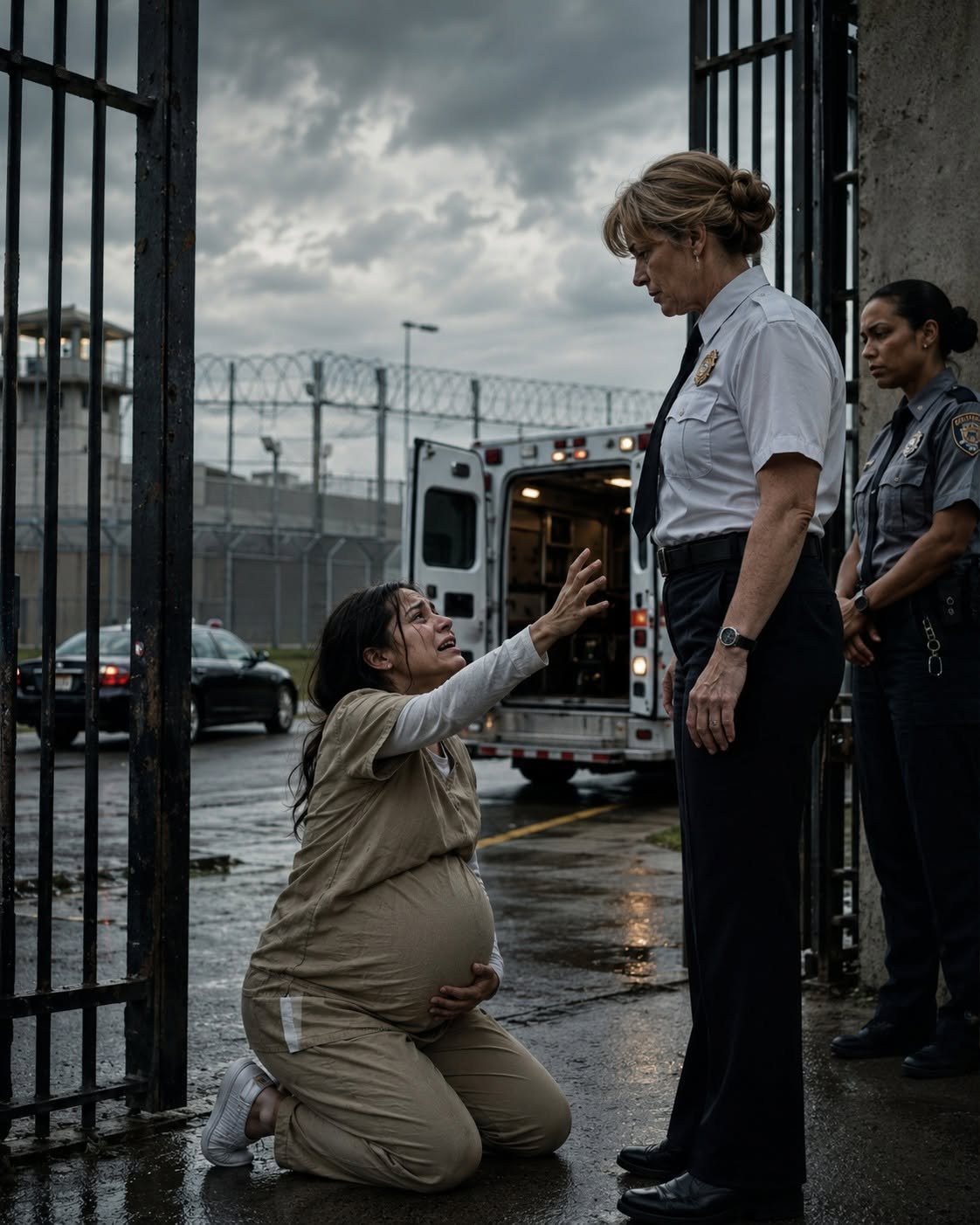
She stood inside the same gate where she had once fallen to her knees and begged to remain behind bars.
This time, she wore ordinary clothes provided by a reentry charity.
Grace slept against her chest beneath a soft yellow blanket.
Eleanor and Ruth waited outside.
Mara stepped through the gate and stopped.
For years, she had imagined freedom as a wide-open road.
Instead, freedom looked like a small apartment arranged through a program for formerly incarcerated mothers.
It looked like job applications, court hearings, parenting classes, and nights spent waking every hour to make sure Grace was still breathing.
It would not be easy.
But it would be theirs.
Ruth handed Mara a folder.
“Temporary housing agreement, pediatric appointments, legal-aid contacts, and your new identification.”
Mara accepted it.
“You arranged all of this?”
“I prefer paperwork that protects people.”
Mara smiled for the first time in days.
Eleanor touched Grace’s blanket.
“She has your mother’s eyes.”
“My father said that too.”
“Then let the resemblance mean something different when you say it.”
Mara nodded.
She walked toward the parking lot, then turned back toward the prison walls.
“I spent eight months believing this place had taken my life.”
Ruth followed her gaze.
“And now?”
“It was the one place my father couldn’t buy his way into.”
Eleanor raised an eyebrow.
“He nearly did.”
“But he didn’t.”
Grace stirred and opened her eyes.
Mara kissed her forehead.
“When you’re old enough,” she whispered, “I’ll tell you that your first home had locked doors.”
She adjusted the blanket around her daughter.
“But I’ll also tell you that those doors kept you safe until your mother learned how to open the right ones.”
They reached the car.
Eleanor opened the back door while Mara secured Grace inside the infant seat.
For a moment, Mara stood with one hand resting against the roof.
There were no officers behind her.
No restraint around her wrist.
No black sedan waiting across the road.
Silas was in custody.
The ledger was in evidence.
Grace was alive.
And for the first time in Mara’s life, no one else had written the next page for her.
She got into the car.
As they drove away, the prison gates grew smaller behind them.
Mara did not look back again.
Epilogue
Six months later, a family court permanently dismissed Hopewell’s custody petition and confirmed Mara as Grace’s sole legal parent.
Silas remained in custody awaiting trial while investigators continued identifying the children taken through his network.
Mara found work at a legal-aid office that helped mothers challenge fraudulent adoption cases.
She could not undo what her father had done.
But she could make sure that fewer women faced it alone.
Every night, before turning off the light in their small apartment, Mara checked the lock on the front door.
Then she looked into Grace’s crib.
For most of her life, locked doors had represented fear.
Now, one locked door meant that she and her daughter were finally home.
THE END
Thank you for reading this story. I’d love to hear your honest opinion below.