
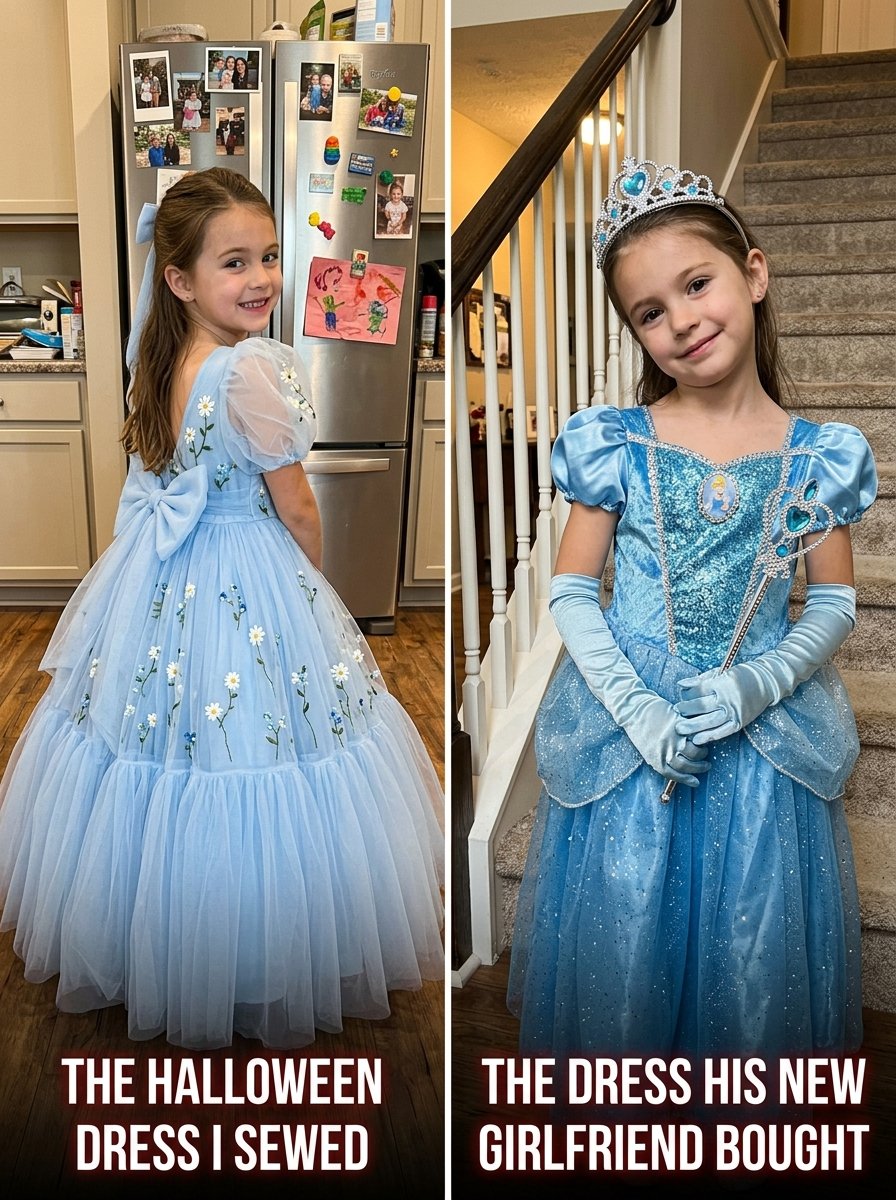
After my ex-husband replaced my daughter’s handmade Halloween dress with an expensive one, I felt humiliated. But when our daughter came back downstairs, her reaction exposed a problem much bigger than a costume.
My ex-husband turned up on Halloween, looked at the costume I’d been sewing until two in the morning, and laughed.
“You’ve always been good at making do. Just never good at actually buying your kid a proper costume.”
Then he called toward the stairs.
“Good thing Stacy figured your mom would need a backup, sweetheart.”
I stood there, looking at Zach, wondering how someone who had once loved me could enjoy humiliating me so much.
Six months earlier, I thought we were happily married. Then Zach told me he was leaving for Stacy. They married shortly afterward, and suddenly I was the woman he’d spent years supporting, at least according to him.
A week after he left, I’d sat at our kitchen table trying to build a résumé with nothing recent on it.
I’d stayed home with Emma for years.
School runs, sick days, summers, everything.
It had been our arrangement, and Zach was the one who suggested it.
Now he talked about those years as though I’d simply refused to work.
So I returned to sewing. First alterations, then costume orders. The money was inconsistent, but it was something I could build.
A few weeks before Halloween, I’d called Zach because Emma needed new shoes and some school supplies.
“You could never manage money without me, could you?” he’d said. “Figure it out yourself for once.”
I hadn’t asked again.
When Emma told me she wanted to be a princess for Halloween, she showed me a picture of a pale-blue dress with a full skirt.
“Do you think you could make something like this, Mom?”
“I can certainly try.”
I’d worked on paying customers’ orders during the day and Emma’s dress after she went to bed.
Three nights of cutting, pinning, and sewing. I’d even unpicked one sleeve twice because it wasn’t sitting right.
By Halloween afternoon, it was finished.
Emma had spun around the kitchen when she first tried it on.
“It’s exactly what I wanted!”
Those words had been worth every sleepless hour.
Then Zach arrived.
Emma was upstairs looking for tights, and her dress hung on the kitchen door.
Zach touched the sleeve before delivering his little speech about proper costumes.
Then he opened a shopping bag and pulled out an expensive-looking princess dress, complete with a tiara.
He turned back the skirt so I could see its lining.
“See that? Proper stitching. Feel the fabric, Em. This one looks so much better on you.”
Emma had come downstairs midway through his demonstration.
He handed her the dress.
“Stacy spent ages picking this out. Once you’re dressed, we’ll record her a thank-you video.”
“Thank you, Daddy,” Emma said.
She carried it upstairs.
I stayed at the sink, picking a loose thread off my sweater.
There was nothing wrong with the dress I’d made. I knew that.
Still, standing in my own kitchen, I felt foolish about every hour I’d spent working on it.
Five minutes later, I heard footsteps.
Zach raised his phone.
“There she is. Let’s show Stacy.”
Emma stopped on the bottom step.
“You can film me now, Dad.”
She was wearing my dress.
The pale-blue skirt spread around her knees, and the sleeves I’d struggled with fit perfectly. Stacy’s tiara sparkled against her hair.
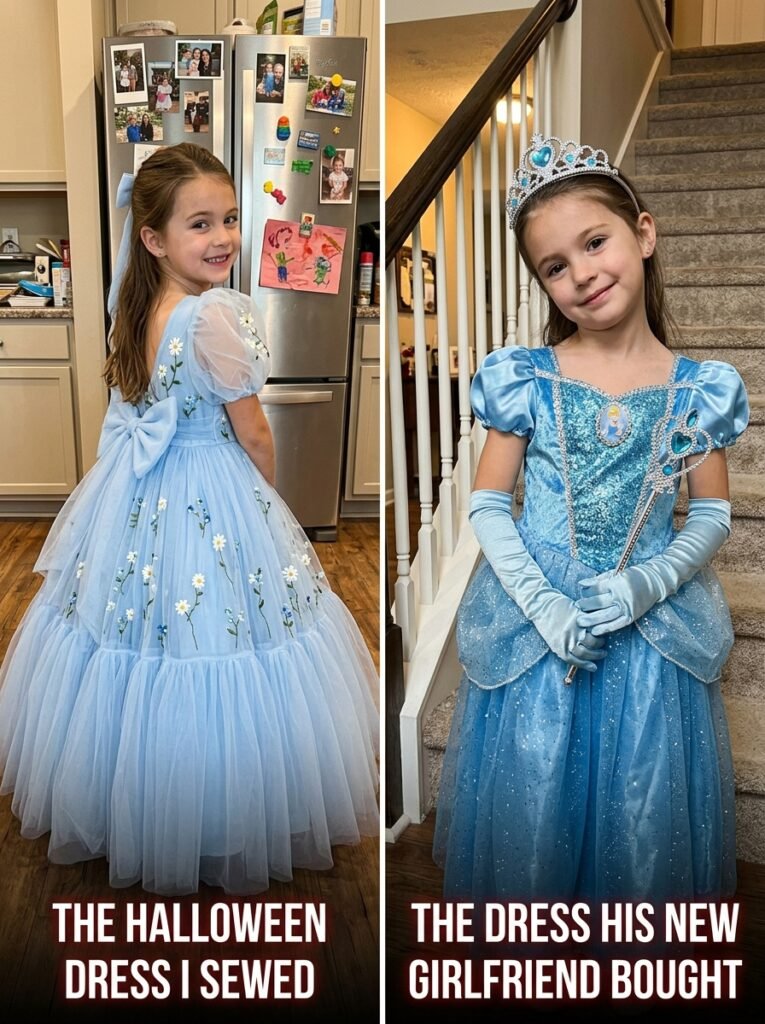
The purchased costume was folded over her arm.
Zach lowered his phone.
“Emma, where’s your new dress?”
“Right here.” She lifted the folded costume. “I’m taking it to your house.”
“But why aren’t you wearing it?”
“Because I wanted to wear this one.”
Zach looked at me.
“Did you tell her to do this?”
“No.”
“Emma, Stacy spent a lot of money on that dress.”
“I know. It’s pretty.”
“Then why not wear it?”
Emma looked down at her skirt.
“Because Mom made this one for me.”
For a moment, Zach said nothing.
Then he sighed.
“Fine. But you need to thank Stacy properly.”
“I was going to.”
She looked at his phone.
“Can you record it?”
Zach reluctantly raised it again.
“Thank you for my dress, Stacy,” Emma said. “I like it. I’m going to keep it at Daddy’s house, and I wore the tiara tonight.”
She smiled, and Zach stopped recording.
“Are we done now?” she asked.
“Yes,” I said before he could respond. “Let’s get your shoes.”
Zach left soon afterward, saying he’d send Stacy the video.
I thought that would be the end of it.
I was wrong.
That evening, Emma collected enough candy to fill half a pillowcase.
She laughed with her friends, admired every decorated porch, and insisted on keeping her princess dress on even after we got home.
When I helped her remove the tiara, I said, “You know you didn’t have to wear my dress just because I made it.”
She looked confused.
“But I wanted to.”
“I know. I just don’t want you worrying about hurting my feelings.”
Emma fiddled with the edge of her sleeve.
“Dad showed me the other dress last weekend.”
I stopped folding her tights.
“He did?”
“He showed me pictures and said Stacy could get me something better.”
“Why didn’t you tell me?”
“Because you were still sewing mine.”
She looked toward the machine on the dining table.
“I heard you working really late.”
I sat beside her.
“Sweetheart, I wanted to make that dress. You didn’t have to protect me.”
“I know.”
But she said it too quickly.
Then she added, “Dad said you probably couldn’t make it as nice as the picture.”
I looked at her.
“What did you say?”
“I told him you could.”
She sounded almost apologetic.
I pulled her close, but my relief about the costume had already changed into something heavier.
Emma hadn’t simply chosen the dress she liked.
She’d known her father was preparing to replace it, and she’d been worrying about how I’d feel.
I wanted to call Zach immediately.
Instead, I kissed Emma’s forehead and told her to get ready for bed.
I needed to understand what was going on before I let Emma get caught in another argument between us.
Four days later, I found out there was more.
Emma came home from school and asked whether she could use some old notebooks from last year.
“Of course, if there are enough blank pages. Why?”
Her teacher had sent home a supply list. Emma needed two notebooks, colored pencils, and a folder for a class project.
“Why didn’t you give me the list?”
She shrugged.
“I thought we could use stuff we already have.”
“We can check. But if you need something new, we’ll get it.”
She hesitated.
“Does it cost a lot?”
“Not really. Why?”
“Because you’re working so much.”
I put down the measuring tape I’d been holding.
“Emma, come sit with me.”
She sat at the table, rubbing a thumb along the seam of her backpack.
“Did someone tell you we couldn’t afford your school supplies?”
“Not exactly.”
“Then what made you worry?”
She explained that Zach had been asking questions during her visits.
Did we have enough groceries? Was I paying the bills? Did she have everything she needed?
At first, she’d answered without thinking much about it.
Then he’d started commenting that things were easier at his house because he didn’t have to worry about money.
“He said you have to work really hard because you didn’t plan very well.”
I stared at the supply list.
The man who had encouraged me to leave my job, then refused to help when Emma needed shoes, was now making our daughter question whether her home was secure.
“Emma, do you ever worry we won’t have enough food?”
She looked embarrassed.
“Sometimes. But there’s always food.”
“Then why worry?”
“Because Dad asks about it.”
That answer hurt more than anything Zach had said in my kitchen.
I told Emma that asking for school supplies wasn’t a burden. Paying bills and managing money were adult responsibilities, and I was handling them.
“If something ever changes, that’s for me to figure out,” I said. “Not you.”
She nodded.
Then she said something I hadn’t expected.
“That’s why I picked the blue dress.”
I looked up.
“What do you mean?”
“I saw other princess dresses too. But that one looked like something you could make with the fabric you already had.”
For a moment, I couldn’t answer.
I’d thought Emma chose that picture because it represented her perfect Halloween.
Now I realized she had been considering what I could afford.
“Did you pick it because you thought I didn’t have enough money?”
“Kind of.”
She quickly added, “But I really liked it. I liked that you were making it.”
“I believe you, sweetheart.”
Her eyes filled.
“I didn’t want you to have to buy anything expensive.”
I moved beside her and put an arm around her shoulders.
“You are allowed to want things, Emma. Sometimes I can buy them, sometimes we have to wait, and sometimes I can make them. That’s normal.”
“But Dad says you shouldn’t have to make everything.”
“Your dad and I see some things differently.”
“Is he mad because I wore your dress?”
“I don’t know. But you didn’t do anything wrong.”
That night, after Emma fell asleep, I looked at the photograph she’d originally shown me.
Pale-blue fabric. Full skirt. Simple sleeves.
I remembered how carefully she’d asked whether I could make it.
I’d mistaken her caution for politeness.
My ten-year-old had been trying to manage my finances while I was trying to give her a happy Halloween.
Something had to change.
The next afternoon, I received a message from Stacy.
We’d barely spoken since Zach left me, so seeing her name was unsettling.
Her message surprised me even more.
“Melanie, I hope you don’t mind me contacting you. Emma mentioned the Halloween video and asked whether I’d seen it. Zach showed it to me last night. I wanted to apologize if the costume caused any trouble.”
I read it twice before replying.
“Emma appreciated the gift. What did Zach tell you about her costume?”
Stacy answered almost immediately.
“He said you were having trouble finishing it and that Emma might not have something suitable to wear.”
I stared at the screen.
“He knew it was finished. He saw it hanging on my kitchen door.”
There was a long pause.
Then Stacy asked whether she could call.
I almost declined.
But I wanted to understand what she’d been told.
When I answered, Stacy sounded uncomfortable.
“Zach said Emma wanted a princess dress, but you were struggling with the sewing. He thought she might be disappointed.”
“Emma chose the design herself,” I said. “She tried it on before Halloween. She loved it.”
“I didn’t know that.”
“Zach knew.”
Stacy went quiet.
Then she said, “Emma showed him the picture weeks ago. I was there. She said you were making it, and she seemed excited.”
That was the confirmation I’d needed.
Zach hadn’t misunderstood Emma’s wishes.
He’d heard them.
“What did he say after that?” I asked.
“He told me you were being overly ambitious and probably couldn’t pull it off.”
I closed my eyes.
Stacy continued.
“He suggested we find something nicer, just in case. I thought I was helping.”
“I understand.”
“I really didn’t mean to upset you.”
“The gift wasn’t the problem,” I said. “What Zach said when he brought it was.”
I repeated his comments about my stitching and about Stacy providing a proper costume.
Stacy sounded genuinely shocked.
“He didn’t tell me any of that.”
For the first time, I considered that she’d walked into this situation believing she was doing something kind.
That didn’t erase what had happened between her and Zach.
But it meant Halloween wasn’t the competition between two women he’d made it appear to be.
“Emma can keep the dress at your house,” I said. “She likes it.”
“I’d like that.”
Before hanging up, Stacy added, “For what it’s worth, Melanie, Emma looked beautiful in the dress you made.”
I thanked her.
Afterward, I sat quietly with my phone.
Zach had known Emma wanted my dress. He’d known I was making it. Yet he’d convinced Stacy that Emma needed rescuing from my efforts.
It was the same story he’d been telling about our marriage.
He provided.
I struggled.
He succeeded.
I made do.
And now Emma was learning to repeat his judgments, even when she didn’t realize what they meant.
I called Zach the following evening while Emma was at a friend’s house.
“I need to talk to you about Halloween,” I said.
He sighed.
“Are we seriously still doing this?”
“Yes. Because Emma has been worrying about whether I can afford groceries and school supplies.”
“I was checking that she’s taken care of.”
“Then ask me. Don’t make her worry about it.”
“I’m allowed to know whether my daughter has what she needs.”
“Absolutely. And when I asked you to help with things she needed, you told me to figure it out myself.”
Silence.
Then he said, “You’re twisting that conversation.”
“I’m not. I’m asking you to stop making Emma feel responsible for money.”
He started talking about how expensive everything had become and how difficult it had been supporting our family.
I let him finish.
Then I said, “You asked me to stay home.”
“That was years ago.”
“And for those years, I raised Emma, managed our household, and made it possible for you to concentrate on your career.”
“I paid for everything.”
“And I took care of everything you weren’t home to do.”
He scoffed.
“Now you’re making Halloween about our marriage.”
“No. I’m telling you how your comments are affecting Emma.”
I explained what she’d said about choosing an inexpensive costume and avoiding requests for school supplies.
For once, he didn’t interrupt.
“She’s ten, Zach. She shouldn’t be calculating what her mother can afford before choosing a Halloween costume.”
“I never told her to do that.”
“Maybe not directly. But she’s listening to you.”
He was quiet.
I continued.
“You can buy her dresses. You can buy her gifts. I’m not competing with that. But you cannot come into my home, insult me in front of her, and expect her to agree that you’re the better parent.”
“That’s not what I was doing.”
“Then don’t do it again.”
I told him that concerns about Emma’s needs had to come directly to me, not through her.
And that neither of us should pressure her to choose between gifts or parents.
Zach didn’t apologize.
He muttered that I was overreacting.
But he finally said, “Fine. I’ll talk to you directly.”
It wasn’t the acknowledgment I’d once wanted from him.
Still, I hung up without trying to convince him I was worth respecting.
That felt different.
The following weekend, Emma and I talked again.
I explained that I was building my sewing business, that we had a budget, and that some purchases required planning.
I didn’t pretend everything was easy.
But I made one thing clear.
“You don’t have to choose cheaper things to take care of me. And you don’t have to choose my gifts over Dad’s to make me happy.”
Emma considered that.
“Even if I like yours better?”
I laughed.
“Even then.”
A week later, I spoke with one of the mothers from Emma’s class.
She asked where I’d bought Emma’s Halloween costume.
When I explained that I’d made it, she asked whether I could sew a dress for her daughter’s winter performance.
We discussed the design, price, and deadline. A few days later, she placed the order and paid a deposit.
It wasn’t enough to transform my finances.
But it was another customer, another piece of work, and another reason to keep going.
I was cutting fabric for that order when Emma came into the dining room holding a new school supply list.
“Mom, I need some things for our science project.”
“Let’s see.”
She handed it over without apologizing.
No nervous questions about prices. No suggestions that she could manage without everything.
Just a ten-year-old telling her mother what she needed for school.
I looked through the list and told her we’d pick everything up that weekend.
“Okay!” she said, already turning toward the kitchen.
I watched her go.
Then I glanced at the pale-blue princess dress hanging beside my sewing machine.
The sleeve I’d unpicked twice was still perfectly smooth.
I remembered Zach touching it, examining the stitching, and making me feel ashamed of three nights’ work.
But Emma had never seen that dress as something I’d made because I couldn’t afford better.
She’d seen it as something made especially for her.
And I finally understood something I’d been struggling to believe since Zach left.
I didn’t have to prove I could give Emma more than he could.
I had to give her a home where she never felt she had to earn her place, hide what she needed, or protect me from being disappointed.
That was something no expensive costume could replace.