PART 4 — “Please Don’t Touch Me”
The hospital atrium was full when Rachel and I arrived.
Patients sat beside donors and hospital employees. Local reporters waited near the back.
Volunteers carried programs with Grant’s face printed on the cover.
Onstage, he stood beside the ceremonial check wearing the navy suit I had bought him for our fifth wedding anniversary.
The screen behind him displayed photographs from my treatment.
Me asleep after chemotherapy.
Me sitting in a wheelchair.
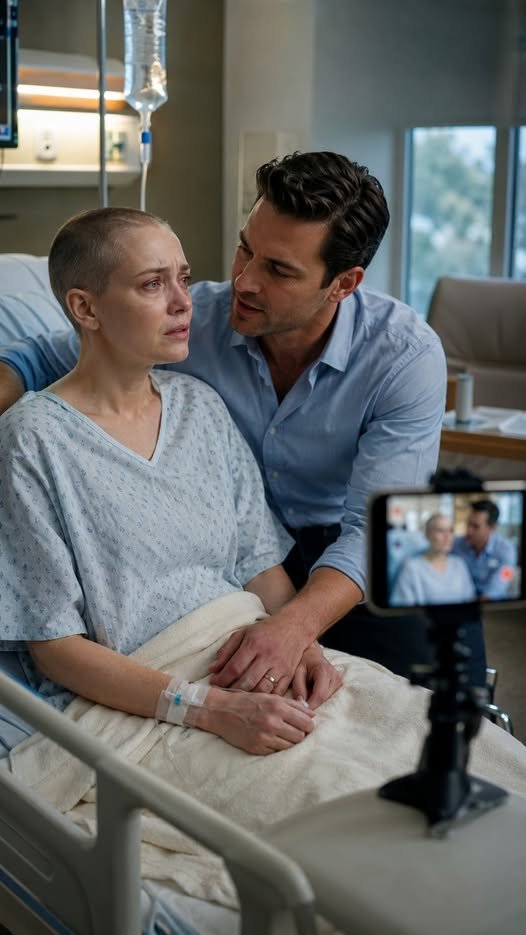
Grant bending protectively over my hospital bed.
When he saw me, surprise flashed across his face.
Then the cameras turned toward us, and Grant became gentle again.
He stepped off the stage with his arms open.
“Nora. Honey, you shouldn’t be here. You need to rest.”
He reached for me.
I stepped backward.
“Please don’t touch me for the photograph.”
The room became silent.
Grant’s smile remained, but his eyes changed.
“You’re overwhelmed,” he said softly. “Let me take you somewhere private.”
“No.”
That single word sounded louder than anything he had ever said during a livestream.
Elena walked onto the stage.
She announced that the hospital foundation would not accept Grant’s $50,000 donation.
She also said that the Community Care Champion award had been withdrawn pending a formal review.
A murmur moved through the crowd.
Grant turned toward her.
“There must be some misunderstanding.”
The screen behind him changed.
My scan result appeared beside the time he had accessed it:
9:12 a.m. — Excellent response to treatment.
Next to it appeared an image from his 7:03 p.m. livestream, when he told donors that my treatment was failing.
Grant looked at me.
“You approved those updates.”
I held his gaze.
“I approved truthful ones.”
The next slide showed the insurance authorization beside Grant’s public claim that my coverage had been denied.
Then the donation ledger appeared.
Transfer recipient: Whitman Creative LLC
$24,000
$18,500
$31,900
A woman sitting in the front row stood.
“I donated after the Boston video.”
Grant raised both hands.
“My agency provided legitimate services. None of this money would exist without our work.”
Then the final transfer appeared on the screen.
$50,000
It was the same amount printed on the giant ceremonial check beside him.
PART 5 — The Check Became Evidence
For the first time, Grant looked frightened.
Not because I was sick.
Because everyone could finally see the money.
He stepped toward the microphone.
“The company created the campaign, produced the videos and managed donor outreach. Those were legitimate expenses.”
Someone near the back called out, “You said you closed the company.”
Grant answered quickly.
“I stepped away from its daily operations.”
“You paid its payroll,” I said.
His face tightened.
Then he turned toward me and lowered his voice, as though the room had disappeared and we were alone behind another hospital door.
“You have no idea what it took to keep everything together while you were sick.”
That sentence had controlled me for months.
Every meal, every ride and every appointment had been placed on an invisible ledger I could never repay.
If I questioned Grant, I was ungrateful.
If I wanted privacy, I was ashamed of his love.
If I tried to speak for myself, I was too confused to understand.
I looked at the dates on the screen.
Grant knew my treatment was working.
He knew insurance had approved the remaining care.
And he still asked frightened strangers to send more money.
“You didn’t keep asking because I was dying,” I said. “You kept asking after you knew I was getting better.”
Grant opened his mouth.
No explanation came.
For once, the silence did not belong to me.
Elena told the audience that the records had been referred to the fundraising platform and that donors would be contacted directly.
The hospital would also remove every promotional video using my image.
Grant reached toward the ceremonial check.
Elena stopped him.
“The foundation cannot accept funds whose source was misrepresented.”
Under the stage lights, the check no longer looked generous.
It looked like evidence.
Reporters moved toward Grant.
Two employees from Whitman Creative slipped out through a side door.
Rachel touched my arm.
“Do you want to leave?”
“Yes,” I answered. “But not with him.”
Outside the atrium, my phone began vibrating.
The fundraising platform had frozen the remaining balance.
Grant had already posted another video.
PART 6 — His New Version of the Story
Grant recorded the video from inside his car.
His tie was loose, his eyes were red and his voice was calm enough to sound wounded instead of angry.
He said the hospital had misunderstood normal campaign expenses.
He claimed every decision had been made for my care.
Then he asked people to show compassion for a marriage under impossible pressure.
He never explained why he had called a good scan bad.
He never explained why he claimed insurance had denied treatment.
And he never mentioned where the $50,000 donation had come from.
By then, the hospital had released its own statement.
My treatment had been authorized.
The foundation had never requested emergency funding for an out-of-state evaluation.
Grant’s donation would not be accepted.
The fundraising platform gave donors two choices.
They could request a refund or redirect their contributions to the hospital’s official transportation fund for cancer patients.
Many donors selected the transportation fund.
Others asked for their money back.
The $118,400 already transferred to Whitman Creative did not return overnight.
It became part of the fundraising platform’s investigation, a civil claim and eventually our divorce case.
Justice involved far more paperwork than applause.
There were interviews, bank statements and days when chemotherapy left me too exhausted to answer another question.
Grant insisted that his agency had earned every dollar.
Some employees believed him.
His clients did not.
Within two months, most of them were gone.
The Whitman Hope Initiative disappeared before it officially launched.
Its website was removed, along with the photograph Grant had taken while I slept.
The hospital deleted every video that used my image.
For the first time since my diagnosis, strangers could no longer watch the worst moments of my life whenever they wanted.
But the quieter changes mattered more.
My medical results came directly to me.
My phone belonged to me again.
No one entered my hospital room unless I allowed it.
Rachel drove me to treatment.
My coworkers brought groceries without turning their kindness into proof of their goodness.
Priya continued bringing terrible coffee and pretending not to notice when I drank only two sips.
Grant kept asking to meet.
First, he said he wanted to explain.
Then he said he wanted to apologize.
Finally, he claimed I owed him one private conversation after everything he had done for me.
I never answered.
Three weeks later, I arrived for my final scheduled treatment.
There was no livestream.
No ring light.
And no husband practicing tears beside my bed.
PART 7 — The Final Infusion
My final infusion ended just before sunset.
The nurse removed the tape from my hand and gave me a thick discharge folder filled with follow-up appointments, medication instructions and telephone numbers to call if anything felt wrong.
Priya arrived carrying a paper cup of coffee.
Rachel brought the sweater I always forgot because treatment made me cold even in July.
No one asked me to smile for a picture.
No one told me how inspiring I looked.
We sat quietly while the last drops of medicine passed through the line.
I had imagined that finishing treatment would feel like fireworks.
Instead, it felt like being allowed to breathe without someone narrating it.
A nurse stepped into the room.
“Grant called again,” she said carefully. “He’s downstairs. He says he wants to explain before you leave.”
I looked toward the closed door.
For months, Grant had decided who could enter my room, what information could leave it and which version of me the world was allowed to see.
He had called control love.
He had called exploitation sacrifice.
And he had made me believe that needing help meant surrendering my right to say no.
“He is not my caregiver,” I said. “And he is not authorized to speak for me.”
The nurse nodded and closed the door again.
I removed the plastic hospital band from my wrist.
It displayed my name, birth date and the barcode nurses used to confirm my identity before giving me medication.
Grant had spent months telling the world who I was.
The brave wife.
The fragile patient.
The reason he had sacrificed everything.
But my name had never belonged to his campaign.
I dropped the band into the trash and tucked my discharge folder beneath my arm.
Rachel offered me her hand.
I smiled and shook my head.
“I can walk.”
She walked beside me anyway.
PART 8 — FINAL: Going Home Without an Audience
The automatic hospital doors opened to the evening air.
There were no cameras waiting outside.
No donation total appeared on a screen.
No one applauded as I crossed the sidewalk.
For the first time in months, I did not need strangers to watch me leave in order to know I was finally going home.
My recovery would not be simple.
There would be follow-up scans, medical appointments and nights when fear returned without warning.
The investigation into Grant’s use of the fundraiser was still continuing.
Our divorce was not yet final.
Some donors would receive refunds.
Others would wait months for answers.
But Grant no longer controlled my medical information.
He no longer decided what parts of my illness became public.
He no longer entered my room holding flowers in one hand and a camera in the other.
Most importantly, he no longer spoke for me.
During my illness, thousands of strangers had praised Grant for loving me.
They had mistaken his performances for sacrifice.
They had watched him hold my hand, kiss my head and promise to save my life.
But love does not need an audience.
It does not turn someone’s suffering into content.
It does not hide good news because bad news raises more money.
And it does not make a sick person feel guilty for wanting privacy.
Rachel unlocked the car and opened the passenger door.
I paused beneath the fading sunlight and looked back at the hospital.
For months, Grant had made my cancer story belong to him.
Now the story was mine again.
I climbed into the car.
There was no livestream.
No practiced speech.
No carefully chosen photograph.
Only my friend beside me, my medical folder in my lap and the quiet road leading home.
For the first time since my diagnosis, silence did not feel like disappearance.
It felt like freedom.
END