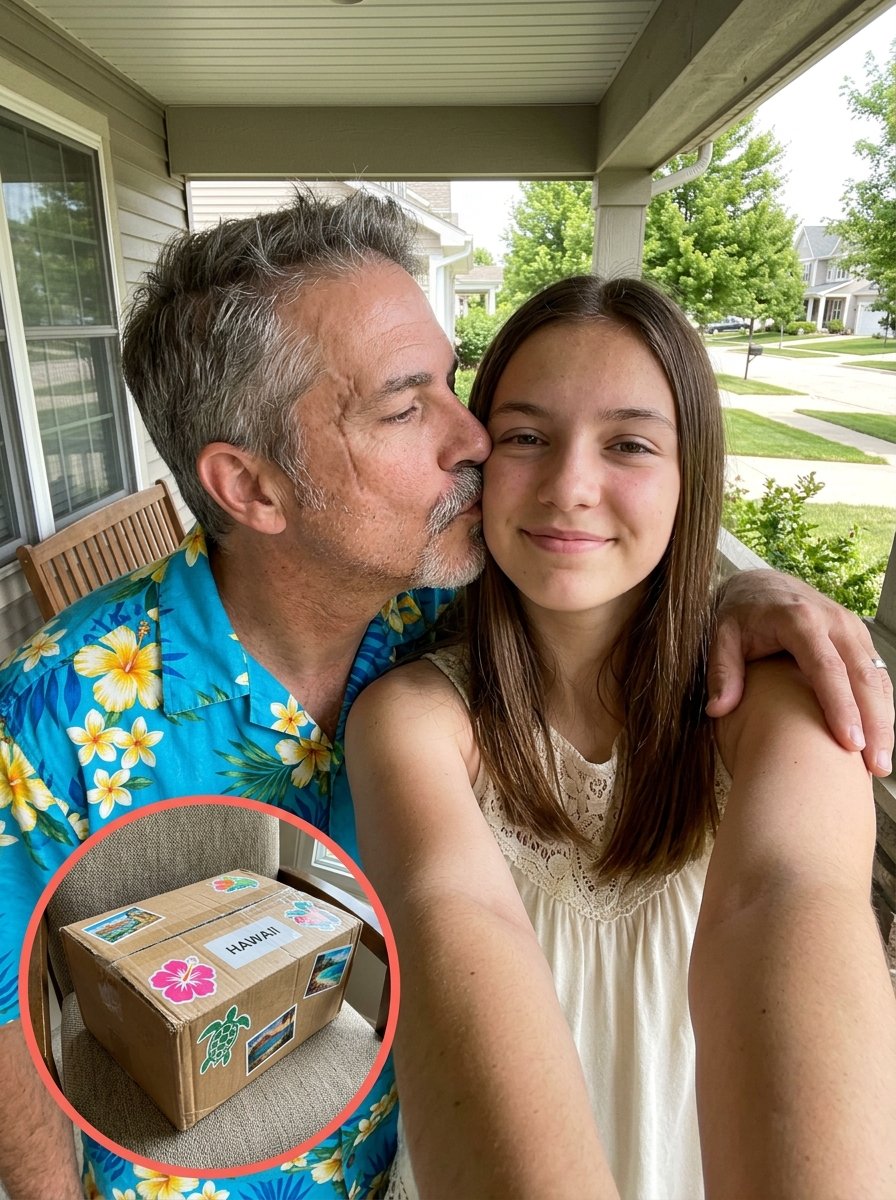
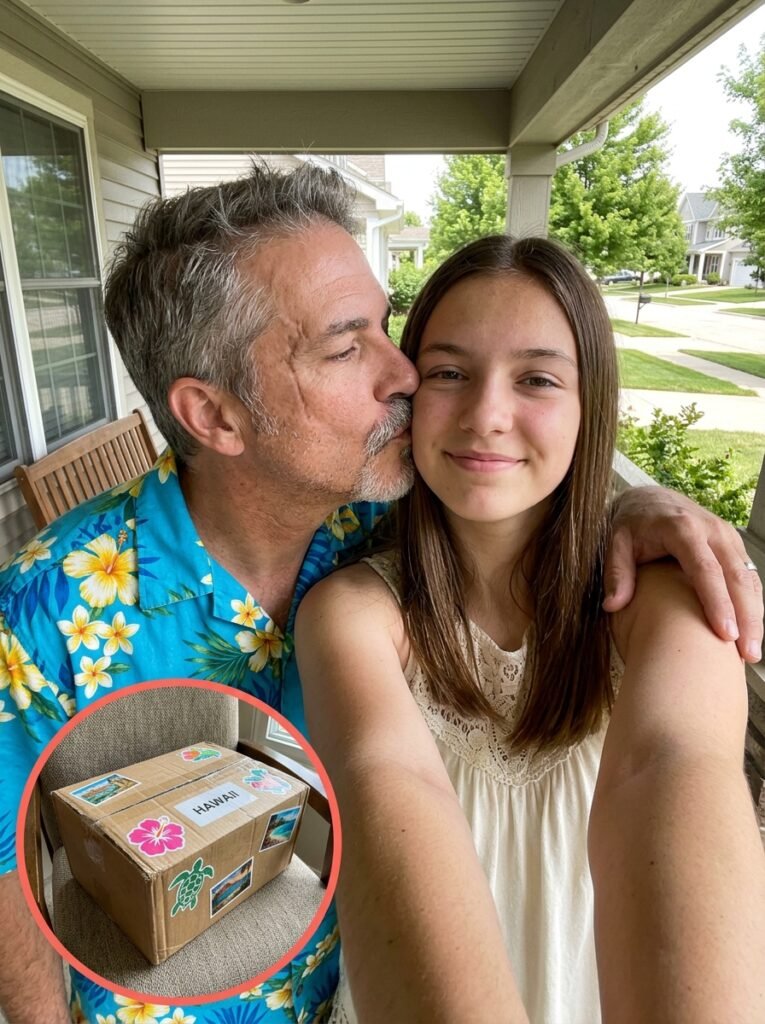
Dad’s faded beach photograph had spent years in our junk drawer, though his thumb had worn one group of people nearly smooth. Two weeks after his death, a big package arrived from Honolulu with no return address. Mom saw the label, grabbed my wrist, and begged me to throw it away without opening it.
I found Dad at the kitchen table with the photograph again.
He kept it in the bottom drawer beside old batteries, takeout menus, and pens that mostly didn’t work.
It showed a beach in Hawaii.
I found Dad at the kitchen table with the photograph again.
The colors had faded enough that the ocean looked gray. Palm trees leaned over one corner, and several tiny people stood near a cooler on the left side of the picture.
Dad was turning it over in his hands.
“What’s it like there?” I asked.
He looked up.
“The rain is warm. You can smell the ocean before you see it.”
“What’s it like there?”
Mom stood at the counter buttering toast.
Her knife stopped halfway across the bread.
Dad noticed.
“So,” he said, putting the photograph down, “how’s work?”
That was Hawaii in our family.
One minute it existed.
The next, somebody changed the subject.
That was Hawaii in our family.
Dad had been born there and left at twenty. He moved to Oregon for work, met Mom, married her, and never went back.
Not once.
I never understood it.
He missed Hawaii openly when I was little.
He’d talk about rainstorms, fruit from roadside stands, the sound of birds before sunrise.
He missed Hawaii openly when I was little.
Then, as I got older, I noticed Mom’s reactions.
She’d get quiet.
Or leave the room.
Once, after Dad mentioned wanting to see the ocean there again, she put her plate in the sink so hard I thought it might crack.
Later, I confronted him.
As I got older, I noticed Mom’s reactions.
“Why does Mom get angry every time you talk about Hawaii?”
Dad was folding a dish towel.
“She’s not angry.”
“She definitely is, Dad.”
He gave me a tired look.
“Try to understand your mother, Annie. If you knew the whole story, you wouldn’t be angry with her.”
I wish I’d asked what he meant.
“If you knew the whole story, you wouldn’t be angry with her.”
Two weeks ago, Dad was driving home when another car crossed into his lane.
He never made it back.
There are events your mind refuses to understand even after your body has already started living inside them.
Dad’s shoes were still beside the garage door.
His coffee mug was in the cabinet.
He never made it back.
His jacket hung from the same hook.
But he was gone.
Mom and I were still sorting through sympathy cards when the delivery arrived.
The package was enormous.
The driver left it on the porch and asked me to sign.
I almost told him he had the wrong house.
The package was enormous.
Then I saw the label.
GILBERT
Our address.
Honolulu origin.
The shipping date was three days before Dad’s accident.
There was no return address I recognized.
The shipping date was three days before Dad’s accident.
I stared at it long enough that the driver asked if everything was okay.
“Yeah.”
It wasn’t.
I dragged the package inside.
“Mom?”
She came into the kitchen carrying a stack of condolence cards.
Then she saw the box.
The cards slipped sideways in her hands.
I dragged the package inside.
“Where did that come from?”
“Hawaii.”
Her eyes went directly to the shipping label.
“Leave it, Annie.”
“What?”
“Just leave it.”
“Mom, it’s addressed to Dad.”
“I can see that.”
“Where did that come from?”
“Someone sent this before the accident. They might be waiting to hear from him.”
She put the cards down.
“Throw it away.”
I stared at her.
“Are you serious?”
“Please.”
“Throw it away.”
She crossed the kitchen and caught my wrist.
“Throw it away. Let’s pretend it never came.”
I pulled free.
That frightened me more than the box.
“What do you know about this?”
“Nothing that matters now.”
“It mattered to Dad.”
“Annie.”
“What do you know about this?”
“Somebody in Hawaii mailed him something the size of a washing machine three days before he died.”
“It’s not a washing machine.”
I looked at her.
“Then you do know.”
Mom closed her eyes.
I found scissors.
“Don’t.”
“It’s not a washing machine.”
I cut the tape.
“Annie, please.”
I opened the cardboard flaps.
Packing paper covered whatever was inside.
I pulled it away.
Blue paint.
Wood.
I opened the cardboard flaps.
For a moment, I genuinely didn’t understand what I was looking at.
Then I removed the rest of the packing material.
It was a chair.
An old wooden kitchen chair painted blue.
I genuinely didn’t understand what I was looking at.
The paint had worn away along the edges. One leg had been repaired with a darker piece of wood. A black mark scarred the bottom rung as if somebody had once set something hot against it.
I looked at Mom.
She sat down in one of our kitchen chairs.
One leg had been repaired with a darker piece of wood.
Not the blue one.
“What is this?”
She didn’t answer.
I pulled the chair from the box.
It wobbled when I placed it on the floor.
Something had been scratched underneath the seat.
It wobbled when I placed it on the floor.
I tipped it sideways.
One word.
Uneven letters carved deeply into the wood.
GILBERT
I covered my mouth.
Dad’s name.
Not written recently.
Carved there long enough ago that the grooves had darkened with the rest of the wood.
Uneven letters carved deeply into the wood.
“Dad,” I whispered, staring at the chair, “what are we supposed to do with this?”
Mom began crying.
She pressed her fingertips against her eyes and sat there while I waited.
Finally, she said, “That was his chair.”
“Where?”
“In Hawaii.”
Mom began crying.
“I figured that part out.”
She looked at me.
“Your father didn’t grow up the way you think he did.”
Life in Dad’s childhood home had become unstable when he was a teenager.
Mom didn’t give me every detail.
“Your father didn’t grow up the way you think he did.”
Dad hadn’t given them to her either.
But for several years, he lived with a foster family.
A crowded house.
Kids coming and going.
Too many shoes by the door.
Too many plates drying beside the sink.
Dad hadn’t given them to her either.
“And that chair?” I asked.
“Kitchen table.” Mom looked at it. “There weren’t enough matching chairs. Gilbert got that blue one.”
“Why keep it?”
“Because it was his.”
Something about the simplicity of that answer stopped me.
Mom told me Dad used to joke that the chair leaned as much as he did.
“Why keep it?”
Nobody formally assigned it to him.
They simply began expecting him to sit there.
Dinner came, and there was a place for Dad.
Breakfast came, and there was a place for Dad.
I thought about the photograph.
I went to the drawer and found it.
They simply began expecting him to sit there.
“Is this them?”
Mom nodded.
I looked again.
For years I’d seen a beach.
Now I noticed the people at the left edge.
Teenagers.
A woman near the cooler.
“Is this them?”
Someone crouched in the sand.
Dad’s thumb had worn the photograph smooth near those tiny figures.
Not over the ocean.
Over them.
“He wasn’t looking at the beach,” I said.
Mom shook her head.
“Not usually.”
“He wasn’t looking at the beach.”
Dad left Hawaii at twenty because an opportunity opened on the mainland.
Nobody threw him out.
His foster family encouraged him to go.
He expected to return.
Then one year became several.
Oregon became a job.
The job became a life.
Nobody threw him out.
Then Mom.
Then me.
“So why didn’t he go back?”
Mom looked toward the window.
“At first, money.”
That made sense.
“Then?”
“Work.”
“And after that?”
“So why didn’t he go back?”
She was quiet.
“He thought he’d waited too long.”
“Too long for what?”
“To show his face.”
I frowned.
“They were his family.”
“He thought he’d waited too long.”
“He didn’t use that word easily.” Mom picked at the corner of a condolence card. “The longer he stayed away, the more embarrassed he became about staying away.”
It sounded ridiculous.
It also sounded exactly like Dad.
“He didn’t use that word easily.”
“Where do you fit into this?”
Mom looked at me.
“What?”
“The whole story. Dad told me I’d understand you if I knew it.”
She pushed her chair back.
“Where do you fit into this?”
“When we were first married, he compared everything to Hawaii.”
“Everything?”
“Rain. Fish. Coffee. Sunsets.”
Despite myself, I smiled.
“That sounds like Dad.”
“It was exhausting.”
The smile disappeared.
“It was exhausting.”
Mom stared at her hands.
“I thought every time he called Hawaii home, he was telling me this wasn’t.”
There it was.
“What did you do?”
“One night I told him if Hawaii was so perfect, maybe he should’ve stayed there. That’s when he told me about the foster home.”
“What did you do?”
Mom looked toward the blue chair.
“I’d thought I was competing with beaches and palm trees.”
Her voice lowered.
“I found out I was competing with the first place he’d ever been sure dinner would include him.”
“Mom.”
“I apologized,” she said.
“I’d thought I was competing with beaches and palm trees.”
“Did he forgive you?”
“Immediately.”
“So you stopped him from going back?”
Her head snapped toward me.
“No.”
The answer came so quickly I believed it.
“I spent years trying to get him to go.”
“Did he forgive you?”
She suggested it when I was ten.
Dad said we couldn’t afford it.
She suggested it after his promotion.
He said work was too busy.
She suggested it for their twenty-fifth anniversary.
Dad said we couldn’t afford it.
Dad said the people he knew were probably gone.
“They weren’t,” Mom said.
“How do you know?”
“Christmas cards.”
I stared at her.
“They sent cards?”
“For years.”
“Did Dad answer?”
“Sometimes.”
“They sent cards?”
“Then why would he think they didn’t want him?”
Mom gave a sad little shrug.
“Because every card reminded him how long it had been.”
One summer she finally told him she’d buy the ticket herself.
Dad said, “Next year.”
“Every card reminded him how long it had been.”
Next year became another decade.
I looked at the chair again.
“Who sent this?”
Mom didn’t answer.
“Mom.”
Her eyes filled.
“I know who sent it.”
“Who?”
“I know who sent it.”
She took a long time.
Then she said, “I asked her to.”
I stared at her.
“You arranged this?”
“Months ago.”
“Why?”
“The house was being cleared. I called one of the women your father grew up with. We still had her address from the Christmas cards.”
“You arranged this?”
“And she still had his chair?”
Mom nodded.
“She laughed when I asked.”
“What did she say?”
“‘We still have the silly thing.'”
“And she still had his chair?”
I looked down at the worn blue paint.
Mom wiped her face.
“I thought if he saw it here, maybe he’d finally understand.”
“Understand what?”
“That he hadn’t disappeared from them just because he’d stayed away.”
“Understand what?”
She had planned to put the chair at our kitchen table.
Then ask Dad one more time.
Go home.
See them.
Stop waiting for some imaginary year when returning would become easier.
The package had been shipped three days before the accident.
Dad never knew it was coming.
She had planned to put the chair at our kitchen table.
I looked at Mom.
“Then why did you tell me to throw it away?”
Her face crumpled.
“Because he was supposed to sit in it.”
Neither of us spoke.
“He was supposed to sit in it.”
A delivery label was still stuck to the torn cardboard.
Below the shipping information was a contact number.
Hawaii.
I reached for my phone.
Mom saw what I was doing.
“Annie.”
Mom saw what I was doing.
“Someone there thinks Dad just got his chair back.”
Her eyes went to the number.
I dialed.
It rang four times.
Then an older woman answered.
“Hello?”
“Someone there thinks Dad just got his chair back.”
I looked at Dad’s name carved beneath the blue seat.
“My name is Annie.” My voice nearly failed me. “I’m Gilbert’s daughter.”
There was a long silence.
Then the woman whispered, “Gilbert had a daughter?”
For a second, I couldn’t answer.
“Yes,” I said. “He did.”
“Gilbert had a daughter?”
The woman gave a shaky laugh.
“He never told us.”
“He didn’t tell me about you either.”
That quieted both of us.
Her name was Ruth. She had been fifteen when Dad arrived at the foster home.
“He never told us.”
She asked about him carefully.
“Did he still cheat at cards?”
“Yes.”
“Did he still hate papaya?”
Apparently he’d lied to me about liking it.
“Did he whistle when he was nervous?”
“Did he still cheat at cards?”
I looked at Mom.
She nodded.
“Every time.”
Ruth laughed again.
These weren’t stories about a secret version of my father.
They were my father.
These weren’t stories about a secret version of my father.
“Why did you keep his chair?” I asked.
“Because it was Gilbert’s.”
“For fifty years?”
“People used it.”
She sounded surprised I thought otherwise.
“Kids sat in it. Somebody broke its leg once. We fixed it. But whenever anyone wanted to throw it out, Mom said, ‘No. That’s Gilbert’s chair.'”
“Because it was Gilbert’s.”
I touched the worn blue backrest.
“Dad thought he’d stayed away too long.”
“Too long for what?”
“To come back.”
Ruth was silent.
Then she said, “Nobody told him that.”
“Too long for what?”
Mom covered her mouth.
She leaned toward my phone.
“Ruth?”
“Yes?”
“Were you angry with him?”
“Sometimes.”
Mom closed her eyes.
“Were you angry with him?”
Ruth continued.
“I still would’ve picked him up at the airport.”
After the call, Mom and I sat beside the blue chair for a long time.
A week later, I took the chair to my apartment.
Mom objected immediately.
I took the chair to my apartment.
“Annie, that’s your father’s chair.”
“I know, Mom.”
I put it at my kitchen table.
The next Sunday, Mom came for coffee.
She stopped when she saw me sitting in it.
I put it at my kitchen table.
For a moment, I thought she’d ask me to get up.
She didn’t.
She sat across from me instead.
Dad’s faded photograph lay between us.
Mom turned it around and pointed to the woman beside the cooler.
“That’s the woman who raised him.”
Dad’s faded photograph lay between us.
I studied the tiny figure.
The blue chair shifted beneath me and tapped unevenly against the floor.
Mom looked down.
“Still does that.”
“Yeah.”
She pushed the sugar bowl toward me.
Outside, Oregon rain streaked the window.
I stayed in Dad’s chair.
The blue chair shifted beneath me and tapped unevenly against the floor.