
The first thing Mara noticed when she walked into the townhouse that Tuesday evening was how quiet it was.
Normally, her mother had the television running somewhere in the background, or a pan was hitting the stove, or her father was moving through the living room complaining about something that needed fixing.
That evening there was none of it.
The house smelled faintly of smoke from the fireplace and the sharp cardboard scent of fresh packing tape.
Then Mara looked toward the living room.
Four boxes were waiting for her.
Her winter coats had been folded carelessly across the top of one of them.
Her drafting case leaned against another.
For a few seconds, she simply stood near the front door with her keys still in her hand.
Her younger brother, Dylan, was beside the fireplace holding a glass of bourbon.
He wore a navy blazer even though he had nowhere to go.
Their mother, Patricia, sat on the sofa.
Their father, Richard, was in the armchair he always claimed before anyone else could.
Their sister, Chloe, leaned against the doorway between the dining room and the living room with her phone in her hand.
Nobody asked Mara how her day had been.
Nobody looked surprised that she had come home.
The arrangement of the room bothered her more than the boxes did.
They were waiting.
This had been discussed before she arrived.
“What’s going on?” Mara asked.
She set her keys on the small table near the door.
Dylan gave her a smile that was almost casual.
“You’re moving out tonight, Mara.”
She looked at him, then at the boxes again.
“What?”
“I need the upstairs bedroom.”
For a moment she thought she had misunderstood.
Dylan continued as though the decision had already been made and only needed to be explained to her.
He wanted her bedroom as an office.
The walk-in closet would give him space for his client clothes.
The room had better light than the smaller bedroom.
And, according to him, it was time everyone in the family started contributing according to their potential.
Mara waited.
She expected her father to interrupt him.
Richard only leaned forward.
“Your brother finally has a serious career,” he said. “We need to support the person with the best chance of moving this family forward.”
Mara felt her grip tighten around the strap of her bag.
Moving the family forward.
The phrase landed strangely because, for the previous four years, Mara had believed that was exactly what she had been doing.
When Richard’s construction supply business collapsed, the consequences had arrived quickly.
There were bills that suddenly could not wait.
There were notices nobody wanted to leave on the kitchen counter.
There were conversations that ended whenever Mara entered the room because her parents did not want her to know how serious things had become.
Eventually, Mara learned anyway.
The property taxes were overdue.
She paid them.
Three mortgage payments came due during a period when Richard could not cover them.
Mara handled those too.
In January, the furnace failed.
The house became so cold that Patricia wore a coat indoors while pretending everything would somehow be fine.
Mara paid for the replacement.
When the grocery account ran low, Patricia would sometimes mention it indirectly.
She never asked outright.
She would say that prices had gone up again, or that she might wait until Friday to buy certain things.
Mara learned what those sentences meant.
She transferred money.
The refrigerator had been replaced because of Mara.
The floors had been refinished because of Mara.
None of those payments had come with a family meeting.
There had been no announcement.
No one had raised a glass and thanked her.
Mara had never wanted that.
She thought that was what families did when things went wrong.
One person carried more for a while, and when they needed help later, somebody else stepped in.
But standing in the living room and looking at four boxes packed without her permission, Mara realized she had been operating under a rule nobody else seemed to share.
“I’ve been contributing,” she said.
Dylan laughed.
“Come on, Mara. Freelance drafting from your laptop isn’t the same as having a real corporate career.”
Mara stared at him.
That sentence was almost enough to make her tell him everything.
Her work might have looked unimpressive from the hallway.
She spent long hours upstairs with her laptop, drafting equipment, headphones, and hard drives.
She did not commute to an office every morning.
She did not wear a blazer to sit at her desk.
She did not come home talking loudly about clients or meetings.
Dylan had apparently decided that meant her work was small.
Mara nearly corrected him.
She nearly told him that the projects passing through her computer were commercial projects worth more than anything their father’s failed business had ever handled.
She almost asked Dylan where he thought the money for the furnace had come from.
Instead, Mara looked at Patricia.
Her mother would not meet her eyes.
She looked at Richard.
His expression was firm, almost impatient.
Then she looked at Chloe.
Her sister was still holding her phone.
It was not ignorance.
That hurt more.
Her family might not have understood the technical details of her job, but they knew Mara paid bills.
They knew things got repaired because she paid for them.
They knew she had stayed in that house years longer than she needed to.
They simply did not value those things the same way they valued Dylan’s new job title.
“This isn’t punishment, sweetheart,” Patricia finally said.
Her voice had the gentle tone she used whenever she wanted something unpleasant to sound reasonable.
“Dylan has momentum right now. He’s meeting important people. He needs a proper space to work.”
Mara glanced toward the stairs.
“I work from that room.”
“You can work anywhere,” Chloe said without looking up.
That was when Mara noticed something near the front door.
Metal legs protruded from beneath a blanket.
Her drafting table.
Someone had already dragged it downstairs.
Mara crossed the room and pulled the blanket aside.
A corner had been scraped badly enough to expose the lighter wood beneath the finish.
She ran her thumb near the damage.
Hundreds of nights had passed at that table.
She had worked there long after midnight while everyone else slept.
She wore headphones so the sound of typing would not bother anybody.
She had eaten cold leftovers at that table.
She had checked invoices there.
She had transferred money to her parents from there.
Now the table was treated like another obstacle Dylan wanted removed.
“How long have you been planning this?” she asked.
Dylan took a slow sip of bourbon.
“Long enough.”
Richard sighed.
“Don’t turn this into a scene, Mara. You’re twenty-eight. You’ve had plenty of time to establish yourself.”
Mara almost laughed.
The comment was so detached from reality that she did not know how else to react.
She could have established herself somewhere else years earlier.
She had stayed because every time she considered leaving, another household problem appeared.
A tax payment.
A mortgage payment.
A broken appliance.
A grocery bill.
And beneath all of it was an idea Mara had never questioned: this was their childhood home, and keeping it was something the family was doing together.
That evening, she finally understood the arrangement.
She had been keeping it.
They had been living in it.
“All right,” Mara said.
Patricia blinked.
“All right?”
“I’ll leave.”
The room changed.
Dylan had expected resistance.
Mara could see it in his expression.
He had prepared arguments.
Maybe he wanted her to beg.
Maybe he wanted the satisfaction of winning a confrontation.
Instead, Mara walked upstairs.
She opened drawers and checked shelves for the things her family had overlooked.
Her passport went into her bag.
So did a hard drive containing years of design work.
She found two framed photographs of her late grandmother.
Then she saw the blue ceramic mug she had used for years.
The handle was chipped.
It was worth almost nothing.
Mara packed it anyway.
Chloe followed her halfway up the staircase.
“You’re seriously not going to fight about this?”
Mara stopped and looked down at her.
“What exactly would you like me to fight for?”
Chloe opened her mouth.
No answer came.
Mara went back to packing.
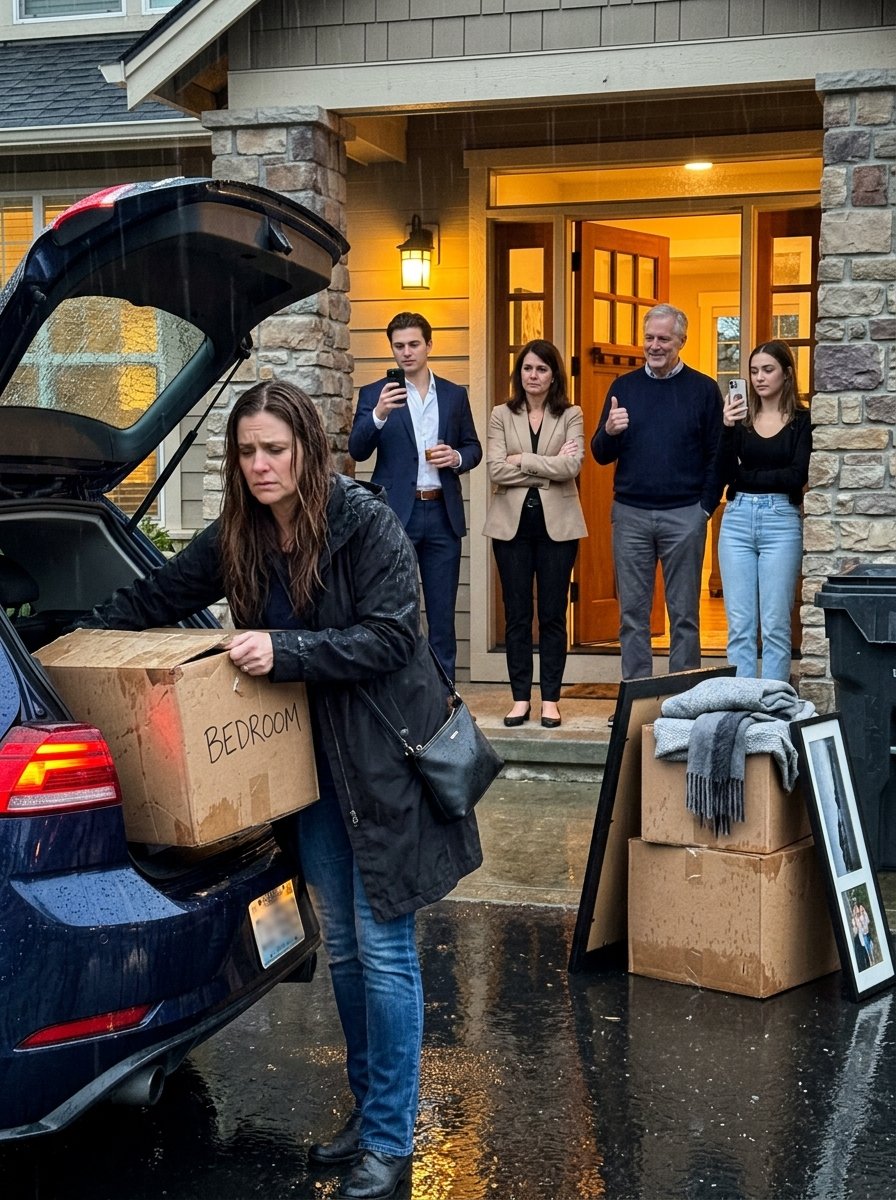
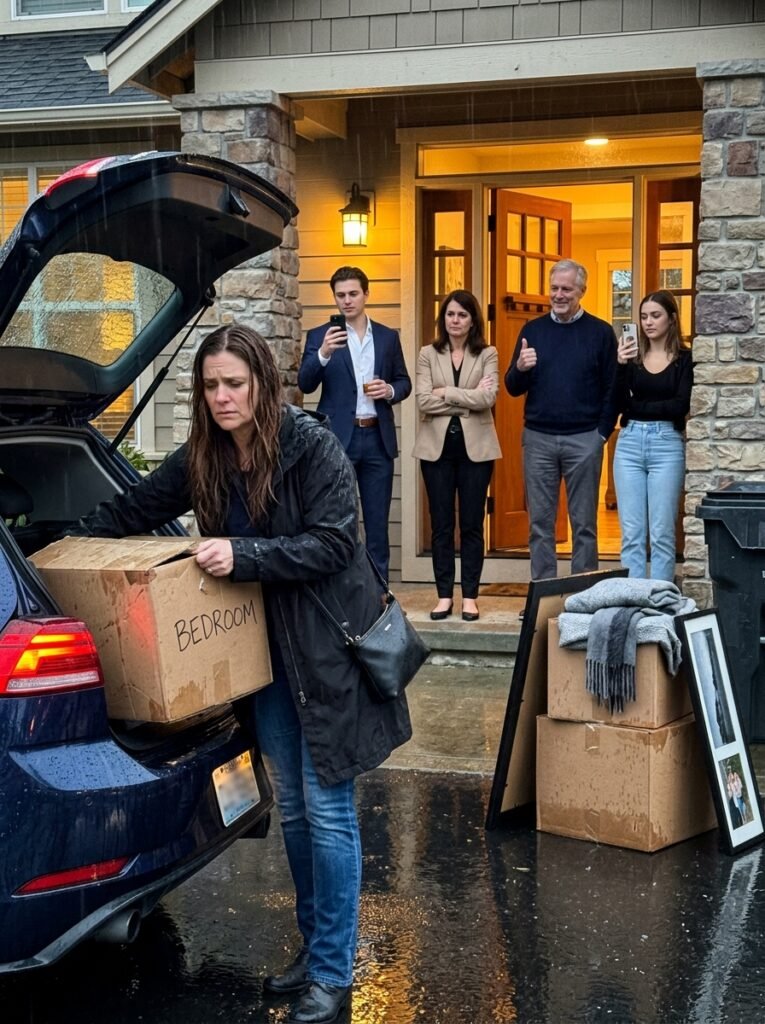
By the time she carried the last of her things downstairs, rain had started falling hard enough to shine beneath the streetlights.
Dylan took two of her boxes.
For one second, Mara assumed he was helping her load the car.
He walked past it.
Then he placed the boxes beside the overflowing trash bins.
Mara stopped.
“What are you doing?”
Dylan put down another box.
Her coats were already getting wet.
Patricia remained beneath the porch roof.
“Don’t be dramatic, Mara. You’re making this harder than it needs to be.”
Mara reached toward one of the boxes.
Then she heard the click.
It was the familiar sound of a phone camera.
She turned.
Dylan had stepped backward and was photographing her belongings in the rain.
“What are you doing?”
“Nothing.”
His thumbs were already moving.
Less than a minute later, Mara’s own phone vibrated.
She pulled it from her pocket.
There was the photograph.
The boxes.
The trash bins.
Her coats darkening under the rain.
The entire scene had been framed to make her belongings look like garbage waiting to be collected.
Dylan had posted it publicly.
Worse, he had tagged the regional office of Mercer Freight Systems, the company where he had recently started working.
Above the picture, Dylan had written:
“Finally, we got rid of the dead weight. Now I can focus on building the life I deserve.”
Mara read it twice.
Then she saw the reactions beneath it.
Chloe had left champagne emojis.
Patricia had written, “Fresh beginnings for everyone.”
Richard had added a thumbs-up.
Mara stood in the rain staring at the screen.
The cruelty of Dylan’s post was one thing.
The speed with which the others joined him was something else.
Nobody hesitated.
Nobody wrote that Mara had helped the family.
Nobody reminded Dylan who had paid bills inside the house he was celebrating reclaiming.
Nobody seemed worried that strangers might see it.
Mara felt an old instinct rise in her.
Explain yourself.
List the payments.
Defend your work.
Tell them what they owe you.
Tell everyone reading the post what really happened.
Her thumb hovered near the screen.
Then she lowered the phone.
Arguing underneath Dylan’s photograph would not change what had happened inside the house.
It would not change Richard’s expression.
It would not change Patricia’s silence.
It would not change Chloe’s champagne emojis.
Something inside Mara became very still.
She opened Dylan’s profile and blocked him.
Then Chloe.
Then Patricia.
Then Richard.
No final message.
No warning.
No paragraph explaining why.
Mara carried the boxes to her car herself.
She covered the drafting table with plastic so the rain would not ruin it further.
Her sleeves were wet by the time she finished.
When she finally sat behind the steering wheel, she looked back once.
Dylan stood beneath the porch light.
Her mother, father, and sister were behind him.
All four were watching her.
Mara wondered whether they were waiting for her to get out of the car.
To cry.
To come back to the porch and demand another conversation.
She started the engine.
Then she drove away.
Her temporary apartment was not much.
It was a place to sleep and somewhere to put her things while she figured out what came next.
That first night, Mara carried the boxes inside one at a time.
The cardboard was damp.
One sleeve of her winter coat was soaked.
The plastic around her drafting table crackled as she pulled it through the doorway.
She placed her grandmother’s photographs somewhere dry.
Then she set the chipped blue mug on the counter.
Only after everything important was inside did Mara look at her phone again.
There were no messages from her family because she had blocked them.
For the first time in years, she did not have to wonder whether the next vibration meant another request for money.
She should have felt devastated.
Instead, exhaustion settled over her.
The family believed they had removed the person holding Dylan back.
They believed the bedroom would become an office, Dylan would continue rising at his company, and Mara would disappear into whatever insignificant freelance life they imagined she had.
What Dylan did not understand was that his public post had not stayed inside the family.
He had tagged his own workplace.
And somewhere across the city, before Mara had even finished moving her damp belongings inside, the photograph had already reached someone who did not see her the way Dylan did.
Someone who understood that “freelance drafting” did not necessarily mean tiny jobs completed at a kitchen table.
Someone who knew the scale and value of the kind of work Mara had spent years producing.
And someone with a direct professional connection to Dylan.
Mara knew none of that when she finally went to sleep.
The next morning, her phone rang.
The number was unfamiliar.
For a moment, she considered letting it go to voicemail.
Then she answered.
“Hello?”
A man spoke.
“Mara?”
“Yes.”
“This is Daniel Mercer.”
She sat straighter.
The surname registered immediately.
Mercer Freight Systems.
Dylan’s employer.
Daniel continued before Mara could decide what to say.
“I’m Dylan’s boss.”
Mara looked across the apartment at the damp boxes she still had not unpacked.
Her drafting case was propped against the wall.
The scratched corner of her table showed beneath the plastic.
Why would Dylan’s boss be calling her?
Then Daniel said, “I just saw what Dylan posted last night.”
Mara said nothing.
His voice was serious.
Not amused.
Not curious in the way strangers became curious when they saw someone else’s family argument online.
There was another quality in it.
Recognition.
A brief silence passed between them.
Then Daniel asked the question that changed the entire feeling of the morning.
“Mara, is it true?”