
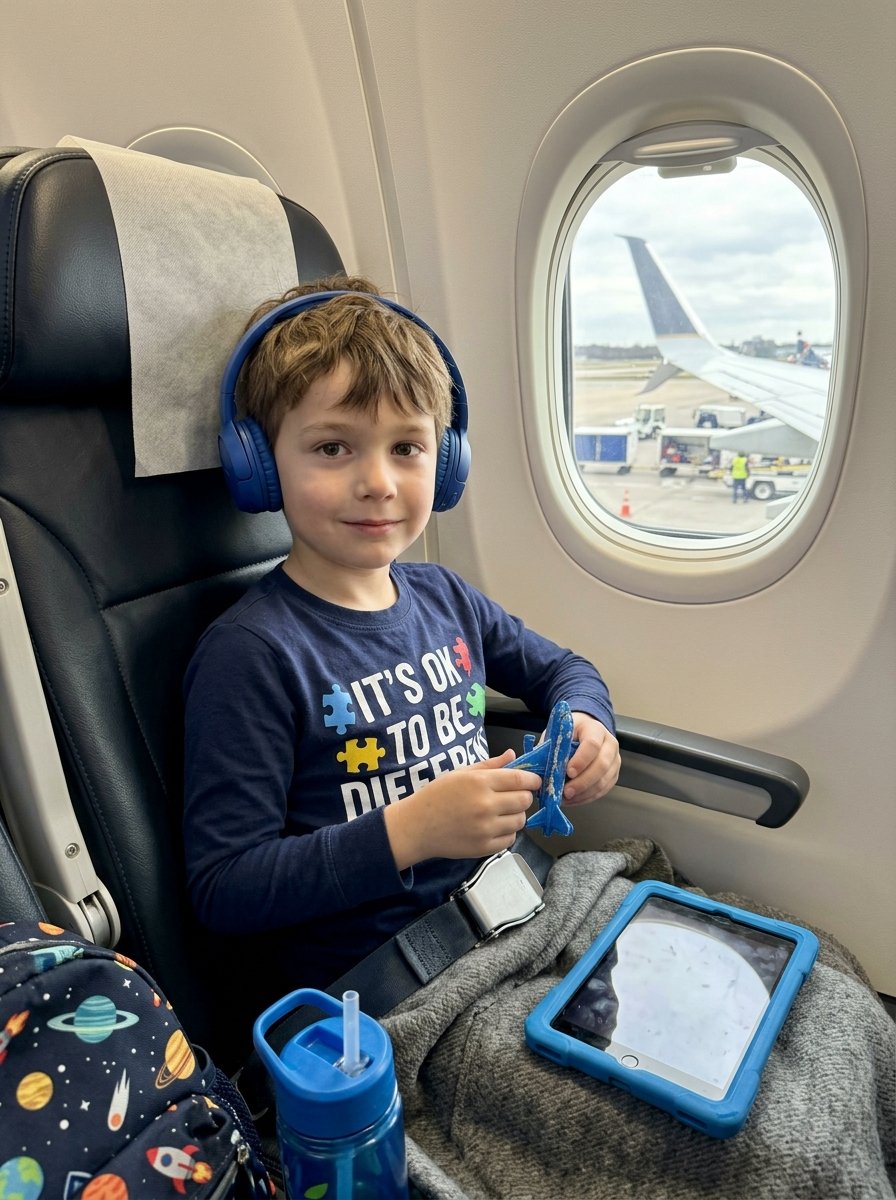
A passenger snapped at my autistic grandson during his first flight, but things took a strange turn when a flight attendant picked up his old toy airplane. Why did she suddenly ask to see my boarding pass?
It was my grandson Benjamin’s first flight.
He’s seven and has autism, so we’d prepared for weeks.
I packed his headphones, crackers, two familiar books, and the little blue airplane he’d carried everywhere since he was five.
I booked him a window seat because he’d spent months asking what clouds looked like from above.
For the first hour, he did beautifully.
He pressed his forehead to the window and whispered the names of things he recognized.
“Cloud.”
“Wing.”
“Cloud.”
Then the plane dropped.
Not far, probably.
But my stomach jumped, the overhead bins rattled, and the seat belt sign chimed.
Benjamin jerked away from the window.
The next bump was worse.
He clapped his hands over his ears and began rocking.
“Blue plane, blue plane, blue plane,” he murmured.
I took his hand.
“You’re safe, sweetheart.”
His fingers squeezed mine.
The man across the aisle turned around.
“Keep it down or get out!”
For a second, I thought I’d misheard him.
Several passengers looked over.
Benjamin rocked faster.
I leaned toward the man.
“He’s seven,” I said. “He’s doing his best.”
The man rolled his eyes.
“Then maybe he shouldn’t be flying.”
Heat rushed into my face.
I had spent weeks worrying about whether Benjamin would be frightened, whether he’d tolerate the engine noise, and whether he’d panic during boarding.
I’d prepared for almost everything except a grown man deciding my grandson’s fear was an inconvenience he had the right to punish.
Before I could answer, a flight attendant hurried over.
“Is everything okay?”
I explained quietly.
Benjamin kept repeating, “Blue plane, blue plane.”
The attendant smiled at him and pulled a small packet from her pocket.
“Would he try foam earplugs?”
I nodded.
She showed them to Benjamin before touching anything near him. He looked at me, and I helped him put them in.
The man across the aisle muttered, “Special treatment.”
The attendant straightened.
“Sir, that’s enough.”
He gave an irritated sigh and leaned back.
I thought that was the end of it.
Then Benjamin’s little airplane slipped off his lap.
It bounced once and landed near the attendant’s shoe.
She picked it up.
Then she froze.
The toy was old, its blue paint rubbed pale along the wings. On the bottom was a faded airline logo and Benjamin’s name in black marker, which I’d written there because he lost things constantly.
The attendant turned it over.
“Where did he get this?”
“It was his grandfather’s.”
Her eyes lifted to mine.
“His grandfather?”
“My husband.”
She looked at the toy again.
“Ma’am… may I see your boarding pass for just a moment?”
I stared at her.
“My boarding pass?”
“If you don’t mind.”
I handed it over.
Her eyes went directly to my last name.
Her expression changed.
Without saying another word, she stood and looked toward the closed cockpit door.
The man across the aisle noticed.
“What now?”
She ignored him.
Instead, she picked up the intercom phone.
Her eyes stayed on my boarding pass as she quietly said, “Captain… I think you need to come out here. Right now.”
My first thought was that something was wrong with the toy.
That made no sense, but little about the last two minutes made sense.
Benjamin tugged my sleeve.
“Grandpa plane.”
“I know, honey.”
The turbulence eased, though the seat belt sign stayed on.
A minute later, the cockpit door opened.
The captain stepped out.
He was probably in his late fifties, with silver at his temples. The attendant handed him the toy before saying anything else.
He stared at it.
Then he turned it over.
His face changed.
He looked at me.
“Did Daniel give this to your grandson?”
I stopped breathing for a second.
Daniel had been gone almost eight years.
“Daniel was my husband.”
The captain looked at Benjamin.
“Did he give you this?”
Benjamin glanced at me.
I answered for him.
“He couldn’t have. Daniel died before Benjamin was born.”
Something in the captain’s expression fell.
“I’m sorry.”
“How did you know his name?”
He didn’t answer immediately.
Instead, he rubbed his thumb gently along one chipped wing.
Then he asked, “So Daniel never told you what this airplane meant?”
I stared at him.
“What do you mean?”
The plane shifted again beneath us.
The captain glanced toward the cockpit.
“I need to get back up front.”
“You knew my husband?”
He handed the toy to me.
“He trained me.”
Before I could ask another question, he added, “Please don’t put that away. I’d like to see it again.”
Then he disappeared behind the cockpit door.
I sat there holding the airplane.
For years, it had been one of those ordinary objects that survived a person’s death for no particular reason.
Daniel had kept it in a desk drawer.
After he died, I’d found it among old licenses, pens, receipts, and photographs from his flying days.
When Benjamin became fascinated with airplanes, I gave it to him.
“That was Grandpa’s,” I had said.
That was all I knew.
The flight attendant crouched beside us again.
“Are you all right?”
“I don’t know.”
She gave me a sympathetic smile.
I looked toward the cockpit.
“Daniel trained him?”
“That’s what I always heard.”
“Always heard?”
She hesitated.
“Your husband was pretty well known among some of the older crew.”
That surprised me almost as much as the captain recognizing his name.
Daniel had loved flying, but at home he hadn’t been a man who told stories about himself. If I asked how a trip went, he’d say, “Long,” or “Fine,” or complain about airport coffee.
“He retired suddenly,” I said. “One day he was talking about schedules. A few months later he was done. He said he’d had enough.”
The attendant looked at me strangely.
“That’s not what I heard.”
I turned toward her.
“What did you hear?”
A call button chimed farther down the cabin.
She looked over her shoulder.
“I’m sorry. I need to get that.”
Then she walked away.
I nearly laughed from frustration.
Benjamin had stopped rocking as hard.
He held the airplane close to his chest.
Across the aisle, the man watched us.
“What is he, some kind of airline royalty now?”
I ignored him.
For the next 20 minutes, I couldn’t stop thinking about Daniel.
He had retired 17 years earlier.
I’d believed him when he said he was tired of missing birthdays, dinners, ordinary evenings.
But I remembered the timing.
Our daughter had been having a terrible year.
She’d been overwhelmed, barely sleeping, struggling to manage work and raising a small child after her marriage fell apart. Daniel had suddenly become available for everything.
Doctor appointments.
School pickups.
Broken appliances.
Late-night phone calls.
At the time, I thought retirement had simply happened to come when we needed him most.
I began to wonder whether that had been backward.
Maybe he retired because we needed him.
When the seat belt sign finally went off, the captain returned.
This time, I wasn’t willing to let him leave with half an explanation.
I held up the toy.
“What did you mean when you said this airplane meant something?”
He looked at the empty aisle beside us.
Then he crouched.
“Daniel trained me when I was a first officer.”
“He never mentioned you.”
“I’m not surprised.”
That answer hurt more than I expected.
The captain continued.
“Early in my career, I was on a flight that went through severe weather. Nobody was badly hurt, but it shook me. Afterward, every time the airplane started bouncing, my mind went somewhere it shouldn’t.”
I glanced at his uniform.
“You were afraid?”
“Very.”
He smiled without humor.
“I hid it well. Or I thought I did.”
“Daniel noticed.”
“He always noticed.”
The captain looked at Benjamin.
“Your grandfather didn’t embarrass me. He didn’t report me as incapable. He made sure I was safe to fly, and then he worked with me.”
He pointed at Benjamin’s toy.
“That little thing used to sit where I could see it.”
I looked down.
“This?”
“That exact airplane.”
He nodded.
“Daniel would put it in front of me and say, ‘Tell me what the aircraft is actually doing, not what your fear says it’s doing.'”
Benjamin had gone completely still.
He stared at the captain.
The captain smiled at him.
“Your grandpa was stubborn.”
Benjamin nodded solemnly.
“He looks stubborn in pictures.”
I laughed before I could stop myself.
So did the captain.
Then something occurred to me.
“If Daniel helped you through all that, why didn’t I know you?”
The smile disappeared.
The captain looked at the airplane.
“Because we didn’t part well.”
He sat in the empty aisle seat across from us.
“Years later, Daniel told me he was leaving.”
“Retiring.”
“That’s what he called it. I didn’t handle it well.”
“Why?”
“Because I thought it was about me.”
“He’d spent years pushing me forward. Then one day he was done. He wouldn’t tell me why. I was angry. I accused him of walking away from everything he’d built.”
The captain swallowed.
“Our last real conversation was an argument.”
“Daniel never told me that.”
“He didn’t tell me much either.”
The captain glanced toward the front.
“Years later, another pilot told me Daniel left because something was happening in his family.”
I knew before he finished.
“Our daughter.”
He looked at me.
I nodded slowly.
“She was going through a very difficult time. Her marriage ended. She had a young child. She didn’t want people knowing how bad things had gotten.”
The memories rearranged themselves as I spoke.
Daniel making breakfast for our grandson before dawn.
Daniel fixing our daughter’s leaking sink.
Daniel sitting at our kitchen table with bills spread around him.
Daniel telling me, whenever I worried he’d miss flying, “I’ve done enough of that.”
I had believed him.
“I thought retirement gave him time to help her,” I whispered.
The captain waited.
“I never realized he retired so he could.”
For years, I’d thought Daniel had finally chosen himself.
Now I understood he had done almost the opposite.
He had given up something he loved and made sure none of us felt responsible for it.
The man across the aisle let out a loud sigh.
“That’s all very touching, but some of us are trying to have a normal flight.”
Benjamin flinched.
His rocking started again.
The captain stood.
“Sir, you’ve already been asked to stop addressing this family.”
“I’m not addressing them. I’m saying what everyone is thinking.”
“No,” the captain said evenly. “You’re saying what you’re thinking.”
The man’s jaw tightened.
“This kid has been making noise for half the flight, and now the whole crew is hovering around him.”
“He’s seven,” I said.
The man shrugged.
“Exactly. Maybe wait until he can handle flying.”
The captain’s expression changed.
Not anger. Something quieter.
“He’s not being removed. He hasn’t endangered anyone, and he isn’t doing anything that requires removal.”
The man gestured toward us.
“So he gets special treatment.”
“Assisting a passenger who’s having difficulty isn’t special treatment.”
The captain’s voice stayed calm.
“You’ve been asked more than once to leave him alone. I’m asking you again.”
People nearby were openly watching now.
The man looked around, seemed to realize nobody was joining him, and finally turned toward his window.
The captain started to hand the airplane back.
Then he stopped.
“Wait.”
He turned it toward the overhead light.
“What?”
“Do you see this?”
He pointed under one wing.
There was a faint gray line I’d always assumed was a scratch.
He rubbed the surface gently with his thumb.
Letters appeared.
Tiny ones.
Almost erased by years of handling.
I couldn’t read them.
The captain could.
“I wrote that.”
“You?”
He nodded.
“What does it say?”
His eyes stayed on the toy.
“‘For when you forget I’m getting back in the cockpit tomorrow.'”
I stared at him.
“I don’t understand.”
He laughed softly.
“It was after one of the worst weeks I had. Daniel spent days convincing me that fear wasn’t the same thing as failure.”
He looked down at the writing.
“I wrote this as a joke because he kept carrying the airplane around during our talks. I told him I was getting back in the cockpit whether he liked it or not.”
The captain went silent.
“I always assumed he threw it away after our argument.”
But Daniel hadn’t.
He’d kept it.
Through retirement.
Through our daughter’s difficult years.
Through the ordinary life we built afterward.
He had put it in that desk drawer, where I eventually found it and handed it to the grandson he’d never met.
The captain blinked several times.
“I was angry at him for a long time.”
“He was angry with you too,” I said.
He looked surprised.
“How do you know?”
“Because that’s the only reason Daniel ever stayed quiet about someone he cared about.”
The captain laughed, but his eyes were wet.
Benjamin leaned toward him.
“Were you scared of turbulence too?”
The captain looked at him.
“Yes.”
“Really scared?”
“Really scared.”
Benjamin examined the gold stripes on his shoulders.
“But you’re the captain.”
The captain smiled.
“I am now.”
Benjamin considered that.
Then he looked out the window.
The clouds had thinned, and sunlight poured across his face.
He stopped rocking.
The captain stood.
Before leaving, he touched the back of Benjamin’s seat.
“Daniel used to talk about retirement sometimes.”
I looked up.
“He did?”
“He’d say, ‘I’ve spent enough years teaching pilots. Maybe I’ll get lucky and teach a grandkid to love airplanes.'”
I felt something inside me break open.
“He never met Benjamin.”
The captain nodded.
“I know.”
For the rest of the flight, Benjamin kept the airplane in both hands.
The man across the aisle didn’t say another word.
After we landed and most of the passengers had left, the flight attendant came back.
“The captain said Benjamin can look through the cockpit doorway if he’d like.”
Benjamin looked at me with enormous eyes.
“The real cockpit?”
“The real one.”
He walked forward holding my hand.
At the doorway, the captain was waiting.
He showed Benjamin the seats, the instruments, and the controls without overwhelming him with details.
Benjamin listened to every word.
Then he held up his little blue airplane beside the cockpit.
For a moment, I pictured Daniel seeing it.
The captain pointed to the toy.
“Think I could keep that?”
Benjamin immediately pulled it against his chest.
“It was Grandpa’s.”
The captain smiled.
“Then that’s exactly where it belongs.”
On the way out, Benjamin turned back.
“I’m going to fly again.”
The captain gave him a small salute.
“I figured you might.”
I had boarded that plane believing the little blue airplane was simply one of the few things I could give Benjamin from a grandfather he’d never known. I left understanding that Daniel had given him something else too.
Years before Benjamin was born, Daniel had looked at a frightened young pilot and refused to judge his future by the hardest moment of his life.
That frightened young pilot became a captain.
And on Benjamin’s first flight, when another man looked at my grandson during his hardest 10 minutes and decided he didn’t belong in the sky, Daniel’s lesson was still there.
So was the little blue airplane.