
Part 1: The Call from School
The call came at 12:15 on a Tuesday afternoon.
My coffee had gone cold beside my keyboard, and the spreadsheet on my computer had begun to blur into one endless list of numbers. I was halfway through a work meeting when my phone vibrated across the desk.
The moment I saw Oak Creek Elementary on the screen, my stomach tightened.
Every parent knows that feeling.
A call from school in the middle of the day never feels ordinary.
Before I even answered, my mind had already imagined a dozen possibilities.
A fall.
A fever.
An accident.
But nothing prepared me for what I was about to hear.
“Mrs. Miller?”
The school secretary’s voice was careful and professional.
“We have Chloe in the nurse’s office again.”
Again.
That one word stayed with me.
“This is the third time this week,” I said, rising from my chair. “What happened?”
“She won’t eat her lunch. She says it hurts when she swallows.”
I grabbed my purse before the secretary had even finished speaking.
“Did she hurt herself?”
There was a pause.
“She’s crying, Sarah. She won’t calm down.”
I left my laptop open, walked out of the meeting, and hurried toward the parking lot.
At the time, I told myself I was annoyed.
I told myself I was frustrated because Chloe had been having strange moments lately, and I did not understand why.
But underneath that frustration was something else.
Fear.
A mother’s fear that she had noticed something wrong but had been too exhausted to understand it.
My daughter Chloe was seven years old.
She had bright blonde hair that never stayed neat for more than ten minutes, a laugh that turned into little hiccups whenever something truly made her happy, and a habit of placing stickers on my wrist whenever she thought I looked tired.
She was my entire world.
And lately, something had been different.
During the drive to Oak Creek Elementary, I remembered all the small things.
The way Chloe tilted her head strangely during breakfast.
The way she pushed food around her plate instead of eating.
The way she started asking for applesauce instead of crackers.
The way she slept curled into herself, with her chin tucked down and her hair covering the front of her neck.
I had noticed those things.
I had noticed everything.
But I was also a single mother trying to keep my life from falling apart.
Bills.
Work.
School schedules.
A mortgage.
The endless exhaustion that comes from being responsible for everything.
Sometimes love and panic look exactly the same when you are tired.
The Nurse’s Office
Oak Creek Elementary looked exactly like every American school I had ever visited.
It smelled of floor cleaner, old paper, and cafeteria food. Children’s artwork covered the walls, and a small American flag stood beside the front office window.
I signed my name at 12:27, clipped a visitor badge onto my coat, and hurried down the hallway.
The nurse’s office door was slightly open.
Then I heard Chloe crying.
My heart broke.
It was not an angry cry.
It was not the sound of a child throwing a tantrum.
It was the quiet, exhausted crying of a little girl who had already used all her strength trying to be brave.
I pushed the door open.
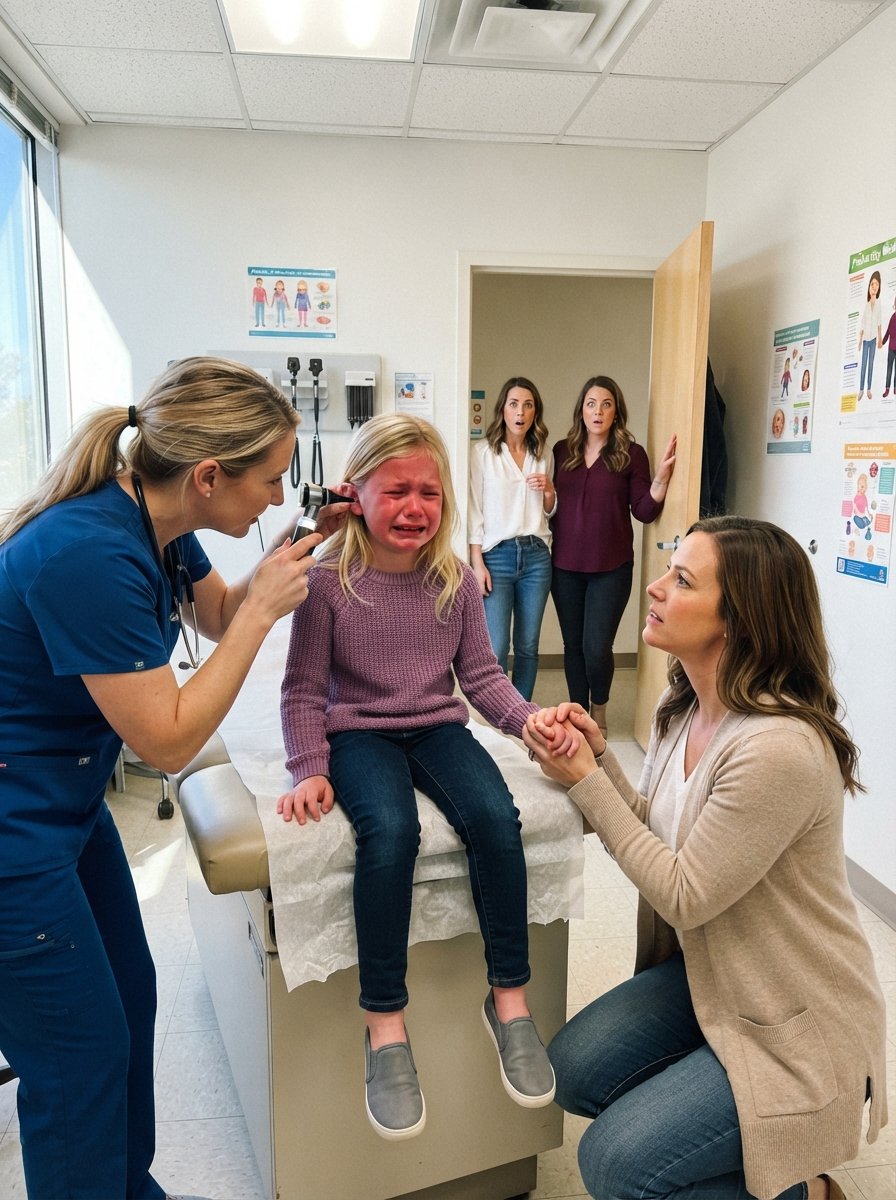
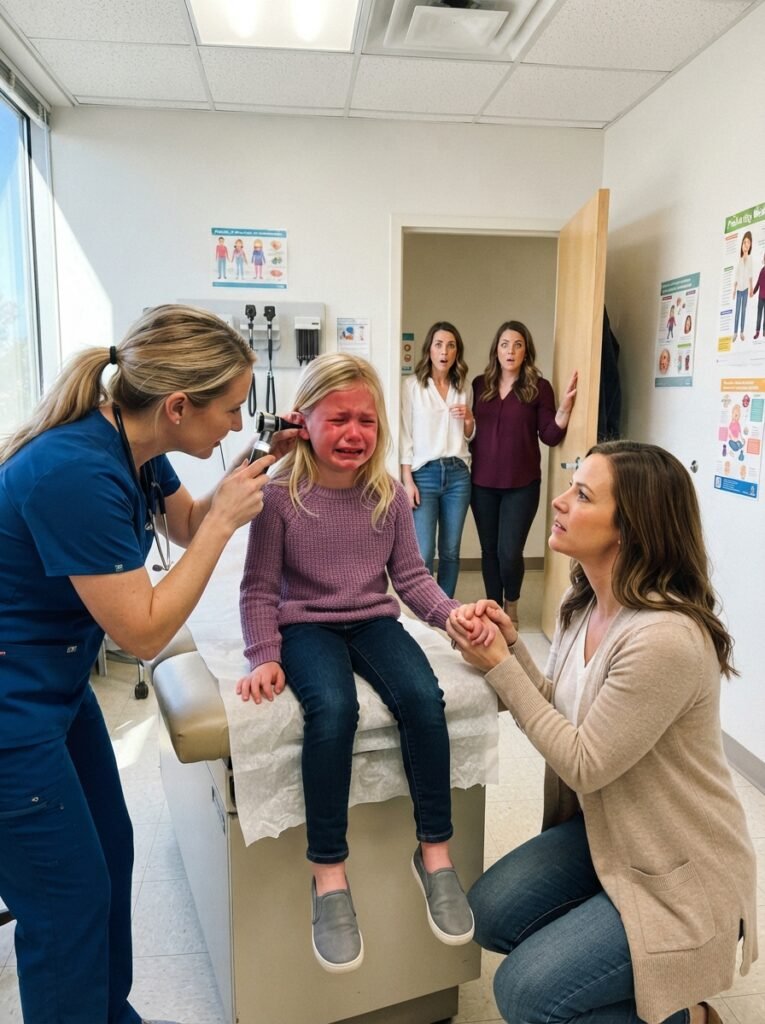
Mrs. Henderson, the school nurse, stood beside the examination table holding a plastic cup of water.
Chloe sat on the paper-covered table wearing her blue sequin sweater. Her shoulders were pulled inward, and her blonde hair fell across her face and neck.
“Chloe, sweetheart,” Mrs. Henderson said, “you need to try drinking something. If you don’t, you’re only going to feel worse.”
Then the nurse noticed me.
Her expression changed for only a second.
But I saw it.
A slight roll of her eyes.
The look of someone who had already decided what kind of problem my daughter was.
“Mrs. Miller,” she said. “I’m glad you came. She’s been here for forty minutes. No fever. No swelling. I’ve checked her throat three times. There’s nothing there.”
I walked toward Chloe and knelt in front of her.
“Baby, look at Mommy.”
She did not lift her head.
Her chin remained pressed tightly against her chest.
“Where does it hurt?”
“When I swallow,” she whispered.
Her voice was painfully small.
“And when I move.”
Behind me, Mrs. Henderson sighed.
“Sarah, I don’t want to sound insensitive, but sometimes children learn that certain complaints result in being picked up early.”
Her words bothered me.
Not because she said them loudly.
Because she said them calmly, as though the matter had already been decided.
As though my daughter were an inconvenience instead of a child asking for help.
My eyes moved toward the nurse’s log on the counter.
Monday: lunch refusal, throat checked, parent notified.
Tuesday: repeated complaint, refused food and water.
Everything looked organized.
Everything looked official.
But paperwork can make fear look neat.
That does not mean the fear is not real.
I turned back toward Chloe.
“Did anyone check beneath her chin?”
Mrs. Henderson frowned.
“Her throat is clear.”
“I’m not talking about the inside of her throat.”
I looked directly at her.
“I’m talking about her neck.”
The second I said it, Chloe reacted.
Her shoulders moved slightly.
It was a tiny movement, almost invisible.
But I saw it.
So did the nurse.
I reached toward Chloe’s hair.
She immediately pulled away.
The paper beneath her crackled.
“Mommy,” she whispered. “Don’t.”
The room went silent.
That was not stubbornness.
That was not a child refusing help.
That was fear.
Real fear.
I slowly lowered my hand.
“Chloe, why don’t you want me to look?”
She placed both hands around her neck.
Protecting it.
Hiding it.
Mrs. Henderson’s expression finally changed.
The annoyance disappeared.
Concern replaced it.
“Move her hair,” I whispered.
The nurse hesitated before reaching forward.
She lifted a small section.
Nothing.
Then she moved the rest of Chloe’s hair away from her neck.
Suddenly, no one in the room breathed.
Just above my daughter’s collarbone was a dark line stretching across her neck.
It was not a scratch.
It was not a bruise.
It was something else.
Something that should never have been there.
Mrs. Henderson stepped closer.
Her hand froze.
The plastic cup slipped from her fingers and struck the counter.
“Oh my God,” she whispered.
“That isn’t irritation. That isn’t a rash.”
The dark line shifted slightly when Chloe swallowed.
My entire body went cold.
I took my daughter’s hands.
“Baby, what happened?”
For the first time that day, Chloe looked directly at me.
I saw something no mother should ever have to see in her child’s eyes.
Relief.
She finally knew that someone believed her.
“Evan said it was a collar,” she whispered.
I froze.
“Evan?”
Chloe looked down.
“He told me not to tell. He said if I told…”
She stopped.
Her eyes filled with tears.
Then she whispered the sentence that changed everything.
“He said he would make it tighter next time.”
At that moment, I stopped being a tired mother rushing between work and responsibilities.
I became a mother who finally understood.
My daughter had not been refusing lunch.
She had been trying to survive something she was too frightened to explain.
And the mark hidden beneath her hair was the first piece of evidence.
Part 2: The Note in the Lunchbox
For several seconds after Chloe said Evan’s name, nobody in the nurse’s office moved.
Outside the room, life continued as though nothing had happened.
Children laughed.
Shoes squeaked across the tile floor.
Teachers walked past carrying papers and coffee cups.
But inside that small room, everything had changed.
Chloe was no longer a child who simply refused to eat lunch.
She was a seven-year-old girl who had been carrying fear around her neck while trying to survive it quietly.
Mrs. Henderson slowly stepped back.
The confidence she had shown earlier was gone.
She looked at Chloe differently now.
Not as a difficult student.
Not as a child searching for attention.
But as a little girl who had been trying to tell the truth.
“Chloe,” she said softly. “Who is Evan?”
Chloe immediately looked down.
Her fingers tightened around the edge of her sweater.
I knew that expression.
She was afraid.
Not because she did not know the answer.
Because she knew what answering might cause.
I moved closer.
“Baby, you can tell us. No one is angry with you.”
She swallowed carefully.
“He said it was just a game.”
My stomach dropped.
“A game?”
She nodded.
“He said puppies wear collars. He said I had to wear one.”
Something inside me broke.
Children are supposed to come home from school talking about friends, homework, and playground adventures.
They should never have to explain why someone made them afraid to swallow.
They should never have to explain why they hid their pain.
They should never believe that silence is the only thing keeping them safe.
Mrs. Henderson immediately reached for the phone.
This time, there was no hesitation.
No frustration.
No assumption.
Only urgency.
“We need emergency services,” she said.
The words were quiet, but they changed the entire room.
A moment later, the school secretary appeared in the doorway holding Chloe’s blue lunchbox.
“I found something,” she said.
Her voice was uncertain.
“It was underneath her thermos.”
She held up a small folded piece of pink paper.
My hands began to shake before I even touched it.
The outside had Chloe’s name written in uneven, childlike letters.
Inside was a short message.
Only a few words.
But they carried something much darker than an ordinary childhood mistake.
The note warned Chloe not to tell anyone.
It said things would become worse if she talked.
I read it once.
Then again.
The room blurred around me.
My daughter had not been quiet because she was confused.
She had been quiet because someone had threatened her into silence.
Principal Wallace arrived moments later.
He entered the nurse’s office wearing the calm expression of someone trained to manage difficult situations.
That expression disappeared the moment he saw Chloe’s neck.
Then he saw the note.
“I need to contact the other child’s parents,” he said.
I shook my head.
“First, call 911.”
My voice surprised even me.
It was calm.
Clear.
Certain.
There would be no more waiting.
No more wondering.
No more giving adults the benefit of the doubt while my child suffered.
The principal nodded immediately.
Within minutes, the school that had treated Chloe’s complaints like a behavioral problem became the scene of an emergency response.
The Hospital Examination
Paramedics arrived at 12:46.
A woman named Denise knelt beside Chloe.
Unlike everyone who had examined her before, Denise did not rush.
She did not tell Chloe to be brave.
She did not tell her it would only take a moment.
She simply asked, “May I look at your neck, sweetheart?”
Chloe nodded.
That simple question mattered.
For the first time that day, an adult asked permission before touching her.
At Mercy Regional Hospital, everything moved quickly.
Bright lights.
Doctors.
Nurses.
Questions.
Forms.
I stood beside Chloe’s bed, holding her hand while Dr. Priya Patel examined the mark beneath her chin.
Then she explained what had happened.
The dark line was not a bruise.
It was not a rash.
It was a thin black elastic cord—the kind used for craft projects or inexpensive lanyards.
Someone had pulled it tightly around Chloe’s neck.
Her hair had hidden the back.
Her sweater collar had covered the rest.
Every time she swallowed or moved her head, the cord caused pain.
I looked at my daughter.
She was seven years old.
She was still wearing her blue sweater.
She was still holding tightly to my hand.
I wondered how long she had sat in classrooms and cafeterias pretending everything was all right.
A hospital social worker entered with paperwork.
A police officer followed her.
The questions began.
What happened?
When did it happen?
Who was involved?
But this time, the questions were different.
No one was asking whether Chloe was telling the truth.
They were trying to understand how so many adults had failed to notice.
The police opened an incident report.
The school provided its records.
The nurse’s log was reviewed.
Monday.
Tuesday.
Repeated visits.
Repeated complaints.
A child saying something hurt.
Adults choosing the easiest explanation instead of looking deeper.
That realization was painful.
Because the first injury was not the cord.
The first injury was not being believed.
The Playground Footage
Later that afternoon, Principal Wallace reviewed the playground camera footage with the school resource officer.
I was not there when they watched it.
But I later learned what the recording showed.
Chloe was standing near the blue slide during morning recess.
Evan approached her.
Two other children were nearby.
He had the elastic cord in his hands.
Chloe stepped backward.
She tried to pull away.
Then she became trapped in a situation she did not know how to escape.
The camera had no audio.
But Chloe’s words filled in what the video could not capture.
Evan had called her a puppy.
He told her puppies did not talk during lunch.
He warned that if she told a teacher, he would make the cord tighter the next time.
That sentence stayed with me.
My daughter was not afraid of getting in trouble.
She was afraid of what would happen if she asked for help.
That evening, I sat beside Chloe’s hospital bed.
The mark on her neck had already begun changing color, but the fear remained.
She looked smaller than usual, as though everything she had experienced had taken up too much space inside her.
“Mommy?”
I looked up.
“Yes, baby?”
“Are you mad at me?”
My heart broke.
“No. Why would I be mad?”
She looked away.
“Because you had to leave work.”
She believed her pain was an inconvenience.
Somewhere along the way, adults had made her believe that needing help made her a burden.
I held her hand tighter.
“Chloe, you never have to stay quiet to make my life easier.”
She looked at me.
“You never have to hide when something hurts. Your job is to be a child. My job is to protect you.”
For the first time that day, she relaxed.
Only a little.
But it was enough.
I knew that whatever happened next, I would never allow anyone to convince my daughter that her voice was the problem.
The real problem was that too many adults had chosen not to listen.
Part 3: The School Faces What It Ignored
The days after Chloe returned home were harder than I expected.
People often imagine that once the immediate danger is gone, everything becomes easier.
They imagine the child is safe, the adults understand what happened, and life slowly returns to normal.
But that is not how healing works.
A hospital can remove the cause of an injury.
It cannot immediately remove fear.
My daughter had spent days carrying something no seven-year-old should ever have carried.
The first night at home, Chloe refused to sleep with her bedroom door closed.
She said the room felt too quiet.
She asked whether someone would hear her if she called for help.
I told her yes.
Every time.
No matter how many times she asked.
After what had happened, she needed more than reassurance.
She needed proof that someone would come when she called.
The next morning, she sat at the kitchen table with a bowl of applesauce in front of her.
Before the incident, applesauce had simply been something she liked.
Now it represented something else.
Something safe.
Something she could swallow without pain.
She took one small bite and looked at me.
“Is it okay?”
I understood what she meant.
She was not asking about the food.
She was asking whether it was safe to trust her body again.
I smiled.
“Yes, baby. You’re safe.”
She nodded and took another bite.
It was a small step.
But it was still progress.
Demanding Accountability
The school investigation moved quickly.
The more I learned, the harder it became to control my anger.
The nurse’s office records showed that Chloe had visited several times.
She had complained about pain.
She had refused food.
She had said swallowing hurt.
The notes were there.
The dates were there.
The documentation existed.
Yet someone had decided she was only having behavioral problems.
That was the part I could not accept.
The signs had been present.
The information was available.
Someone had simply decided that it meant something else.
I requested every document connected to the incident.
The nurse’s log.
The visitor records.
The incident report.
The medical paperwork.
The school policies.
I wanted everything in writing.
Not because I wanted revenge.
Because I wanted accountability.
Anger can disappear.
Documents remain.
Dates do not forget.
Records do not change their minds.
Evidence does not become tired of telling the same story.
Several days later, Mrs. Henderson called me.
I almost did not answer.
Part of me wanted to remain angry because anger gave me something solid to hold.
But when I answered, I heard something unexpected.
She was crying.
“Sarah, I am so sorry.”
I said nothing.
“I should have listened. I saw the notes. I saw the repeated visits. I thought I understood what was happening.”
Her voice broke.
“I was wrong.”
I closed my eyes.
The truth was complicated.
Mrs. Henderson was not the person who had hurt Chloe.
But she was an adult who had failed to see her.
Sometimes that kind of failure leaves its own damage.
“I needed you to believe her the first time,” I said.
There was a long silence.
“I know.”
That was all she could say.
No explanation could undo those moments.
The District Meeting
The school district held a formal meeting the following week.
Principal Wallace attended.
The superintendent was there.
There were school representatives, my attorney, and several district officials.
I chose not to go alone.
Not because I wanted a fight.
Because I had learned something important.
Parents are often told to be patient, reasonable, and understanding.
But sometimes being reasonable means making sure your child’s voice is not lost in a room full of professionals.
The district presented its response plan.
New supervision rules.
Additional staff training.
Changes in the way repeated health complaints would be handled.
My attorney asked one simple question.
“Why did Chloe receive a safety plan only after she was hurt, but not after she first reported pain?”
No one answered immediately.
That silence said everything.
Evan’s family sent a statement through the school.
They said he was young.
They said he did not understand the seriousness of his actions.
They said it had been a mistake.
I read the letter once and placed it inside the folder with Chloe’s medical records.
Children can make mistakes.
Children can act impulsively.
But adults have a responsibility to teach them the difference between a mistake and harm.
Adults also have a responsibility to protect children who have been hurt.
That responsibility does not disappear simply because the child who caused the harm is also young.
Speaking Before the School Board
At the next school board meeting, I spoke for three minutes.
I did not show Chloe’s photograph.
I did not say Evan’s full name.
I did not stand there to destroy another child.
I stood there because my daughter needed the adults in that room to understand something important.
A child saying, “Something hurts,” should never become background noise.
I held up the documents.
The nurse’s records.
The hospital summary.
The school policy.
Then I said, “My daughter was not refusing lunch. She was trying to survive something she was afraid to explain.”
The room became completely silent.
For the first time, nobody was asking Chloe to prove she had been hurting.
They were listening to what had happened.
By the end of the month, Oak Creek Elementary had changed its procedures.
Recess supervision rules were updated.
Staff members could no longer monitor large playground areas alone while distracted.
Phone use was restricted during active supervision.
Repeated visits to the nurse triggered additional review and immediate parent communication.
Students received lessons about bullying, threats, and the difference between a game and cruelty.
Those changes did not erase what had happened to Chloe.
But they meant another child might be heard sooner.
That mattered.
Chloe Returns to School
Eventually, Chloe returned to school.
On the first morning, she held my hand tightly as we walked toward the entrance.
She was nervous.
I could feel it in her grip.
Then the new school nurse, Mr. Alvarez, came outside to meet her.
He did not stand behind a desk.
He did not wait for Chloe to explain everything.
He lowered himself to her height.
“If your body tells you something is wrong,” he said, “I will listen.”
Chloe studied him for a moment.
Then she nodded and walked inside.
Healing did not happen all at once.
It came in small moments.
Her first full meal.
The first night she slept without calling for me.
The first time she wore her hair up again without checking her neck in the mirror.
The first real laugh after weeks of fear.
One rainy afternoon, we were driving home from school while music played softly in the car.
Chloe suddenly began laughing.
It was not a nervous laugh.
It was not careful or forced.
It was her real laugh.
The one I had missed.
I looked at her through the rearview mirror and understood something.
What happened had changed her.
But it did not define her.
Final End: Her Voice Mattered
Months later, Chloe found the folder where I kept all the documents.
She touched the papers carefully.
“Why do you keep these?” she asked.
I sat beside her.
“Because sometimes people forget uncomfortable things.”
She looked at the folder.
“But you remembered.”
I smiled.
“Yes. I remembered because your voice mattered.”
She thought about that for a moment.
“I was scared,” she said.
“I know.”
“But I still told.”
I pulled her into my arms.
“Yes, you did.”
That was the truth I wanted her to carry for the rest of her life.
Not the fear.
Not the mark beneath her hair.
Not the day someone hurt her.
I wanted her to remember her courage.
The courage to speak.
The courage to ask for help.
The courage to believe that even a quiet voice deserves to be heard.
I still remember the cold coffee beside my keyboard.
I remember the call at 12:15.
I remember the nurse’s office and the moment that dark line appeared beneath my daughter’s hair.
But more than anything, I remember the moment Chloe finally stopped hiding.
Because Chloe was never the problem.
She was the child who kept telling the truth until someone finally listened.