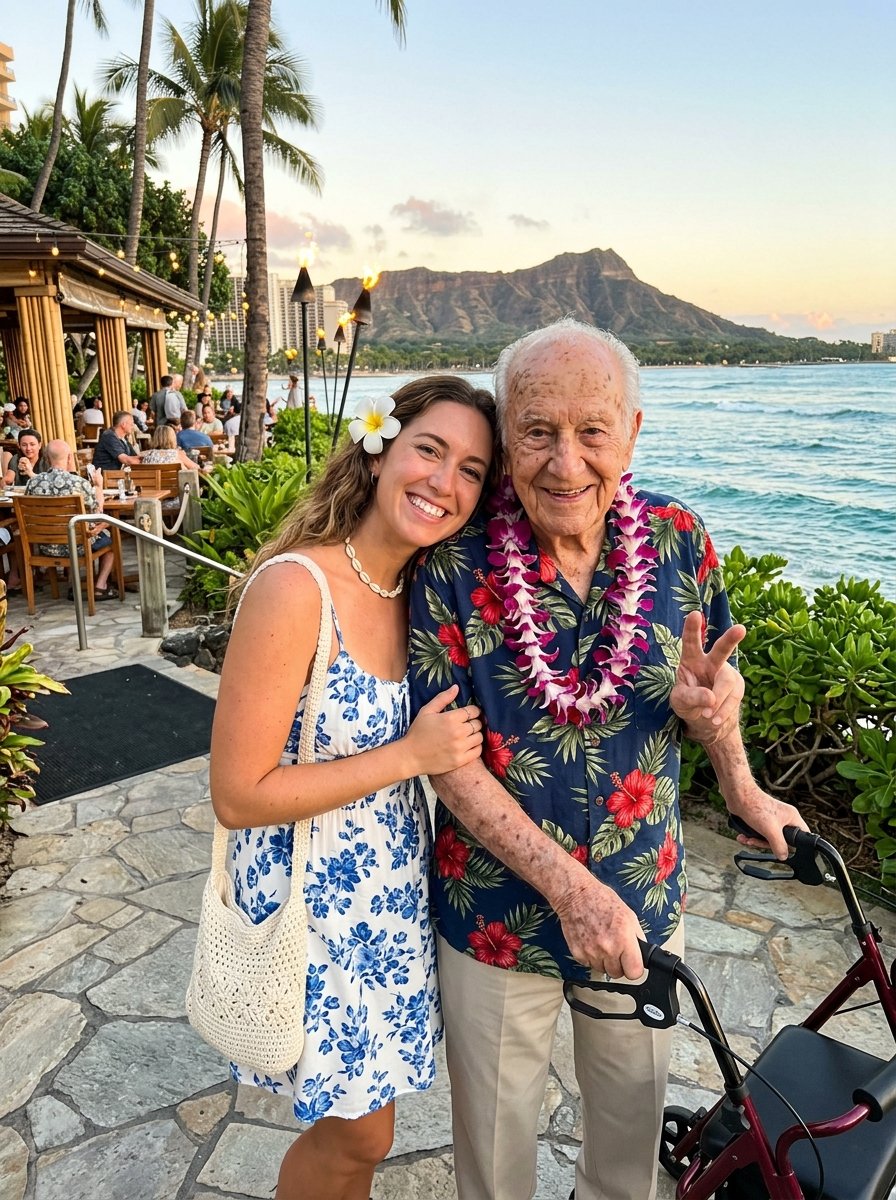
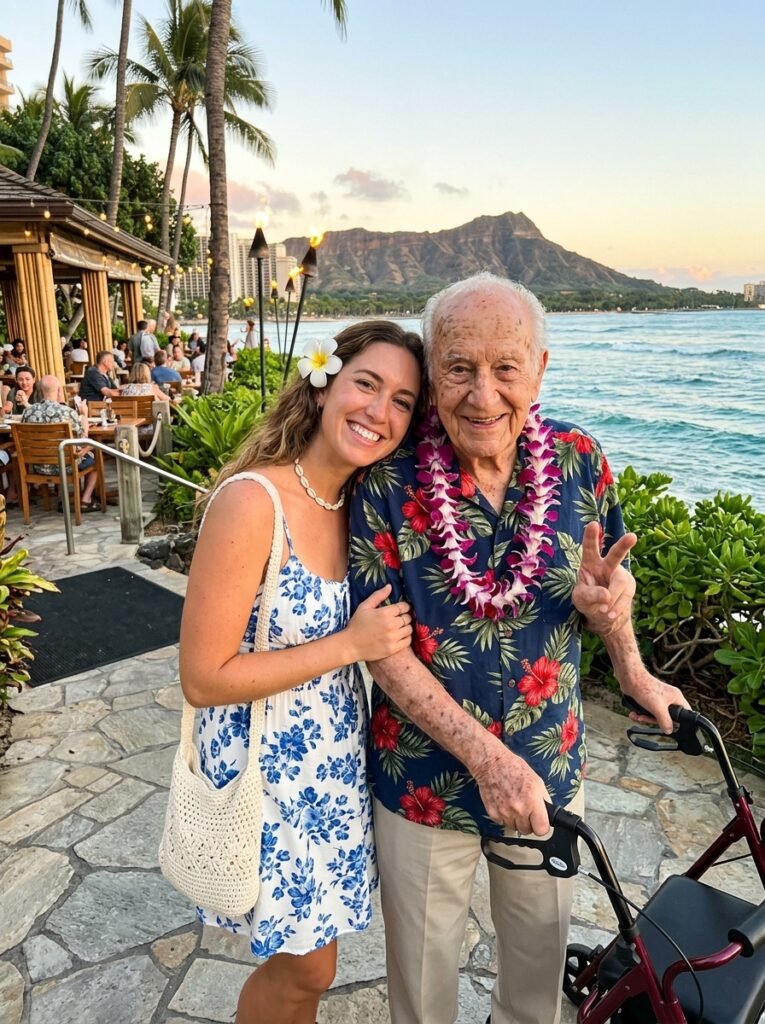
I thought taking Grandpa Henry back to Hawaii would give him one last beautiful memory. Instead, the trip uncovered a part of his past none of us knew existed. By the time I learned why an old hotel had never forgotten him, I was questioning everything I thought I knew about my family.
“We’ve been looking for your grandfather for more than 80 years.”
I stared at Andrew across the hotel desk.
Grandpa Henry was upstairs resting before our flight home. I’d come down to settle the bill.
Instead, the manager was looking at me like he’d been waiting for this conversation his whole life.
“That’s impossible,” I said. “He hasn’t been back to Hawaii since the war.”
“We’ve been looking for your grandfather for more than 80 years.”
Andrew’s eyes filled.
“We’ve been looking for your grandfather for more than 80 years because of what he did.”
My stomach tightened.
“What did he do?”
Andrew glanced toward the elevators.
“What did he do?”
“There’s someone you need to meet first.”
That’s when I realized the strange looks we’d been getting all week hadn’t been random.
Three days earlier, a housekeeper saw Grandpa Henry and dropped every towel in her arms.
They landed beside his travel chair.
Grandpa Henry turned to me.
At 103, his legs weren’t as steady as they used to be, but his grin hadn’t changed since he taught me to drive at sixteen.
“There’s someone you need to meet first.”
“Either I’m still incredibly handsome,” he said, “or there’s something on my shirt.”
I looked at the bright hibiscus print he’d chosen himself.
“The flowers are the size of dinner plates.”
“So we’re going with handsome.”
The housekeeper bent quickly to gather the towels.
“So we’re going with handsome.”
“Ma’am, are you okay?” I asked.
“Yes. I’m sorry. Clumsy.”
Then she hurried away.
“She recognized you.”
“Annie, I’m an old man. At this point, people stare to make sure I’m moving.”
“Yes. I’m sorry. Clumsy.”
I’d saved for 3 years to bring Grandpa Henry back to Oahu.
He’d survived Pearl Harbor during World War II, then returned to Ohio, met my grandmother Evelyn, and built a life that never quite left room for Hawaii.
After Grandma Evelyn died, I’d sometimes find him tracing the Pacific on the old map above his kitchen table.
“Just once more,” he’d say. “I’d like to smell that ocean before I go.”
I’d saved for 3 years.
He’d called me every Sunday for as long as I could remember, so I saved until I could show up with two tickets.
Now we were finally there, and I was determined to make everything perfect.
The next morning, he insisted on walking part of the waterfront with his cane. I stayed close enough to grab him.
“Annabel. If I fall, you can catch me. But you can’t catch me before I fall.”
“That’s terrible advice.”
He’d called me every Sunday.
At a bench, he pulled a worn photograph from his pocket.
Grandma Evelyn.
“You brought Grandma?”
“I wasn’t coming all this way without her.”
He kissed two fingers and touched them to the picture.
“You brought Grandma?”
That afternoon, we visited Pearl Harbor.
Grandpa Henry stood quietly for a long time.
On the walk back, a soft guitar melody drifted from a nearby courtyard.
Grandpa Henry stopped, tightening his hand around his cane.
“Grandpa Henry?”
We visited Pearl Harbor.
“I haven’t heard that song in a very long time.”
“From when you were stationed here?”
He looked at me.
“Something like that.”
“Do you want to leave?”
“No.”
“Something like that.”
“I can ask them to change.”
“No, Annie.”
His voice stayed gentle.
“You can’t change the music because it hurts.”
Then he started walking again.
“I can ask them to change.”
At dinner that night, Grandpa Henry nudged my wrist.
“Put the phone away.”
“I’m checking tomorrow’s plans.”
“Tomorrow will survive without you.”
Then he nodded toward the kitchen. An older cook was watching us. The moment I caught his eye, he disappeared behind the doorway.
“I’m checking tomorrow’s plans.”
“That’s the third person,” I said.
Across the room, Andrew, the hotel manager, looked directly at Grandpa Henry before quickly turning away.
“Has this hotel always belonged to the same family?” I asked.
Grandpa Henry paused.
“Why?”
“Because everybody here is acting like they know you. Did you know them?”
“That’s the third person.”
“No.”
The word came too quickly.
“You hesitated.”
“I’m old. Everything I do has a delay.”
The next morning, while Grandpa Henry rested upstairs, I studied the family photographs covering the lobby wall.
One from the early 1940s stopped me. A young Hawaiian woman stood outside the hotel.
“You hesitated.”
I’d seen Grandpa Henry staring at that same photograph the night before.
“Can I help you?”
I turned.
Andrew stood behind me.
“Yes. You can tell me why your staff keep staring at my grandfather.”
His expression changed.
“Can I help you?”
“Annabel.”
“A housekeeper dropped her towels. The cook keeps watching him. Your desk clerk pointed at him yesterday.”
He glanced toward the elevators. “Is he upstairs?”
“Yes. Whatever’s happening, I need the truth.”
Andrew looked at the old photograph.
“Is he upstairs?”
Then back at me.
“We’ve been looking for your grandfather for more than 80 years.”
My skin went cold.
Grandpa Henry’s name had been part of Andrew’s family stories for generations.
“When your reservation appeared, I thought it had to be someone else,” he said. “Then I saw the photo you posted and tagged here.”
My skin went cold.
“That still doesn’t prove it.”
“His age, Ohio, and service all matched. Then he asked whether the hotel still belonged to the same family.”
I looked toward the photograph.
“Who is she?”
“Come with me,” he said simply.
“That still doesn’t prove it.”
He opened the door to a narrow room behind the lobby.
An elderly Hawaiian woman sat beside a table covered in old letters.
Her eyes filled.
“Goodness, you look so much like Henry.”
“How do you know my grandfather?”
“My name is Leilani.”
“How do you know my grandfather?”
It was her.
Leilani pointed toward the wall behind me.
“Look.”
Grandpa Henry was young, thin, and smiling, his arm around Leilani’s shoulders.
They looked happy… and in love.
“Look.”
Then I saw the date. It was years before he met Grandma Evelyn.
I kept moving along the photographs.
A baby. The same girl at five, 16, her wedding, then holding a child of her own.
“Who is she?”
A voice behind me answered.
“Rose.”
“Who is she?”
I turned.
An elderly woman stood in the doorway.
Grandpa Henry’s crooked smile stared back at me.
“I’m Rose.”
I looked from Leilani to the photographs.
“I’m Rose.”
“No. No way.”
“Rose is Henry’s daughter.”
My mind went straight to my mother, Alison, who had spent her whole life believing she was Grandpa Henry’s oldest daughter.
“My mom has a sister.”
Rose sat slowly.
“Rose is Henry’s daughter.”
“Your mother?”
“Alison.”
I told her how old Mom was.
Rose swallowed. “I’m older.”
“Did Grandpa Henry know about you?”
“I found out I was pregnant after he was transferred,” Leilani said.
“Your mother?”
Relief came too quickly.
“So he didn’t.”
“I wrote to him.”
The relief vanished.
“And?”
“He never answered.”
“I wrote to him.”
Rose opened a box filled with returned and unopened letters spanning months.
“He wouldn’t ignore these,” I said. “He’s not that kind of man.”
Rose’s expression hardened.
“You don’t know the young man who left.”
“Neither do you.”
The words came out before I could soften them.
“He’s not that kind of man.”
Rose stood.
“I know I grew up without him.”
“And I know the man who’s called me every Sunday for 30 years.”
“Both can be true.”
I looked at the letters again. I reached out to touch them.
Leilani touched my wrist.
“I know I grew up without him.”
“Please don’t.”
I pulled my hands back.
Grandpa Henry was upstairs. He was happy, packing for our return home.
My first instinct was to get him on the plane, call Mom, and decide later how much he could handle.
“I need time,” I said. “Before I tell him, I mean.”
Leilani watched me.
“Please don’t.”
“Take it.”
Rose looked away.
Nobody told me what to do.
Grandpa Henry was sitting beside his open suitcase when I returned.
He took one look at me.
“What did you do?”
“Take it.”
“Nothing.”
“That bad?”
I sat across from him.
For once, I didn’t touch the suitcase or check his water.
“Grandpa Henry, I need you to come downstairs.”
“Why?”
“That bad?”
“Someone’s waiting for you.”
He studied me.
“Who?”
I swallowed.
“Leilani.”
His face changed instantly.
“She’s alive?”
That told me everything.
“Someone’s waiting for you.”
When Grandpa Henry entered, Leilani struggled to her feet.
“Henry.”
He stopped. “Leilani.”
Then he saw Rose.
“I’m Rose,” she said without moving toward him. “I’m your daughter.”
He reached for the chair behind him.
“I’m your daughter.”
“My daughter?”
“The one you never came back for.”
“I didn’t know! Leilani, is this true?”
“My mother wrote.”
“I never received anything!”
“I didn’t know! Leilani, is this true?”
“I spent my whole life believing you did.”
I looked at Rose’s photographs.
At a lifetime of birthdays, graduations, children, grandchildren.
At a whole life Grandpa Henry had missed.
The words escaped me.
“I spent my whole life believing you did.”
“Grandpa, what have you done? How are we supposed to live with this now?”
He looked at me.
The hurt on his face made me regret it immediately.
“I wrote every week,” Leilani said.
“So did I,” Grandpa Henry replied. “Mine came back.”
“Grandpa, what have you done?”
“Most of ours did too.”
I checked the oldest envelopes.
One made me stop.
“This went to Ohio. Didn’t your family come from there?”
Grandpa Henry held out his hand.
“Let me see.”
I checked the oldest envelopes.
I turned the envelope over.
Handwriting covered the back.
“Henry has moved on. Please do the same.”
Grandpa Henry went still.
“Whose handwriting is that?” Rose asked.
“Henry has moved on. Please do the same.”
“My mother’s.”
Nobody spoke.
Grandpa Henry stared at the letter.
“She once asked whether I planned to throw my life away chasing Hawaii. I never understood how she knew.”
Leilani covered her mouth.
His mother had intercepted the letter about Rose.
“My mother’s.”
He pushed himself upright.
“Take me upstairs, Annie.”
My hand went straight to his arm.
“Okay.”
Then I stopped.
His mother’s decision had stolen 80 years.
“Take me upstairs, Annie.”
I let go.
“You’ve spent 80 years living with somebody else’s decision,” I said. “I’m not making another one for you.”
Grandpa Henry stared at me.
“If you want to leave after you’ve heard everything, I’ll take you upstairs. But you get to choose after you know.”
Slowly, he sat again.
Rose wiped her cheek.
I let go.
“If you’d known about me, would you have come back?”
Grandpa Henry opened his mouth.
Then closed it.
“I want to say yes.”
Rose gave a sad laugh.
“But?”
“I want to say yes.”
“You deserve better than an answer that makes me feel good.”
He looked at her.
“I was young. I was scared. I was reeling from the war… I can’t swear who I would’ve been.”
His voice broke.
“But I would’ve known you existed. You should’ve had that much.”
Rose nodded through tears.
“I can’t swear who I would’ve been.”
“I spent my whole life believing you chose not to know me.”
“And I spent all these years thinking your mother chose not to answer my letters.”
Leilani reached across the table.
“Seems we were both wrong.”
Rose noticed Grandma Evelyn’s photograph in Grandpa Henry’s pocket.
“Seems we were both wrong.”
“Who’s she?”
“My wife.”
Rose drew back slightly.
Grandpa Henry saw it.
“I met Evelyn later. I loved her for the rest of her life.”
Then he looked at Leilani.
“I loved her for the rest of her life.”
“That doesn’t erase what happened here.”
“You were allowed to have a life, Henry.”
Her voice trembled.
“I just wish we’d known why it wasn’t here.”
Rose eventually asked, “Do you have other children?”
Grandpa Henry told her.
“You were allowed to have a life, Henry.”
When he reached Alison’s name, Rose looked at me.
“Your mother.”
I nodded.
“I have a sister.”
My phone felt heavy in my pocket.
“Do you think she’d want to know about me?” Rose asked.
“I have a sister.”
The answer rose immediately.
Of course Mom would.
I stopped myself.
That wasn’t mine to decide either.
“I think she deserves the choice.”
Andrew appeared at the door.
Of course Mom would.
“Your car for the airport will be here soon.”
I checked the time. For once, I’d forgotten about our schedule.
“Our flight,” Grandpa Henry said.
“Not today.”
“Annabel, changing tickets costs money.”
I’d forgotten about our schedule.
“I saved for 3 years to bring you here. I’m not ending this because a ticket says we’re done.”
He gave me a tired look.
“You’re very stubborn.”
“You taught me.”
That evening, the five of us sat together.
Nobody pretended 80 years could be repaired over dinner.
“You’re very stubborn.”
Rose didn’t call Grandpa Henry “Dad.”
He never asked her to.
There were awkward pauses, unanswered questions, and one laugh that surprised us all.
At one point, Grandpa Henry looked at Rose.
“I don’t know what you’re supposed to call me.”
She thought about it.
Grandpa Henry looked at Rose.
“Henry seems like a safe bet.”
Something passed across his face.
He nodded.
“Henry it is.”
Later, I stood outside with my phone in my hand.
Mom’s name filled the screen.
“Henry it is.”
Grandpa Henry had already told me he wanted to stay another week.
“I’ve waited 80 years to come back here,” he’d said. “I’m not giving Rose two dinners and calling that enough.”
Rose had agreed to the extra time, but carefully.
“We don’t have to become a family in seven days.”
Grandpa Henry nodded. “Then we’ll start by becoming people who know each other.”
That was the first plan all day I hadn’t made for him.
“We don’t have to become a family in seven days.”
Now I looked through the doorway. Rose sat across from him with an old photograph between them. Leilani was explaining where it had been taken.
I went back inside.
Rose looked up.
“When I call my mom,” I said, “how do you want me to tell her about you?”
She hesitated.
I went back inside.
Grandpa Henry lowered his eyes. “She needs to hear it from me too.”
“You’ll tell the others yourself?”
“Tomorrow. All of them.”
I held up my phone.
“And Mom?”
He looked at Rose.
“Tomorrow. All of them.”
“Tonight. I don’t want you to carry this for me, Annie. And I know you’d want to talk to your mom without this hanging over you.”
No more letting years grow around hard truths.
Rose rubbed her thumb across the photograph.
“What if your mother doesn’t want to talk to me?”
The old version of me would’ve promised she would.
“I don’t want you to carry this for me, Annie.”
Instead, I said, “Then she’ll get time to decide what she can handle. But she won’t be kept in the dark.”
Rose nodded.
“When you tell her, start with my name.”
I pressed call.
Mom answered on the third ring.
“Annabel? Is Grandpa Henry okay?”
“When you tell her, start with my name.”
I looked at him.
He reached for Rose’s hand, then stopped before touching it.
She noticed.
After a moment, Rose closed the distance herself.
“He’s okay,” I said. “But we’re staying another week.”
“Why?”
I looked at him.
Grandpa Henry looked at me.
This time, I didn’t answer for him.
He leaned toward the phone.
“Alison,” he said, his voice shaking, “there’s something about my life you should’ve known a long time ago.”
I looked at Rose.
I didn’t answer for him.
“And her name is Rose.”
The room went silent, but nobody rushed to fill it.
For once, I didn’t try to manage what came next.
Grandpa Henry had 80 lost years behind him, one week ahead of him, and a daughter holding his hand because she’d chosen to.
That was enough for tonight.