
He Had No Idea Who I Used to Be
PART 1 — The Call
My name is Caleb Vance.
For seventeen years, I worked nights cleaning the Livingston County Courthouse in a small Colorado town.
To everyone who passed me in those halls, I was invisible.
Old work boots. A faded shirt. A mop bucket. Gray hair. Tired eyes.
That was exactly how I wanted it.
Before I became a husband and father, I had lived another life.
For nearly two decades, I served in elite military units, leading operations in places most Americans would never hear about. I made decisions under gunfire, walked into situations other men were trying to escape, and brought people home from missions that were never supposed to exist.
Then I met Laura.
Then our son, Ethan, was born.
And I walked away from all of it.
I wanted something ordinary.
A wife.
A son.
A quiet house.
A job where nobody depended on me to make life-or-death decisions.
For seventeen years, I got exactly that.
Until one night, while I was wringing out a mop on the courthouse’s second floor, my phone buzzed.
Laura.
She never called during my shift.
The moment I heard her crying, my stomach dropped.
“Caleb,” she choked out. “It’s Ethan.”
My hand went numb.
The mop slipped from my fingers and hit the marble floor.
“What happened?”
“There’s been a shooting. They took him to Mercy General. Please… just hurry.”
I don’t remember the drive.
I remember running red lights.
I remember my hands crushing the steering wheel.
And I remember repeating the same sentence over and over.
Please let my son be alive.
When I burst into the emergency department, Laura was standing outside Trauma Bay Three, shaking so hard she could barely stay upright.
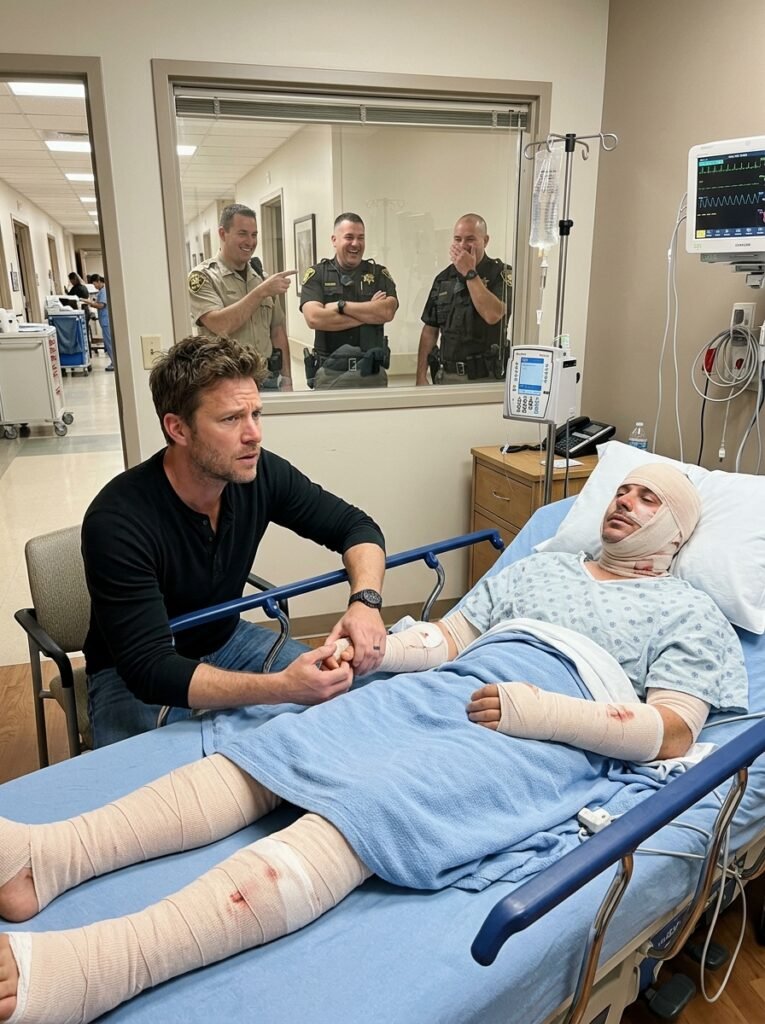
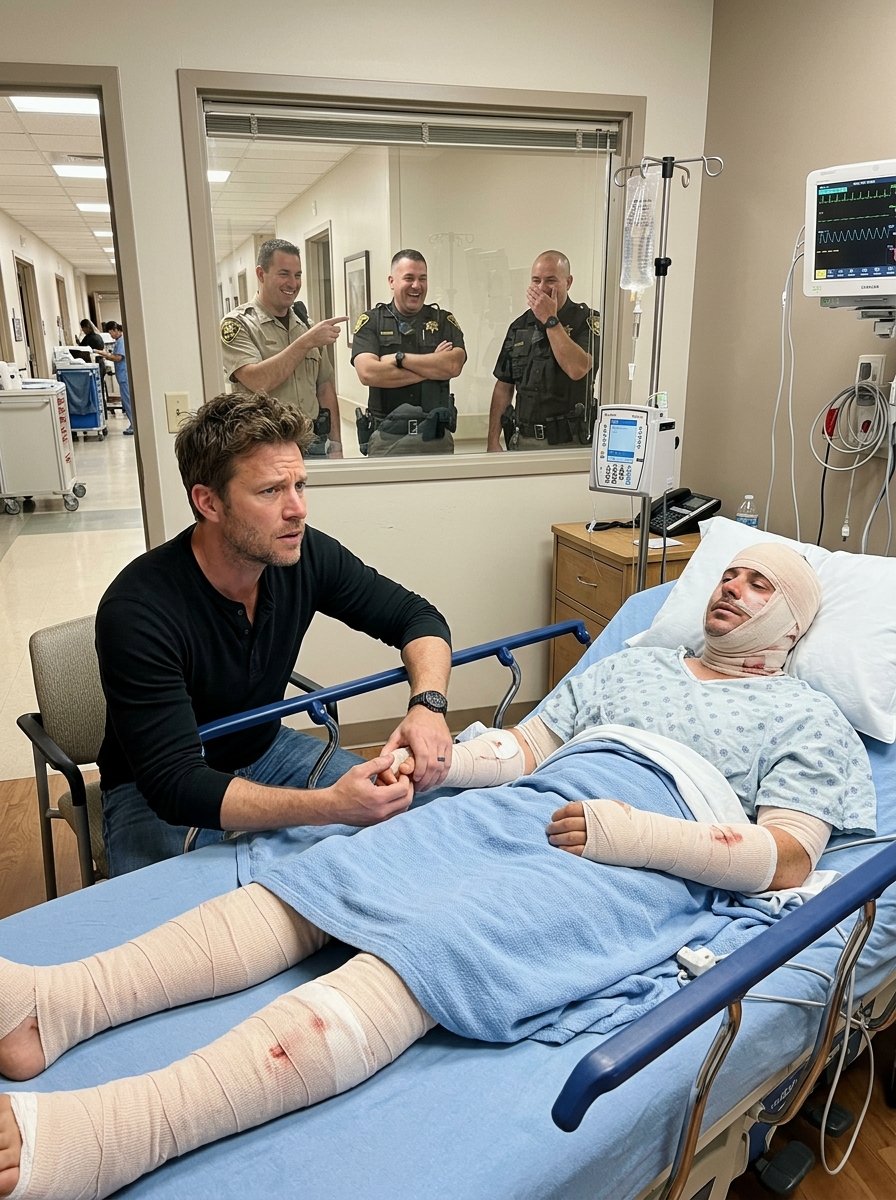
Then I looked through the glass.
Ethan was lying there.
My seventeen-year-old boy.
Captain of his high school basketball team.
The kid who left his sneakers in the hallway and emptied the refrigerator after midnight.
Now his face was pale with pain.
Both legs were wrapped in thick bandages already stained dark red.
A doctor stepped through the doors.
I froze.
“Marcus?”
Dr. Marcus Vance stared at me.
We had served together years earlier overseas. Now he was one of the best trauma surgeons in Colorado.
I stepped toward him.
“How bad?”
Marcus hesitated.
That hesitation told me everything.
“Both kneecaps are severely damaged,” he said quietly. “There are bone fragments throughout the joints. He’ll need several surgeries. Recovery could take months—possibly longer.”
Laura covered her mouth.
I grabbed the wall to steady myself.
“Who did this?”
Marcus glanced down the hallway before lowering his voice.
“The sheriff.”
The words landed like a hammer.
Everyone in Livingston County knew the sheriff.
Powerful.
Connected.
Protected.
He wore his badge as though it gave him ownership over every person in the county.
I walked into Ethan’s room and took his hand.
His eyes slowly opened.
“Dad?”
Then he started crying.
“He shot me.”
I squeezed his fingers.
“He laughed,” Ethan whispered.
My jaw tightened.
Ethan swallowed hard.
“He said, ‘Shouldn’t have looked at me wrong, boy.’”
For several seconds, the only sound in the room was the hospital monitor.
Then Ethan looked toward his bandaged legs.
“Dad…”
His voice cracked.
“I can’t feel them.”
Tears ran down his face.
“I’ll never walk again.”
I leaned down, kissed his forehead, and forced myself to remain calm.
“You listen to me. We don’t know that yet. Marcus is going to do everything he can.”
Ethan closed his eyes.
I held his hand until the medication pulled him back to sleep.
But somewhere deep inside me, something I had buried seventeen years earlier opened its eyes.
Hours later, while Ethan was in surgery, I sat alone in the hospital parking lot.
The sheriff believed his badge protected him.
He believed the county protected him.
He believed men like me were too weak and too frightened to fight back.
I scrolled through contacts I had not touched in nearly two decades.
Then I found one number.
I pressed call.
The man answered after one ring.
“Reaper?”
Nobody had called me that in seventeen years.
I looked toward the hospital window where my son was fighting for his future.
“Get the team together.”
Silence followed.
Three seconds.
That was all it took.
Then the man said quietly,
“Where?”
And I knew they understood exactly what kind of night this had become.
PART 2 — The Gathering Shadow
Thirty-six hours after my call, four men who officially did not exist arrived in Livingston County.
They did not travel together.
They did not check into the same hotel.
Instead, one by one, they arrived at an abandoned lumber warehouse four miles outside town—a property I had quietly purchased years earlier.
I stood beneath a single hanging work light when the heavy metal door slid open.
The first man to enter was Jackson.
Callsign: Ghost.
A counter-surveillance specialist who could find information most people believed had disappeared forever.
Behind him came Miller.
Anvil.
Six-foot-four and built like a concrete wall.
Then James.
Doc.
The medic who had kept me alive twice overseas.
Last came Scythe, a former marksman whose patience had saved more lives than most people would ever know.
None of them looked like soldiers anymore.
Jeans.
Canvas jackets.
Baseball caps.
They could have been truck drivers or construction workers.
Ghost stopped in front of me.
“Reaper.”
He looked at my gray hair and janitor’s boots.
“We saw the local news. They’re saying Ethan was involved in a suspected drug transaction.”
My jaw tightened.
“That’s a lie.”
I told them what happened.
Ethan had been driving home after basketball practice when the sheriff pulled him over near a gas station.
The sheriff claimed Ethan’s taillight was broken.
Then he demanded Ethan’s phone.
When Ethan reached toward his wallet for his license, the sheriff dragged him from the vehicle, kicked him onto the gravel, and shot him through both knees.
“What about the dashcam?” Doc asked.
“According to the department, it malfunctioned.”
“And the gas station cameras?”
“The owner turned the footage over to deputies. An hour later, the station had a fire that destroyed the recorder.”
Anvil cursed under his breath.
“What about the prosecutor?”
“In the sheriff’s pocket.”
I looked around the room.
“They’re charging Ethan with felony assault on a peace officer.”
Even Ghost looked stunned.
“From his hospital bed?”
“Yes.”
Ghost opened his laptop.
“We started digging after your call.”
He turned the screen toward me.
“The shooting isn’t the beginning of this. The sheriff has been running a narcotics operation through the county for years. Several deputies are involved. We found suspicious accounts and payments connected to people inside the department.”
I stared at the screen.
Evidence.
That was what I needed.
Not revenge.
Evidence.
I looked at the men around me.
“We are not killing anybody.”
Anvil raised an eyebrow.
I continued.
“If we hurt him, he becomes the victim. If we expose him, he becomes what he really is.”
“A criminal,” Ghost said.
“Exactly.”
I walked toward the workbench.
“He took my son’s future because he believed nobody could challenge him.”
I turned back toward them.
“So we take his badge.”
I pointed toward Ghost’s computer.
“His money.”
Then toward the courthouse in the distance.
“His protection.”
Finally, I looked at each of them.
“And his freedom.”
Ghost closed the laptop.
“How do we start?”
I looked toward the dark windows.
“We start by finding the evidence he thought he destroyed.”
PART 3 — The Fall of an Empire
At 2:15 Friday morning, the sheriff sat behind his desk inside the Livingston County Sheriff’s Department.
He poured bourbon into a glass, completely unaware that his world had already begun collapsing.
His phone rang.
“Sheriff.”
A distorted voice answered.
“Check your computer.”
He frowned.
“Who is this?”
“Check the screen.”
The call ended.
His monitors flickered.
Then files began appearing.
Bank statements.
Suspicious transfers.
Hidden accounts.
Internal department records.
And then a video.
The sheriff froze.
It was footage from the gas station.
The footage he believed had burned.
The video showed Ethan standing beside his truck.
It showed the sheriff dragging him onto the gravel.
It showed Ethan raising empty hands.
And it showed the sheriff firing.
Twice.
Then laughing.
For the first time in years, fear entered the sheriff’s face.
He reached for the telephone.
Nothing.
Then his cell phone buzzed again.
A message appeared.
You should have left the boy alone.
The sheriff rushed outside.
Across the street stood a man wearing a faded canvas jacket and heavy work boots.
Me.
The gray-haired janitor who had pushed a mop past his courthouse office hundreds of times.
The man he had never bothered to look at twice.
His expression changed when he recognized me.
I raised one hand and tapped my wrist.
Time was up.
Then I turned away.
“Stop!” he shouted.
I kept walking.
“You think you can threaten me?”
I turned around.
“I’m not threatening you.”
He laughed nervously.
“You’re a janitor.”
“For seventeen years.”
I stepped closer.
“Before that, I was something else.”
His smile disappeared.
“But none of that matters,” I continued. “Because this isn’t about what I used to be.”
I looked directly into his eyes.
“This is about what you are.”
His hand moved toward his weapon.
Before he could draw it, headlights flooded the street.
Federal vehicles.
State investigators.
Unmarked SUVs.
The sheriff stared as agents stepped onto the pavement.
“What did you do?” he whispered.
“Nothing you didn’t do to yourself.”
One of the agents approached.
“Sheriff, step away from your weapon.”
His face went pale.
“You can’t do this.”
Another agent held up a warrant.
“Yes, we can.”
The sheriff looked at me.
“You think you won?”
I shook my head.
“This was never about winning.”
I thought of Ethan lying beneath hospital lights.
“It was about making sure you never do this to someone else’s child.”
The agents placed him in handcuffs.
For the first time since I had known him, the sheriff had nothing left to hide behind.
No badge.
No deputies.
No prosecutor.
No power.
Only the truth.
FINAL — The Reckoning
By six o’clock Friday morning, the courthouse complex was surrounded by federal vehicles.
Agents seized department computers, financial records, evidence files, and patrol vehicles.
Search warrants were executed at the sheriff’s home.
Investigators found large amounts of unexplained cash, illegal narcotics, falsified reports, and evidence connecting members of the department to multiple criminal investigations.
At seven o’clock, the gas station video reached the media.
Within hours, the entire county had seen what really happened to Ethan.
The public reaction was immediate.
The prosecutor resigned.
Several deputies were suspended.
And before noon, every charge against Ethan was dismissed.
The sheriff was led from his own department in handcuffs.
The same courthouse steps I had cleaned for seventeen years became the place where his power finally disappeared.
I watched from across the street.
No smile.
No celebration.
Watching another man lose everything did not repair my son’s legs.
Justice and revenge were not the same thing.
I wanted justice.
Two weeks later, sunlight streamed through the windows of Ethan’s hospital room.
He sat in a wheelchair with braces around both legs.
Marcus stood beside him, studying the latest X-rays.
Finally, the doctor smiled.
“The second surgery worked.”
Laura grabbed my arm.
Marcus continued.
“The damaged bone has been repaired. The tendons are responding well. Rehabilitation is going to be difficult, Ethan. Six months, maybe longer.”
Ethan swallowed.
“But?”
Marcus smiled.
“You’re going to walk again.”
Laura burst into tears.
Ethan stared at the doctor.
“And basketball?”
Marcus laughed softly.
“One step at a time.”
Ethan wiped his eyes.
“If I do everything you tell me?”
“Then I wouldn’t bet against you.”
Ethan laughed for the first time since the shooting.
Later, when Marcus and Laura stepped outside, Ethan looked toward me.
“Dad?”
“Yeah?”
“The news keeps talking about an anonymous whistleblower.”
I said nothing.
“They said someone found the missing video and uncovered the sheriff’s financial records.”
He studied my face.
“Do you know who did it?”
I smiled faintly.
“Sometimes the right people are watching out for you.”
Ethan narrowed his eyes.
“Dad.”
“What?”
“You are terrible at lying.”
I laughed.
He reached for my hand.
“Who were you before you became a janitor?”
The question caught me off guard.
I sat beside him.
“Someone I don’t need to be anymore.”
He looked toward his legs.
“Did you hurt anybody because of me?”
“No.”
I answered immediately.
“And that matters.”
He nodded slowly.
I squeezed his shoulder.
“The strongest thing a man can do isn’t always fighting.”
“What is it?”
“Knowing when not to.”
That evening, I returned to the Livingston County Courthouse.
The reporters were gone.
The agents had finished for the day.
The marble hallways were quiet again.
I opened the janitor’s closet.
Filled my yellow bucket with warm water.
Added soap.
Picked up my mop.
Then I stepped into the main hall and started working.
The same floor.
The same old boots.
The same faded shirt.
But something had changed.
For seventeen years, I had believed the man I used to be was buried somewhere in my past.
Maybe he was.
And maybe that was where he belonged.
I did not need to be Reaper anymore.
I did not need medals.
I did not need people to know my name.
I had Laura.
I had Ethan.
And my son was going to walk again.
As I pushed the mop across the polished floor, I looked up at the high courthouse ceiling and smiled.
The sheriff had thought I was only a gray-haired janitor.
Maybe he was right.
Because after everything I had been in my life, there was only one title that truly mattered to me anymore.
Father.
THE END