
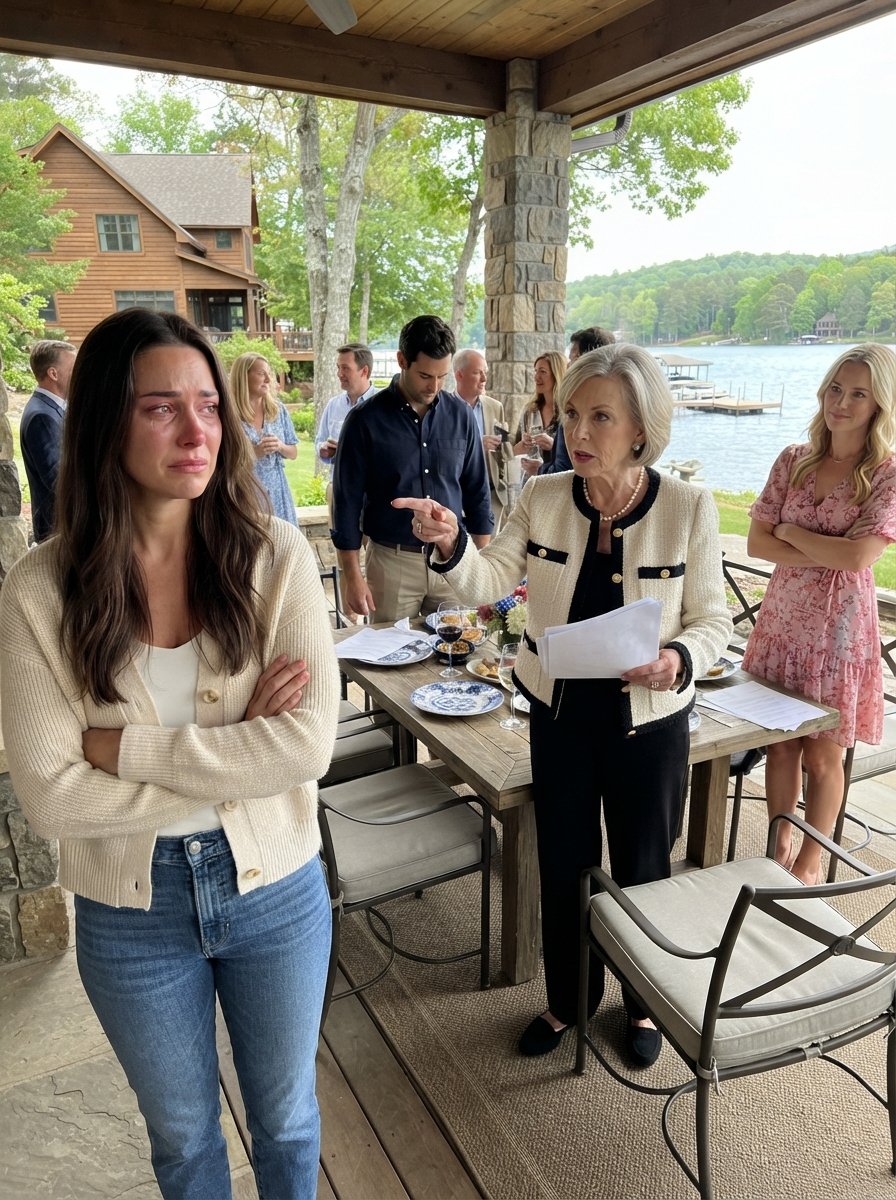
The moment my husband told me to apologize to his family or get out of his house, something inside me went completely silent.
Not broken.
Not frightened.
Silent.
For fourteen years, I had been the invisible hand holding his family together.
And they were about to discover what happened when I finally let go.
My name is Mona Carter, and for most of my marriage, I worked for the postal service in a small Michigan town where everyone knew which houses had barking dogs, which porches had loose steps, and which families smiled at you in public while tearing one another apart behind closed doors.
My husband, Phil, came from one of those families.
His mother, Lorraine, owned a beautiful lakefront estate twenty minutes outside town. It sat on nearly four acres, with tall oak trees, a private dock, and a wide stone terrace that looked across the water.
To Phil’s family, it was sacred ground.
Birthdays happened there.
Christmas happened there.
Weddings happened there.
Every summer, the family held a reunion on the property.
And for fourteen years, I secretly paid to keep it from being lost.
Phil never told anyone.
That was the arrangement.
At first, it wasn’t supposed to become an arrangement at all.
It started during the second year of our marriage.
Phil had just lost his job at a regional furniture warehouse. Lorraine’s property taxes had increased sharply, and she called one night in tears.
“I don’t know what I’ll do if I lose the house,” she told Phil.
He assured her he would take care of everything.
Then he hung up and sat at our kitchen table with his face in his hands.
“We don’t have enough,” he said.
I looked at our bank balance.
He was right.
We didn’t.
But I had been saving overtime money.
So I covered the taxes.
“Just this once,” Phil said.
Three months later, the homeowner’s insurance came due.
I covered that too.
Then there was a roof repair.
Then another tax bill.
Then another insurance premium.
Phil kept promising he would find steady work.
He never really did.
There were jobs, certainly.
A landscaping company for six months.
A hardware store for four.
A short-lived attempt at selling used boats.
Then a vague business idea involving custom outdoor furniture.
Eventually, the excuses lasted longer than the jobs.
Still, his family believed Phil was doing wonderfully.
Lorraine praised him constantly.
“My son always takes care of his mother.”
“Phil is the responsible one.”
“Phil has a good head on his shoulders.”
Every time she said it, he smiled.
And every time, I stayed quiet.
At first, I told myself I was protecting him.
Then I told myself I was protecting our marriage.
Eventually, I stopped telling myself anything at all.
I simply paid.
Over fourteen years, I covered property taxes, homeowner’s insurance, flood coverage, emergency plumbing, storm damage, and even part of a foundation repair.
I never kept an exact total.
Not then.
I didn’t want to know.
Knowing would have forced me to admit how much of my life I had poured into a property that didn’t belong to me.
Then came last summer’s reunion.
That was the day everything cracked open.
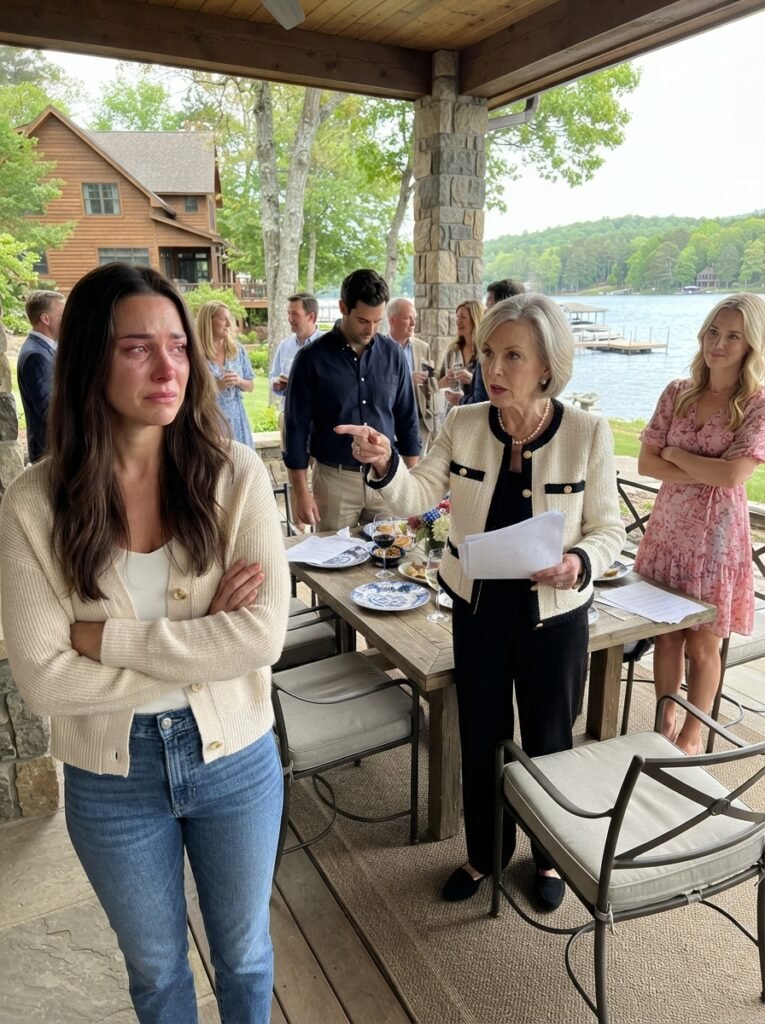
Lorraine had arranged white tables under the trees beside the lake. There were grilled steaks, potato salad, lemonade, wine, and three generations of Carters talking over one another.
Phil’s younger sister, Sherry, arrived late in a new SUV.
Sherry had always treated me with the particular kindness people reserve for someone they consider beneath them.
She hugged me, then immediately looked at my blouse.
“Still working at the post office?”
“Still.”
She smiled.
“You must love routine.”
I smiled back.
“You must love debt.”
She blinked.
I walked away before she could answer.
That afternoon, Lorraine tapped her wineglass with a fork.
“I have an announcement.”
Everyone turned.
She stood beside Sherry with one arm around her daughter.
“I’m getting older. I want to make sure this property stays in the family. So I’ve decided to transfer ownership of the lake house to Sherry.”
Applause exploded around the patio.
Sherry put both hands over her mouth.
“Oh, Mom!”
Phil clapped.
His cousins cheered.
I felt something cold settle in my stomach.
Not because I wanted the house.
I didn’t.
But I knew the financial history of that property better than anyone alive.
I raised my hand slightly.
“Lorraine, can I ask one thing?”
The cheering faded.
She looked at me.
“What?”
“Does the transfer include responsibility for the upcoming property taxes and insurance premium?”
Her smile disappeared.
Sherry’s face hardened.
“What kind of question is that?” she asked.
“A practical one.”
Lorraine stared at me across the table.
Then she gave a short laugh.
“You married in, Mona. You do not get a vote.”
Someone snickered.
Then another person laughed.
Phil’s uncle Ron said, “Careful, Mona. Sounds like you’re trying to claim an inheritance.”
“I didn’t say anything about inheritance.”
Sherry folded her arms.
“You always do this.”
“Do what?”
“Make everything uncomfortable.”
My eyes moved to Phil.
He was looking down.
At his shoes.
I waited.
Surely he would say something.
He knew what I had done.
He knew who paid the taxes.
He knew who paid the insurance.
He knew I had worked Christmas Eve routes, freezing rain shifts, and six-day weeks while he told his mother he was “handling things.”
He said nothing.
Lorraine lifted her chin.
“This is a family decision.”
I almost laughed.
Fourteen years of my money had been family enough.
But my voice stayed calm.
“Understood.”
I left thirty minutes later.
Phil stayed until after sunset.
For the next week, we barely spoke.
Then Saturday night, he came into the kitchen holding a sheet of paper.
He slapped it onto the island.
“What’s this?” I asked.
“Read it.”
I did.
It was an apology.
My apology.
Except I hadn’t written it.
It said I regretted my “inappropriate financial questions.”
It apologized to Lorraine for “disrespecting her generosity.”
It apologized to Sherry for “casting a shadow over a beautiful moment.”
At the bottom was a blank line.
For my signature.
I looked up.
“Sherry wrote this.”
Phil didn’t deny it.
“She wants to put this behind us.”
I stared at him.
“She wants me to apologize for asking who will pay the bills I’ve been paying?”
His jaw tightened.
“Don’t start.”
“Phil.”
“Sherry is done with the drama, and so am I.”
His voice became flat.
“You have two choices, Mona. Apologize to my sister, or leave my house.”
My house.
That phrase struck me harder than anything Lorraine had said.
I looked around the kitchen.
The cabinets I had refinished.
The curtains I had sewn.
The mortgage payments that came out of our joint account, mostly funded by my paycheck.
My house.
I looked at him.
“I have one question.”
He sighed.
“What?”
“Did you ever tell your mother who actually pays the taxes on her sanctuary?”
His expression changed.
A muscle jumped in his jaw.
“That is irrelevant.”
“No, it isn’t.”
“Yes, it is.”
“Why? Because then everyone would know the golden boy hasn’t supported anything in fourteen years?”
His hand slammed against the counter.
“Enough.”
I didn’t flinch.
His face went red.
“You have until Wednesday. Sign the apology, or pack your bags.”
Then he turned and walked into the garage.
The door slammed.
I stood alone.
The refrigerator hummed.
The clock ticked.
And then my eyes landed on the wall calendar.
August 1.
The insurance premium was due August 5.
Four days away.
The payment was scheduled to withdraw automatically from a private account in my name.
I looked down at Sherry’s apology.
Then at the calendar.
A strange calm moved through me.
I tore the letter in half.
Then again.
And again.
Phil thought he had given me until Wednesday.
I only needed until Monday.
That night, after he went to bed, I opened my laptop.
I canceled the automatic insurance payment.
Then I gathered every digital statement I could find.
Taxes.
Insurance.
Repairs.
Electronic transfers.
Fourteen years of them.
Then I searched flights.
At 1:17 a.m., I bought a one-way ticket to Arizona.
My sister Karen lived outside Tucson. We had drifted apart over the years, partly because she had never liked Phil.
“He’s comfortable letting you carry him,” she told me once.
I had been furious.
Mostly because she was right.
Monday morning, I left before sunrise.
One suitcase.
My passport.
My birth certificate.
My retirement documents.
Bank records.
And the folder containing copies of every payment connected to Lorraine’s property.
I left my house key on the kitchen counter.
Beside it, I placed the unsigned apology.
No note.
No explanation.
At the airport, I turned off my phone.
For the first time in years, nobody could demand anything from me.
When I landed in Tucson, Karen hugged me so hard I nearly cried.
“What happened?” she asked.
I told her everything.
Not just the reunion.
Everything.
The money.
The lies.
The years.
She listened without interrupting.
When I finished, she said quietly, “Mona, you don’t need a vacation.”
“What do I need?”
“A lawyer.”
Three days later, my phone finally came back on.
Forty-seven messages.
Phil had sent the first.
Where are you?
Then:
This isn’t funny.
Then:
Mom’s insurance payment didn’t go through.
Then:
Call me.
Then:
We need to fix this.
Sherry’s messages were worse.
You’re being childish.
Mom could lose coverage.
You can’t just stop paying without warning.
That one made me laugh out loud.
Without warning.
Lorraine left six voicemails.
The first was angry.
The second was confused.
The third was almost polite.
The sixth sounded frightened.
“Mona, call me. There are apparently some financial matters we need to discuss.”
Financial matters.
Apparently.
I didn’t call.
Instead, Karen took me to see her attorney, Daniel Ruiz.
Daniel was in his early fifties, soft-spoken, and frighteningly precise.
He spent two hours reviewing my documents.
Then he asked a question.
“Did Lorraine know you were paying?”
“I don’t think so.”
“Did Phil?”
“Every dollar.”
“Did he ever represent to you that these payments were temporary?”
“For the first few years.”
“And later?”
“He just expected them.”
Daniel leaned back.
“What about the property transfer to Sherry?”
“What about it?”
“Do you have the date?”
I told him.
He typed something into his computer.
Then frowned.
“What?”
He didn’t answer immediately.
Instead, he asked, “Mona, did your husband ever ask you to sign anything related to Lorraine’s property?”
“No.”
“Any loan paperwork?”
“No.”
“Any power of attorney?”
“No.”
He stared at the screen.
Then turned it toward me.
A document appeared.
A mortgage filing.
My name was on it.
My full legal name.
I felt the blood leave my face.
“What is that?”
Daniel’s voice went quiet.
“According to this filing, you signed as a guarantor on a home equity loan against Lorraine’s property eight years ago.”
“I absolutely did not.”
“You sure?”
“Daniel, I have never seen that document in my life.”
He zoomed in.
There was a signature.
It looked like mine.
Almost.
But not quite.
My stomach turned.
“Phil.”
Daniel said nothing.
I whispered it again.
“Phil forged my signature.”
The loan was not small.
Two hundred and eighty thousand dollars.
And most of it had never gone toward the property.
Daniel traced the disbursements.
They led to an LLC.
Phil’s LLC.
An outdoor furniture company I thought had failed before it ever started.
Except apparently, it had received nearly two hundred thousand dollars in borrowed funds.
Then dissolved eighteen months later.
I sat frozen.
“So Lorraine’s house…”
“Was collateral.”
“And I was listed as guarantor?”
“Yes.”
“But if Sherry just received the deed—”
“That doesn’t eliminate the lien.”
I closed my eyes.
This was already worse than I imagined.
But Daniel wasn’t finished.
He tapped another record.
“There’s something else.”
“What?”
“Your husband filed a second document three years ago.”
My throat tightened.
“What kind?”
“A spousal consent form.”
I felt sick.
“For what?”
Daniel looked directly at me.
“For a refinance.”
“I didn’t sign that either.”
“I didn’t think so.”
He turned the screen again.
Another signature.
Mine.
Another forgery.
And beneath it was something even stranger.
A mailing address I didn’t recognize.
Daniel stared at the page.
“Do you know this address?”
“No.”
He searched it.
The result appeared.
A small office building forty miles away.
Registered to a private holding company.
The company’s manager was listed as Sherry Carter.
My breath caught.
“She knew.”
Daniel nodded slowly.
“It appears possible.”
Suddenly, the reunion felt different.
The deed transfer.
The hostility.
The urgency.
The apology.
This wasn’t only about pride.
They were trying to keep me quiet.
Over the next four weeks, Daniel’s office uncovered more.
Phil had used my identity on three financial documents.
Sherry had witnessed two of them.
Lorraine’s signature appeared on all three.
The money had moved through Phil’s company, then into accounts connected to Sherry.
One payment—$62,000—had gone toward the down payment on her new home.
Another had paid off credit cards.
Another had funded the SUV she drove to the reunion.
And the lake house I had spent fourteen years protecting?
It was drowning in hidden debt.
The taxes I paid had prevented foreclosure.
The insurance I paid had kept the lender from forcing expensive coverage.
My money hadn’t simply supported the family estate. It had unknowingly protected their fraud.
Then Daniel found the piece that changed everything.
He called me into his office on a Thursday morning.
Karen came with me.
On Daniel’s desk sat a thick binder.
“I’ve been waiting to confirm this before telling you,” he said.
My heart began pounding.
“Confirm what?”
He opened the binder.
Inside were copies of an old trust.
The Carter Family Property Trust.
Created twenty-three years ago by Lorraine’s late husband, Arthur.
Phil’s father.
I remembered Arthur only vaguely. He died before Phil and I married.
Daniel pointed to a clause.
“Arthur established restrictions on the lake property.”
I read silently.
The house could remain with Lorraine for her lifetime.
After that, ownership was to pass equally to Phil and Sherry.
But there was a condition.
The property could not be sold, mortgaged, refinanced, or transferred without written approval from the trust’s independent beneficiary representative.
“Who is that?” I asked.
Daniel turned the page.
I stared at the name.
My name.
Mona Elaine Carter.
I looked up.
“This is impossible.”
“Apparently Arthur amended the trust shortly before he died.”
“But I didn’t even know him.”
“You did.”
“No. Phil and I weren’t married then.”
Daniel pulled out another document.
A photograph.
Old.
Faded.
My mother stood beside Arthur Carter.
They were young.
Very young.
My hands began shaking.
“What is this?”
Karen leaned closer.
Her face changed.
Daniel spoke carefully.
“Mona, your mother worked for Arthur Carter’s company for eighteen years.”
I remembered that.
Barely.
My mother had been a bookkeeper.
She never talked much about it.
Daniel continued.
“Arthur named you as the independent beneficiary representative.”
“Why?”
Daniel was silent.
Then he slid another envelope across the table.
It was sealed.
Yellowed.
My name was written on the front.
Mona.
The handwriting was unfamiliar.
“Where did this come from?”
“Arthur’s attorney kept it with the trust records.”
My fingers trembled as I opened it.
Inside was one handwritten page.
Mona,
If you’re reading this, something has gone wrong.
Your mother asked me never to tell you while she was alive, and I respected that promise.
But the truth is this:
I am your biological father.
I stopped breathing.
Karen gasped.
The room tilted.
I kept reading.
Your mother and I were young, foolish, and afraid. She chose to raise you with the man you knew as your father, and I respected her decision.
I watched your life from a distance.
I never wanted to disrupt it.
But I wanted to protect something for you.
The lake property was purchased partly with money from your mother’s family. That contribution was never formally recognized.
For that reason, I placed you in the trust.
If my family ever misuses the property, you have the authority to stop them.
You are not an outsider.
You never were.
—Arthur
I read it three times.
Then I whispered, “Phil is…”
Daniel nodded.
“Your half-brother.”
Karen covered her mouth.
I stood so quickly the chair scraped backward.
“No.”
My entire marriage flashed through my mind.
My mother had died when I was twenty-six.
Phil and I met two years later.
She never knew.
Arthur was already dead.
No one had known.
Or so I thought.
Then Daniel said the sentence that made the room go cold.
“There’s one more thing.”
I stared at him.
“What?”
“We found correspondence between Arthur’s attorney and Lorraine.”
My skin prickled.
“Correspondence?”
“She knew.”
I couldn’t speak.
Daniel handed me a copy of a letter.
Dated eighteen years earlier.
Lorraine,
Per Arthur’s instructions, Mona Elaine Carter is to remain listed as independent beneficiary representative.
Given the sensitive family circumstances, Arthur has requested confidentiality.
My vision blurred.
Lorraine knew.
Maybe not every detail.
But enough.
She knew I was connected to Arthur.
She knew I had authority under the trust.
And suddenly, her words at the reunion became grotesquely ironic.
You married in. You do not get a vote.
Except I had more legal authority over that property than any of them.
And she knew it.
Six weeks after I left, I returned to Michigan.
Daniel came with me.
So did a forensic financial investigator.
Phil texted me the morning I landed.
Mom wants to settle this quietly.
I replied for the first time in six weeks.
I’ll be at the lake house at 3:00.
Everyone was waiting.
Lorraine.
Phil.
Sherry.
Uncle Ron.
Two cousins.
Even Sherry’s husband.
When my rental car pulled into the driveway, they came outside.
Phil looked exhausted.
“Mona.”
I stepped out.
Daniel got out beside me holding the binder.
The investigator followed.
Sherry’s face tightened.
“Why did you bring strangers?”
Daniel handed her a business card.
“I’m Mona Carter’s attorney.”
Lorraine went pale.
Phil stared at me.
“What is this?”
I looked at the lake.
The water was calm.
Exactly as it had been six weeks earlier.
Then I turned back.
“You wanted me to apologize.”
Phil closed his eyes.
“Mona, please.”
“No. I think it’s your turn.”
Sherry laughed nervously.
“For what?”
Daniel opened the binder.
“For identity fraud, forged signatures, unauthorized borrowing, fraudulent transfers, and violations of the Carter Family Property Trust.”
Silence.
Complete silence.
Lorraine’s face drained of color.
Phil whispered, “Trust?”
That surprised me.
“You didn’t know?”
He looked at his mother.
Lorraine said nothing.
Sherry suddenly stepped backward.
Daniel continued.
“The deed transfer to Ms. Sherry Carter is invalid.”
Sherry’s head snapped up.
“What?”
“The trust prohibits transfer without written authorization from the beneficiary representative.”
“Who?”
Daniel looked at me.
Everyone followed his gaze.
I said quietly, “Me.”
Phil stared.
Sherry laughed once.
A sharp, frightened sound.
“That’s ridiculous.”
I reached into the binder and pulled out Arthur’s letter.
Lorraine closed her eyes.
I watched her.
“You knew.”
She whispered, “Mona…”
“You knew.”
Phil looked between us.
“Knew what?”
I could barely say it.
“Arthur was my biological father.”
Phil went completely still.
Sherry’s mouth opened.
No sound came out.
Uncle Ron sat down hard in a patio chair.
Phil stared at me as though I had become a stranger.
“No.”
Lorraine began crying.
“I tried to protect everyone.”
“By letting me marry him?”
Her head jerked up.
“What?”
Phil looked sick.
“You knew she was Dad’s daughter.”
Lorraine shook her head desperately.
“No. No, I knew Arthur had made provisions for Mona. I knew there had been… something with her mother. But I never knew for certain she was his child until after your wedding.”
My stomach dropped.
“After?”
Lorraine covered her face.
“The attorney confirmed it when Arthur’s files were reviewed.”
Phil staggered backward.
“You knew for fourteen years?”
“I didn’t know how to tell you.”
Sherry whispered, “Oh my God.”
I felt physically ill.
Daniel stepped closer.
“Mona, there’s something we need to clarify.”
I turned.
His expression had changed.
He opened another folder.
“The DNA testing we ordered for inheritance verification came back this morning.”
I blinked.
“You didn’t tell me.”
“I wanted confirmation before saying anything.”
Phil looked at him.
“What testing?”
Daniel looked at me.
“The test compared preserved biological material from Arthur’s medical records with your sample.”
My heart pounded.
“And?”
He paused.
“Arthur Carter was not your biological father.”
Everyone froze.
I stared at him.
“What?”
Lorraine dropped her hands.
Daniel continued.
“The letter was false.”
I looked at Lorraine.
She looked terrified.
“Who wrote it?”
Daniel lifted another document.
“A handwriting examiner compared it with archived samples.”
My eyes moved slowly toward Lorraine.
Daniel said, “The letter was written by Lorraine.”
Phil whispered, “Mom?”
Lorraine backed toward the table.
“No.”
Daniel continued.
“Arthur did name Mona in the trust. But not because she was his daughter.”
My voice shook.
“Then why?”
Daniel looked at me.
“Because your mother was.”
The world stopped.
Karen whispered, “What?”
Daniel turned the old photograph around.
Arthur and my mother.
“Arthur wasn’t your father.”
He pointed to the woman beside him.
“He was your mother’s father.”
I couldn’t process the words.
Lorraine collapsed into a chair.
Daniel explained.
Arthur had had a daughter before marrying Lorraine.
My mother.
Born from an earlier relationship.
She had remained largely outside the Carter family.
Years later, Arthur placed her daughter—me—into the trust.
That made Phil…
Not my half-brother.
My uncle.
Sherry…
My aunt.
I closed my eyes.
The horror shifted.
Still bizarre.
Still devastating.
But not what I had feared.
Phil sat down.
For the first time since I had arrived, I saw tears in his eyes.
“Mona…”
But Daniel still wasn’t finished.
He turned to Lorraine.
“The forged paternity letter appears to have been created after Arthur’s death. Our investigator believes you fabricated it to make Mona believe she had no legitimate claim to the trust unless she remained silent.”
Lorraine began sobbing.
“I was scared.”
“Of what?” I asked.
Her eyes met mine.
“That you would take the house.”
I laughed.
It came out broken.
“I spent fourteen years paying for the house.”
“I know.”
That stopped me.
“You knew?”
She nodded.
The entire patio went still.
“I knew after the second year.”
Phil looked at her sharply.
“What?”
Lorraine wiped her face.
“The insurance company called once. Your name was on the payment.”
I stared at her.
“So every time you praised Phil…”
She looked down.
“I knew.”
“Every time you called him your golden boy.”
Silence.
“Every time you let me sit there while everyone believed I contributed nothing…”
Her shoulders shook.
I stepped closer.
“Why?”
Lorraine finally looked at me.
“Because if Phil believed he was successful, he stayed close to me.”
I turned toward him.
His face crumpled.
There it was.
The truth beneath all the money.
All the lies.
All the humiliation.
A mother who needed her son dependent.
A son who needed his mother impressed.
A sister who needed access to the money.
And me.
The woman who made the entire illusion financially possible.
Daniel closed the binder.
“The lender has already been notified. The fraudulent liens are being challenged. The deed transfer is suspended. Criminal referrals are being prepared.”
Sherry started crying.
Phil looked at me.
“Are you really going to do this?”
I met his eyes.
“No, Phil.”
Hope appeared on his face.
Then I finished.
“You did this.”
I filed for divorce the next morning.
The lake house was eventually placed under court supervision while the fraudulent loans were unwound.
Sherry sold her SUV.
Phil’s remaining business assets were seized.
Lorraine moved into a small condo.
But the biggest surprise came almost a year later.
The trust dispute ended.
Because Arthur had named my mother—and later me—as the protected family line, the court determined that my interest in the property had priority over the improperly executed transfers.
I was offered control of the lake estate.
Everyone assumed I would keep it.
I didn’t.
I sold it.
Not to a developer.
Not to another wealthy family.
I sold it at a reduced price to a nonprofit organization that turned it into a lakeside retreat for women rebuilding their lives after financial abuse.
On opening day, I stood on the dock watching a group of women carry boxes into the house.
Karen stood beside me.
“You know what Lorraine would say.”
I smiled.
“Probably that I married in.”
Karen laughed.
I looked back at the house.
For fourteen years, I thought I was paying to preserve someone else’s family legacy.
I was wrong.
I had been paying tuition.
The price had been enormous.
But the lesson was priceless.
Never confuse being needed with being loved.
Never let someone’s pride become your lifelong debt.
And never believe you have no voice simply because everyone at the table benefits from your silence.
Phil had once given me two choices.
Apologize.
Or leave.
I chose a third.
I left—and took my life back with me.