

Things had been simple enough until my older sister, Martha, came back into the picture.
Martha is 32, and there’s really no polite way to say this: responsibility has never been her strongest quality.
Growing up, she was the golden child. I never knew whether it was because she was the firstborn or because our parents simply had a permanent soft spot for her, but in their eyes, Martha could almost never do anything wrong.
She dropped out of college twice.
The first time, she said she didn’t feel inspired. The second time, she blamed her professors for being too demanding.
She had also never managed to keep a job for more than a few months. Whenever something became difficult, she quit and found a reason why someone else was responsible.
And every single time, our parents rescued her.
If she fell behind on rent, they paid it.
If her car broke down, they covered the repairs.
When she got a speeding ticket, Mom wrote the check while complaining that the police unfairly targeted young women.
Meanwhile, I was cleaning toilets at a diner to save money for college and taking out loans to cover the rest of my tuition.
For the last couple of years, I assumed Martha had finally been living independently.
Apparently, I was wrong.
She had actually been moving from apartment to apartment, repeatedly falling behind on rent and depending on Mom and Dad to keep her afloat.
I didn’t know any of this until she showed up one day and casually announced that she was pregnant.
I’m not interested in judging anyone for their choices, but Martha was nowhere near financially or emotionally stable. The baby’s father was a man she had only been seeing for a few months, and from what I understood, he wasn’t exactly excited about the pregnancy.
Once she told him, he essentially disappeared.
You might think becoming a mother would finally force Martha to get serious about her life.
It didn’t.
Instead, she ran directly to Mom and Dad, who immediately switched into rescue mode.
Within a week, they began renovating their basement into a small apartment for her. They even installed a kitchenette.
I never asked exactly where the money came from, but I overheard Mom mention that they were using some of their retirement savings.
I tried to stay out of it.
It was their money. If they wanted to spend it helping Martha again, that was their decision.
Still, I could already see where things were heading.
My parents had a habit of turning Martha’s problems into everyone else’s responsibility. Whenever she created another mess, suddenly the entire family was expected to sacrifice until everything was fixed.
At first, I convinced myself it wouldn’t involve me.
Martha would live in the basement. She would have her own space. I would continue working, saving money, and living my own life.
Watching my parents bend over backward for her again was irritating, but I tried not to focus on it.
That lasted about two months.
Then the comments started.
Mom began telling me I should spend more time with Martha because she was “struggling.”
Apparently, the fact that I worked full-time and came home exhausted most days wasn’t relevant.
Then came the guilt trips.
“You know Martha doesn’t have anyone else to lean on right now,” Mom would say. “It’s so hard being pregnant and single.”
Every time she said it, she looked directly at me as though I were supposed to solve Martha’s situation.
Dad wasn’t much better.
He managed to bring Martha into nearly every conversation.
“You should be grateful for everything you have, Abby,” he told me one night at dinner. “Not everyone is as lucky as you.”
Lucky.
I was barely getting by while trying to establish my teaching career and save money.
Meanwhile, Martha was receiving a newly renovated apartment, financial support, and endless sympathy.
Then one evening, I overheard Mom and Dad talking in the living room while I was in the kitchen making tea.
“She’s going to need a lot of help once the baby comes,” Mom said.
“Of course,” Dad replied. “We’ll all pitch in.”
“All?” Mom asked.
“Well, you, me, and Abby.”
I almost dropped my mug.
Neither of them had mentioned this plan to me.
Yet apparently, they had already decided I would participate.
That was when the situation stopped feeling irritating and started feeling threatening.
I didn’t know exactly what they expected from me yet, but clearly they were planning to pull me into Martha’s life whether I agreed or not.
The uneasy feeling only became stronger as Martha started coming over more often.
She would drop onto the couch and complain about how difficult pregnancy was and how unfair it was that her ex had disappeared.
Then she would comment about how lucky I was to have a steady job and no children to worry about.
Every time, I bit my tongue.
But inside, I kept thinking the same thing.
Why does this always become my problem?
By the time we sat down for dinner one night, I knew something was coming.
Everyone was acting just a little too casual.
Mom and Dad chatted about meaningless things, including the neighbor’s new fence. Martha sat scrolling through her phone.
It felt staged, as though everyone except me already knew the real topic.
Halfway through dinner, Mom cleared her throat.
“So, we’ve been thinking,” she started, glancing at Dad.
I froze.
Nothing good ever followed that sentence.
“With Martha moving back home, she’s going to need some help,” Mom continued in an overly sweet voice.
“Help with what exactly?” I asked.
Dad answered before she could.
“With the baby, of course. Martha has a lot on her plate right now, and it’s going to be hard for her to manage everything on her own.”
I glanced at Martha.
She was still staring at her phone as though the conversation had nothing to do with her.
“Okay,” I said. “But what does that have to do with me?”
Mom and Dad exchanged a look.
“Well,” Mom began, “you’re already living here, and you’re so good with kids, being a teacher and all. We thought it made sense for you to help with babysitting.”
“Help?” I repeated.
Dad nodded enthusiastically.
“Yeah. Just keep an eye on the baby while Martha gets back on her feet. It wouldn’t be full-time or anything. Just when you’re home.”
I stared at him.
“You want me to babysit a newborn on top of working full-time?”
“Well, you’re home by three most days,” Mom pointed out.
“And you’re not paying market rent,” Dad added, as though that settled the matter.
That was when I understood.
They weren’t asking me to help occasionally.
They were planning to turn every hour I wasn’t at work into unpaid childcare.
“Wait,” I said, setting down my fork. “You want me to come home after teaching all day and then take care of Martha’s baby?”
Mom sighed as though I were deliberately making things difficult.
“It’s not like that, Abby. We’re all going to pitch in.”
“All?” I repeated.
“Yes,” Dad said firmly. “We’re family, and family helps each other.”
Finally, Martha looked up from her phone.
“Wow, Abby,” she said with a smirk. “I didn’t realize helping your sister was such a big deal for you.”
My hands tightened beneath the table.
“It’s not about that,” I said. “I have my own life and my own job. I can’t just drop everything to babysit.”
“You’re being selfish,” Mom snapped. “Martha is going through a really hard time. The least you can do is help her.”
“Why is it my responsibility to fix her choices?” I shot back. “She’s 32 years old. She’s not a child anymore.”
Martha stared at me in disbelief.
“That’s enough,” Dad said. “We’re all in this together, whether you like it or not. You’re living under our roof, and we expect you to contribute.”
“I pay rent,” I replied. “I buy my own groceries. I help with chores. How is that not contributing?”
The room went silent.
Martha sat there looking smug, as though the argument had already been decided in her favor.
Finally, Mom spoke.
“Well, if you’re not willing to help, maybe we need to rethink your living arrangement.”
My stomach dropped.
“Are you threatening to kick me out?”
“Of course not,” Mom said quickly. “But if you’re not willing to contribute more, maybe we need to discuss raising your rent.”
I could hardly believe what I was hearing.
I paid them rent.
I bought my own food.
I handled my own expenses.
And now they were using housing costs to pressure me into becoming Martha’s unpaid nanny.
“You’re seriously going to do this?” I asked. “You’re going to punish me because I don’t want to be Martha’s free nanny?”
“It’s not punishment,” Dad replied. “It’s about being part of the family.”
“No,” I said, standing from the table. “It’s about you two enabling Martha like you always have. And now you’re trying to drag me into it.”
“Don’t talk about your sister like that,” Mom snapped.
“I’m done. You want to help Martha? Fine. But leave me out of it.”
I went upstairs and slammed my bedroom door.
My heart was pounding.
I had always known my parents favored Martha.
But this felt different.
This was about control.
They wanted me living under their roof because it gave them leverage over me.
And the thing I couldn’t stop thinking about was Martha’s smug expression.
She had barely participated in the conversation. She simply sat there scrolling through her phone because, in her mind, none of this was really her problem.
Mom and Dad were already rearranging their lives around her.
Now they expected me to do the same.
I barely slept that night.
Every time I closed my eyes, I replayed dinner and imagined all the things I should have said.
When my alarm finally went off, the anger was still there.
But underneath it was something worse.
I felt trapped.
I had considered moving out before, but I was only a few months into my teaching job and still trying to build my savings.
Rent in the area was extremely expensive.
Living alone on my salary seemed almost impossible.
For the next few days, the atmosphere inside the house became unbearable.
Mom and Dad were clearly angry, but instead of having another direct conversation, they switched to passive-aggressive remarks.
“Must be nice to have so much free time after work,” Mom said one evening as I walked inside.
“Yeah, some people don’t have that luxury,” Dad added without looking up from his newspaper.
I ignored them and went upstairs.
There was no point arguing.
Anything I said would become another fight.
Meanwhile, Martha acted completely comfortable.
She wasn’t officially moved into the basement yet, but she was already at the house almost every day.
Her shoes appeared beside the couch. Her purse stayed on the dining table. Shopping bags accumulated around the living room.
One evening, I came home and found her stretched across the couch eating ice cream while watching reality television.
She barely acknowledged me.
I went into the kitchen and opened the refrigerator.
Half my groceries were gone.
The bread I had bought.
My yogurt.
Even my leftovers from the previous night.
I walked back into the living room.
“Did you eat my food?”
Martha barely looked up.
“Mom said I could.”
“She’s not the one who paid for it.”
Martha rolled her eyes.
“Chill out, Abby. It’s just food.”
“It’s my food. If you want groceries, go buy your own.”
“Jeez, you don’t have to be such a drama queen,” Martha replied. “You’re acting like I stole your car.”
I stood there furious while she picked up her phone and began texting, dismissing me again.
I wanted to tell her exactly how entitled she was.
But what would it change?
Martha had spent her entire life behaving this way because our parents protected her from consequences.
Now they wanted me to help continue the same pattern.
The next morning, Mom cornered me while I made coffee.
“You need to apologize to your sister.”
“For what?”
“For making her feel unwelcome. She’s going through so much right now, and the last thing she needs is you being difficult.”
“Are you serious? She ate my food and acted like it was nothing. How is that my fault?”
Mom sighed.
“It’s just food, Abby. You can always buy more.”
“That’s not the point. She doesn’t respect anyone’s boundaries, and you’re letting her get away with it.”
“Boundaries?” Mom scoffed. “This is her home now too. You need to learn how to share.”
That was when I realized there was no point trying to reason with her.
She didn’t want to understand my side.
She wanted me to comply.
Over the next week, the pressure intensified.
Mom and Dad repeatedly hinted that my rent would increase if I refused to “step up.”
Martha moved more of her possessions into the house, filling the basement with furniture and boxes.
She even started using my bathroom because apparently the one downstairs wasn’t good enough.
I kept trying to stay out of everyone’s way.
It didn’t matter.
One evening, I came home and found Dad sitting in the living room with what looked like a budget spreadsheet.
“We need to talk,” he said.
I reluctantly sat down.
“We’ve been looking at the numbers,” Dad explained. “With Martha moving in, expenses are going up. We think it’s only fair for you to contribute more.”
“You’re already charging me rent. How much more do you want?”
He shrugged.
“We’re still figuring that out. But if you’re not willing to help with the baby, this seems like the best solution.”
There it was again.
My rent was leverage.
“This is ridiculous,” I said, standing. “I’m already paying more than enough for what I get here. If you want me to leave, just say so.”
“No one is asking you to leave,” Dad replied quickly. “We’re just asking you to do your part.”
“My part? You mean Martha’s part?”
Dad started to answer, but I walked away.
By then, I knew I couldn’t keep living there.
I couldn’t stay in a house where my boundaries meant nothing and where my parents viewed me as convenient free labor.
I didn’t know exactly how I would leave.
But I knew I had to.
If I allowed them to turn me into Martha’s backup parent now, it would never stop.
There would always be another favor.
Another emergency.
Another reason why my own plans were supposedly less important.
I did not want to wake up five years later still living there, angry and trapped.
The next morning, I sat down with coffee and opened the spreadsheet where I tracked my expenses.
Rent.
Groceries.
Gas.
Student loans.
I wasn’t an amazing saver, but I had consistently put something aside every month.
After adding everything up, I realized moving out was possible if I found an affordable roommate and cut back in other areas.
Then I remembered my coworker, Alicia.
A few weeks earlier, she had mentioned that she needed a roommate.
At the time, I barely thought about it.
Now it felt like an escape route.
I texted her.
“Hey, is that roommate thing still an option?”
She answered almost immediately.
“Yep, still looking. Why? You interested?”
“Yeah, maybe. Can we talk after work?”
“Of course.”
That afternoon, I stayed late until the school hallways were quiet, then walked to Alicia’s classroom.
She was grading essays at her desk.
“What’s up?” she asked.
I hesitated, unsure how much I wanted to explain.
Finally, I said, “I’m thinking about moving out of my parents’ place. They’re making things complicated.”
Alicia nodded without pushing for details.
“The offer is still open,” she said. “It’s not a big place, but it’s clean, and we’d split everything down the middle. Rent is $800 a month, utilities included.”
It was slightly more than I had hoped to spend.
But I could manage it.
“When would you need someone to move in?”
“Yesterday,” she joked. “But seriously, anytime. If you’re in, the room is yours.”
I told her I would confirm by the end of the week.
In my mind, though, the decision had already been made.
I had found my way out.
The next problem was leaving without creating even more drama.
If my parents learned about the plan too early, I knew exactly what would happen.
They would guilt me.
Argue with me.
Possibly increase my rent immediately.
Maybe do anything else they could think of to make leaving harder.
So I stayed quiet.
I packed gradually.
Clothes.
Personal documents.
Anything important or expensive to replace.
I stored small bags in the trunk of my car beneath a blanket.
At the same time, I documented my belongings.
I photographed my furniture, electronics, and anything else that might become disputed later.
Martha had a habit of becoming confused about who owned what whenever something benefited her.
I wasn’t taking any chances.
One night, after everyone went to bed, I printed a letter formally giving my parents thirty days’ notice.
I wanted everything in writing so there would be no argument later that I had simply disappeared without warning.
At six the next morning, I slipped the envelope beneath my parents’ bedroom door.
Their reaction came that same day.
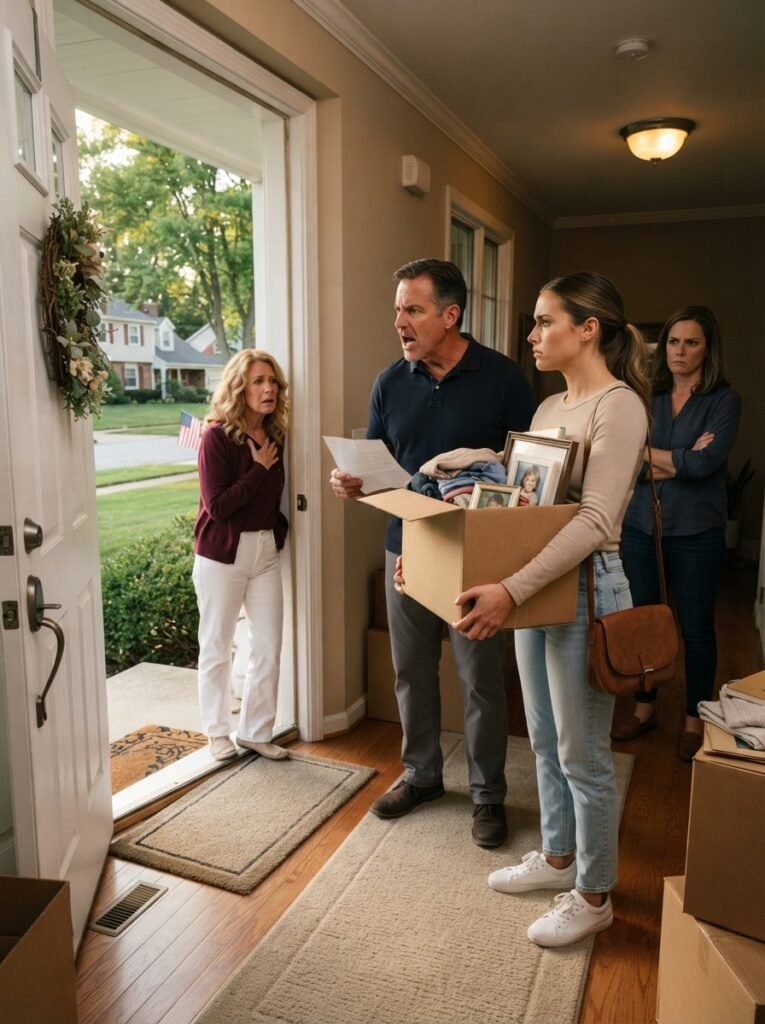
When I returned from work, Mom and Dad were waiting in the living room.
“What’s this?” Dad asked, holding up my letter as though it were evidence of some betrayal.
“It’s my notice.”
“You’re really doing this?” Mom asked, her voice already trembling.
“Yes. I found a place, and I’ll be moving out by the end of the month.”
“You can’t just leave,” Mom said. “What about Martha? What about the baby?”
I took a slow breath.
“Martha and the baby aren’t my responsibility. I’ve done everything I can to help around here, but I can’t keep living like this.”
“What is wrong with you?” Dad shouted. “You weren’t stubborn like this before. We’ve given you so much—letting you live here, helping you get on your feet—and this is how you repay us?”
My fists tightened.
“I pay rent. I buy my own food. I’ve been responsible for myself since the day I graduated. I’m not a kid anymore, and I’m not your backup plan for Martha.”
Mom started crying.
“How can you do this to us? To your sister?”
I didn’t answer.
There was nothing left to explain.
The following days were painfully awkward.
Mom and Dad barely spoke to me unless they had another guilt trip to deliver.
Martha behaved as though nothing had changed.
She continued moving her belongings into the basement and spreading them throughout the house.
During the final days before my move, I focused entirely on preparation.
I packed my last essentials.
Checked my budget repeatedly.
Arranged with Alicia to pick up the keys.
Everything was ready.
Still, I couldn’t completely shake the feeling that something would go wrong.
The morning I officially moved out, Alicia came over with her car to help carry the last boxes.
I had deliberately chosen an early hour.
I hoped Martha would still be sleeping and my parents would be busy enough to leave me alone.
Naturally, it didn’t happen that way.
I was halfway through loading my car when Dad appeared.
“What are you doing?” he demanded.
“I told you. I’m leaving today.”
“You can’t just sneak out like this,” he snapped, following me outside. “We’re a family, Abby. Are you abandoning your own family?”
I placed the box into my trunk and faced him.
“I’m not abandoning anyone. I’m choosing to live my own life. There’s a difference.”
Before Dad could answer, Mom appeared in the doorway.
Her arms were crossed, and tears were already running down her face.
“You’re really doing this?”
“Yes.”
“What about Martha?” she sobbed. “What about the baby?”
I sighed.
“Mom, I’ve told you before. Martha and the baby aren’t my responsibility. I can’t keep sacrificing my own life to fix her mistakes.”
That immediately set her off.
“How dare you talk about your sister like that? She’s doing the best she can!”
“Is she? Because from where I’m standing, it looks like she’s waiting for everyone else to do the work for her.”
At that moment, Martha appeared from the basement.
She took one look at the driveway and smirked.
“Don’t worry, Mom,” she said sarcastically. “If Abby wants to be selfish, then we don’t need her anyway.”
I fought the urge to respond.
Instead, I turned toward Alicia, who had just arrived.
“Let’s get this done.”
Alicia gave me a sympathetic look and began helping with the remaining boxes.
Behind us, my parents continued shouting.
“Who’s going to help us now?” Dad yelled.
“How can you be so heartless?” Mom cried.
Martha leaned against the doorframe, watching as though the whole thing were entertainment.
By the time the cars were packed, I felt physically exhausted.
I stood in the driveway and looked once more at the house I had called home for years.
I expected the moment to feel bittersweet.
Instead, I felt relief.
I started my car and drove away, with Alicia following behind me.
The moment I entered her apartment complex, some of the tension finally left my body.
The place wasn’t luxurious.
But it was clean.
Quiet.
And, most importantly, peaceful.
Alicia helped me carry everything upstairs.
Within an hour, I had unpacked enough to make the room feel livable.
Afterward, we sat on the couch talking about work.
It felt completely ordinary.
And ordinary felt amazing.
The peace lasted about two hours.
Then my phone started vibrating nonstop.
Calls.
Texts.
Voicemails.
My parents.
Aunts.
Cousins.
Mom had apparently already announced that I had “abandoned the family,” and suddenly everyone had an opinion.
One voicemail from Aunt Carol said:
“Abby, how could you do this to your sister? She’s pregnant and vulnerable. Don’t you care about family?”
Then a cousin texted:
“Selfish doesn’t even begin to describe you.”
Then came Martha’s social media posts.
She went fully into victim mode, uploading pictures of her pregnancy with captions like:
“Some people would rather run away than help their own family. At least my baby will know what real love looks like.”
I blocked her immediately.
It was infuriating.
But I refused to let any of it drag me back.
The entire reason I had left was to escape exactly this kind of manipulation.
The following week, things became even stranger.
Mom showed up at my school during lunch.
She was crying, demanding to speak with me and telling me I had destroyed the family.
She insisted Martha was falling apart without my help.
Eventually, my principal had to ask her to leave.
I was mortified.
I spent the rest of the day avoiding eye contact with my coworkers, knowing everyone was probably wondering what kind of chaos followed me home.
A couple of weeks later, I realized I had accidentally left an important file at my parents’ house. It contained my teaching certification, tax documents, and other work-related papers.
In the rush to move, I had forgotten to check the small drawer where I kept them.
After what happened with Mom at school, I had finally explained the situation to a couple of coworkers.
They immediately offered to help.
“Let us know when you’re ready to grab the rest of your stuff,” Alicia said. “We’ll make it quick.”
A few days later, Alicia and another coworker, Maria, went with me to collect everything.
I thought having witnesses would prevent more nonsense.
I underestimated my family.
When we reached my old bedroom, I barely recognized it.
Martha had already started moving into the room.
Her clothes were stuffed into my dresser.
Baby items covered my desk.
My nightstand had been emptied and replaced with her belongings.
“What’s going on here?” I muttered.
Martha appeared in the doorway holding a cup of coffee.
“Oh, hey,” she said casually. “I guess some of my stuff got mixed in. It’s hard to tell what’s yours and what’s mine at this point.”
I stared at her.
“You mean the stuff that was in my room, where I’d been living for years?”
She shrugged.
“Well, you already left, so what does it matter?”
It was obvious she had done it deliberately.
What she didn’t realize was that I had expected exactly this kind of behavior.
I opened the photo folder on my phone.
“I already have photos of everything,” I said, holding up the screen. “And I made a list of all my belongings, down to the serial numbers on my electronics.”
Her expression changed immediately.
Before she could respond, Mom and Dad arrived.
“What’s going on?” Dad demanded. “What are you doing in here?”
“I came to grab some things I forgot, but Martha is claiming she can’t tell what belongs to her and what belongs to me. Fortunately, I documented everything I own.”
Dad’s expression darkened.
“If you take anything that doesn’t belong to you, I’ll call the police.”
I laughed once without humor.
“Go ahead.”
That ended the threat.
Alicia and Maria helped me sort through everything.
At one point, Martha even tried to claim that my laptop belonged to her.
I simply pulled up the purchase receipt and a photograph of the serial number.
The more evidence I produced, the angrier she became.
“This is so unfair!” she shouted. “You’re stealing from a pregnant woman!”
I finally turned toward her.
“The only person trying to steal anything here is you. Just like you’ve been trying to steal my time and freedom by expecting me to become your unpaid nanny.”
I looked her directly in the eyes.
“Not anymore.”
Then I left with Alicia and never looked back.
That was six months ago.
Martha has since had the baby.
And, exactly as I expected, everything has become chaotic.
My parents are now providing the childcare they tried to assign to me while also working full-time.
They’re exhausted.
Overwhelmed.
And apparently beginning to understand just how much work they had casually expected me to absorb.
According to the few relatives who still speak to me, Martha still hasn’t seriously looked for a job.
She says she’s too stressed to work.
Maybe she is.
But apparently, she still spends much of her time on her phone while Mom and Dad handle most of the practical responsibilities.
She remains in their house with a crying infant while the unfinished basement renovation continues draining their retirement savings.
My parents have tried contacting me repeatedly since I left.
At first, their messages were angry.
They called me selfish and ungrateful.
When that failed, the messages turned into guilt trips about how much the baby supposedly needed me.
Their newest tactic has been sending photos of my niece with captions such as:
“Don’t you want to meet your only niece?”
And:
“She needs her aunt in her life.”
I blocked their social media accounts and set up filters for their emails.
A few relatives who understand my side occasionally tell me what is happening.
But I have made my position clear.
I’m not interested in rebuilding those relationships unless my parents and Martha acknowledge what they did and actually change their behavior.
The ironic part is that if they had respected my boundaries and simply asked whether I could babysit occasionally like normal people, I probably would have said yes.
I love children.
Helping once in a while would never have bothered me.
But they didn’t ask.
They tried to trap me into becoming permanent free childcare while ignoring my time, my money, my space, and my right to make decisions about my own life.
That destroyed any willingness I had to help.
And that’s where things stand now.
The biggest lesson I took from the whole experience is this:
Sometimes the healthiest thing you can do for your family is stop rescuing them from the consequences of their own behavior.