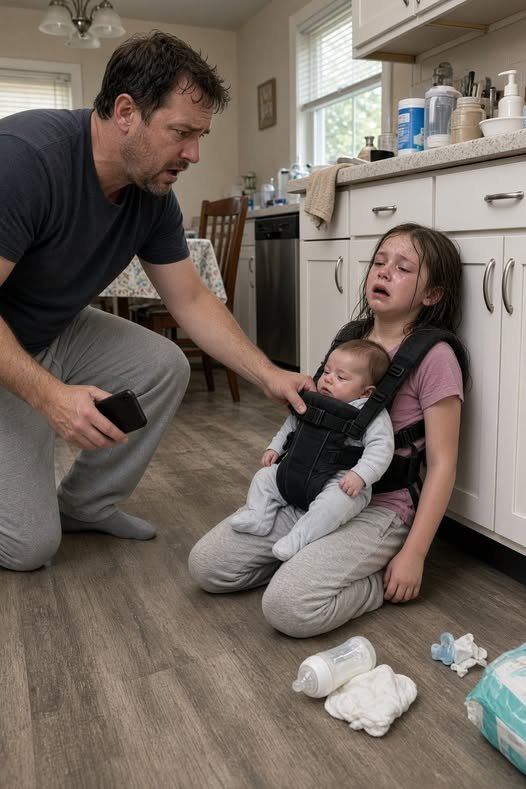
The deadbolt shifted before I could respond to Tessa, and the front door began to swing inward.
Their mother stepped inside with one hand still on the door, then stopped when she saw me sitting at the kitchen table with Miles against my chest and Tessa beside me.
Her eyes moved to the phone in my hand.
Not my phone.
The other one.
For a second, none of us said anything because there was no useful version of the truth she could invent fast enough to make the room look normal.
She looked at the phone. She looked at Tessa. She looked at Miles. She did not look at me.
“Where did you get that?” she asked.
That was her first question.
Not whether Miles was okay.
Not why Tessa looked exhausted.
Not why I was home hours earlier than expected.
I kept my voice level because my daughter was sitting three feet away, and she had already carried more adult responsibility that afternoon than she ever should have been given.
“Tessa showed me where it was.”
Their mother finally looked at her.
Tessa immediately pulled her hands into the sleeves of her shirt.
It was such a small movement, but I knew my daughter well enough to understand it.
She thought she had done something wrong.
I hated that.
Their mother took a step toward us.
“Grant, give me the phone.”
“No.”
She stopped.
I wasn’t shouting.
I wasn’t standing over her.
I simply put the phone on the table beside my hand, screen facing up, and asked the one question that mattered before anything else.
“How long were you gone?”
She glanced toward Tessa again.
“I told her I was going out for a few minutes.”
“That wasn’t my question.”
Her shoulders tightened.
“I lost track of time.”
Tessa stared at the tabletop.
Miles made a tired little sound against my shoulder, then settled when I shifted him higher.
I waited.
Their mother exhaled sharply.
“I don’t know. A while.”
“You told Tessa 17 minutes.”
“I thought it would be 17 minutes.”
“Before lunch,” I said. “That’s when she says you left.”
Her face changed just slightly.
That was enough.
She knew I had the timeline now.
The call from Tessa was still in my phone history.
The hidden phone had a notification stamped 1:17 p.m.
The newest message was worse because it didn’t describe an accident, a delay, or anything she had been forced to deal with.
It gave an instruction.
Leave the kids with Tessa and come now.
I turned the second phone so she could see the screen.
“You want to tell me who R is?”
“Not in front of the kids.”
That was the first thing she said that I agreed with.
“Fine.”
I stood, still holding Miles, and looked at Tessa.
“Can you go sit in the living room for a minute? Door stays open. You’re not in trouble.”
She nodded, but before she moved, she looked at her mother.
Then she said something so quietly I almost missed it.
“I tried.”
Their mother frowned.
“Tried what?”
“To wait 17 minutes.”
Tessa’s voice shook, but she kept going.
“I really tried.”
I saw the exact moment their mother understood what those words meant.
Tessa hadn’t ignored instructions.
She hadn’t been impatient.
She hadn’t called me to cause trouble.
She had spent hours measuring herself against a promise made by an adult who never came back when she said she would.
Miles had gotten hungry.
He had cried.
Tessa had walked him around until her arms hurt, then used the carrier because she was afraid she might drop him.
When she finally called me, she wasn’t tattling on her mother.
She was asking permission to stop being responsible for a baby she was physically too tired to keep holding.
Their mother lowered her eyes.
“Tessa, I—”
“And you told her to lie for you,” I said.
Her head snapped toward me.
Tessa froze.
I immediately regretted saying it with her still there, but the words had already landed.
Their mother said, “I did not tell her to lie.”
Tessa looked confused.
I asked her gently, “What were you supposed to tell me if I got home early?”
She swallowed.
“That Mom went to get groceries.”
Their mother pressed her lips together.
There it was.
Not an interpretation.
Not jealousy.
Not whatever story R might eventually tell.
A 9-year-old had been given a cover story in case her father came home before expected.
I wanted to demand every password on the hidden phone. I wanted to know how long it had existed. I wanted to know how many afternoons had been rearranged around messages I had never seen. I did something else.
I carried Miles to his room and changed him.
He needed me more than my anger did.
When I came back, Tessa was sitting on the couch with a glass of water, her knees pulled up under her.
I told her she could stay there and watch something if she wanted.
She asked, “Are you mad at me?”
“No.”
“Really?”
“Really.”
Then I crouched so we were eye level.
“You were never supposed to be the adult in that situation. You called me when you needed help. That’s what I want you to do every single time.”
She nodded, but I could tell one conversation wasn’t going to erase the afternoon from her head.
Kids don’t automatically stop carrying responsibility just because an adult finally tells them to put it down.
Back in the kitchen, their mother was still standing near the table.
The hidden phone was exactly where I had left it.
She hadn’t touched it.
“R is someone I’ve been seeing,” she said.
She said it quietly.
I felt the words, but strangely, they were not the part that hit me hardest.
Maybe I had already understood that much when I read the message.
Maybe finding my daughter on the kitchen floor had rearranged the order of what mattered.
“Did R know Tessa was nine?” I asked.
She hesitated.
“Yes.”
“Did R know Miles was eight months old?”
Another pause.
“Yes.”
“And R still told you to leave them with her.”
She rubbed both hands over her face.
“It wasn’t supposed to happen like this.”
“How was it supposed to happen?”
“I was supposed to go over there, talk for a few minutes, and come straight back.”
“You told Tessa 17 minutes.”
“I know.”
“You were gone for hours.”
“I know.”
“No,” I said. “You know now. Tessa knew while she was sitting on the floor trying not to drop her brother.”
She flinched, but I wasn’t trying to hurt her.
I was trying to keep the conversation attached to the thing that could not be talked around.
The secret relationship mattered.
The second phone mattered.
The lies mattered.
But I could deal with betrayal between adults later.
A child had been placed in a situation she couldn’t safely manage, then instructed not to call the parent who could help her.
That was different.
Their mother pulled out a chair and sat down.
“I made a terrible decision.”
“Yes.”
“I thought she’d be okay.”
“She wasn’t.”
“I didn’t think Miles would get that upset.”
“He’s eight months old.”
“I know how old he is.”
“Then don’t make this about how he reacted.”
That stopped her.
The kitchen felt smaller than it had that morning.
On the counter sat the ordinary things we’d both probably walked past a thousand times without noticing, but all I could see was the empty patch of floor where Tessa had been sitting when I came through the door.
Her legs had been stretched out because she was too tired to keep repositioning herself.
Her fingers had trembled when I unclipped the carrier.
And she had apologized to me.
That part stayed with me.
Their mother started crying then, but not loudly.
I didn’t comfort her.
I didn’t attack her either.
I said, “I need you to stay somewhere else tonight.”
She looked up.
“Grant.”
“The kids need calm tonight.”
“This is my house too.”
“I’m not arguing about the house. I’m talking about tonight.”
She glanced toward the living room.
Tessa couldn’t see us from where she was sitting, but I could hear the television turned low.
Their mother asked, “You’re taking the kids away from me over one mistake?”
“No.”
I pushed the hidden phone a few inches toward her.
“I’m reacting to the decision you made, the lie you prepared, and the fact that our daughter was afraid to call me because you told her not to.”
She stared at the phone.
The screen lit again.
R was calling.
Neither of us reached for it.
The buzzing stopped.
A few seconds later, another notification appeared.
“Are you there?”
Their mother closed her eyes.
I didn’t open anything else.
I didn’t need another discovery that night.
I already had enough information to decide what the next few hours needed to look like.
She packed a bag.
There was no screaming scene at the door.
There was no dramatic speech.
Before she left, she went into the living room and asked Tessa if she could talk to her.
Tessa looked at me first.
I said, “Only if you want to.”
That mattered.
For the first time all afternoon, an adult was giving her a choice instead of an instruction.
Tessa nodded.
Their mother sat on the edge of the other chair, leaving space between them.
“I should not have left you responsible for Miles,” she said.
Tessa said nothing.
“I should not have told you not to call Dad.”
Still nothing.
“And I should never have told you what to say if he came home.”
Tessa finally looked at her.
“Were you really going to get groceries?”
Their mother swallowed.
“No.”
The answer hurt her.
I could see that.
But it was clean.
No excuse was attached to it.
Tessa looked down again.
“Okay.”
That was all she said.
Their mother left a few minutes later.
I locked the door behind her, then went straight back to the kids instead of standing there replaying the confrontation.
Miles needed a bottle.
Tessa needed dinner.
The house needed to become boring again.
That night, boring felt like a luxury.
After Miles fell asleep, Tessa stayed at the kitchen table while I made her something simple to eat.
She kept watching me as if she expected another question.
Finally she said, “Am I old enough to watch him?”
I knew what she was really asking.
Was this something she had failed at?
“You’re old enough to help with him when an adult is here,” I said. “You can make him laugh. You can hand me wipes. You can sit beside him while I’m making dinner. But you are not responsible for being his parent.”
She picked at the edge of her napkin.
“What if it’s just 17 minutes?”
“No.”
She looked relieved before she looked sad.
That told me more than anything else had.
The next morning, I wrote down the timeline while it was still fresh.
Not because I wanted to turn our family into an investigation, but because I had spent nearly 15 years training dogs by watching what actually happened instead of what someone later wished had happened.
Pressure changes memory.
Facts help.
I had Tessa’s call time.
I had the 1:17 p.m. notification on the second phone.
I had the message telling their mother to leave the kids with Tessa.
And I had Tessa’s account of being told to say her mother had gone for groceries if I returned early.
I did not ask Tessa to repeat the story over and over.
Once was enough.
Her job was to be nine.
Mine was to remember.
Their mother and I spoke again three days later after the immediate anger had stopped controlling every sentence.
We met at the house while the kids were elsewhere with someone we both trusted.
She admitted she had kept the second phone because she knew the messages with R would damage our relationship if I saw them.
She also admitted that leaving that afternoon had not been an emergency.
R wanted her to come.
She wanted to go.
She expected to be back before anyone noticed.
That was the whole ugly mechanism.
There was no complicated explanation hiding underneath it.
She had convinced herself that a short lie would disappear if nothing went wrong.
Then something did.
“What happens now?” she asked.
“I don’t know what happens to us yet,” I said. “But I know what happens with the kids.”
She waited.
“They are not going to be left without an adult because either of us wants to be somewhere else.”
She nodded.
“And Tessa is never going to be used as cover again.”
Another nod.
“If she calls me, nobody punishes her for it.”
“I wouldn’t.”
“You already told her not to.”
Her face tightened.
Then she said, “You’re right.”
That was the first conversation where she stopped trying to reduce the size of what had happened.
It didn’t fix anything.
But it changed what repair could look like.
For a while, we lived separately.
The kids stayed on predictable routines, and any time their mother was with them, another responsible adult was available until I felt confident the basic safety boundary was real rather than promised.
I wasn’t interested in punishing her.
I was interested in never getting another call from Tessa whispering that her body couldn’t keep doing an adult’s job.
Tessa changed in small ways after that afternoon.
For several days, whenever Miles cried, she stood up automatically.
I would tell her, “I’ve got him.”
At first she hovered nearby.
Then she started believing me.
Once, Miles fussed while she was doing homework at the kitchen table, and she pushed her chair back so quickly her pencil rolled onto the floor.
I picked Miles up before she reached him.
“Finish your math.”
She stared at me.
“You sure?”
“Very.”
She sat back down.
That tiny moment felt bigger than it should have.
Trust often comes back that way—not through promises, but through the same ordinary thing happening safely enough times that your body finally stops bracing for the old version.
Their mother had work to do too.
When she saw the kids, she stopped asking Tessa to help with Miles unless I was present and the request was clearly optional.
If Tessa said no, the answer stayed no.
No guilt.
No reminder that she was the older sister.
No suggestion that helping proved love.
She also apologized again months later, but differently.
This time she didn’t say she was sorry things had gotten out of hand.
She said, “I made you responsible for your brother because I wanted to leave, and then I made you responsible for hiding it. You should never have had to choose between obeying me and calling your dad.”
Tessa listened.
Then she asked, “Are you still mad that I called him?”
Their mother shook her head.
“No. I’m glad you did.”
Tessa studied her face for a few seconds.
“Okay.”
Again, that was all.
She didn’t owe either of us a beautiful forgiveness scene.
She was a kid.
She was allowed to decide how much trust returned and how quickly.
As for R, I eventually learned enough to understand the relationship, but I stopped treating that person as the center of the story.
R hadn’t carried Miles.
R hadn’t listened to Tessa crying into the phone.
R hadn’t made the promise to our children.
Their mother had.
Whatever happened between the adults mattered, but the choice that changed our household had been made inside our own front door.
That distinction helped me make decisions without turning anger into the decision-maker.
I didn’t stay in the relationship just to keep the family looking intact.
I didn’t make permanent choices in the first night either.
We took the problems one at a time.
Safety first.
Then honesty.
Then whatever could be rebuilt after those two things were no longer negotiable.
Some parts of our old life did not come back.
That was real too.
But Tessa slowly stopped watching the clock whenever an adult left the room.
Miles grew heavier, louder, and more determined to grab anything within reach.
The baby carrier remained in the house, hanging from its usual hook near the kitchen.
For a long time, Tessa wouldn’t touch it.
I never asked her to.
Then one evening, months after that phone call, I was making dinner while Miles sat safely nearby and Tessa worked on a school project at the table.
Their mother was visiting, sitting across from Tessa and helping her sort colored paper into a pile.
Miles started fussing.
Tessa looked up automatically.
So did their mother.
Their mother stood first.
“I’ve got him,” she said.
Tessa watched her pick Miles up, settle him against her shoulder, and walk back into the kitchen without asking Tessa for anything.
Then my daughter lowered her eyes to her project again.
A minute later she reached for another piece of paper and asked me what we were having for dinner.
Nothing dramatic happened.
That was the point.
The hidden phone had exposed a secret, but the part I cared about most was simpler than that: my daughter was no longer waiting for permission to stop being the adult.
The carrier stayed on its hook.
Tessa stayed at the table.
And when Miles began to cry again, the adults got up.