
I hung up and looked at the old photograph on my refrigerator. Lauren at eleven, missing a front tooth, holding a pancake she had accidentally burned too dark. My arm around her waist. Both of us laughing.
I wanted to reach into that photograph and warn us. Not about Ethan. Not about Margaret. About how easily love can be confused with access, and approval, and the fear of losing both.
The dinner happened three days later.
Lauren had invited me only because Owen had asked why his grandmother was not coming. I learned that later. At the time, I thought my daughter was opening a door.
A valet managed the cars lining the cul-de-sac. White lights wrapped the porch columns. Through the front windows I could see guests gathered beneath garlands and red velvet bows, and the house looked the way Margaret had always needed it to look, like evidence of something permanent and earned.
Lauren greeted me with a stiff hug. I held out the orchid I had brought for Margaret. She appeared behind Lauren within seconds and took the plant from me with a gracious smile and handed it to a catering server without looking at it again.
My place had been set at a folding card table beside the mudroom. Three other chairs surrounded it. No one sat in any of them. The main table had room for sixteen. There were sixteen other guests. Lauren avoided my eyes.
When I reached for the hall closet to hang my coat, Margaret touched my arm.
“Guests’ coats are being kept in the primary suite,” she said pleasantly. “Yours can go on the hook.”
She pointed to a brass hook beside the back door, above a pile of wet boots.
I hung my coat there.
I had spent years believing that enduring small humiliations with grace made me the better person. That night, sitting beside the coats at the folding table while December air brushed my neck, I finally understood that silence sometimes teaches people exactly how much they can continue to take from you.
Dinner progressed. Margaret told a long story about a charity board. Ethan described a new development near Boulder. Lauren smiled when expected and refilled glasses before anyone asked, and she moved through her own dinner party like a person performing the role of someone who lived there. I watched her carefully. She looked tired, not ordinary tired, but the kind of tired that comes from holding up a life that has grown too heavy to hold naturally.
Halfway through the main course, Margaret tapped her wineglass.
“I have a small announcement.”
She reached into her handbag and removed a cream folder. She explained that Harbor Ridge was expanding, that Ethan and Lauren would be taking on a more significant role, that a family trust had been created to consolidate several properties and protect the children’s future.
Ethan placed a pen beside Lauren’s plate.
My stomach tightened. “What exactly is she signing?”
Margaret did not look at me. “A routine acknowledgment.”
“Then there is no reason she cannot have an attorney review it first.”
Lauren closed her eyes. “Mom.”
Ethan leaned toward her. “It’s the same document we discussed.”
“No,” Lauren said quietly. “You discussed it. I didn’t agree.”
His expression shifted. Only for a second. But I saw it, and so did Margaret, and the room felt the change in pressure the way a room does before weather arrives.
Margaret smiled at her guests. “Families sometimes make simple matters more complicated than necessary.”
I stood. “Lauren, do not sign anything tonight.”
Margaret turned toward me with the slow patience of someone who has never needed to hurry.
“You are seated at my daughter-in-law’s table, eating food provided by my family, and accusing us of dishonesty.”
“I am seated beside the coats.”
A few guests looked down at their plates.
Margaret’s voice went softer, which made it crueler.
“Helen, your resentment has become an embarrassment. Lauren has spent years trying to include you, but you reject every effort because you cannot bear seeing her rise beyond the life you gave her.”
The words struck the room like something dropped and shattered.
Lauren’s face tightened. I waited for her to object. She did not.
I looked at my daughter.
“Your name is on properties you have never seen. Companies you cannot explain. Loans you did not negotiate. Ask them why.”
Margaret pressed a hand to her chest. “This is outrageous.”
“You used my address on one of the filings.”
“An administrative error.”
“That is exactly what Ethan said.”
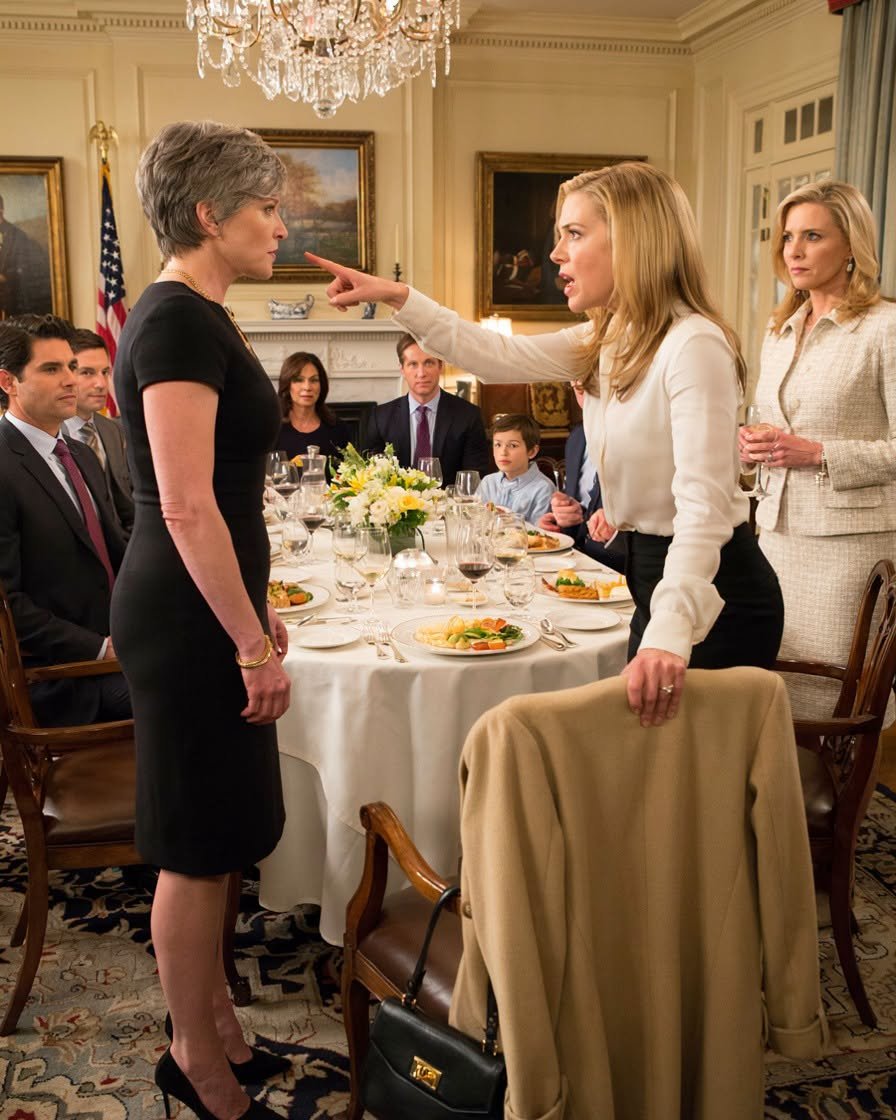
Lauren rose so abruptly her chair struck the wall.
“Stop,” she said. Her hands were shaking. “Stop this right now.”
“I will stop when you stop signing.”
“You don’t know what you’re talking about.”
“I know enough.”
“You have humiliated me in front of everyone I know.”
“I would rather embarrass you tonight than visit you through glass later.”
Her face crumpled for half a second, something real and unguarded moving across her features before the anger rushed in to protect it.
She pointed toward Margaret and said the words that had been prepared for her, perhaps not by anyone in the room that evening, but by years of small decisions and cultivated fear.
Owen whispered her name.
Margaret settled back in her chair and believed she had won.
I thought of every double shift. Every pancake morning. Every night Lauren had waited beneath grocery-store lights while I counted a cash drawer.
I crossed the room, stood beside Margaret, and told her I would not apologize for stopping her from making my daughter the fall woman for her crimes.
The doorbell rang.
Federal agents entered with warrants. Ethan tried to block the hallway and was instructed to step aside. Margaret reached for her phone and was told to place it on the table. The birthday guests moved away from her and Ethan the way people move away from something that has suddenly revealed itself to be dangerous, not from courage, but from the instinct to ensure no one thinks they were standing together.
Lauren stood in the center of the dining room unable to speak.
Agents went upstairs. Others photographed the cream folder beside Lauren’s plate. The Christmas lights still glowed outside, cheerful and indifferent.
Lauren turned toward me.
“What is happening?”
Before I could answer, an agent approached her.
“Mrs. Miller, we need to speak with you about several businesses registered in your name.”
She looked at Ethan.
He would not meet her eyes.
That was the moment my daughter understood that the danger was real and that she had been standing inside it for a very long time.
The search continued for hours. Guests slipped out through the front without saying goodbye. I stayed because the children were frightened. Owen sat beside me on the stairs and asked whether his father was in trouble. I told him I did not know everything yet. He asked whether I was leaving.
I looked at him. “Not unless your mother asks me to.”
Lauren stood ten feet away. She heard me. Her face folded, and she turned before I could see whether she was crying.
Just after midnight, Ethan was taken for questioning. Margaret left separately with an attorney who had arrived still buttoning his overcoat. Lauren was not arrested. She was instructed not to destroy records or move assets, and her passport was temporarily surrendered while investigators evaluated her role.
When the last agent left, Lauren sat at the dining table alone. The folding card table remained beside the coats. I made hot chocolate for the children and put them to bed. When I came downstairs, Lauren was holding a property record from the inventory the agents had left behind.
“How long have you known?” she asked.
“A few months.”
“You went to the government?”
“I spoke to an investigator after my address appeared on a company filing.”
“You could have tried harder with me.”
I looked at her steadily. “I tried until you returned your children’s Christmas gifts.”
She pressed her lips together.
“You wanted this to happen.”
“No mother wants to watch her child’s home searched.”
“You hated them.”
“I distrusted them.”
“You hated the life I had.”
“I hated what you had to become to keep it.”
She asked me to leave. The words hurt, but less than they might have. Perhaps there is a limit to how many times the same wound can surprise you. I put on my coat from the brass hook, and at the door I told her to find an attorney who had never worked for Harbor Ridge, to tell the truth even when it embarrassed her, and to remember that those two things were connected.
I left.
For eleven days I heard nothing.
The investigation broke publicly the next morning. Television crews gathered outside Harbor Ridge’s offices. Reporters showed footage of Ethan entering the federal courthouse and Margaret leaving her lake house behind dark glasses. Her charity partnerships disappeared from the company website. She resigned from two boards before either could remove her. People who had applauded her at fundraising dinners began telling reporters they had always sensed something unusual about the operation, and I thought about how quickly respectability dissolves when it is no longer useful to maintain it.
Lauren’s attorney called two weeks later. Her name was Susan Park, recommended not by the Millers but by the federal public defender’s office.
“Lauren has authorized me to speak with you,” she said. “We need to document your conversations about the property filings.”
I gave Susan everything. The envelopes. The county notices. The dates of every conversation. A photograph of the returned Christmas package because the shipping label helped establish the timeline of when Lauren had cut off contact after I raised concerns. The unfinished Blue Mesa packet was especially significant. The notary confirmed that Lauren had stopped signing after I intervened, and that Ethan had appeared angry. For the first time, my interference was not described as jealousy or obstruction or the meddling of a resentful woman.
It was evidence.
Two weeks after the raid, Lauren arrived at my apartment with Owen, Chloe, three suitcases, and a laundry basket full of school uniforms. Snow clung to her hair. The mortgage accounts had been tied to disputed funds and the property placed under legal restraint. Ethan had controlled most of their finances, and her personal account held almost nothing.
I stepped aside. She and the children moved into my two-bedroom apartment. I gave Lauren my room and slept on the pullout couch.
She did not thank me the first night. I did not expect her to. Shame had wrapped itself around her too tightly for gratitude to fit alongside it.
For several days we spoke only about practical things. School pickup. Laundry. Attorney calls. Whether Chloe had finished her spelling homework. Lauren spent hours at my kitchen table reviewing documents she had once signed without reading, and with every page she learned another piece of her life had belonged to someone else. The lake house was owned by an LLC. The cars were leased through Harbor Ridge. The children’s education accounts had been used as collateral. Several pieces of jewelry Margaret had given her were company assets purchased before charity galas. Even the credit card Lauren used for groceries had been paid through a business account under investigation.
One evening she held up a statement. “I don’t own anything.”
“You own what matters.”
She gave me a tired look. “Please don’t say the children.”
“I was going to say your name. It is still yours. You can decide what it means from now on.”
She cried in the bathroom that night because she did not want Owen and Chloe to hear. I sat outside the door. I did not offer advice or reassurance. I simply stayed there until she opened it.
The children adjusted faster than we did. Owen slept on an air mattress in the living room. Chloe shared my bedroom with Lauren. They complained about the slow internet and the upstairs neighbor’s heavy footsteps, but they also rediscovered things they had forgotten they liked. We made pancakes on Saturday mornings. We walked to the public library. We bought a string of colored lights from a discount bin and put them around the apartment window, and the apartment looked, in the evenings, like somewhere people actually lived.
On Christmas Eve, Owen brought out a dented metal box. Inside were the superhero comics I had purchased for his eighth birthday, still wrapped in blue paper, the tape slightly yellowed.
“Mom found them in the garage before we left,” he said.
I looked at Lauren.
She was standing by the stove. “I never threw them away,” she said.
“I thought you did.”
“I couldn’t.”
It was not an apology. But it was the first brick removed from the wall between us, and sometimes that is where forgiveness begins, not with a statement but with a small proof that something was preserved.
The real apology came in January. Lauren had spent the morning with federal investigators and returned carrying a legal pad filled with notes. She removed her coat. Then she took mine from the hook beside the door and hung it in the hall closet, beside hers.
Such a small thing. I nearly cried over it.
She sat at the kitchen table and told me that Margaret was blaming her for the creation of Cedar Peak. That Ethan was saying she had handled the paperwork. Her voice was flat and exhausted, the voice of someone who has used up everything that was keeping her together.
I sat across from her and let her talk.
Then she stopped and looked at her hands.
“I called you jealous,” she said.
“Yes.”
“I let them seat you by the kitchen at my wedding.”
“Yes.”
“I lied about Owen’s birthday.”
I said nothing.
She looked toward the living room, where the children were doing homework. “I knew it was wrong. Every time. I knew.”
“Why did you do it?”
“At first I thought I was keeping the peace. Then I realized Margaret’s approval felt more permanent than yours. You would always forgive me. She might not.” She paused. “That sounds terrible when I say it out loud.”
“It sounds honest.”
“She made everything feel conditional. The school. The house. Ethan’s position in the company. If I disagreed about anything, she would go quiet, and Ethan would tell me I had embarrassed him. They never raised their voices. They never had to.”
“Polite cruelty is still cruelty.”
“I became good at it too,” she said.
“Yes.”
She looked at me, surprised by the answer. I reached across the table.
“I love you too much to lie about what happened.”
Tears gathered in her eyes. “I’m sorry, Mom. Not just for that dinner. For all of it.”
I wanted to forgive her immediately. That is a mother’s instinct, to erase the bill before the child has understood the cost. But I had spent too many years making myself smaller so that her life could feel larger, and we could not rebuild anything real on the same foundation.
“I believe you are sorry,” I said. “But an apology does not repair everything. It is where repair begins.”
She nodded slowly. “What do I do?”
“Tell the truth. Accept that I may need time. And do not teach your children that love means choosing the most powerful person in the room.”
Lauren covered her face and cried in the way people cry when they have finally stopped managing how they appear.
I moved my chair beside hers.
Forgiveness did not arrive like a decision. It came through ordinary days, the way most things that last are built. Lauren found temporary work at a physical therapy clinic, scheduling appointments and managing phones with the same competence she had always had and been persuaded to apply to someone else’s interests. She took the city bus when I needed the car. She met with investigators, answered every question, and surrendered emails that helped establish Ethan and Margaret had concealed the purpose of the companies from her.
She also began therapy, which surprised me. In my generation it was something people whispered about. Lauren mentioned it plainly over breakfast one morning, the way she might mention a dentist appointment.
“My counselor says I confused being accepted with being safe,” she told me.
“That sounds expensive.”
She laughed. It was the first real laugh I had heard from her in months, and it filled the small apartment the way it used to fill a grocery-store car on the drive home from work.
By spring, prosecutors formally identified Lauren as a cooperating witness. The relief was real and incomplete. Her marriage ended. Several friendships went quiet. Parents at the children’s school avoided her in the pickup lane. A woman who had attended Margaret’s birthday dinner crossed an entire grocery aisle to avoid eye contact.
Lauren noticed. “So this is what it felt like for you,” she said.
“No. They excluded me because I did not impress them. They are excluding you because you remind them they were fooled.”
“That doesn’t make it better.”
“No. But it makes it less personal.”
Ethan eventually pleaded guilty to conspiracy and wire fraud. Investigators proved that he had directed employees to prepare documents in Lauren’s name and had signed electronic forms using credentials she did not know he possessed. Margaret fought longer. In court she described herself as a charitable businesswoman betrayed by people beneath her. The evidence told a different story. Emails showed her directing employees to place vulnerable properties under relatives’ names. Recorded calls captured her discussing which family members would be easiest to manage. In one message she referred to Lauren as presentable, loyal, and unlikely to read beyond the signature tab.
Lauren saw that message before sentencing.
She sat at my kitchen table holding the printed page. “Presentable,” she said quietly.
I understood what hurt her. Margaret had never considered her family. She had considered her useful. There is a particular grief that comes with that understanding, and it does not resolve neatly, because you cannot mourn someone who was never quite what you believed them to be.
At the sentencing hearing Lauren walked to the lectern in a navy suit bought on clearance and addressed the court. Then she turned toward her mother-in-law.
“You taught me that family loyalty meant silence,” she said. “You gave me comfort and called it love, then used my gratitude as permission. When my mother tried to warn me, I humiliated her because disappointing you felt more dangerous than hurting her.”
The courtroom was still.
She looked toward me.
“My mother worked double shifts so I could have choices. I used one of those choices to become ashamed of where I came from. Then, when she risked losing me to protect me, I ordered her out of my house.”
I held very still.
“She did not destroy my life,” Lauren said. “She saved what was left of it.”
Margaret received a federal prison sentence and a restitution order. Justice, I learned, is not a clean ending. It is paperwork and waiting rooms and delayed hearings and imperfect attempts to return what cannot be fully restored. But it was enough to stop her from continuing.
A year after the raid, Lauren rented a modest duplex in Lakewood. Two bedrooms, a narrow backyard, a kitchen with dated oak cabinets. The refrigerator did not make ice through the door. When she first showed it to me, she seemed embarrassed by the size of it.
“The carpet needs replacing,” she said.
“It has stairs,” I said.
She looked at me.
I smiled. “You always wanted stairs.”
She laughed and hugged me in the empty living room.
We spent two weekends painting the walls. Owen chose gray for his room. Chloe chose a lavender so bright it seemed to hum. Lauren bought most of the furniture secondhand, and at a yard sale she found a walnut dining table with scratches along one side. The owner apologized for the damage.
“We have children,” Lauren said. “It will fit right in.”
Our first Thanksgiving at the duplex was small. No caterer. No valet. No place cards. Lauren cooked the turkey too long and I forgot the sugar in the cranberry sauce and Owen burned the dinner rolls while Chloe tried to hide them under a dish towel. We laughed until Lauren had to lean against the counter to stay upright.
Before dinner, I reached for my coat.
Lauren opened the hall closet.
Inside were her jacket, the children’s winter coats, and an empty wooden hanger. She took my coat from my hands and hung it beside theirs. Not near the boots. Not by the back door.
With the family’s.
When we sat down, Lauren pulled out the chair beside hers.
“This is your place,” she said.
I looked at the table. There was room for five and no one had been pushed aside to make room for me. I sat down.
Halfway through dinner, Chloe asked the kind of question only children ask directly.
“Grandma, are you still mad at Mom?”
Lauren stopped cutting her turkey.
I considered the answer. “No. But being forgiven and being trusted are not the same thing.”
Chloe frowned. “How do you get trusted again?”
“Slowly.”
“How slow?”
Lauren smiled, and it was a sad smile but a real one. “As long as Grandma needs.”
I reached for her hand beneath the table.
“Not forever,” I said.
Outside, snow began settling over the small backyard. The duplex was not impressive. No fountain stood in the driveway. No one at that table sat on a charity board. The glasses did not match and the chandelier had come from a hardware store. But Owen was telling a terrible joke and Chloe was feeding turkey to the dog under the table and Lauren’s hand was warm in mine.
For the first time in years, no one in the room was performing happiness for anyone else.
After dinner Lauren brought out a small cream envelope with my name on it.
“What is this?” I asked.
“Open it.”
Inside was a photograph from her wedding. I was standing near the ballroom doors in the blue dress I had saved six months to buy, alone, watching Lauren dance with Ethan. The chandelier light caught the bracelet on her wrist.
On the back she had written: I’m sorry I left you standing at the edge of my life. Thank you for refusing to stay there.
I read it twice. Then I folded it carefully and returned it to the envelope.
Lauren watched me. “I know a note doesn’t fix it.”
“No,” I said. “But it tells the truth.”
That photograph now sits on my dresser.
Not because I enjoy remembering the woman standing alone by the kitchen doors, but because I respect her. She believed silence was dignity. She believed that swallowing humiliation was the price of keeping her daughter close. She was wrong on both counts, and it took a federal warrant and an empty Christmas box and a folding table near the coats for her to understand that.
Standing up did not make me cruel. Telling the truth did not destroy Lauren’s family. The family had already been damaged by secrets, by fear, by the belief that wealth and social approval could excuse the way a person is made to feel small in the places where she should be most at home.
The truth only turned on the lights.
And once the lights were on, my daughter finally saw who had been standing beside her all along. Not Margaret, with her pearls and her charity tables and her careful management of every room she entered. Not Ethan, with his charcoal coat and his supermarket flowers and his precise, practiced warmth.
Just me. In a blue dress. Near the kitchen doors.
Waiting.