
The official story said Rafael was reckless, charming, and unreliable. The private truth is uglier. Rafael had debts. He had enemies. He had been furious that Alejandro controlled most of the family company. And after the plane crash, Rafael had been the one who managed the personal effects, the hospital contacts, the funeral arrangements, and the destroyed records.
Destroyed records.
That phrase makes Alejandro break a glass in his study.
You are not there when it happens, but you hear it.
Your mother goes still.
The DNA result confirms what everyone already knows.
You are Valentina de la Vega.
Alejandro’s daughter.
The mansion reacts like a body waking from a coma.
Some servants cry. Others whisper. The old cook makes sweet bread and says she always felt the house was waiting for a child. The butler, who has served Alejandro for twenty-five years, stands in the hallway with tears in his eyes and apologizes to your mother for every time he treated her like she was invisible.
Mariela accepts the apology, but she does not smile.
She has learned that apologies from people with power should be weighed carefully.
Alejandro does not throw a party.
He does not call the press.
He does not lift you into his arms and claim a perfect ending because there is nothing perfect about a child losing two mothers in different ways, or a father losing ten years, or a woman raising a stolen child under threat.
Instead, he kneels in front of you in the garden one morning.
Your mother stands behind you.
He holds a small silver bracelet in his palm.
It has your old name engraved on it.
Valentina.
“This was yours,” he says. “You wore it when you were a baby.”
You look at the bracelet.
Then at your mother.
Then at him.
“My name is Sofía.”
Alejandro nods immediately.
“Yes. It is.”
“Am I also Valentina?”
His eyes shine.
“If you want to be. You do not have to decide today.”
You think about that in the serious way children think about things adults do not understand.
Then you ask, “Can I be both?”
Alejandro’s face breaks open.
Not into a smile exactly.
Into hope.
“Yes,” he says. “You can be both.”
You hold out your wrist.
He fastens the bracelet gently, careful not to touch the broken-star birthmark too long. Your mother watches with tears in her eyes. For a moment, the three of you stand together beneath the jacaranda trees, not yet a family, but no longer strangers.
Then the danger returns.
It comes through a phone call.
One of Alejandro’s investigators finds the nurse who worked the private airfield clinic the night of the crash. She is old now, living quietly in Puebla, but when shown your baby photo, she begins to cry. She says a child was brought in alive after the crash. A little girl with smoke in her hair, crying for her mother.
She says Rafael arrived before Alejandro.
She says he ordered everyone out.
She says money changed hands.
She says the official report was altered by morning.
And then she says the worst thing.
“There was another man with him.”
Alejandro’s face becomes stone.
“What man?”
The nurse hesitates.
“Your attorney. Licenciado Montes.”
Alejandro turns very slowly toward the man sitting across the room.
Licenciado Montes has been the family lawyer for three decades. He handled the estate. He handled the funeral. He handled the missing reports. He is also the man who, just yesterday, advised Alejandro to keep your return private until “the company is protected.”
Montes stands.
“Alejandro,” he says calmly. “This woman is confused.”
But the old nurse on the video call is shaking now.
“No,” she whispers. “I remember his voice.”
Montes reaches for his briefcase.
Clara, Alejandro’s new head of security, blocks the door.
Your mother pulls you behind her.
Alejandro does not shout.
That is scarier.
“You knew,” he says.
Montes adjusts his cuffs.
“I protected the family.”
The same words bad people always use when they mean money.
Alejandro steps closer.
“You let me bury an empty coffin.”
Montes looks almost bored.
“You were unstable. Your wife was dead. Rafael said the child would become a target. I made a practical decision.”
Your mother’s voice cuts through the room.
“You sold a child.”
Montes finally looks at her.
“You should be grateful. Without me, she would not have survived.”
Mariela’s face hardens.
“She survived because Rafael panicked and handed her to someone poor enough for you to ignore.”
The lawyer’s eyes flicker.
There.
The truth.
Rafael had not been noble. He had been afraid. Maybe guilt found him too late. Maybe he realized Montes planned to erase the child completely. Maybe, for one night in his selfish life, he did one decent thing and gave you to Mariela before dying with his secrets.
Montes is arrested that afternoon.
Not quietly.
Alejandro calls the authorities himself, then the press. He stands at the gates of the mansion with you inside the house, protected from cameras, and tells the world his daughter is alive. He names Rafael. He names Montes. He names the falsified reports, the bribed officials, the empty coffin.
His voice breaks only once.
When he says your name.
“Valentina Sofía de la Vega is alive.”
Your mother hears it on television in your bedroom.
You sit beside her, drawing with colored pencils. You do not understand why the whole world suddenly wants to know your face. You only know your mother looks scared again.
“Are they going to take me away?” you ask.
Mariela drops to her knees.
“No.”
Alejandro, standing in the doorway, answers at the same time.
“Never.”
The two adults look at each other.
Something changes then.
Not trust.
Not fully.
But an agreement deeper than words.
You belong to both of them now, and neither will let the world tear you in half.
The weeks that follow are chaos.
Cameras camp outside the gates. Reporters call Mariela a nanny, a maid, a hero, a kidnapper, a saint, and a suspect depending on which channel wants more viewers. Alejandro sues three outlets in one week for suggesting Mariela kept you for money.
Mariela refuses interviews.
When one reporter shouts through the gate asking if she raised you to get rich, Alejandro nearly storms outside. Mariela stops him.
“Don’t,” she says. “They want anger.”
“What do you want?”
She looks at the cameras.
“The truth. But not from them.”
So Alejandro gives her a lawyer, a public statement, and something even more important: control. Mariela tells the story in her own words, once, sitting beside Alejandro but not behind him.
She says she was poor.
She says she was frightened.
She says she loved you before she knew your last name could buy hospitals.
And then she looks straight into the camera.
“If I had wanted money, I would have sold the secret,” she says. “Instead, I spent five years counting coins for inhalers.”
That clip spreads everywhere.
People believe her because truth has a different sound.
The legal system moves slowly, but Alejandro moves faster.
He creates a foundation for children with asthma and respiratory illness, naming it after both your mothers: the Isabel-Mariela Breath Fund. Isabel was your birth mother, the woman who died in the crash. Mariela is the mother who kept you alive afterward.
When Alejandro shows Mariela the papers, she cries.
“I don’t want my name on rich people charity,” she says.
“It is not charity,” he replies. “It is debt.”
She studies him for a long moment.
Then she says, “Make sure poor children get the medicine before cameras get the photos.”
Alejandro almost smiles.
“Yes, ma’am.”
You begin calling him Papá six months later.
It happens by accident.
You are in the garden, running too fast, and you trip over a stone. Your knee scrapes against the path. You start crying before the pain fully arrives because children cry from surprise first.
Alejandro reaches you first.
Your mother is right behind him.
He kneels, panicked, asking where it hurts, and you throw your arms around his neck.
“Papá,” you sob.
He freezes.
The whole garden freezes with him.
You feel it, but you do not take the word back.
After a second, his arms close around you carefully. His face presses into your hair. His shoulders shake once, then again.
Mariela kneels beside both of you.
She touches your back.
“You’re okay, mi amor,” she says.
Alejandro looks at her through tears.
Not asking permission.
Thanking her.
She nods.
That night, you sleep with the silver bracelet on your wrist and your old stuffed rabbit under your arm.
The mansion is no longer a mausoleum.
There are toys in the living room. Tiny shoes by the staircase. Medicine in the kitchen cabinet. Drawings taped to the refrigerator. Laughter sometimes startles the staff because they are still getting used to hearing it.
Alejandro changes too.
Not all at once.
Grief does not leave a house because a child returns. It has to be packed away carefully, room by room. Some days he is quiet. Some days he stands before Isabel’s photograph and apologizes in whispers. Some days he watches you play and has to leave the room because joy hurts when it arrives after too much loss.
But he always comes back.
Mariela stays.
At first, she keeps her small room near the service wing because that is where she feels safe. Alejandro offers her a suite near yours, and she refuses. Then you get sick one night and ask for both of them, and by morning Alejandro has quietly converted the room beside yours into a warm bedroom with yellow curtains and Veracruz flowers painted on the walls.
Mariela pretends to be annoyed.
She moves in three days later.
Years pass.
You grow taller.
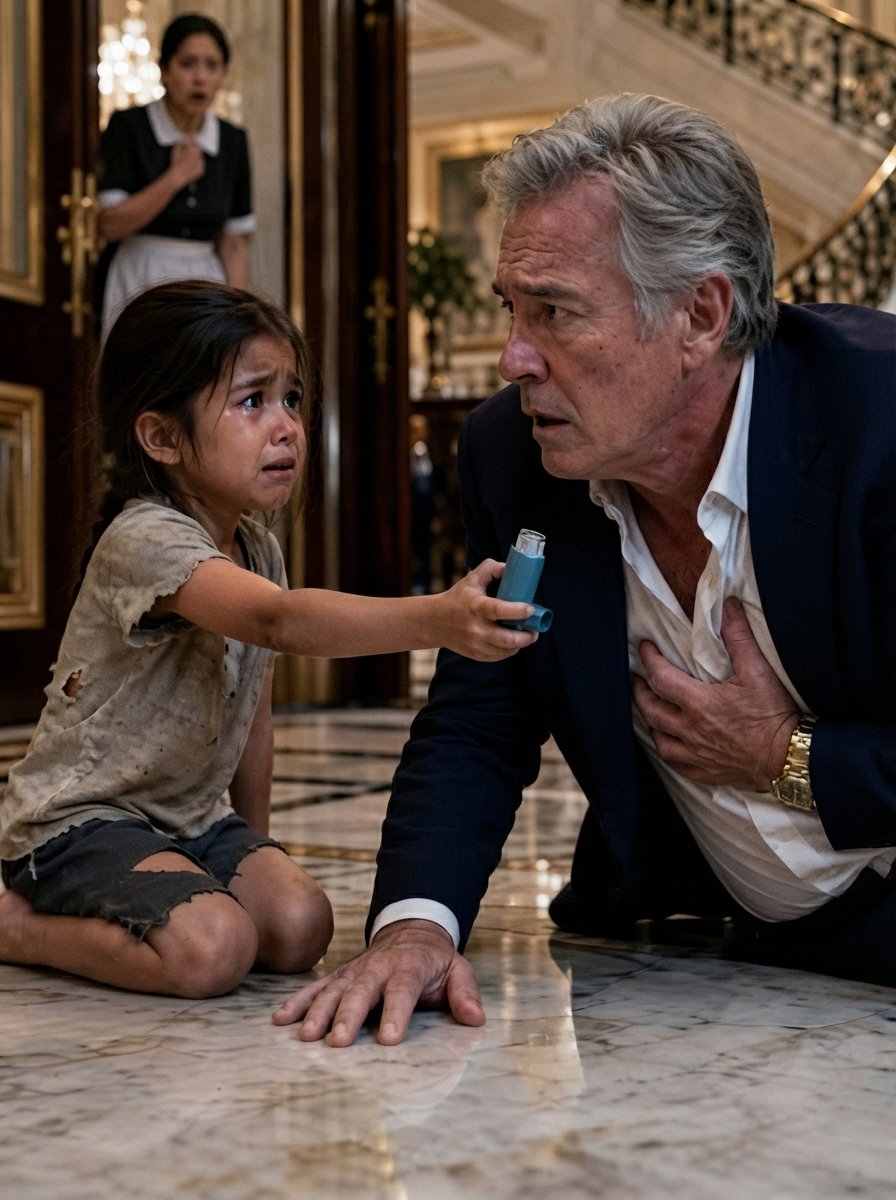
Your asthma gets better with proper care. You still carry an inhaler, but now there is always another one waiting in a drawer, and another in your school bag, and another in Alejandro’s car. The first empty inhaler, the one you used to save him, is placed inside a glass case in his study.
Not as a trophy.
As a reminder.
Below it, a small plaque reads:
The smallest hand in the house saved the life that had forgotten how to live.
When you are ten, Alejandro tells you the story again, but this time with more truth.
He tells you about the crash.
About your mother Isabel.
About Rafael.
About Montes.
About Mariela.
He does not make himself sound innocent. He tells you he stopped looking too soon because grief made him believe official papers over his own heart. He tells you that wealth can build walls so high even truth has trouble climbing over them.
You listen quietly.
Then you ask, “Was I stolen?”
He says, “Yes.”
You ask, “Was I saved?”
He looks toward the garden, where Mariela is cutting flowers.
“Yes,” he says. “By her.”
You think about this.
Then you say, “Then I don’t want people to only say I was stolen.”
Alejandro looks at you.
“What do you want them to say?”
You touch the broken-star birthmark on your wrist.
“That I was found.”
On your fifteenth birthday, the mansion fills with music.
Not society music. Not the stiff kind Alejandro’s old friends expect. Real music. Veracruz drums for Mariela. A string quartet for Isabel. Pop songs for you and your school friends. The staff dance with guests. The old butler cries again, which everyone pretends not to notice.
Alejandro gives a speech.
He keeps it short because you warned him not to embarrass you.
But near the end, his voice softens.
“Ten years ago, I believed my heart had been buried with my wife and daughter,” he says. “Then a five-year-old girl used her last breath of medicine to give me mine back.”
You roll your eyes because teenagers must roll their eyes at fathers.
But you are smiling.
Mariela stands beside him now, not behind him. She wears a deep blue dress and a necklace Alejandro gave her, though she still complains it is too expensive. She is not staff. She is family.
When the cake comes out, it has two names written in gold.
Sofía Valentina
You used to think having two names meant your life was split.
Now you know it means both parts survived.
Later that night, after the guests leave, you find Alejandro in the study looking at the empty inhaler.
“You’re doing the sad thing again,” you say.
He turns, smiling faintly.
“I am remembering.”
“Same face.”
He laughs softly.
You walk to the glass case and look at the inhaler.
“It really was the last one?”
“Yes.”
“Mamá was scared when I used it.”
“She had every reason to be.”
“But if I hadn’t…”
You stop.
Alejandro steps beside you.
“If you hadn’t, I might have died,” he says. “And if I had died, the truth may have stayed buried.”
You look at him.
“So my asthma saved us?”
He considers this with great seriousness.
“No,” he says. “Your heart did.”
You lean your head against his arm.
For a long time, neither of you speaks.
The mansion is quiet now, but not cold. Somewhere upstairs, Mariela is humming while putting away your birthday gifts. Outside, the city glows beyond the windows, the same city where she once counted coins for your medicine and Alejandro counted losses no money could repair.
You touch the broken-star mark on your wrist.
Once, it was the clue that shattered a lie.
Now, it is simply part of you.
You were the maid’s daughter.
You were the magnate’s lost child.
You were Sofía.
You were Valentina.
You were the little girl who walked out of a laundry room holding her last inhaler and saved a dying man on a marble floor.
And because you did, he finally discovered the truth that money, power, and silence had buried for years.
You did not just save his life.
You brought him back to yours.