
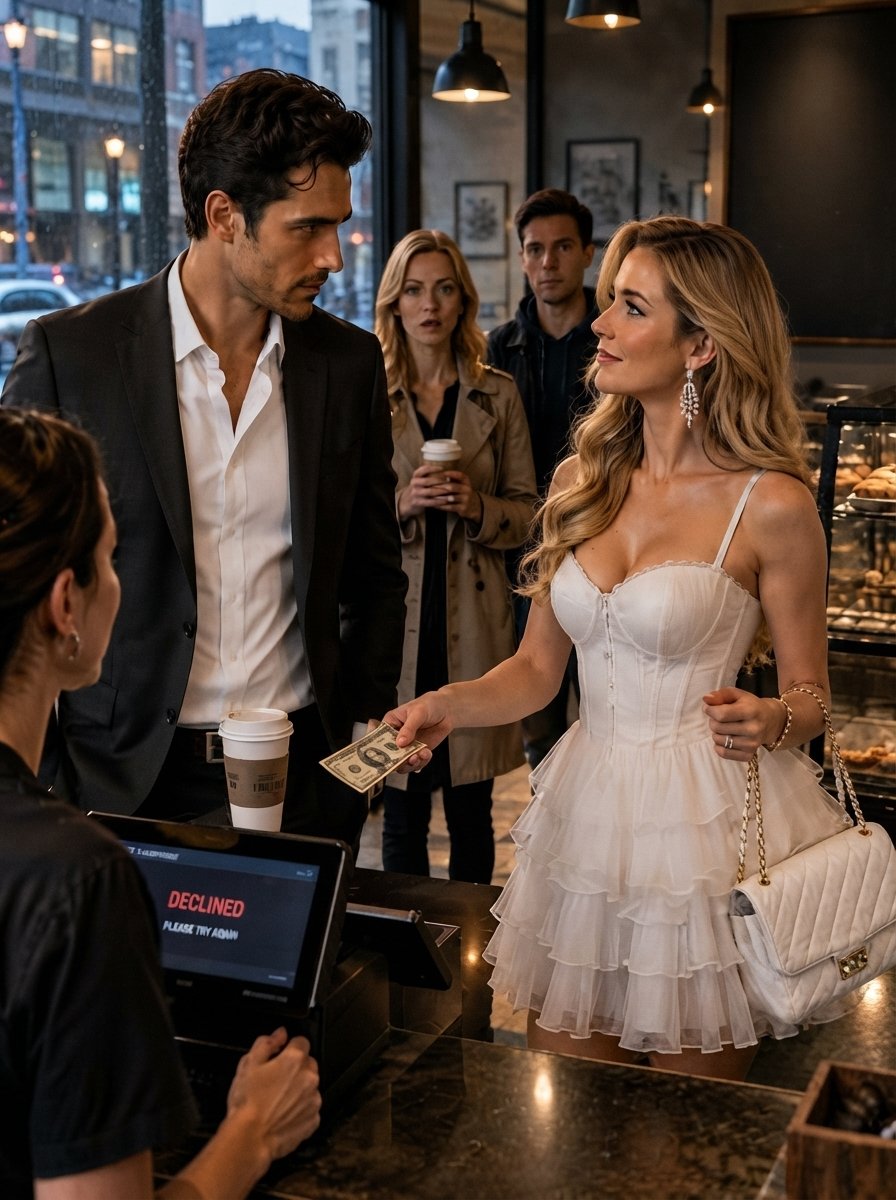
The cashier said, “Your card was declined,” loud enough for three people in line to turn their heads.
For most men, it would have been a minor inconvenience.
For Nathan Cole, it was almost funny.
He was worth more than three hundred million dollars.
He owned the fifty-two-story building visible through the coffee shop window.
And at 8:17 on a rainy Monday morning in downtown Chicago, Nathan Cole could not afford a four-dollar cup of coffee.
“Try it again,” Nathan said quietly.
The cashier gave him the sympathetic smile reserved for people whose lives had just become uncomfortable in public.
She swiped the black metal card a second time.
The screen flashed red.
DECLINED.
Nathan stared at it.
Impossible.
Then he remembered.
His bank had frozen that particular card because his assistant had reported suspicious charges the night before.
His wallet, containing three other cards and several hundred dollars, was sitting on the console of his SUV.
The SUV was six blocks away with his driver.
Nathan reached for his phone.
Dead.
Of course.
Behind him, somebody sighed.
Nathan Cole, the man who could approve a twenty-million-dollar acquisition before breakfast, suddenly wanted the polished concrete floor to open beneath his Italian shoes.
“I’ll leave it,” he said.
He started to step away.
“Wait.”
The voice came from behind him.
A woman wearing a navy security uniform approached the register.
She was probably in her mid-thirties. Brown hair twisted into a practical bun. No expensive jewelry. No designer handbag. Just tired eyes, sensible black shoes, and an employee badge clipped near her shoulder.
Rachel Bennett.
Before Nathan could object, she pulled a few crumpled bills from her pocket.
“I’ve got it.”
Nathan frowned.
“You don’t need to do that.”
“I know.”
“That’s not what I meant.”
She looked at him.
For the first time that morning, someone looked at Nathan without recognition.
No calculation.
No nervousness.
No excitement.
Just simple human understanding.
Rachel handed the cashier five dollars.
Nathan said, “I can pay you back.”
“I’m sure you can.”
“There’s an ATM.”
She smiled.
“Sir, it’s coffee. Not a mortgage.”
The cashier tried not to laugh.
Nathan almost smiled himself.
Almost.
Rachel picked up her canvas tote from a nearby table.
He stopped her.
“At least give me your number. Or your Venmo.”
“No.”
He blinked.
“No?”
She shrugged.
“Someone helped me once when I needed it. You help somebody else someday.”
Then she walked toward the door.
Nathan remained beside the counter holding the paper cup.
“Wait. Rachel.”
She glanced back, apparently surprised he had read her badge.
“Yes?”
“Thank you.”
Something softened in her expression.
“You’re welcome.”
Then the door opened.
Cold Chicago rain blew inside.
Rachel disappeared into the morning crowd.
Nathan stood there long after she was gone.
The coffee cost $4.36.
He would remember the exact amount for the rest of his life.
Because no one had done something that small for him in years.
People bought Nathan dinner because they wanted contracts.
They donated to his charities because they wanted photographs.
They laughed at his jokes because they wanted access.
Even women he dated sometimes seemed more interested in the name Cole than the man carrying it.
But Rachel Bennett had spent money she clearly did not have much of, refused repayment, and walked away.
By nine o’clock, Nathan was fifty stories above the city inside Cole Meridian Systems, the software and financial technology company he had founded sixteen years earlier.
His chief operating officer, Daniel Ross, stood across from Nathan’s desk discussing a pending acquisition.
Nathan heard perhaps twenty percent of it.
Daniel finally stopped.
“You haven’t heard a word I said.”
Nathan looked up.
“I heard you.”
“Then what did I say?”
Nathan glanced toward the empty coffee cup sitting strangely out of place beside financial reports.
Daniel followed his gaze.
“What happened to you?”
“My card got declined.”
Daniel laughed.
Nathan did not.
“A woman paid for my coffee.”
Daniel’s amusement faded.
“And this is why you look like somebody just explained emotions to you?”
Nathan leaned back.
“She didn’t know who I was.”
“Congratulations. You’ve encountered a civilian.”
Nathan ignored him.
“She was wearing a security uniform.”
Daniel raised an eyebrow.
“In the building?”
“I think so.”
“You want me to find her?”
Nathan’s answer came too quickly.
“No.”
Daniel smiled.
Nathan frowned.
“What?”
“You absolutely want me to find her.”
“I said no.”
“You’re staring at a disposable cup like it contains your childhood memories.”
Nathan looked at the cup again.
Daniel laughed.
“Fine. I won’t find her.”
He made it to the door before Nathan said, “Rachel Bennett.”
Daniel stopped.
Nathan hated himself immediately.
“Security uniform. Mid-thirties.”
Daniel slowly turned around.
“You’re unbelievable.”
“I just want to repay her.”
“Four dollars and thirty-six cents?”
“Five.”
“Generous.”
Nathan threw a pen at him.
Daniel caught it.
By lunchtime, Daniel returned with a thin folder.
Nathan stared at it.
“I told you not to investigate her.”
“You also gave me her name, employer, approximate age, and a description.”
Nathan took the folder.
Rachel Bennett was thirty-five.
She worked overnight security for Armitage Protective Services, assigned to the Cole Meridian building from midnight until eight in the morning.
That explained why she had been at the coffee shop immediately after her shift.
She lived in Rogers Park.
No criminal record.
No social media presence beyond a dormant account.
And according to payroll records, she had recently requested additional shifts.
Nathan closed the folder.
“That’s enough.”
Daniel hesitated.
“There’s one more thing.”
Nathan looked up.
“What?”
“She applied for a job here.”
Nathan reopened the folder.
Six months earlier Rachel had applied for a junior cybersecurity analyst position at Cole Meridian.
She had not received an interview.
Nathan frowned.
“Security analyst?”
“Apparently she completed a certification program two years ago.”
“Why is she working downstairs as a guard?”
“Because our recruiting software automatically rejected her.”
“Why?”
Daniel turned the page.
“No four-year degree.”
Nathan’s expression hardened.
Rachel had completed an associate degree in information technology while working full time.
She held three professional certifications.
She had scored in the top seven percent on Cole Meridian’s optional technical assessment.
The automated system had still eliminated her because one field read: Bachelor’s degree required.
Nathan looked toward the windows.
“Who designed that filter?”
Daniel gave him a long look.
“We did.”
Nathan’s company sold hiring software.
Among other things.
The irony tasted bitter.
“She scored that high?”
“Ninety-third percentile.”
“And nobody reviewed it?”
“Apparently not.”
Nathan closed the file.
“Bring her in.”
Daniel smiled.
Nathan lifted a hand.
“For an interview.”
“Of course.”
“And don’t tell her I asked.”
Daniel headed toward the door.
“Why?”
Nathan looked at the empty coffee cup.
“Because I want to know what happens when nobody knows who she helped.”
Rachel Bennett almost deleted the email.
She was sitting at her kitchen table after four hours of sleep when the message arrived.
Cole Meridian Systems would like to invite you to interview for the cybersecurity analyst position.
Rachel read it three times.
Then she laughed.
Not because it was funny.
Because six months earlier, Cole Meridian had sent her a robotic rejection less than twelve minutes after she submitted her application.
She had assumed no human being had ever seen it.
She was right.
Now, suddenly, someone had.
Her eleven-year-old son, Noah, entered the kitchen carrying a cereal bowl.
“Why are you staring at your laptop like it insulted Grandma?”
Rachel smiled.
“I got an interview.”
Noah froze.
“For the computer job?”
“Maybe.”
“The skyscraper?”
“Yes.”
His eyes widened.
“Mom.”
“I know.”
“You said that job pays almost twice what you make now.”
Rachel closed the laptop.
“Let’s not celebrate yet.”
Noah set down his bowl and hugged her anyway.
Rachel held him tightly.
He was too tall now.
When had that happened?
She worked nights partly because it let her be home when Noah returned from school.
It also meant she lived permanently exhausted.
Rachel had been twenty-four when Noah was born.
His father had disappeared before his first birthday.
No dramatic goodbye.
No terrible fight.
Just increasingly unanswered calls until eventually Rachel accepted the truth.
She was alone.
Her mother, Evelyn Bennett, had helped for several years until a stroke took most of Evelyn’s mobility.
Now Rachel supported three people.
Herself.
Noah.
And her mother, who lived in a modest assisted-living apartment near Evanston.
Every dollar had a destination before Rachel earned it.
Rent.
Medication.
School lunches.
Electricity.
Insurance.
That Monday morning, the five dollars she spent on Nathan’s coffee had been meant for her own breakfast.
She had eaten crackers from her locker instead.
She never regretted it.
Her mother had taught her something when she was young.
If helping someone costs you a little but saves them humiliation, pay the little.
So she had.
And forgotten about it.
Mostly.
The man had been difficult to forget.
He had looked wildly out of place being embarrassed.
Tall.
Dark-haired.
Expensive suit.
Gray-green eyes.
The kind of face that belonged on a billboard selling watches.
But his expression after the card declined had not been arrogant.
It had been human.
That was what Rachel remembered.
Two days later, she entered the forty-seventh floor of Cole Meridian wearing the only business suit she owned.
Her hands trembled.
She hated that.
Rachel could face an intoxicated stranger in a parking garage without fear, yet a receptionist with perfect teeth could make her feel twelve years old.
A human resources manager named Melissa Carter greeted her.
The technical interview lasted ninety minutes.
Rachel forgot to be nervous after the first twenty.
She solved a network vulnerability scenario.
Identified a weakness in a simulated payment system.
Then challenged one of the assumptions in the company’s own threat-modeling framework.
The senior engineer across the table leaned forward.
“Why do you think our framework is wrong?”
“I don’t think it’s wrong.”
Rachel pointed toward the diagram.
“I think it assumes attackers behave logically.”
“They usually do.”
“Until they don’t.”
She circled a node.
“If I wanted into this network, I wouldn’t attack your strongest systems. I’d attack the people who service them.”
The engineer smiled slowly.
“Continue.”
Unknown to Rachel, Nathan Cole watched the interview through a secure video feed in his office.
Daniel stood beside him.
“She’s good,” Daniel said.
Nathan did not answer.
Rachel was better than good.
She was sharp without performing intelligence.
Confident without arrogance.
When she didn’t know something, she said so.
When she disagreed, she explained why.
Nathan had interviewed executives who spent an hour finding elegant ways to avoid admitting uncertainty.
Rachel simply said, “I don’t know, but this is how I’d figure it out.”
Nathan smiled.
Daniel noticed.
“This is getting disturbing.”
“Shut up.”
At the end of the interview Melissa said, “We have one final person who would like to meet you.”
Rachel nodded.
The conference-room door opened.
Nathan entered.
Rachel’s expression froze.
He had changed from the rain-soaked stranger at the coffee shop.
No open collar.
No embarrassed glance at a declined card.
Now he wore a charcoal suit and the quiet authority of a man who belonged wherever he stood.
Rachel looked from him to Melissa.
Then back.
Nathan extended his hand.
“Nathan Cole.”
Rachel slowly stood.
“Cole?”
“Yes.”
“As in Cole Meridian?”
“Yes.”
She stared at him.
“You own this company.”
“I founded it.”
Her face turned bright red.
Nathan almost felt guilty.
Almost.
“You let me buy your coffee.”
“I tried very hard not to.”
“You’re a billionaire.”
“Not quite.”
Rachel looked genuinely annoyed.
“That makes it worse.”
Melissa coughed to hide a laugh.
Nathan said, “Can we talk privately?”
Rachel glanced around.
“Am I in trouble?”
“No.”
“Did I violate some company policy by loaning the CEO five dollars?”
“You didn’t loan it. You refused repayment.”
“That is not the important part.”
Nathan asked Melissa to give them a few minutes.
When they were alone, Rachel crossed her arms.
“You arranged this interview.”
“Yes.”
Her expression changed.
Disappointment.
Nathan saw it immediately.
“You didn’t think I earned it.”
“That isn’t what I said.”
“You read my badge, had somebody research me, saw I applied here, and decided to do me a favor.”
Nathan leaned against the table.
“I did have someone look up your application.”
“I knew it.”
“But I didn’t tell anyone to hire you.”
Rachel remained silent.
“You scored in the ninety-third percentile on our assessment six months ago. Our system rejected you because you don’t have a bachelor’s degree.”
Her anger faded slightly.
Nathan continued.
“Our system failed. Not you.”
Rachel looked down.
“That’s easy for the man who owns the system to say.”
“It’s harder for the man whose name is on it.”
That made her look up.
Nathan slid a paper across the table.
“Your technical score today was the highest among seventeen candidates.”
Rachel stared at it.
“You’re serious?”
“Yes.”
“The interview wasn’t fake?”
“No.”
“And nobody was told about the coffee?”
“Only Daniel.”
“Who’s Daniel?”
“The man currently laughing somewhere because I promised him I wouldn’t get involved.”
Rachel sat down.
For a moment, Nathan watched disbelief slowly transform into hope.
It affected him more than he expected.
“What happens now?” she asked.
“If the hiring team recommends you, you get an offer.”
“You don’t decide?”
“I could.”
“But?”
Nathan smiled.
“You wouldn’t trust it if I did.”
Rachel considered that.
“No.”
“Neither would I.”
She looked at him for several seconds.
Then smiled.
“Maybe you’re slightly less annoying than I thought.”
“Slightly?”
“The billionaire thing is still irritating.”
“Again, not technically.”
“Please stop defending yourself.”
Nathan laughed.
It surprised both of them.
Rachel received the offer Friday afternoon.
The salary was eighty-four thousand dollars.
She read the number until the screen blurred.
Her current security job paid forty-one.
With overtime, maybe fifty.
Cole Meridian offered health insurance.
Tuition assistance.
Retirement matching.
Normal daytime hours.
Rachel covered her mouth.
Noah found her crying at the kitchen table.
“Mom?”
She turned the laptop toward him.
He read the email.
Then screamed.
Actually screamed.
They hugged so hard Rachel nearly knocked over her chair.
That evening she drove to her mother’s assisted-living apartment carrying takeout from Evelyn’s favorite Chinese restaurant.
Evelyn Bennett was sixty-eight, silver-haired and elegant despite the wheelchair that had become permanent after her stroke.
Her speech was slower than before.
Her mind remained sharp.
Rachel told her everything.
The coffee.
Nathan.
The interview.
The job.
Evelyn listened with increasing surprise.
Then Rachel mentioned his name.
“Nathan Cole.”
The color left Evelyn’s face.
Rachel stopped.
“Mom?”
Evelyn gripped the wheelchair armrest.
“What did you say?”
“Nathan Cole.”
Evelyn’s voice dropped.
“Cole Meridian?”
“Yes.”
Her mother turned toward the window.
Rachel frowned.
“You know him?”
“No.”
The answer came too quickly.
“Mom.”
“I knew his father.”
Rachel went still.
“Richard Cole?”
Evelyn closed her eyes.
Rachel had seen Richard Cole’s name before.
Chicago newspapers had written about him often.
He had been an industrialist, investor, and philanthropist.
He died in 2003.
Nathan had been twenty-one.
“What do you mean you knew him?”
Evelyn’s hands began trembling.
“Long ago.”
“How?”
“Rachel, please.”
“Mom.”
Evelyn looked at her daughter.
There was fear in her eyes.
Not nostalgia.
Not sadness.
Fear.
“Promise me something.”
Rachel’s stomach tightened.
“What?”
“Do not tell Nathan Cole my name.”
Rachel stared.
“Why?”
“Promise me.”
“Mom, my last name is Bennett. He already knows my name.”
Evelyn closed her eyes.
“Then pray he never asks about me.”
Nathan did ask.
Not immediately.
For the first month Rachel worked at Cole Meridian, their contact remained professional.
Mostly.
Nathan found reasons to visit the cybersecurity floor more frequently.
Daniel noticed.
Everyone noticed.
Rachel pretended not to.
She was too busy trying not to drown.
Her first assignment involved auditing the company’s authentication systems.
Her second involved investigating a pattern of suspicious access attempts.
On her third week, she found something unusual.
Someone had attempted to enter a restricted archival server.
Not recently.
Years earlier.
Repeatedly.
The server contained legacy company records transferred from Cole Industrial Group, Nathan’s father’s business.
Most employees ignored those archives.
Rachel did not.
The access attempts came from an internal administrative account that had supposedly been deactivated in 2003.
She brought the issue to her supervisor.
He shrugged.
“Probably migration noise.”
“It happened forty-seven times.”
“In twenty-three years.”
“Using credentials assigned to a dead employee.”
That got his attention.
The former employee’s name was Evelyn Bennett.
Rachel’s heart stopped.
She stared at the screen.
Mother.
Her supervisor said, “You okay?”
Rachel closed the window.
“Yes.”
That evening, instead of going home, Rachel drove to Evanston.
Evelyn was waiting beside the window.
Rachel entered carrying no food.
No smile.
She placed a printed security report on her mother’s table.
Evelyn looked down.
Her face collapsed.
“You worked for Richard Cole.”
Silence.
“Mom.”
“Yes.”
“What did you do?”
Evelyn stared at her hands.
“I was his executive assistant.”
Rachel sat down.
“For how long?”
“Eight years.”
“You never told me.”
“No.”
“Why?”
“Because that part of my life destroyed almost everything.”
Rachel felt cold.
“What is on that server?”
Evelyn looked toward the doorway.
Then whispered, “Something Richard spent the last years of his life trying to hide.”
Rachel’s pulse accelerated.
“From Nathan?”
Evelyn’s eyes filled with tears.
“Especially from Nathan.”
Nathan was thirty minutes into a board meeting the next morning when Rachel sent him a message.
I need to speak to you privately. It concerns your father.
Nathan stopped reading.
Daniel leaned over.
“What?”
Nathan showed him.
Daniel’s expression changed.
The meeting ended ten minutes later.
Rachel waited in Nathan’s office.
She looked pale.
Nathan closed the door.
“What happened?”
“Did my mother ever work for your father?”
Nathan frowned.
“Your mother?”
“Evelyn Bennett.”
The name hit him strangely.
Familiar.
Not from memory exactly.
From somewhere deeper.
Nathan walked toward his desk.
“Say that again.”
“Evelyn Bennett.”
Nathan opened a drawer and removed an old leather notebook.
His father’s.
Richard Cole had kept journals.
Most were mundane business records.
Nathan turned pages.
Then stopped.
A name appeared repeatedly.
E. Bennett.
His chest tightened.
“She was his assistant.”
Rachel nodded.
Nathan looked at her.
“Why didn’t you tell me?”
“I didn’t know.”
Nathan believed her.
“What does she know?”
Rachel took a breath.
“I’m not sure.”
“Rachel.”
“She told me your father hid something.”
Nathan’s expression hardened.
“What?”
“She wouldn’t say.”
Nathan looked again at the journal.
His father had died after a brief battle with pancreatic cancer.
Before dying, Richard had spent weeks trying to tell Nathan something.
Nathan had been angry then.
Angry at the illness.
Angry at the company.
Angry at a father who had spent more time building factories than raising his son.
Their final conversation still haunted him.
Richard had gripped Nathan’s wrist from his hospital bed.
“There’s something about your mother.”
Nathan had pulled away.
His mother, Caroline, had died when Nathan was six.
Nathan did not want Richard rewriting the dead during his final days.
“Not now, Dad.”
“You need to know.”
“We’ll talk tomorrow.”
There was no tomorrow.
Richard died before sunrise.
For twenty-three years Nathan wondered what sentence had remained unfinished.
Now Rachel Bennett had walked into his life carrying his father’s former assistant’s name.
Nathan looked at her.
“I want to speak to your mother.”
Rachel shook her head.
“She doesn’t want to see you.”
“Why?”
“I don’t know.”
“That isn’t enough.”
“It’s enough for her.”
Nathan’s voice hardened.
“My father died trying to tell me something. If your mother knows what it was, I deserve to hear it.”
Rachel’s eyes softened.
“I agree.”
“Then help me.”
She hesitated.
“I’ll ask her.”
Evelyn refused.
Then Rachel returned the next night.
And the next.
On Friday, Evelyn finally surrendered.
“One meeting.”
Nathan arrived alone.
No attorney.
No Daniel.
He entered Evelyn’s apartment carrying his father’s leather journal.
The moment Evelyn saw it, tears filled her eyes.
“I remember that.”
Nathan sat opposite her.
“You knew my father.”
“Yes.”
“How well?”
Evelyn smiled sadly.
“Well enough to know his greatest strength was ambition.”
She paused.
“And his greatest weakness was fear.”
Nathan leaned forward.
“Fear of what?”
“Losing you.”
Nathan did not understand.
Evelyn reached into a drawer.
She removed an old envelope.
Inside was a photograph.
Richard Cole, perhaps thirty-five years old.
Beside him stood a young Evelyn.
And another woman.
Nathan recognized her immediately.
His mother.
Caroline.
The three of them stood outside a hospital.
Nathan turned the photograph over.
Written on the back:
June 14, 1982. The day everything changed.
Nathan’s birthday was June 14, 1982.
His hands went cold.
“What happened that day?”
Evelyn began crying.
“Your mother nearly died giving birth.”
Nathan waited.
“You were born early. There were complications.”
“I know that.”
“No.”
Evelyn shook her head.
“You know what Richard told you.”
Nathan’s breathing slowed.
Rachel sat beside her mother.
“Mom, tell him.”
Evelyn looked directly at Nathan.
“Caroline did give birth that day.”
Nathan gripped the photograph.
“But?”
“But her baby died.”
Silence.
Nathan stared at her.
“What?”
“Her son was stillborn.”
The room seemed to tilt.
Nathan stood.
“No.”
Evelyn’s tears fell.
“I’m sorry.”
“No.”
“Nathan.”
“My birth certificate.”
“Was altered.”
“My father.”
“Was not your biological father.”
Nathan backed away from her.
Rachel stood.
“Nathan.”
He raised a hand.
“Don’t.”
His face had gone white.
“You’re saying Richard Cole stole a baby?”
Evelyn shook her head.
“No.”
“Then where did I come from?”
Evelyn looked at Rachel.
Then at Nathan.
And for the first time, Rachel understood why her mother had been afraid.
Evelyn whispered, “From me.”
Rachel stopped breathing.
Nathan stared at her.
Evelyn continued.
“I gave birth in the same hospital.”
Rachel’s voice cracked.
“You had another child?”
Evelyn nodded.
“A son.”
Nathan’s face became empty.
“You’re saying…”
Evelyn covered her mouth.
“You are my son.”
Rachel stumbled backward.
“No.”
Nathan said nothing.
Rachel looked between them.
“That would make him…”
Her voice disappeared.
Evelyn nodded.
“Your brother.”
Rachel stared at Nathan.
The man whose coffee she had bought.
The CEO who had opened the door to her career.
The man she had slowly begun to care about in a way she had not allowed herself to name.
Her brother.
Nathan turned toward the window.
For a full minute, nobody spoke.
Then he asked, “Why?”
Evelyn’s voice trembled.
“I was nineteen.”
She corrected herself.
“Twenty.”
“I had no money. Your biological father had left when he learned I was pregnant.”
She looked toward the old photograph.
“I worked temporarily for a company connected to Richard’s family. Caroline was kind to me. She knew I was expecting.”
The delivery had been catastrophic.
Caroline lost her baby.
Evelyn delivered Nathan hours later.
“I was terrified,” Evelyn said. “I had nowhere to live after my mother threw me out. Richard came to my hospital room.”
Nathan turned.
“What did he offer you?”
Evelyn flinched.
“A life for you.”
Nathan laughed once.
There was no humor in it.
“He bought me.”
“No.”
“He paid you.”
“He arranged housing. Education. Work.”
“So yes.”
Evelyn cried.
“I was young.”
Nathan’s voice broke.
“And you gave me away?”
“I thought you would have everything.”
“I had everything except the truth.”
Rachel whispered, “Nathan.”
He turned sharply.
“And you had no idea?”
“No.”
He looked at her face.
Something in his expression changed.
Pain more than anger.
Then he left.
Nathan disappeared from work for four days.
Daniel told everyone he was traveling.
Rachel knew better.
She sent one message.
I’m sorry. I truly didn’t know.
No response.
On the fifth day, Nathan returned.
He looked older.
Rachel found him in his office after midnight.
“You should go home,” he said without turning around.
“So should you.”
Nathan looked over the city.
“I ordered DNA tests.”
Rachel said nothing.
“The results came this afternoon.”
He placed a folder on the desk.
Rachel’s heart pounded.
“And?”
Nathan looked at her.
“Your mother is not my mother.”
Rachel stared.
“What?”
“The DNA excludes her.”
Relief and confusion collided.
“But she…”
“Lied.”
“Why?”
“That is what I intend to discover.”
Nathan opened another report.
“There’s more.”
He tapped a section.
“My maternal DNA matches someone already in a commercial genealogy database.”
Rachel sat slowly.
“Who?”
Nathan turned the laptop toward her.
A family tree appeared.
At the center was a name Rachel recognized.
Evelyn Bennett.
Not her mother.
Her grandmother.
Rachel blinked.
“My grandmother was also Evelyn.”
Nathan nodded.
“Your mother was named after her.”
Rachel’s grandmother had died before Rachel was born.
Nathan pointed to the match.
“The DNA suggests Evelyn Bennett Senior was my grandmother.”
End Part Here: She Paid for a Stranger’s Coffee After His Card Was Declined and Had No Idea He Was the CEO Who Could Change Her Life