
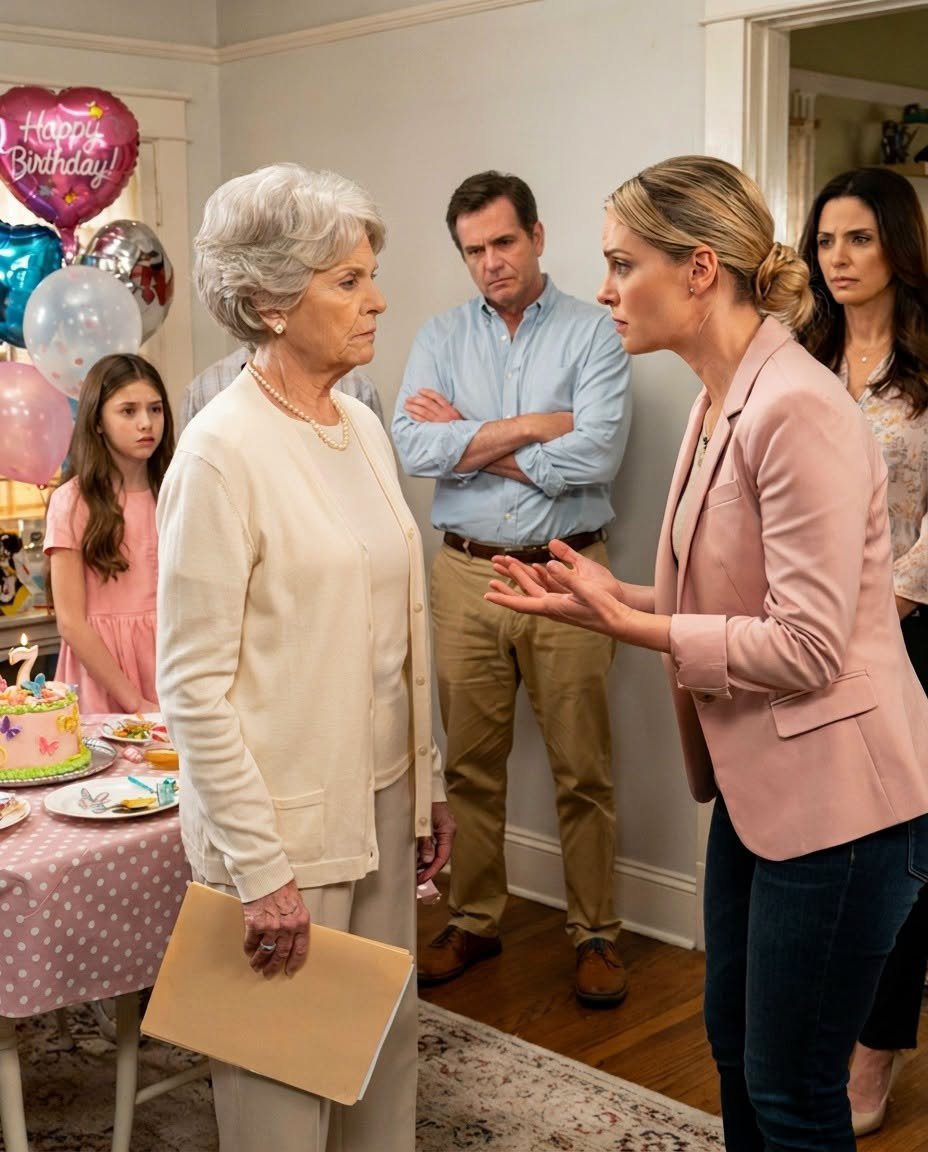
I thought about Lucas’s face when he opened the gift. I thought about Sophie, who was three and did not yet know that the adults responsible for her were having this conversation. I thought about Derek in the kitchen with his lemonade, looking like a man who had been gradually replaced by someone wearing his face.
Then I said, “I understand what you’re asking.”
And I turned, found Rachel in the crowd, said quietly that we needed to leave, and moved toward the door.
Rachel read my face in the way she reads symptoms, quickly and without needing everything explained. She gathered Owen and followed without questions.
Ten minutes later I was sitting in a shopping center parking lot half a mile from Derek’s house with the engine running and my phone in my hand.
Rachel sat in the passenger seat. “Mom. What did she say?”
I told her.
Rachel is not a person who panics, which is useful in a surgeon and equally useful in a sister. She listened to the full account without interrupting, and when I finished she was quiet for a moment in the way she is quiet when she is organizing information.
“Call Thomas,” she said.
Thomas Brennan has managed my finances and served as my legal adviser for twenty years. He knew Martin. He helped structure the trusts. He is fifty-eight years old and has the particular patience of someone who has spent two decades watching families navigate money and has seen every variation of what happens when they do it poorly.
He answered on the third ring.
“Sylvia,” he said.
“I need you to know something has happened,” I said. “And I need you to tell me exactly where we stand.”
He told me to take my time.
I did not take much time. I gave him the relevant facts in the order they had occurred, the conversation in the hallway, the specific demand, the context of the preceding months. Thomas listened without interrupting, which is one of the things I have always valued about him, the willingness to receive information completely before responding to it.
When I finished, there was a brief silence.
“The trusts are structured correctly,” he said. “You are the trustee. The funds are not accessible to Derek or Amber without your authorization. That cannot be changed without your agreement, and you have no legal or ethical obligation to agree.”
“I know that,” I said. “I want to know what else needs to happen.”
“We should review the trust documents and make sure everything is current and properly filed. We should also document today’s conversation. And depending on how this develops, we may want to consider whether any adjustments to the structure would better protect the accounts going forward.”
“When can you meet?”
“Monday morning,” he said. “First thing.”
I thanked him and ended the call.
Rachel was watching me. “What did he say?”
“He said what I already knew,” I told her. “But it helps to hear it said by someone who knows where all the documents are.”
I drove home through the early September afternoon feeling something I had not expected to feel, which was not anger, exactly, but a kind of clarity. The sadness was there too, underneath it, the specific sadness of confirming what you had hoped was not quite as bad as you feared. But the clarity was sharper than the sadness, and it was the clarity I needed.
Monday morning I sat in Thomas’s office with the full documentation of the trusts and a written account I had prepared of the conversation with Amber, including the date, the location, and the specific language she had used. Thomas reviewed everything methodically, making notes in the margin of a yellow legal pad in his compact handwriting.
What we addressed first was the structure of the trusts themselves. They were sound, Thomas confirmed. Ironclad was the word he used, and he used it without drama, simply as an accurate technical description. I was the sole trustee. The funds could not be redirected, accessed, or restructured without my authorization. Derek and Amber had no legal standing to compel any change in the arrangement.
What we addressed next was documentation.
Thomas explained that while the trusts were currently protected, the best additional protection was a thorough paper record, a clear accounting of the original intent behind each account, the conditions of distribution, and any communications that appeared to challenge or pressure the arrangement. We spent two hours building that record. Bank statements. Original trust documents. The written account of the hallway conversation. A timeline of the escalating pressure over the preceding year, reconstructed from my calendar and my email records and the notes I had kept with more foresight than I realized at the time.
“People like Amber,” Thomas said, not unkindly, “often stop when they encounter documentation. The pressure depends on the target not having organized resistance. Once they understand the resistance is organized, the calculation changes.”
I asked him what else he recommended.
He suggested a letter. Not threatening, not adversarial, but clear. A formal communication from his office to Derek and Amber acknowledging that I was aware of the request to transfer trustee authority, explaining the legal structure of the accounts, and stating plainly that no such transfer would occur. Professional in tone. Impossible to misread.
“That letter,” he said, “will also create a record that they were formally informed. If anything escalates from here, the record matters.”
The letter went out Wednesday.
Derek called me Thursday evening. His voice had the quality I had been hearing in it for months, tired and careful, the voice of a man managing multiple demands simultaneously and finding none of them satisfying. But there was something underneath it that was slightly different, a note that might have been embarrassment, or might have been relief, the two emotions being closer than most people expect.
“Mom,” he said. “Can we have dinner? Just us. Without Amber.”
I said yes.
We met at a restaurant near his office on Friday, a quiet place where we had eaten together many times over the years. He arrived looking like he had not been sleeping well, which is different from looking tired in the ordinary sense. He ordered water and sat with it for a moment before he said anything.
“I didn’t know she was going to say that to you,” he said. “About the trusts.”
“Were you aware she intended to have that conversation eventually?”
He was quiet. “She had mentioned wanting to talk to you about the structure. I didn’t know she was going to do it that way.”
“At your son’s birthday party,” I said. “In the hallway.”
“I know.” He rubbed his forehead. “Mom, I know.”
I looked at my son across the table and did what I had always tried to do with him, which was to tell the truth without cruelty.
“Derek, I am not angry at you,” I said. “But I need you to understand what I saw in that house when we arrived. You were standing in your own kitchen looking like a visitor. Almost no one from your family was there. Your brother didn’t come. My sister wasn’t invited. And your wife specified the exact hour I was permitted to attend my grandson’s birthday.”
He did not argue with any of it.
“I know things have gotten narrow,” he said. “I’ve been trying to find the balance.”
“Balance requires both sides of the scale to be acknowledged,” I said. “I don’t think your side has been.”
He was quiet for a long time. When he spoke again, his voice was different, lower and more careful, the voice of someone saying something they have been carrying for a while.
“She told me that you were trying to control the family,” he said. “That the trusts were your way of holding power over us. That you never really let go after Dad died.”
I let the words settle.
“And what did you think?” I asked.
“I thought it was complicated,” he said. “And then I kept hearing it until I started thinking maybe it wasn’t complicated.”
“That’s how that works,” I said. “That’s exactly how it works.”
We sat with that for a moment.
“I’m not trying to control your family,” I said. “I set up those trusts because I watched Martin die and I understood that the money I had built over thirty years needed to go somewhere real. Somewhere it would actually help Lucas and Sophie begin their lives rather than disappear into someone else’s priorities. That is what I was protecting. Not power. Those children.”
Derek looked at the table. Then he looked at me.
“I know,” he said quietly. “I think I’ve known.”
What followed was not a resolution. I want to be honest about that, because stories that end in clean resolutions are usually leaving something important out. What followed was a beginning, the cautious and effortful beginning of Derek finding his way back to himself, which is slower and less linear than it sounds.
He started meeting me alone for dinner, once or twice a month, the way we used to before Amber’s gravitational field had pulled those evenings into the general category of things that created friction. He talked more honestly in those conversations than he had in years, about his marriage and what had changed in it, about the fatigue he had been managing, about the specific experience of watching someone you love become someone you are slightly afraid to disappoint.
I listened more than I spoke. That has always been the harder discipline for me, and the more necessary one.
Thomas’s letter had the effect he predicted. There was no formal response. Amber did not contact me directly to continue the conversation. The pressure around the trusts did not resurface, at least not in any form I was asked to address. The documentation had done what documentation does when it is done correctly, which is to make clear to all parties exactly where the edges are.
What it could not do was resolve the question of access to my grandchildren, which remained constrained in ways that required patience rather than legal remedy. Patience is something I had more of than I had expected, having spent a year quietly preparing for a confrontation I had hoped would not come and having emerged from it with the documentation in order and my position intact. I could afford patience.
I saw Lucas and Sophie on the Sundays Derek began managing more deliberately, visits that Amber did not oversee with the same granularity she had before, whether because the letter had recalibrated something or because Derek had found, slowly and imperfectly, the backbone I had always believed was there beneath the erosion.
At one of those Sunday visits, Lucas showed me a drawing he had made of the robot set assembled. He had stayed up past his bedtime to finish it, apparently, and had hidden it in his backpack to give me.
I keep it on my desk.
Three months after the birthday party, I had a longer conversation with Amber. Not the confrontation I might have had immediately after the hallway, when everything was still raw, but a deliberate conversation I initiated at a time I chose, at a restaurant on neutral ground, with enough time and space for both of us to be something other than our worst versions.
I told her what I had told Derek, that I was not trying to control her family, that the trusts were for the children and had always been for the children, that my desire to be in Lucas and Sophie’s lives was not a challenge to her authority as their mother but a straightforward expression of love.
I also told her that the conversation in the hallway, on Lucas’s birthday, in the manner she had chosen to have it, had confirmed something for me that I had been trying to resist confirming for two years. And that what happened next depended not on any change in the legal structure of the trusts, which was not changing, but on whether we could find a way to be honest with each other about what we both actually wanted.
Amber is not an uncomplicated person, and she did not respond simply. There was defensiveness and there were several moments where I thought she might leave. But she stayed, and she talked, and some of what she said was more revealing than she intended.
She told me that her own mother had been controlling, and that watching me with Derek and the grandchildren activated something in her that was not entirely rational. She told me that she had grown up without financial security and that the trusts felt like a locked room in the house she was trying to make her own. She told me that she was aware, on some level, that she had handled things badly and that she was not sure how to back away from the position she had taken without it feeling like a defeat.
I told her that it was not a defeat. That protection of my grandchildren’s futures was not a competition. That I had never wanted to be her adversary, and I did not want to be one now.
I do not know whether Amber believed me completely. I do not know whether the changes that followed came from that conversation or from the letter or from whatever Derek had said to her in the weeks between. Probably all three, and other things I was not present to see.
What I know is that the visits became more regular. That Amber began texting me occasionally, small things, a photograph of Sophie in her Halloween costume, a note that Lucas had built the entire robot set and was asking whether Grandma Sylvia knew how to program it. These were not large gestures, but they were real ones, the kind that cost something to make and are therefore worth more than the kind that cost nothing.
What I know is that Derek is finding himself again, slowly and with effort, learning to hold his own ground in his marriage without losing either himself or Amber in the process. I do not imagine it is easy. I know it is necessary.
What I know is that my grandchildren have a grandmother who is present, who shows up on the Sundays that are available, who reads to Sophie until she falls asleep and who is learning the basics of robot programming in order to be useful to Lucas, which is the kind of grandparenting that does not photograph particularly well but is the kind that matters.
And I know that the trust funds are exactly where they have always been, properly structured and properly documented, growing quietly for the day Lucas and Sophie and Owen will be ready for them.
Martin built those accounts with me in the years before we knew what would happen to him, before the diagnosis that moved faster than either of us had prepared for. He believed in giving children a beginning rather than a rescue. He believed that love expressed through protection was as real as love expressed through presence.
I believe both of those things. I have spent four years holding them together without him, which is the hardest work I have done since the years when I was fighting for a seat at tables that had not expected me to stay.
The difference is that now I know exactly which tables are worth staying at.
I know what I am protecting and why.
And I know that the people who love me, really love me, the ones who are worth the patience and the long dinners and the Sunday visits and the slow work of rebuilding what erosion damaged, those people have always known it too.
They just sometimes need time to remember.
On a Tuesday afternoon in late November, Lucas called me from Derek’s phone. He had asked permission, apparently, which was new, and the asking of it told me something about what was shifting in that house.
“Grandma Sylvia,” he said, “I built the whole robot. It moves now. Do you want to come see?”
“Yes,” I said. “I very much want to come see.”
“Can you come Saturday?”
“I’ll be there Saturday.”
There was a pause on the line, the pause of a six-year-old who has more to say and is assembling the words for it.
“Grandma? I’m glad you came to my birthday.”
I held the phone for a moment with my hand over my eyes.
“I wouldn’t have missed it,” I said. “I never will.”