
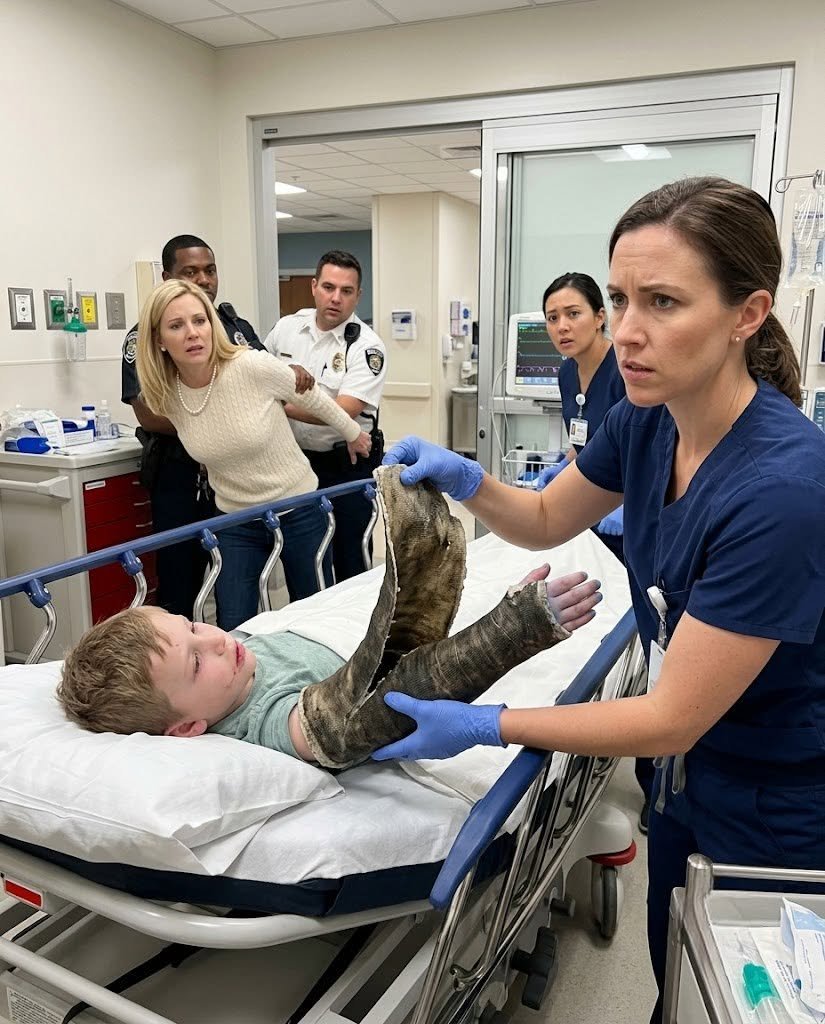
The rotting smell in Trauma Room 2 was unbearable, but when I finally cut off the 8-year-old boy’s filthy, neglected cast, what fell out onto the sterile floor made every seasoned ER nurse scream and step back in pure horror.
The smell reached the hallway before the stretcher had even cleared the ER doors.
It was sweet, metallic, and heavy enough to cling to the back of my throat, cutting straight through the bleach and disinfectant that usually defined the emergency department.
Fluorescent lights buzzed above the nurses’ station while rubber soles squeaked across the polished floor, carts rolled between rooms, and monitors sounded their familiar alarms.
Underneath all of it was that smell.
Wet. Rotten. Wrong.
I’m Dr. Sarah Jenkins, and after eight years in emergency medicine, I had learned not to judge the seriousness of a case by the way a patient arrived.
People walked in while having heart attacks because they were embarrassed to call an ambulance.
Parents carried children through the doors apologizing for bothering us, only for us to discover that those children were far sicker than anyone realized.
I had treated mangled hands, infected wounds, broken bones, and injuries that made experienced staff members quietly look away for half a second before getting back to work.
I had also treated children whose parents had waited far too long before seeking help.
But the boy being rushed toward Trauma Room 2 stopped the normal rhythm of our entire unit.
Marcus, one of our nurses, came toward me quickly with one hand pressed over his mask.
His face had gone gray.
“Dr. Jenkins, now,” he said. “Eight years old. Mom says mild flu. Heart rate 140, temperature 103.8, blood pressure dropping. He’s barely responding.”
He glanced toward the sliding door of Trauma Room 2 before lowering his voice.
“It’s his arm.”
That was all he said.
Then the door opened.
The air that rolled out hit me like a physical force.
For one second, instinct told me to turn my head.
Training took over instead.
I stepped inside.
The child on the bed was so small that at first glance he looked closer to five than eight.
His lips were cracked and dry.
His skin had the thin, waxy appearance I had seen in children who had been seriously ill much longer than the adults around them wanted to admit.
His eyes were open, but they did not track the movement around him normally.
They drifted past the ceiling lights while Marcus spoke to him, as if the boy were slowly slipping somewhere beyond our reach.
His right arm lay stiffly beside him.
A fiberglass cast covered it from his knuckles to above his elbow.
I had seen thousands of casts.
Kids usually decorated them with signatures, jokes, hearts, superheroes, or messy drawings from classmates.
This one looked nothing like that.
It was black with dirt.
Dark rings stained the fiberglass.
The edges were frayed and rough, and the material had begun digging into the swollen skin around it.
The boy’s exposed fingertips were blue.
I pressed one gently and watched for the color to return.
It didn’t.
Clara, one of our most experienced nurses, came in behind me already wearing two masks.
She had rubbed peppermint oil beneath her nose, something staff occasionally used when a smell became difficult to tolerate.
It barely helped.
Her eyes moved from the cast to the boy’s face.
Then to the monitor.
Her hands tightened around the blood pressure cuff.
“How long has this cast been on?” I asked.
The boy’s mother was standing in the corner.
She held a paper Starbucks cup in one hand.
Her name was Martha Harris.
Nothing about her appearance matched the chaos surrounding her child.
She wore a cream sweater and a pearl necklace.
Her blonde bob was smooth and carefully styled, and her nails looked freshly done.
She stood there with a composure that felt almost impossible beside the bed where her son was burning with fever and barely responding.
Then she smiled at me.
It was a thin, polite smile, the kind someone might give while waiting for a delayed appointment.
“Oh, about a month,” she said. “He’s clumsy. Always falling out of trees in the backyard. We’re only here because he felt warm this morning. Probably a seasonal bug.”
A month.
I looked back at the cast.
A month did not look like that.
A month did not smell like that.
The monitor showed the boy’s heart racing while his blood pressure continued moving in the wrong direction.
Marcus opened a pediatric IV kit near the crash cart.
Labels were already lined up beside him.
The sepsis protocol sheet had been clipped to the bed rail.
Clara began checking the boy again while keeping her voice calm enough not to frighten him further.
Everybody in that room understood that we were running out of time.
Everybody except Martha seemed willing to acknowledge it.
I moved closer to her.
“Mrs. Harris, your son is in septic shock,” I said. “That cast has to come off immediately. He may lose his hand. He may lose his life.”
I expected panic.
I expected questions.
I expected her to look toward her son.
Instead, the small smile on her face tightened.
“No,” she said.
For a moment I thought she had misunderstood me.
“His orthopedic surgeon said two more weeks,” she continued. “Give him antibiotics, and we’ll leave.”
The room seemed to shrink around that sentence.
I had just told a mother that her eight-year-old child could die.
Her response was that we should give him medication and send him home.
I kept my attention on her, but every few seconds my eyes returned to the boy’s hand.
Those blue fingers were not an abstract warning anymore.
They were visible evidence that whatever was happening beneath that cast could no longer be ignored.
Clara wrapped the blood pressure cuff around the child with controlled, practiced movements.
Even she could not completely hide the tremor in her hands.
Marcus prepared what we would need while another monitor alarm sounded from somewhere down the hall.
The smell remained everywhere.
It filled the room, followed us toward the door, and settled into every breath.
Martha took another small sip from her coffee.
That simple movement disturbed me almost as much as her words.
Neglect does not always arrive looking monstrous.
Sometimes it arrives brushed, scented, and perfectly composed, carrying expensive coffee and asking everyone else to pretend the smell is not coming from the child.
I looked at the boy again.
He barely reacted when Clara touched him.
His chest rose shallowly beneath the hospital gown.
His fingertips stayed blue.
And something from three years earlier surfaced in my mind.
Another child.
Another polished explanation.
Another adult who had managed to make delay sound reasonable.
I remembered the uneasy feeling I had ignored for too long because I wanted complete answers before I pushed harder.
Emergency medicine teaches you to move quickly, but it also teaches you how often people hide serious situations behind ordinary words.
A fall.
A fever.
A misunderstanding.
Something that could wait until tomorrow.
End Part Here: The rotting smell in Trauma Room 2 was unbearable, but when I finally cut off the 8-year-old boy’s filthy