The Inhaler She Wasn’t Allowed to Use
Part 1 — “I Can’t Breathe Right”
At 10:17 on a Tuesday morning, my seven-year-old daughter, Lily Carter, raised her hand during reading class at Jefferson Elementary School in Ohio.
“Mrs. Grayson,” she whispered, “I can’t breathe right.”
Her teacher barely looked at her. She continued writing vocabulary words on the board.
“You were talking perfectly well a minute ago.”
But Lily’s breathing was already changing.
A thin whistle followed every breath. Her shoulders rose higher each time she tried to inhale, and the muscles around her ribs tightened beneath her yellow school shirt.
“My inhaler,” Lily said. “It’s in my backpack.”
Several students turned toward her.
Lily had asthma.
More importantly, the school knew it.
I had already submitted a doctor-signed emergency action plan stating that Lily was allowed to carry and use her rescue inhaler whenever asthma symptoms appeared.
Lily reached into her backpack and pulled out the blue inhaler.
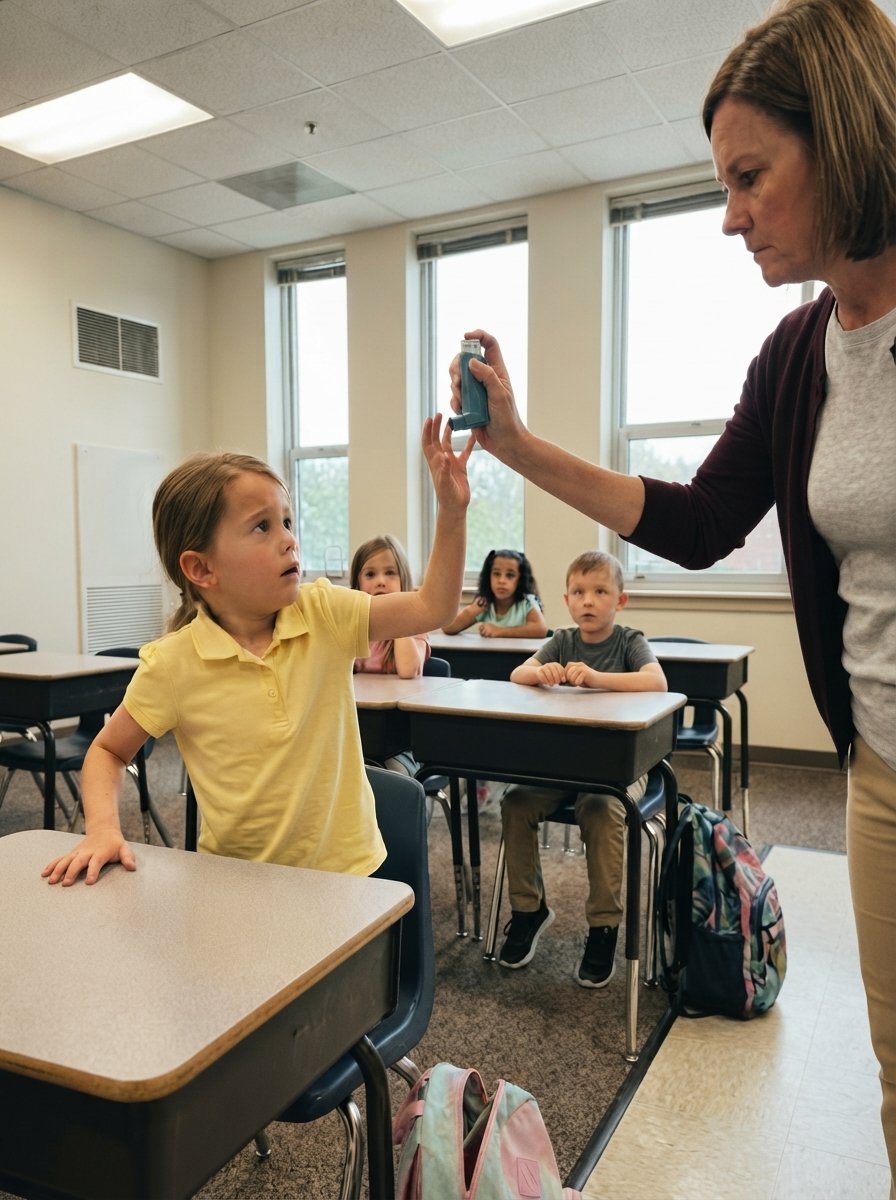
Before she could use it, Mrs. Grayson crossed the room and took it from her hand.
“You don’t need this,” the teacher said. “You need to calm down.”
“My chest hurts,” Lily gasped.
“You used that excuse during recess last week.”
Lily reached for the inhaler again.
Mrs. Grayson held it out of reach.
“Sit down and take slow breaths.”
Lily tried.
She truly tried.
But she couldn’t.
Her breaths became shorter and weaker. She bent over her desk, pressing both hands against it as she struggled desperately for air.
The color began draining from her lips.
A boy named Ethan Morales stood up.
“She looks really sick,” he said.
“Sit down, Ethan,” Mrs. Grayson ordered.
Lily tried to speak again.
Nothing came out.
Then her knees gave way.
She collapsed onto the classroom floor.
That was the moment Ethan stopped listening to his teacher.
He ran out of the classroom, sprinted down the hallway, and slammed both hands against the nurse’s office door.
“Lily can’t breathe!”
School nurse Rebecca Owens grabbed her emergency bag and rushed back with him.
The instant she saw Lily on the floor, she knew the situation was serious.
“Call 911 now!”
Rebecca found Lily’s inhaler, attached it to a spacer, and began helping her while frightened classmates watched from around the room.
What had started as a child quietly asking for her medication had become a full medical emergency in front of an entire class.
Five minutes later, paramedics arrived.
They carried Lily through the hallway on a stretcher while other students were moved away from the classroom.
Ethan stood among them, watching Lily disappear down the hallway.
He had done the one thing the adult in charge had specifically told him not to do.
He had acted.
And by then, there was no argument left about whether Lily had truly needed help.
The rescue inhaler had been used.
Emergency services had been called.
Paramedics had taken Lily to the hospital.
And the timeline was painfully simple.
Lily had asked for her inhaler before she collapsed.
At 10:29, Principal Mark Holloway’s office phone rang.
“This is Dr. Rachel Carter,” I said. “I’m Lily’s mother. The hospital just contacted me.”
Principal Holloway closed his office door.
I had only one question.
A question that would turn a terrifying medical emergency into something the school could no longer avoid explaining.
Part 2 — “Why Did Your Teacher Take Away My Daughter’s Inhaler?”
“Why did one of your teachers take away my daughter’s rescue inhaler?”
I didn’t ask why the ambulance had been called.
I didn’t ask whether the nurse had responded quickly enough.
I wanted to know what had happened before all of that.
Because Lily had recognized her own symptoms.
She had told Mrs. Grayson that she couldn’t breathe properly.
She had identified exactly what she needed.
She had reached into her backpack.
She had placed the blue rescue inhaler in her own hand.
And then an adult had taken it away from her.
That detail mattered.
Lily’s asthma wasn’t something the school had never heard about.
I had already submitted the emergency action plan signed by her doctor. It clearly stated that my seven-year-old daughter was permitted to carry and use her rescue inhaler whenever symptoms appeared.
The sequence of events was impossible to ignore.
Lily asked for help.
The inhaler was taken away.
Ethan warned the teacher that Lily looked seriously ill.
He was told to sit down.
Lily collapsed.
Only after Ethan disobeyed the teacher and ran for the nurse did Rebecca Owens reach the classroom.
Rebecca called 911.
She gave Lily the inhaler with a spacer.
Then she stayed with her until paramedics arrived.
I wasn’t questioning whether everyone eventually understood that Lily was in danger.
By the time the stretcher moved through the hallway, nobody could possibly deny it.
My question was much simpler.
Why had my daughter been prevented from using her medication before the situation became life-threatening?
Principal Holloway didn’t have an immediate answer.
But now he had to find one.
Because Lily had followed her emergency plan exactly as she had been taught.
And the inhaler had still been taken from her hand.
Part 3 — Full Story / Complete Ending
Lily Had Done Everything Right
Before Lily ever collapsed onto that classroom floor, she had done exactly what the adults in her life had taught her to do.
Recognize the warning signs.
Tell an adult.
Reach for her rescue medicine.
Use it before the symptoms become worse.
The problem was that the adult in charge had stopped her.
That was the fact I refused to let disappear beneath everything that happened afterward.
Yes, the nurse had responded.
Yes, paramedics had arrived.
Yes, Lily eventually received her inhaler with a spacer.
I was grateful for every person who helped her once the emergency was recognized.
But none of that changed what had happened at 10:17 that morning.
Lily had spoken up.
She had told her teacher what was wrong.
She had reached for the medication she was supposed to carry.
Then Mrs. Grayson had taken it from her.
On the other end of the phone, Principal Holloway stayed quiet for several seconds.
Behind my voice, he could hear the noise of the hospital.
I was trying desperately not to let fear turn into shouting.
I repeated my question.
“Why did one of your teachers take away my daughter’s rescue inhaler?”
“Mrs. Carter,” he said carefully, “I’m finding out exactly what happened.”
“Then start with the inhaler.”
Not the ambulance.
Not the hallway.
Not what happened after Ethan found the nurse.
The inhaler.
Principal Holloway understood.
He ended the call only after promising me that the school would preserve the timeline of what had happened and review the emergency information already on file for Lily.
Then he walked directly to the nurse’s office.
Rebecca Owens was putting supplies back into her emergency bag.
Her hands were steady now.
Her face wasn’t.
“Rebecca,” Mark said, “I need Lily Carter’s health file.”
She stopped.
“Her asthma plan?”
“Everything we have.”
Rebecca pulled up Lily’s medical information.
There it was.
The emergency action plan wasn’t something I had casually mentioned months earlier.
It was officially part of Lily’s school health record.
The document identified her asthma.
It explained her rescue inhaler.
And it clearly stated that Lily was permitted to carry and use the medication whenever symptoms appeared.
Mark read the relevant section twice.
Then he looked at Rebecca.
“When you reached the classroom, what did you see?”
Rebecca didn’t exaggerate.
She didn’t need to.
Lily was on the floor.
Her breathing was severely compromised.
Her classmates were frightened.
Ethan had arrived at the nurse’s office shouting that Lily couldn’t breathe.
Rebecca had rushed to the classroom, assessed Lily, called 911, located the inhaler, used it with a spacer, and remained with her until the paramedics took over.
“Was there any doubt she needed help?” Mark asked.
“Not when I saw her.”
Mark nodded.
But that answer explained only the final minutes.
It didn’t explain the first ones.
The Teacher’s Explanation
Mrs. Grayson was waiting in an empty conference room near the principal’s office.
She had stopped teaching after the ambulance left, and another staff member had taken over her class.
When Mark walked into the room, she began talking before he even sat down.
“I didn’t know it was going to become that serious.”
Mark placed Lily’s emergency plan on the table between them.
“Tell me what happened from the moment Lily first spoke to you.”
Mrs. Grayson folded her arms.
At first, her explanation almost sounded reasonable—if someone ignored what happened afterward.
She said Lily had been talking normally earlier.
She said Lily had seemed anxious in class before.
She believed Lily was becoming upset and thought slowing her breathing would help.
Then Mark asked the question that mattered.
“Did Lily take an inhaler out of her backpack?”
Mrs. Grayson hesitated.
“Yes.”
“Did you take it from her?”
Another pause.
“Yes, but I was trying to calm her down first.”
There it was.
This had not been a misunderstanding about whether Lily had an inhaler.
There had been no confusion about where the medication was stored.
The teacher had seen the inhaler in Lily’s hand.
And she had deliberately removed it.
“What did Lily say when you took it?” Mark asked.
Mrs. Grayson stared at the table.
“She said her chest hurt.”
“Anything else?”
“She said she needed it.”
Mark let the answer sit between them.
Mrs. Grayson began explaining again.
She said children sometimes panicked.
She said Lily had complained about symptoms during recess the previous week.
She said she believed she was preventing Lily from becoming dependent on medication when she might only need to calm herself.
But every explanation ran into the same problem.
Lily’s emergency plan existed precisely so a seven-year-old child wouldn’t have to debate with an adult about whether her symptoms were serious enough.
Mark didn’t accuse Mrs. Grayson of wanting to hurt Lily.
Intent wasn’t the main question anymore.
Her actions were.
“Where was the inhaler when Rebecca entered the classroom?” he asked.
Mrs. Grayson told him.
Mark wrote it down.
Then he asked about Ethan.
Mrs. Grayson stiffened.
“He ran out after I told him to sit down.”
“Why did he run out?”
“To get the nurse.”
“And did the nurse need to be called?”
Mrs. Grayson didn’t answer.
She didn’t need to.