“Am I in Trouble?”
Across town, I sat beside Lily’s hospital bed.
Her yellow school shirt had been folded into a plastic belongings bag beside my chair.
Lily was exhausted.
The frightening tightness in her chest had eased after treatment, but every few minutes I caught myself watching her chest rise and fall simply to reassure myself that she was breathing normally.
For years, I had taught Lily one simple rule about asthma.
If your breathing starts changing, tell an adult and use your rescue medicine the way you’ve been instructed.
Lily had followed that rule.
That was the part I couldn’t stop thinking about.
“Mom?”
I looked up.
“I’m here.”
Her voice was small.
“Am I in trouble?”
My stomach tightened.
“For what?”
“For taking my inhaler out in class.”
I stared at her.
“No. Absolutely not.”
Lily didn’t look convinced.
“Mrs. Grayson said I didn’t need it.”
I moved my chair closer.
“You knew your breathing felt wrong. You told her. You reached for the medicine we talked about. You did exactly what you were supposed to do.”
Lily blinked hard.
“I tried.”
Two words.
I would remember those two words longer than almost anything the principal said that day.
I tried.
My daughter had recognized danger in her own body.
She had asked an adult for help.
And somehow she had ended up wondering whether she had done something wrong.
At that moment, my goal changed.
I didn’t only want an explanation.
I wanted Lily to trust herself again.
The Timeline Told the Truth
When Principal Holloway called back, I didn’t immediately demand punishment.
I wanted facts.
He told me the school had confirmed Lily’s emergency plan was on file.
Mrs. Grayson had admitted that Lily took the inhaler from her backpack.
She had also admitted taking it from Lily’s hand.
The school was formally reviewing what happened.
Until that review was complete, Mrs. Grayson would not return to Lily’s classroom.
I closed my eyes.
That mattered.
But there was something else.
“What about Ethan?”
Mark sounded surprised.
“Ethan?”
“The boy who ran for the nurse.”
Mark had already spoken with him.
Ethan’s story was painfully simple.
He had heard Lily say she couldn’t breathe.
He saw her take out the blue inhaler.
He saw Mrs. Grayson take it away.
He warned that Lily looked sick.
Mrs. Grayson ordered him to sit down.
Then Lily collapsed.
And Ethan ran.
He ran because Lily wasn’t speaking anymore.
He ran because the adult in charge wasn’t leaving the room.
He ran because, at seven years old, he understood that something was terribly wrong.
Mark assured me Ethan would not be punished for leaving the classroom.
“Good,” I said quietly. “Because he may be the reason the nurse reached Lily when she did.”
That evening, Principal Holloway reconstructed the morning minute by minute.
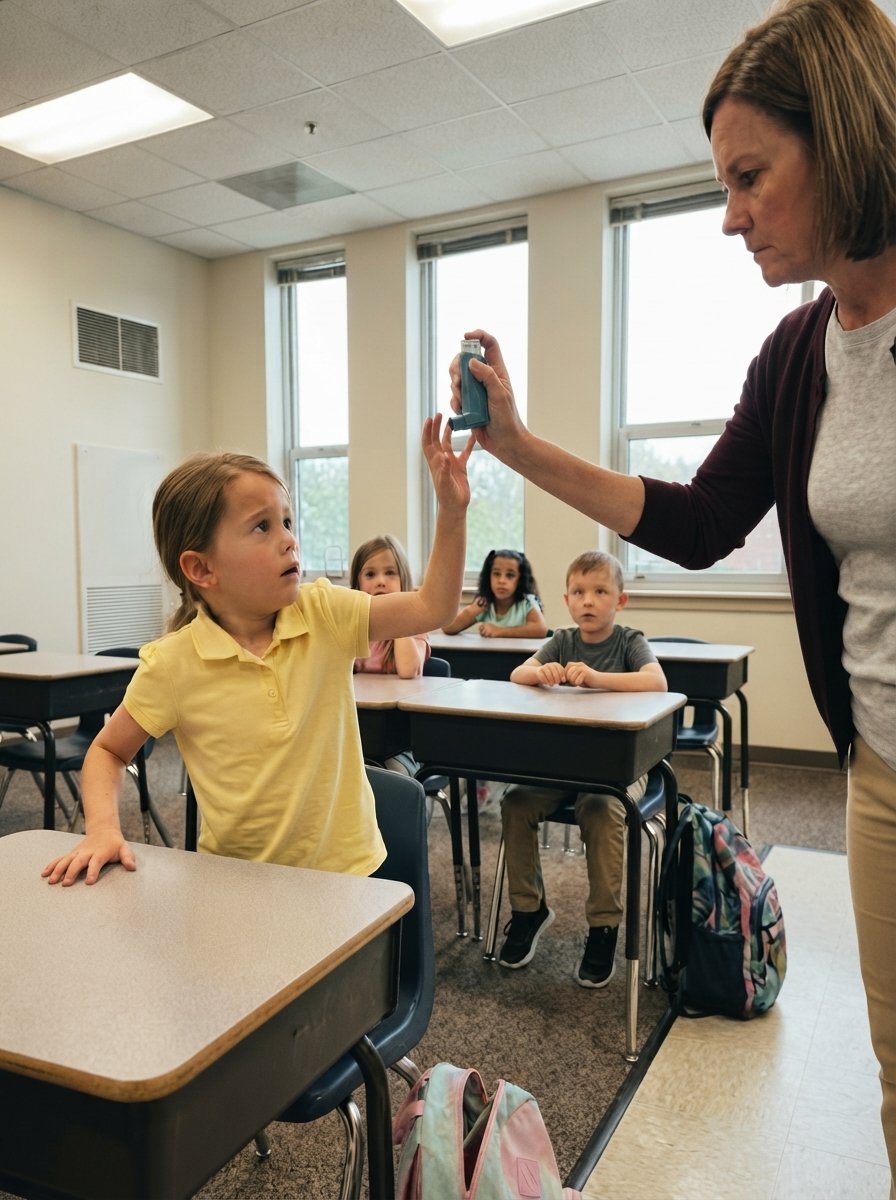
At 10:17, Lily raised her hand.
She said she couldn’t breathe properly.
She reached for her rescue inhaler.
Mrs. Grayson removed it from her hand.
Lily’s breathing became worse.
Ethan spoke up.
He was told to sit down.
Lily collapsed.
Ethan ran for Rebecca.
The nurse arrived.
911 was called.
Paramedics came five minutes later.
At 10:29, my call reached the principal’s office.
Written in order, the story suddenly had no soft edges.
Nobody could hide behind phrases such as “a rapidly developing medical emergency.”
The emergency had developed while Lily was asking for access to the very medication designed to help prevent it.
What I Asked the School to Change
The next morning, I spoke with Mark again.
This time, I had a short list.
First, I wanted confirmation that Lily would always be allowed to keep her rescue inhaler accessible.
Second, I wanted every adult responsible for her during the school day to understand exactly what her emergency plan required.
Third, I didn’t want Lily forced to repeatedly describe her collapse to every adult who became curious about what happened.
And finally, I wanted Ethan’s decision to get help treated for what it truly was.
Not disobedience.
Not classroom defiance.
A response to an emergency.
Mark agreed to every immediate safety measure the school could implement.
The investigation into Mrs. Grayson’s conduct would continue separately.
I appreciated that distinction.
Lily’s safety couldn’t wait for arguments about punishment.
Safety came first.
Access to her medicine came first.
Making sure my daughter would never again have to convince an adult that she was allowed to follow her own medical plan came first.
Consequences could come afterward.
Mrs. Grayson was later given another opportunity to explain herself.
This time, she didn’t deny taking the inhaler.
Instead, she focused on why she believed she had done it.
She said she thought Lily’s fear was making her symptoms worse.
She said she planned to return the inhaler once Lily calmed down.
She said she hadn’t realized how quickly the situation could become dangerous.
But her explanation only confirmed the central problem.
She had substituted her own judgment about Lily’s emotions for the medical instructions already established for Lily’s asthma.
She had seen the medication.
She had heard Lily ask for it.
Then she had made a choice.
And Lily had suffered because of the delay.
Lily Went Back to School
The review didn’t need dramatic accusations.
It needed the timeline.
Rebecca’s account showed the condition Lily was in when the nurse arrived.
Ethan’s account explained what happened before Rebecca entered the classroom.
Lily’s own words showed that she had recognized her symptoms and asked for her inhaler.
Mrs. Grayson’s explanation confirmed that taking the medication had been deliberate, even if she insisted her intention had only been to calm Lily.
And the medical plan established that Lily’s asthma—and her permission to carry and use her inhaler—had already been documented.
One fact supported the next.
That was enough.
Three school days after the collapse, Lily was ready to return.
I drove her to school that morning.
The same blue inhaler was secured inside the same backpack she had carried on Tuesday.
Before we got out of the car, Lily touched the zipper of the pocket where the inhaler was stored.
“I can use it if I need it?”
I turned toward her.
“Yes.”
“Even in class?”
“Yes.”
Lily nodded.
But her hand remained on the zipper.
I understood.
Rules written on paper felt different after an adult had looked directly at the medicine in your hand and told you the rule didn’t matter.
Inside the school, Principal Holloway met us near the office.
He didn’t turn Lily’s return into a public event.
Rebecca came out of the nurse’s room and crouched slightly so she could speak to Lily without towering over her.
She didn’t ask Lily to describe the collapse again.
She simply confirmed where Lily’s inhaler was and reminded her that she could come to the nurse anytime she needed help.
Then Ethan appeared at the far end of the hallway with his class.
He saw Lily.
He slowed down.
And for the first time since Tuesday, Lily smiled without someone asking her if she felt okay.
Ethan gave her a small, awkward wave.
Lily waved back.
I wanted to hug him.
Instead, when he came close enough, I simply said:
“Thank you for getting help.”
Ethan shrugged the way children do when adults make something important sound bigger than they think it is.
“She couldn’t breathe,” he said.
That was all.
No hero speech.
No dramatic performance.
Just the same simple observation he had made inside the classroom when another adult ordered him to sit down.
Lily returned to class with another teacher while the school continued reviewing Mrs. Grayson’s conduct.
Her classmates watched her walk in.
Then they quickly pretended they weren’t watching.
That may have been the kindest thing they could have done.
Lily placed her backpack beside her desk.
For a moment, her fingers rested on the pocket containing the inhaler.
Then she opened her reading book.
The room slowly returned to the ordinary sounds of a school morning.
Paper turning.
Chairs moving.
Pencils rolling across desks.
Children whispering before class began.
I stood in the doorway only long enough to watch Lily turn to the correct page.
I didn’t need a ceremony.
I didn’t need dramatic speeches.
I needed this.
An ordinary morning.
An accessible inhaler.
Adults who understood that a child’s medical emergency plan was not a suggestion to be debated after symptoms appeared.
And a seven-year-old girl who could raise her hand again without wondering whether telling the truth about her own body would get her into trouble.
Before I left, Lily glanced toward her backpack one more time.
The blue inhaler was still inside the front pocket.
Exactly where she could reach it.
This time, no one moved it away from her.
And that was exactly where it belonged.