
Below the terrifying number was a legal addendum written by Iris, but echoing my voice: “The owner of this property does not demand repayment of this sum. It is presented solely as a mirror, so you may finally understand the staggering weight of the life you have consumed. However, going forward, you are no longer family living in a spare room. You are tenants.”
The contract carried a singular, merciless clause: “Failure to remit the $1,100 payment within three (3) calendar days of the first of the month will result in the immediate forfeiture of the lease. Upon forfeiture, the title of the property will automatically transfer to the A.D. Women’s Shelter Charitable Trust. There will be no grace periods. There will be no appeals.”
I had essentially put a gun to their entitled lifestyle. They were no longer royalty in their own minds; they were hostages to their own lack of work ethic.
Back home, their curated, Instagram-perfect reality imploded. Without my emergency funds, Austin’s bank realized he had no income to support his auto loans. His prized Mercedes SUV was repossessed from the condo parking lot in broad daylight. Chloe, who had spent the last nine years cultivating the persona of a “ladies-who-lunch” stay-at-home mother, was suddenly staring down the barrel of minimum wage.
That evening, as I watched the Grecian sunset paint the sky in strokes of violent pink and gold, my burner phone pinged. I had allowed Iris to forward specific emails to me. It was a message from Chloe. It was a sprawling, unhinged manifesto of victimhood.
“You have ruined us, you selfish, vindictive old woman,” she wrote. “We are drowning. Austin is having panic attacks. I had to sell my bags just to pay the first month’s rent you extorted from us. You are destabilizing your own grandchild’s life. We cannot survive this. You are a monster.”
I read the email twice. I felt a brief, terrifying ghost of my old guilt try to claw its way up my throat. I looked at the diamond ring still sparkling on my finger.
I typed back a single, measured reply:
“Chloe, you aren’t surviving. For the first time in eleven years, you are actually living. Adults work to keep a roof over their own heads. That is not a punishment. It is reality. Welcome to it.”
A week later, as I was touring the Colosseum in Rome, Iris called me. She sounded amused. “Theresa, you won’t believe this. Austin just hired a bottom-feeder attorney. He’s officially filing a lawsuit against you for ‘Emotional Abandonment and Fraudulent Misrepresentation of Estate.’ He’s trying to sue you for the house you’re currently living in.” I paused, looking up at the ancient ruins. “Iris,” I smiled, “did you tell him?” “No,” Iris chuckled. “I thought I’d let him figure it out when the new owners change the locks.”
By the sixth month of my voyage, the Mediterranean sun had baked away the pale, anxious pallor I had worn for years. I was in Florence, taking a cooking class, learning to make pasta from scratch with a fierce Italian grandmother who spoke no English but understood the language of grief and rebirth.
Back in Miami, the legal threats had evaporated the moment Austin’s lawyer discovered that I had sold my primary residence—the house they had dumped the animals in—to a cash buyer two days before I left. I was legally untethered. A ghost with a bank account.
As the reality of their situation set in, the tone of their communications shifted drastically. The venomous rage gave way to a hollow, desperate, echoing confusion. Austin had finally hit the concrete wall of adulthood. Because he was unable to rely on his “mother’s network,” his employer had fired him for chronic tardiness and lack of initiative. To meet Iris’s ruthless rent deadline, my forty-one-year-old son was now working the night shift at a logistics warehouse and driving for a ride-share app on weekends.
Then, in late November, the true test arrived.
It was 3:00 a.m. in Paris. Rain was lashing against the window of my boutique hotel room. My burner phone rang. It was an emergency override call from Iris.
“Theresa, I’m sorry to wake you,” Iris said, her professional tone laced with genuine concern. “Austin called my emergency line. He’s at Mount Sinai Hospital. He had a severe panic attack while driving—thought it was a heart attack. He’s okay, but he has no health insurance since he lost his corporate job. He’s begging for you. He says the bill is going to be ten thousand dollars. He’s asking for a loan from the ‘family savings’.”
I sat up in bed, the silk sheets pooling around my waist. The mother inside me—the woman who had slept on the lumpy couch, the woman who had sold her earrings—screamed to get on the next flight out of Charles de Gaulle. I could feel my heart pounding against my ribs, a physical ache in my chest.
He is my baby, the voice whispered. He is in pain.
I gripped the phone, my knuckles turning white. I looked across the room at the blue suitcase, now covered in stickers from Athens, Rome, and Barcelona. I remembered the look of cold indifference on his face at his father’s grave. I remembered the $418,000 ledger.
If I saved him now, every ounce of pain, every lesson, would be erased. He would go right back to the boy who demanded the world on a silver platter.
“Iris,” I said, my voice cracking, tears finally spilling hot and fast down my cheeks. “Send him a text from my number. Just one sentence.”
“What do you want it to say, Theresa?”
I closed my eyes and delivered the hardest blow of my life. “Tell him: I trust you to find a way, Austin. I am not the safety net anymore. I am just your mother, and I have no more money to give. Call the hospital billing department. They have payment plans for men who are ready to take responsibility for themselves.”
I didn’t sleep the rest of that night. I paced the floor, crying until my eyes were swollen shut and my throat was raw. It felt unnatural. It felt like cutting off my own limb. But the next morning, I walked out into the Parisian rain, bought a beautiful oil painting from a street artist, and realized with a shock that my chest felt lighter. The limb was gone, but the infection had been cured.
Back home, the profound silence I offered became the catalyst for true transformation. The change didn’t start with Austin; it started, shockingly, with Chloe.
In January, an email arrived with a photo attachment. It was a picture of Chloe’s hands. The acrylic nails were gone, replaced by short, unpolished nails. Her skin was dry and chapped. She was wearing a stain-covered apron from a mid-tier chain restaurant.
The email read:
“Theresa. I’m writing this on my break. I’ve been working as a waitress for four months. My feet bleed some nights. I get screamed at by customers for cold soup. I come home and Austin is asleep from his warehouse shift, and I have to make Maya’s lunch with whatever energy I have left. I hated you for doing this to us. I wanted you to die on that ship.
But last night, I was scrubbing the grease off the stove, and I remembered you doing the exact same thing in our apartment after Maya was born. You did it so I could sleep. You did it for free. And I never even said thank you. I thought mothers were just supposed to bleed for their kids. My own mother paid my way until I met Austin. I didn’t know any better. But I know now. I am so, so sorry. I finally understand why you always looked so tired. We paid the rent early this month.”
I read the email, a profound sense of peace washing over me. I replied: “I never asked for gratitude, Chloe. That was my fatal mistake. When a person never asks for anything, she trains everyone around her to stop offering. You are becoming a magnificent mother to Maya. Keep going.”
Two months later, as my ship began its final transatlantic crossing back to Florida, my phone buzzed with an incoming call. It wasn’t Iris. It was a direct FaceTime request from Austin’s number. My breath hitched. For the first time in almost a year, I pressed the green ‘Accept’ button. The screen connected, but it wasn’t Austin’s face looking back at me.
“Grandma?”
The voice was small, hesitant, and incredibly sweet. Maya’s face filled the screen of my phone. She looked older, her hair pulled back in a neat, slightly messy ponytail—clearly done by a father who was still learning.
“Hello, my darling,” I breathed, touching the screen as if I could stroke her cheek.
“Dad gave me his phone. He said he was too ashamed to call you himself yet,” Maya whispered, looking off-camera nervously. “But he wanted me to tell you… we have a surprise for you when your big boat comes back. Grandma, Dad and Mom are different now. They’re home more. They don’t yell about money anymore. Dad smells like cardboard boxes, but he plays board games with me on Sundays. Are you really coming back?”
“I’ll be there in three weeks, Maya,” I smiled, wiping a tear from my eye. “And I have forty-one postcards to show you.”
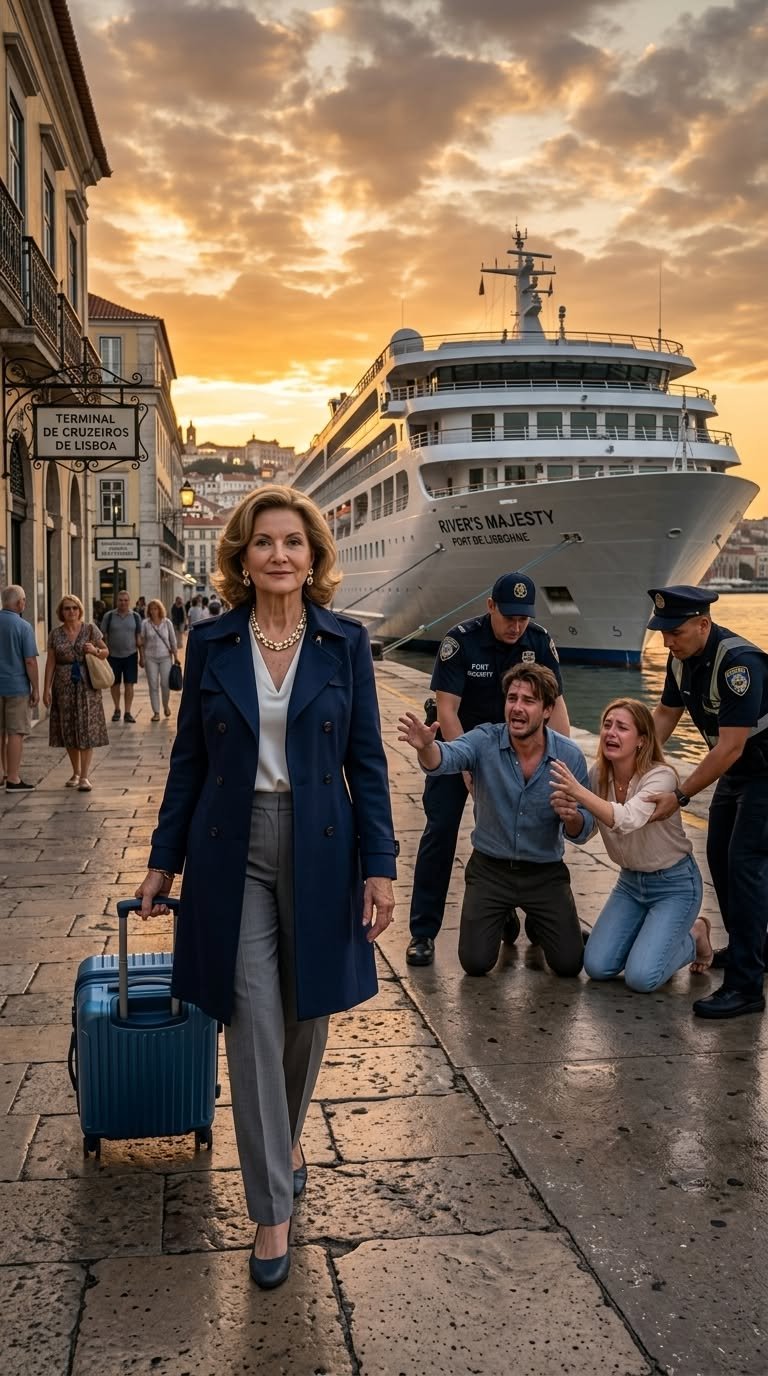
When I finally disembarked at the Port of Miami in late April, the humidity hit me like a familiar, damp blanket. But I was not the hunched, anxious, exhausted woman who had fled in the dark twelve months prior. I had walked ancient ruins, navigated foreign train systems alone, and learned to sit in a cafe for hours simply enjoying my own company.
I walked through customs with my head held high. My hair was professionally styled into a chic, silver bob. I wore a tailored white linen suit, a vibrant silk scarf tied elegantly around my neck, and the diamond solitaire ring on my finger. I rolled the beat-up blue suitcase behind me. It was no longer a symbol of canceled dreams; it was a testament to my liberation.
I walked through the sliding glass doors into the arrivals hall.
Austin was standing near the barricade. He looked entirely different. The arrogant posture was gone. He looked older, his shoulders slightly stooped from the physical labor of the warehouse. He was wearing a plain, inexpensive polo shirt. There were dark circles under his eyes, but the eyes themselves were startlingly clear.
He didn’t rush toward me. He didn’t demand anything. He simply stood there, waiting for my permission to approach.
I stopped a few feet away from him. We stared at each other across the chasm of the last year.
“Hello, Austin,” I said quietly.
He swallowed hard, his Adam’s apple bobbing. He didn’t speak. Instead, he stepped forward, reached out, and gently took the handle of the blue suitcase from my hand. It was a mundane, simple gesture—carrying his mother’s luggage. But it was the first time in his adult life he had ever offered to carry my weight. It was the heaviest thing he had ever lifted.
We drove to a quiet, dimly lit Italian restaurant. The silence in the car was thick, but it wasn’t hostile. It was the awkward, fragile silence of two strangers trying to figure out how to speak to one another.
We ordered dinner. Austin insisted on paying, using a battered debit card instead of the platinum credit cards he used to flaunt. After the plates were cleared, a long, agonizing silence settled over the table.
Austin reached into the pocket of his jacket. His hands were trembling slightly. He pulled out a small, worn, velvet jewelry box and slid it across the white tablecloth toward me.
I looked at the box, then up at him, confused. “Austin, what is this?”
“I saw it in a pawn shop window downtown,” he said, his voice cracking, thick with unshed tears. “The one you went to when Dad got sick. The owner recognized me from the photos you used to show him. I… I picked up extra weekend shifts driving for Uber for six months to buy it back.”
I slowly opened the box. Resting on the velvet were my diamond wedding earrings. The ones I had sacrificed to buy his father more time.
“I don’t deserve to sit at this table with you,” Austin whispered, staring down at his calloused hands. “When Dad died, I didn’t look at you and see a grieving widow. I looked at you and saw an asset. A resource that had suddenly freed up. The ledger Iris gave me… I read it every night for a month. Four hundred and eighteen thousand dollars. But the money wasn’t the worst part. The worst part was realizing I had treated the woman who gave me life like an ATM machine.”
He looked up, tears finally spilling over his eyelashes. “I wanted you to have those back. Not as a financial resource. But as a symbol of who you actually are. You’re not just a ‘mom’ to be used. You’re Theresa. You’re a person. I am so deeply, deeply sorry.”
I looked at the earrings. Then I looked at the man sitting across from me. He was bruised, exhausted, and humbled. He had been broken down to his foundation, and he had rebuilt himself.
I reached across the table and touched his hand. His skin was rough, scarred from warehouse work. It felt incredibly similar to his father’s hands.
“Mom,” he choked out, “is there any way you can ever forgive me?”
I smiled, a genuine, soft smile that reached my eyes. “I’m not holding a grudge, Austin. There is nothing to forgive. I wasn’t punishing you. I was just waiting for you to grow up.”
He let out a ragged breath, a sob escaping his chest, and he gripped my hand like it was a lifeline. We sat there in the quiet restaurant, a mother and a son, finally meeting each other as equals for the very first time.
As we walked out of the restaurant into the warm Miami night, Maya came running toward us from where Chloe had parked the car. Her face was bright with pure joy. “Grandma! Grandma! Are you going to stay?” she yelled, throwing her arms around my waist. I looked at Austin, holding my blue suitcase, standing next to Chloe, who offered me a small, respectful smile. I looked up at the stars, feeling Ernest’s presence in the warm breeze. “I have a lot of living left to do,” I said, stroking Maya’s hair, “but yes. I think I’ll stay. But I’ll be keeping my own apartment this time.”