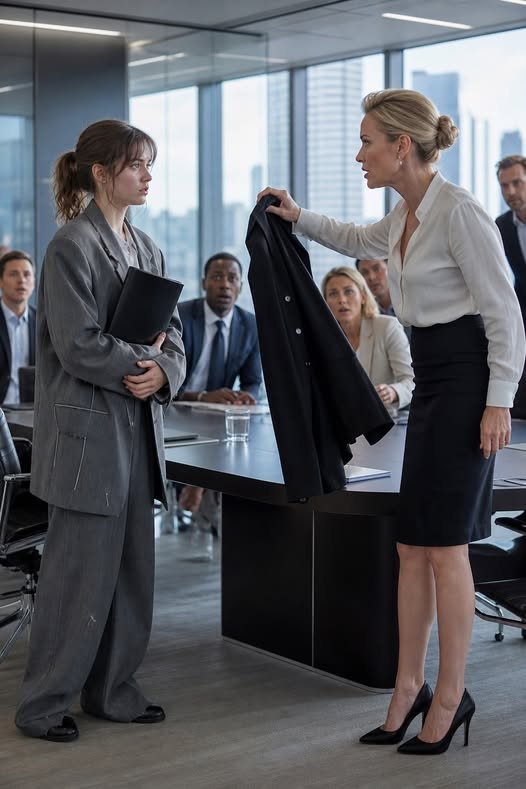
Richard stood. “You’re evicted. You hear me? You are no longer welcome in my house.”
There it was. The old weapon.
I reached into my pocket and placed my house keys on top of the dossier.
“I moved out two weeks ago.”
His eyes dropped to the keys.
Then I placed the safety pin beside them.
One heavy-duty safety pin from Vanessa’s interview suit. I had kept it in my wallet since that day.
“I’m no longer holding this family together,” I said.
Diane sobbed harder. “Keira, please. We’ll lose everything.”
“No,” I said. “You already spent everything. I’m simply withdrawing my funding.”
Vanessa’s voice cracked. “You’re ruining my life.”
I looked at my sister and felt nothing soft.
“You used my name to buy a car for a man who doesn’t love you,” I said. “Your life was already ruined. You just hadn’t received the invoice.”
Richard lunged one step forward.
The intercom chimed.
I had not touched it.
The concierge’s voice came through the speaker. “Miss Murphy, building security is standing by as requested.”
Richard stopped.
I pointed to the door. “Leave.”
One by one, they did.
When the door clicked shut behind them, the apartment became so quiet I could hear my own breathing.
The confrontation was over, but the collapse had only begun.
On Monday morning, I would cancel the last transfer, and gravity would do the rest.
Part 10
I canceled the automatic transfer at 7:03 Monday morning.
No ceremony. No shaking hands. No dramatic music. Just my laptop on the kitchen island, a cup of green tea beside it, and one gray button that said Confirm.
For months, three hundred and fifty dollars had moved every Friday from my secret account to the joint account. It was small compared to my real salary, but to my parents it had become oxygen. They used it to hide overdrafts, pay pieces of Vanessa’s bills, and keep the lie breathing one more week.
I clicked confirm.
The oxygen stopped.
By Tuesday afternoon, payments began bouncing. The Bahamas venue. The florist. A catering installment. The country club dues my parents should have canceled years before but kept because appearance mattered more than survival.
The overdraft fees stacked like falling bricks.
Then the auto lender moved.
I had sent them the fraud packet after my family left the penthouse: the delinquency notice, the forged contract, the IP trace, the proof of identity theft. Subprime lenders might be careless when approving loans, but they become intensely attentive when fraud threatens their asset.
Wednesday morning, a tow truck backed into my parents’ driveway.
Mia heard it from a neighbor who heard it from another neighbor who had watched the whole thing from behind plantation shutters.
Vanessa ran outside in a silk robe, screaming that the driver had no right. The recovery agent handed her a clipboard and kept working. Five minutes later, Preston’s black luxury SUV was winched onto a flatbed while half the neighborhood pretended not to watch.
Preston stood on the porch and did nothing.
By noon, he had packed.
By three, he texted Vanessa from a rideshare heading toward the airport. He said he needed space. He said the wedding had become “too complicated.” He said they wanted different things.
Vanessa posted nothing that day.
That was how I knew she was truly devastated.
The bigger truth emerged fast. Preston had not been wealthy. His family money had dried up years earlier. His country club membership was funded by credit cards and wishful thinking. He had believed Vanessa was marrying into real estate money. Vanessa had believed Preston had old money waiting somewhere behind a locked gate.
They were two empty glasses clinking together, each waiting for the other to be full.
By Thursday, Southern Heritage Properties received its foreclosure notice. The legal paper was taped to the glass front door of my parents’ brokerage for anyone on the sidewalk to see.
Diane tried to spin the story first. She called relatives across South Carolina, sobbing that I had stolen from them, abandoned the family, and suffered some kind of breakdown after success went to my head.
She underestimated Mia.
Mia sent a polished email titled Clarification of Financial Obligations. She attached the sanitized dossier: attempted mortgage fraud, forged auto loan, transcript of Richard’s extortion. She sent it to the family. Then, with the kind of quiet violence only a paralegal can perfect, she blind copied several members of the country club hospitality committee.
By dinner, my mother’s world had gone silent.
No invitations. No sympathetic calls. No whispered support from women who lived for whispered support.
Only read receipts.
Friday night, rain washed the city clean. I sat on my sofa watching harbor lights blur on the glass.
My phone flashed with messages.
Dad: You need to fix this.
Mom: Please come home. We can be a real family.
Vanessa sent six audio messages, sobbing that Preston left because of me.
I listened to none of them.
One year earlier, those notifications would have split me open. I would have felt responsible for their fear, their shame, their consequences. I would have believed love meant rescue.
Now I saw the truth plainly.
They were not reaching for me.
They were reaching for the money.
I blocked my father first.
Then my mother.
Then Vanessa.
The phone went dark.
For the first time in my life, silence did not feel like punishment.
It felt like ownership.
Part 11
Six months later, winter settled over Charleston with bright skies and sharp wind off the water.
My life had become almost suspiciously peaceful. I woke before sunrise in my penthouse, made coffee in a kitchen nobody criticized, and watched container ships move through the harbor like slow steel animals. I bought clothes that fit. I paid my bills early. I slept without listening for footsteps outside my bedroom door.
At Vanguard, I became known as difficult in the most useful way. I questioned sloppy projections. I made vendors explain vague numbers. I caught errors before they became disasters. Evelyn called that “operational hygiene,” which was the closest she ever came to praise.
One Tuesday morning, she summoned me to her office and slid a deed across her desk.
“Vanguard needs a secondary command center in Mount Pleasant,” she said. “We purchased a distressed commercial property at auction.”
I looked down.
The address belonged to Southern Heritage Properties.
My father’s ruined brokerage.
Evelyn watched me read it. “You’ll oversee the remodel.”
She did not mention irony. She didn’t need to.
That afternoon, I drove to the old office. The brass letters had been removed from the brick facade, leaving pale ghosts where my father’s company name used to shine. Inside, the lobby smelled of dust, old carpet glue, and abandonment.
The heavy oak desk where Richard once sat barking into a phone was gone. The walls were bare. The conference room where he had probably promised investors returns he couldn’t deliver stood empty except for a folding table.
I unrolled Vanguard’s blueprints across it.
Server room here. Dispatch terminals there. Secure network cabling through the old executive suite.
I was not sentimental about the space. Erasing his vanity with functioning infrastructure felt correct.
My phone buzzed while I measured the back office.
A blocked voicemail had slipped into a hidden folder.
I played ten seconds.
Richard’s voice sounded smaller than I remembered. He said they were in a weekly rental. He said everything had been a misunderstanding. He asked for a bridge loan. He promised repayment when things stabilized.
Same language. Same lie. Different volume.
I deleted it before he finished.
That evening, Mia called laughing so hard she could barely speak.
“I saw them,” she said. “Your mother and Vanessa. King Street consignment shop.”
I set down my grocery bag. “Doing what?”
“Trying to sell handbags and dresses. Vanessa was crying because the manager offered her a fraction of what she thought they were worth.”
I could picture it too clearly. Vanessa clutching silk like it had betrayed her. Diane pretending she was above the transaction while needing the cash desperately.
“And Keira,” Mia said, her voice bright with wicked satisfaction, “their clothes did not fit. Your mother had on this faded coat from another decade. Vanessa’s blouse sleeves were too short.”
I leaned against the counter and closed my eyes.
The women who made me wear discarded scraps to the most important interview of my life were now wearing leftovers of their own collapse.
I did not cheer. I did not cry.
I simply stood in my clean apartment and let the symmetry settle.
Some people call that karma. I call it load-bearing failure.
When a structure survives only because someone unseen is absorbing all the pressure, it does not fall because that person becomes cruel. It falls because that person finally steps away.
And I had stepped away for good.
Part 12
David came over for dinner that Friday with Mia.
He brought red wine and a nervous smile. Mia brought flowers and kissed my cheek like my apartment had always been a place where family could arrive without danger.
The kitchen smelled of roasting garlic, bread, and rosemary chicken. I had set three plates at the table overlooking the harbor. It still felt strange to host people without bracing for a demand.
David helped chop vegetables. He was quieter than Mia, but not hiding behind silence anymore.
Halfway through dinner, he set down his fork.
“I keep thinking about all the times I told myself it wasn’t my business,” he said.
Mia looked at him, not rescuing him from the discomfort.
I waited.
“When Dad took your scholarship check,” David continued, “I knew. I mean, I didn’t know the details, but I knew enough. When Mom made jokes about your clothes or your job, I heard them. I told myself staying neutral made me decent.”
He swallowed.
“It didn’t. It made me useful to them.”
The room went quiet except for the faint hum of the city below.
I appreciated the apology. I believed it. But belief did not require instant intimacy. Forgiveness, I had learned, was not a door people got to kick open because they finally felt sorry.
“I’m glad you see it now,” I said. “But I’m not going back to pretending.”
“I’m not asking you to.”
Mia reached for her wine. “Good answer.”
We laughed, and the tension broke.
After dinner, we stood on the balcony wrapped in coats, watching lights ripple on the dark water. David told me he had stopped answering our parents’ calls too. Mia had helped him set boundaries, though from the sound of it, hers involved more legal terminology than mine.
“They keep asking where you are,” he said.
“They know enough.”
“They say you’ll come around.”
I smiled faintly. “They always did confuse access with love.”
The wind lifted my hair off my face. Across the river, cranes blinked red in the night.
I thought about the girl in the beige suit, sitting in that cold boardroom with safety pins digging into her skin. She had believed survival meant becoming small enough not to anger anyone. She had not understood yet that some families do not stop taking because you are empty. They stop only when you lock the door.
I did not forgive my parents.
I did not forgive Vanessa.
Not because I carried rage like a hobby, but because forgiveness had been demanded from me my entire life as payment for continued abuse. I was done paying.
The next week, I changed my legal mailing address, updated emergency contacts, and removed every remaining trace of my parents from my documents. No shared accounts. No recovery email. No old permissions. No “just in case.”
Evelyn approved my remodel plan for the Mount Pleasant command center and told me the projected efficiency gains were “acceptable,” which in Evelyn’s language meant excellent.
Mia became my real family. David became family again slowly, carefully, through action instead of words.
Vanessa tried once to reach me through a new social account. The message began with “I know we both made mistakes.”
I blocked it before reading the second line.
There was no “both.”
There was the person who stole my identity, and the person who survived it.
On the first anniversary of my interview, I opened the small box where I kept the safety pin. It lay there dull and ordinary, a tiny piece of metal that once held up pants meant to humiliate me.
I carried it to the balcony.
For a moment, I thought about throwing it into the river. Then I stopped.
I didn’t need a dramatic ending.
I placed it back in the box, closed the lid, and put it on a shelf in my office. Not as a wound. As evidence.
A reminder that I had once been pinned into someone else’s version of my life.
And then I had unpinned myself.
Part 13
The Mount Pleasant command center opened in early spring.
Vanguard installed glass walls, high-speed servers, satellite mapping screens, and rows of routing terminals where my father once displayed fake awards and framed photos of properties he no longer represented. The building no longer smelled like stale coffee and panic. It smelled like new paint, warm electronics, and possibility.
Evelyn asked me to give the opening remarks.
I stood in the renovated lobby in a cream suit I bought with my own money. The jacket fit at the shoulders. The waist did not need pins. The sleeves ended exactly where they should.
A group of employees gathered near the entrance, holding paper cups of coffee. Mia stood at the back beside David, smiling like she knew every version of me that had led to this one.
I kept the speech short.
“Good systems depend on honest data,” I said. “When we ignore weak points, they do not disappear. They become more expensive. This center exists because we chose to identify what was broken, remove what was failing, and build something stronger in its place.”
Evelyn’s mouth twitched. That was her version of applause.
Afterward, I walked through the former conference room alone. Sunlight came through the windows in long clean strips. My heels clicked against new flooring.
I remembered being sixteen in my parents’ kitchen with a five-hundred-dollar STEM grant check in my hand. I had wanted a laptop that didn’t shut down every twenty minutes. My father took the check and told me family resources went where they shined brightest.
For years, I thought that meant I was dim.
Now I understood the trick.
They had not invested in Vanessa because she shined. They had aimed every light at her and told me the darkness was my fault.
My phone buzzed.
Mia had sent a photo from outside: me through the glass doors, standing beneath the Vanguard sign.
Caption: Look at you, boss.
I smiled.
Later that afternoon, a courier delivered a small envelope to my office. No return address. My assistant had already scanned it for anything suspicious because Evelyn Cross had trained paranoia into an art form.
Inside was a handwritten note from my mother.
Keira, I don’t know how things got so bad between us. A mother’s love is complicated. Your father is not well. Vanessa is struggling. We miss you. Please don’t let pride destroy what is left of this family.
There was no apology for the suit.
No apology for the bank account.
No apology for the loan, the fraud, the threats, or the years I spent being treated like a household utility.
Only a request that I rename my boundaries as pride.
I read it twice, then walked to the shredder beside my desk.
The blades pulled the paper in with a soft mechanical growl.
That was the closest thing to a reply she would ever receive.
That evening, I returned to my penthouse and cooked dinner for one. Salmon, rice, asparagus, a glass of white wine. The city outside glowed gold, then blue, then black.
I ate slowly at my own table.
No one interrupted. No one counted the cost. No one told me what I owed.
My life was not loud after the collapse. It was not cinematic every day. Most mornings were email, coffee, traffic, meetings, laundry, invoices, and quiet.
That was the miracle.
Peace, I learned, is not always fireworks. Sometimes it is a properly fitting blazer. A bank account with one name on it. A dinner no one weaponizes. A phone that stays silent because the people who used to drain you no longer know how to reach you.
My parents wanted a daughter who would fund their lies forever.
Vanessa wanted a shadow she could stand on to look taller.
They did not get what they wanted.
They got the truth instead.
And the truth, once fully documented, required no forgiveness from me to be complete.
THE END!