“Nobody at the County Shelter Could Get Anywhere Near the Chained Military Dog, Shaking With Rage Alone in Quarantine — Until Someone Finally Understood Why” The old feed delivery man asked one quiet question about water, handed over his gloves, and stepped toward the steel door while the dart rifle rose behind him.
Maya, the youngest vet tech on shift, planted herself in the hallway and tried to sound braver than she felt.
“Sir, you can’t go back there.”
Samuel Gage stopped with both hands on the handles of his feed cart.
The bags of dog food were stacked higher than his chest, dusty from the back of his old pickup, and his flannel shirt carried the smell of hay, cold air, and a farm that had survived more winters than most people.
Down the concrete hall, something hit metal hard enough to make every dog in the adoption wing start barking.
The sound that followed was not barking.
It was lower.
It was a growl that seemed to come from the floor.
Maya swallowed.
“Animal control brought him in three days ago,” she said. “Belgian Malinois. Extreme aggression. Nobody can get near him.”
Samuel looked past her.
He did not lean around her.
He did not puff up.
He simply listened.
Brenda Yates, the shelter director, hurried around the corner with a clipboard pressed to her chest like a shield.
“Mr. Gage, thank you for the delivery,” she said. “Leave the invoice up front. Kevin is bringing the dart rifle.”
Samuel’s faded blue eyes moved to her.
“Has he taken any water?”
The question landed strangely in the hallway.
Not had they offered it.
Had he taken it.
Brenda blinked. “We can’t get a bowl in. He lunges. He flips it. He has already bent one kennel door.”
The growl rolled again, raw and steady.
Dr. Anya Sharma stepped out of her office and saw the old feed man still standing there as if the panic in the building was weather moving around a fence post.
She had noticed him before.
The straight back.
The small movements.
The way he never turned his blind side to a room.
Her father had stood like that when he came home from the Marines.
Animal control officer Kevin Finch pushed through the front door with a catch pole in one hand and the dart rifle in the other.
“All right,” he said too loudly. “Let’s give Napoleon his nap.”
Samuel turned his head toward him.
“The dart won’t work.”
Kevin laughed once. “And what makes you the expert, pops?”
Samuel did not answer the insult.
He looked at the barred door at the end of the hall and said, “A dog trained to stay standing under stress will fight the drug until his body gives out.”
Anya felt the room go still.
Those were not farmer words.
Those were not guess words.
Brenda frowned. “This animal is dangerous.”
“Yes,” Samuel said. “And fear is not a crime.”
No one spoke after that.
The old man set his worn gloves on the counter.
Then he pointed with his chin toward the quarantine hall.
“Let me try.”
Brenda shook her head before he finished. “I cannot let a civilian walk into a dangerous enclosure.”
“He is dying in there,” Samuel said. “Not from hunger. Not yet from thirst. From not knowing who is friend and who is enemy.”
Kevin lifted the rifle a little higher.
Anya stepped between them.
“Brenda,” she said quietly, “if we dart him now, I think we may kill him.”
That was the sentence that cracked the room.
Brenda looked at the door.
She looked at the old man.
Then she nodded once, even though every rule in her head was screaming at her.
“Kevin stays on the door,” she said. “If that dog moves wrong, you fire.”
Samuel did not argue.
He walked down the hall with the same measured pace he had used to bring in feed bags every Tuesday.
Only now everyone could see it.
He was not walking like an old farmer.
He was walking like a man returning to a place he knew.
At the quarantine door, the growling rose into a violent storm.
Kevin slid the bolt back.
Samuel stopped him from opening the door all the way.
He cracked it only a few inches and waited.
One minute passed.
Then another.
The shelter staff crowded behind him, barely breathing.
“Lower the rifle,” Samuel said without turning around.
Kevin’s jaw tightened.
Anya put a hand on his arm.
The barrel dipped.
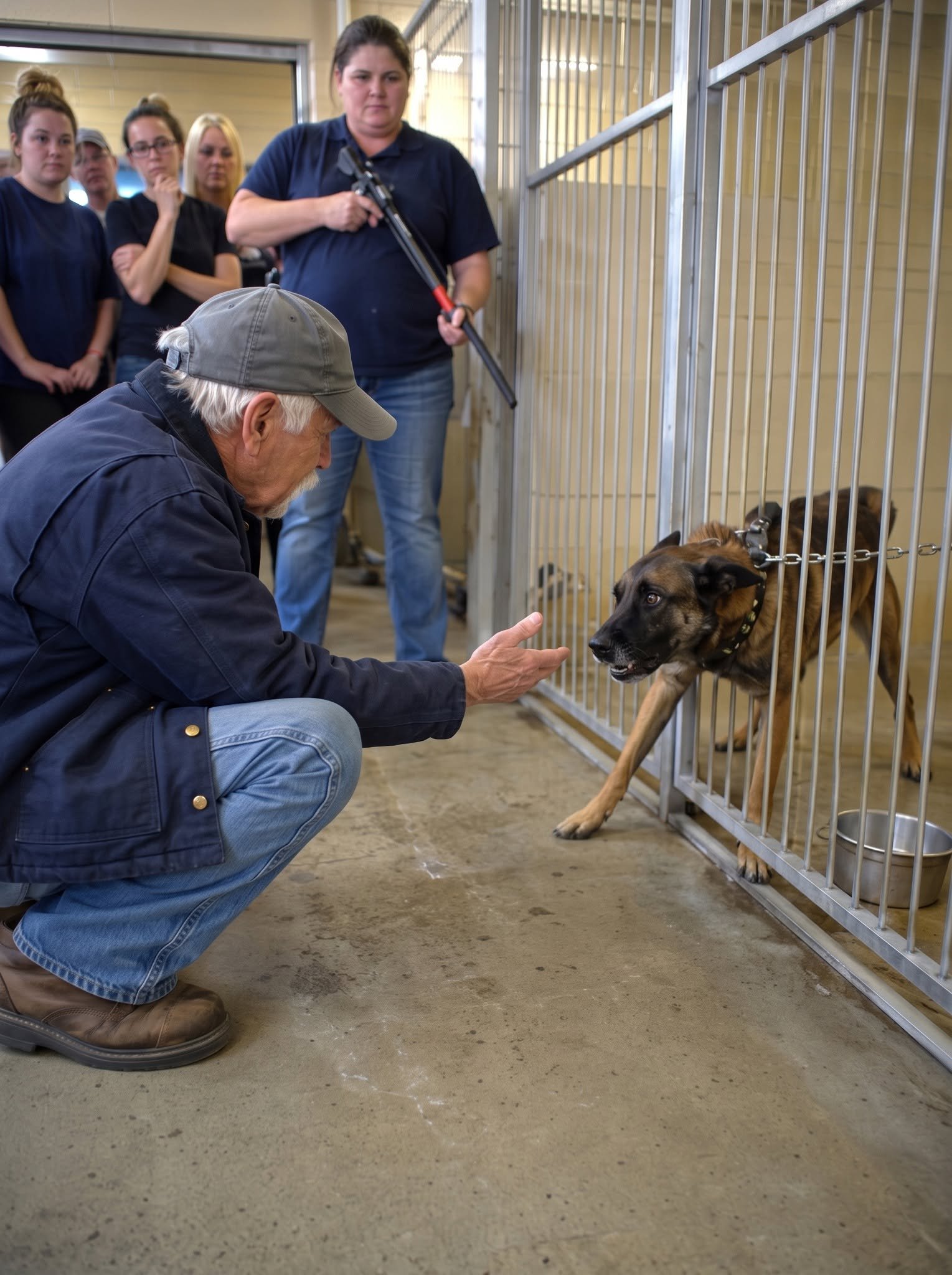
Samuel slipped inside.
Through the little barred window, they saw the dog at the end of the chain, filthy and magnificent, every muscle locked, teeth white against black gums.
Samuel did not stare at him.
He crouched sideways, hands loose, eyes lowered to the concrete.
The dog strained forward.
The chain snapped tight.
Kevin raised the rifle again.
Samuel lifted one palm.
Then the old man took one slow breath, and whispered a word none of them had ever heard.
“Kestrel.”
The dog’s head lifted.
And the real shock hadn’t even begun.
PART2
Nobody at the county shelter remembered the last time a sound had changed the temperature of a building.
Then the Malinois arrived.
Animal control brought him in on a Monday afternoon with two officers sweating through their uniforms and one bent kennel gate rattling in the back of the truck.
The dog was black-faced, tan-bodied, filthy from the road, and so exhausted that his legs shook under him.
Still, every person who stepped toward him saw the same warning in his eyes.
Come closer and I will do the job I was built to do.
Brenda Yates had run the county shelter for eleven years, and she had seen fear wear many faces.
She had seen puppies tremble in laundry baskets.
She had seen old hounds press their faces into corners.
She had seen dogs snap because pain made the world too loud.
This one was different.
He was not confused in the ordinary way.
He watched doors, hands, feet, keys, shoulders, and breathing.
He studied people the way people study storms.
By the second day, he had refused food, flipped every water bowl, and bent the front of a kennel hard enough to split the weld.
By the third day, he had been moved into the old quarantine run.
Brenda hated that room.
It was concrete and steel, meant for short emergencies, not for a living creature with a mind still burning behind his eyes.
But she had two young techs, one veterinarian, a lobby full of adopters, and a staff who had started flinching every time the back hallway shook.
Rules exist because fear spreads faster than compassion.
That morning, Samuel Gage rolled in the feed delivery like he always did.
He came every Tuesday in an old pickup with a cracked dashboard and hay dust in the bed.
He was tall in a quiet way, with a weathered face, pale eyes, and hands that looked as if they had fixed fences, pulled calves, buried dogs, and never once asked for sympathy.
Most people saw a farmer.
Dr. Anya Sharma had always seen a little more.
Her father had served twenty-two years in the Marines, and some things stayed in a person’s body after the uniform came off.
Samuel stood too straight for a man who supposedly spent his life stooped over feed sacks.
He turned through doorways like he already knew where every exit was.
He listened before he spoke.
When the growl rolled down the hallway, Samuel stopped with his hands on the cart.
Maya stepped in front of him.
“Sir, I appreciate you bringing the feed, but you cannot go back there.”
Samuel did not look offended.
He looked past her, toward the quarantine door.
“Has he taken any water?” he asked.
That question was the first thing that made Anya set down her chart.
Not did you give him water.
Not is there water in the room.
Had he taken it.
It was the question of someone who understood that an animal could be surrounded by help and still be unable to accept any of it.
Brenda answered before Maya could.
“No. He lunges. He knocks it over. We cannot get close enough to help him.”
Samuel nodded once.
The nod did not mean approval.
It meant he had added the fact to a map inside his head.
Then Kevin Finch came through the front doors with a catch pole in one hand and the dart rifle in the other.
Kevin was good at his job most days.
He was young, strong, and used to frightened animals becoming manageable once the right tool came out of the truck.
But the Malinois had made him look foolish the day before, and embarrassment can make a man louder than he needs to be.
“Better clear out, pops,” Kevin said. “We are about to have a little rodeo.”
Samuel looked at the rifle.
“The dart will not work.”
The room paused around the sentence.
Kevin gave a dry laugh.
“You a dog expert now?”
Samuel’s voice stayed low.
“A dog like that will read the dart as an attack. He will fight the drug until he cannot fight his own heart.”
Anya felt the small hairs rise along her arms.
That was not a guess.
That was experience.
Brenda tried to hold on to the shape of the day.
There were forms for aggressive animals.
There were risk notices.
There were procedures for sedation, evaluation, and, if all else failed, euthanasia.
She had not slept well because that last word had already appeared on the edge of the decision.
It was not cruelty that had brought them there.
It was responsibility with no better tool in its hand.
Samuel looked at the hallway again.
“He is dying from fear,” he said.
No one corrected him.
“He is alone in hostile country,” Samuel continued. “Everyone at the door is an enemy. He does not know the rules anymore.”
Anya heard her father’s language in that sentence.
Hostile country.
Rules.
Enemy.
The farmer was still standing in boots dusted with feed meal, but something older and sharper had stepped forward behind his eyes.
“Let me try,” Samuel said.
Brenda almost said no quickly enough to save herself from thinking.
Then the dog slammed the chain against the concrete again, and the whole shelter answered with terrified barking.
Anya moved closer to Brenda.
“If we sedate him in this state, we may kill him,” she said.
Brenda closed her eyes for one second.
A shelter director learns to make decisions that leave bruises no one can see.
When she opened them, she looked at Samuel.
“If I let you in, Kevin stays at the door.”
Samuel nodded.
“If he moves wrong, Kevin fires.”
Samuel nodded again.
He handed his gloves to Maya.
Her fingers shook when she took them.
The hallway seemed longer when he started down it.
Kevin followed with the rifle.
Anya followed Kevin.
Brenda came last, hating every step and taking it anyway.
At the quarantine door, Samuel lifted one hand to stop them.
He did not let Kevin swing the door all the way open.
He opened it only a crack and waited.
The barking exploded, then slowly folded back into a growl.
Samuel stood there through all of it.
Patience is not doing nothing.
Sometimes patience is the first language a frightened creature can still understand.
“Lower the rifle,” Samuel said.
Kevin stiffened.
Anya gave him a look that carried every ounce of medical authority she had.
The rifle lowered.
Samuel slipped into the room and pulled the door nearly closed behind him.
Through the barred window, Anya saw the dog at the far end of the chain.
He was magnificent in the most painful way.
His coat was matted.
His eyes were red from exhaustion.
His body was built for speed and command, but every line of it had been bent into survival.
Samuel did not stare at him.
He checked the corners, the anchor bolt, the chain length, the door, the bowl, the drain.
Then he crouched sideways and rested his forearms on his knees.
The dog snarled.
Samuel murmured something low.
The dog stiffened.
It was the wrong language, or almost the right one, and that seemed to make the animal angrier.
Kevin raised the rifle again.
“Wait,” Anya whispered.
Samuel stopped speaking.
He closed his eyes for half a breath.
When he opened them, he looked younger and far away.
Then he whispered one word.
“Kestrel.”
The growl stopped.
It did not soften.
It stopped as if someone had cut a wire.
The dog’s head lifted.
His teeth disappeared behind closed lips.
His ears came forward.
For the first time since arriving at the shelter, the Malinois looked at a human being without measuring the space between them.
He looked at Samuel as if he had heard home in one syllable.
Brenda made a sound behind the glass.
Kevin forgot to breathe.
Samuel did not move toward the dog yet.