
Part 1: The Package She Never Needed
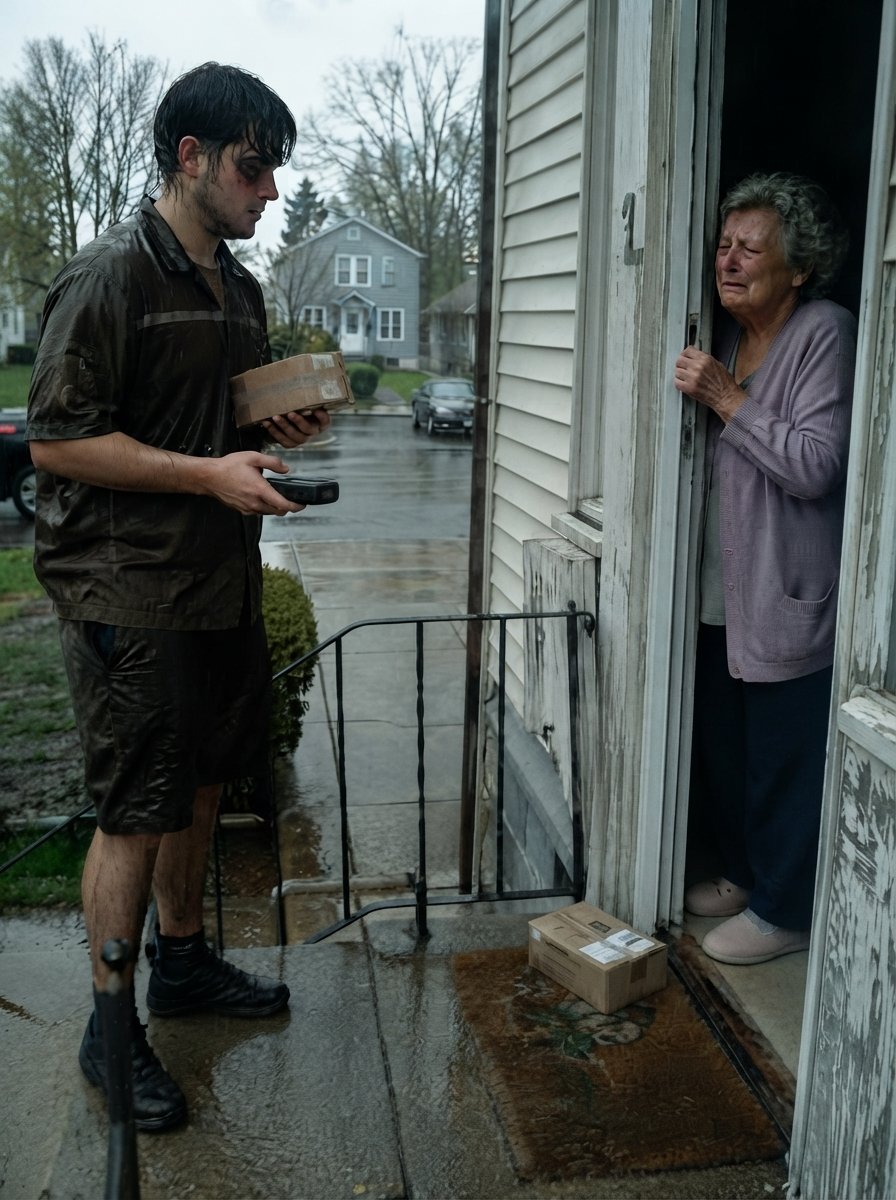
The rain was coming down hard that Tuesday afternoon—the kind of cold Ohio rain that soaked through my uniform jacket and made every delivery feel twice as difficult.
My name is Silas.
I was twenty-eight years old, exhausted, and already thirty stops behind schedule.
In delivery work, you do not walk.
You run.
Scan.
Drop.
Photograph.
Back to the truck.
Every second matters.
There is no time for conversations.
At least, that was how I lived before Elara.
Elara was eighty-one and lived alone at the end of an oak-lined street on my regular route.
Almost every day, I had a tiny package for her.
A plastic comb.
A pair of socks.
Greeting cards.
Cheap kitchen items.
Nothing important.
But Elara was always waiting.
Before I reached the porch, her wooden door would open.
“Hello, Silas.”
Her face would brighten.
“Stay dry out there.”
“Be careful driving.”
I would smile politely, hand over the package and hurry away.
“Have a good day, ma’am.”
Five seconds.
Sometimes less.
For months, I never wondered why an eighty-one-year-old widow needed a delivery almost every day.
Then came that rainy Tuesday.
I reached her porch carrying another small padded envelope.
Elara was not at the door.
That was unusual.
Then I looked down.
Yesterday’s package was still sitting on the welcome mat.
My stomach tightened.
Elara never left packages outside.
My scanner beeped.
I was falling further behind.
I should have placed the new package beside the old one, taken the required photograph and continued my route.
Instead, I knocked.
“Elara?”
Nothing.
I knocked harder.
“It’s Silas. The delivery driver.”
Nearly a minute passed.
Then I heard slippers slowly crossing the floor.
The deadbolt clicked.
The door opened.
Elara looked nothing like the woman who usually greeted me.
Her eyes were red.
Her face looked exhausted.
Tears were running down her cheeks.
“Elara, are you okay? Should I call an ambulance?”
She shook her head.
“No.”
Her voice trembled.
“I’m not sick.”
She looked back into the empty house.
“I’m just tired of the silence.”
Then she told me something I would never forget.
Her husband had died six years earlier.
Her son and daughter lived far away.
They had jobs, families and responsibilities of their own.
They called.
They sent money when she needed it.
They loved her.
But most days, Elara woke up alone.
Ate alone.
Watched television alone.
Went to bed alone.
“The silence gets so loud sometimes,” she whispered.
Then she looked at the package in my hand.
“I don’t need those things.”
I frowned.
“What things?”
“The packages.”
She gave a broken little smile.
“I buy the cheapest things I can find.”
“Why?”
Her eyes filled again.
“Because then someone has to walk up my driveway.”
I stopped breathing for a moment.
“For ten seconds,” she continued, “I get to see another person.”
My scanner beeped again.
A cold electronic sound demanding that I continue moving.
I looked at it.
Then at Elara.
An eighty-one-year-old woman had been spending part of her fixed income buying things she did not need because human contact had become something she felt she had to purchase.
I switched the scanner off.
“Elara?”
“Yes?”
“Do you have coffee?”
For the first time that afternoon, her face changed.
“I can make some.”
I removed my wet boots and went inside.
Her home smelled like peppermint, old books and furniture polish.
Family photographs covered the walls.
Children.
Graduations.
Weddings.
Grandchildren.
A house filled with evidence that Elara had once lived inside a very loud life.
Now there was only the ticking clock.
We sat at her kitchen table for almost an hour.
I let my route wait.
She told me about her husband, who had built birdhouses in the garage.
She told me about being a schoolteacher.
She missed the sound of children running through hallways.
She told me funny stories about her students.
About raising her children.
About growing older without noticing it was happening.
She did not complain.
That somehow made it harder.
She was simply lonely.
When I finally left, she walked me to the door.
“Thank you, Silas.”
“You didn’t have to stay.”
“Yes,” I said.
“I think I did.”
That afternoon changed my life.
Soon, my lunch break became Elara’s lunch break too.
Every weekday at 12:30, I parked near her house.
I brought sandwiches.
She made coffee.
For thirty minutes, her quiet home filled with conversation.
And for thirty minutes, the constant rush inside my head finally stopped.
Two years passed.
Then one afternoon, my supervisor parked behind my delivery van.
And everything changed again.
Part 2: When Kindness Broke the Rules
My supervisor’s name was Vance.
At exactly 12:31, he walked toward Elara’s porch carrying a company tablet.
“Silas,” he said.
“Step away from the house.”
I stood on the porch holding two sandwiches.
Behind me, Elara had already prepared the kitchen table.
Two cups.
Two napkins.
One chair for her.
One for me.
Vance looked at me.
“Your lunches here are over.”
Elara appeared behind the screen door.
The moment she saw the company tablet, she understood.
“Oh.”
That tiny word nearly broke me.
Vance explained that my route data had been flagged.
Every weekday, my van stopped at the same address.
My scanner became inactive for thirty minutes.
Later deliveries were sometimes delayed.
Customers had complained.
One needed a package before leaving town.
Another said I consistently arrived later than expected.
Other drivers occasionally had to absorb stops when I fell too far behind.
I hated hearing it.
Because I had spent two years telling myself that my lunches with Elara harmed nobody.
That was not completely true.
Elara mattered.
But so did the people waiting farther down my route.
Vance showed me the report.
“Head office wanted to terminate you.”
My stomach dropped.
Elara heard him from the porch.
“No.”
Her hand went to her chest.
Vance continued.
“I convinced them to issue a final warning.”
I looked at him.
“What does that mean?”
“You sign it.”
“You properly log your breaks.”
“And this stops during active delivery hours.”
I looked back toward Elara’s kitchen.
Two cups were waiting.
A plate of cookies sat between them.
“And if I refuse?”
“You go back to the station.”
Elara stepped outside.
“Silas.”
I turned.
“Please sign it.”
“Elara—”
“I will not be the reason you lose your job.”
Her voice trembled.
I tried bargaining with Vance.
“Fifteen minutes?”
“No.”
“Five?”
“Silas.”
I laughed bitterly.
“We deliver things people don’t even need overnight, but I can’t sit with an old woman for five minutes?”
“That’s not fair,” Vance replied.
“No. It isn’t.”
Then his expression changed.
“You think I don’t know?”
He looked toward Elara.
“My mother lives three towns away.”
“My sister checks on her because I’m usually working until dark.”
His voice softened.
“You think I enjoy doing this?”
I stopped arguing.
Vance was not cruel.
He was another tired person trapped between compassion and responsibility.
“If every driver ignored whatever rule they believed was unfair,” he said, “I couldn’t run the operation.”
“And if nobody ever bends a rule for someone who needs help,” I asked, “what happens to people like Elara?”
Neither of us had an answer.
So I signed.
That afternoon I drove the fastest route I had completed in years.
Scan.
Drop.
Photograph.
Run.
One customer smiled.
“You’re early today.”
Another thanked me because he desperately needed the package.
At another house, a child shouted from behind the window:
“The delivery truck!”
Each stop reminded me of something uncomfortable.
There were people behind all those doors too.
That evening, after finishing work, I drove back to Elara’s house.
She opened the door immediately.
Then she hugged me.
“I’m sorry,” I whispered.
“Don’t apologize for kindness.”
We sat at the kitchen table.
My sandwich was still waiting.
“I saved it.”
“Just in case you came hungry.”
I had to look away.
Then Elara said something unexpected.
“I’ve been selfish.”
“No.”
“Yes.”
She folded her hands.
“Loneliness can make you greedy.”
“Not for money.”
“For time.”
“For attention.”
“For proof that you still exist.”
“You gave me something too,” I told her.
She looked at me.
“You were the only part of my workday that didn’t feel like a machine was chasing me.”
That made her laugh.
But we both knew the problem remained.
“I’ll visit after work,” I said.
“No.”
“What?”
“You’re twenty-eight, Silas.”
“You need a life too.”
She pointed at me like the teacher she had once been.
“You are exhausted.”
“You eat dinners inside your van.”
“You wear mismatched socks.”
I looked down.
She was right.
“I needed you,” Elara said. “But my loneliness cannot become a cage around your life.”
The next afternoon, I drove past her house at 12:30.
For the first time in two years, I did not stop.
Elara sat on the porch holding her coffee.
She waved.
I waved through the windshield.
Then I continued driving.
It was one of the longest ten seconds of my life.
A few days later, I visited after work.
Elara looked pale.
Her mail remained unopened.
“You love getting mail,” I said.
She gave me a sad smile.
“I love people.”
“Mail only pretends to be people.”
I finally asked about her children.
Her daughter was Simone.
Her son was Calder.
“Do they know how lonely you are?”
“No.”
“Elara.”
“I will not make my children feel guilty.”
“They should know.”
“They love me.”
“I know.”
“They are busy.”
I understood.
I wanted an easy villain.
But there was not one.
Her children lived far away.
They had offered to move her closer.
She refused.
They called.
They helped financially.
Distance was not the same as abandonment.
But Elara was still lonely.
Both truths could exist.
Then one Monday, I found a note taped to her mailbox.
Silas,
Do not visit tonight. Please rest.
I am going to try something brave.
Your friend,
Elara
That evening, she called me.
“I did it.”
“Did what?”
“I invited the neighbors for coffee.”
I sat upright.
“When?”
“Tomorrow.”
“At 12:30.”
Six invitations.
Six nearby houses.
“What if nobody comes?” she asked.
I did not lie.
“Then I’ll visit after work, and you can tell me they missed the best coffee in Ohio.”
The next afternoon, I drove down her street.
I slowed slightly.
Elara sat alone beside a table holding seven coffee mugs.
My chest tightened.
Then a woman in a red coat walked across the lawn carrying food.
An older widower followed with a folding chair.
Then came a young mother pushing a stroller.
I watched Elara cover her mouth.
The red-coated woman hugged her.
My scanner beeped.
For once, I smiled at the sound.
I kept driving.
That night, Elara called.
“Five people came.”
“Six if we count the baby.”
She laughed.
“They want to come again.”
Then her voice softened.
“Silas?”
“Yeah?”
“I think I forgot I could still open my own door.”
Porch coffee became a weekly tradition.
Then twice a week.
More people came.
A widower.
A retired mechanic.
A young mother desperate for adult conversation.
A night-shift worker who slept through most of the day.
People who had lived twenty steps apart for years finally learned each other’s names.
I thought the problem had been solved.
Then someone posted a photograph online.
End Part Here: A 28-year-old delivery driver noticed an 81-year-old woman hadn’t picked up yesterday’s package. When he knocked on her door