The room became silent.
“I thought I was spreading kindness. But I was really taking control of someone else’s moment.”
Then Mr. Calloway rose from his seat in the back.
“That child wasn’t asking to become famous,” he said.
“She was asking to finish a song.”
He looked around the room.
“I clapped because everyone needed to remember she was a person. I didn’t clap so the whole town could turn her into a lesson.”
Then he said something Maribel would never forget.
“Public is not the same as permission.”
That evening, the school agreed to change its policy.
No close-up videos of students would be shared publicly without permission.
No child’s medical or personal story would be used for promotion.
And no student would be turned into an inspirational example without the family agreeing first.
It was not a perfect solution.
But it was a beginning.
Part 3: Her Voice Belonged to Her
After the meeting, Wren found Mr. Calloway in the hallway.
“Mom says I don’t have to sing again.”
“She’s right.”
Wren looked at him.
“Do you think I should?”
Mr. Calloway did not answer immediately.
He treated her question as if it deserved time.
Finally he said:
“I think you should wait until the answer feels like yours.”
“What if I don’t know?”
“Then not knowing is your answer for now.”
Wren nodded.
Then she asked about his granddaughter.
“Did she ever play violin again?”
Mr. Calloway hesitated.
“I don’t know.”
“You don’t know?”
“She played at home for a while. Then less. I stopped asking because talking about it made her sad.”
Wren thought about that.
“Maybe she was waiting for someone to ask differently.”
The words stayed with him.
That night, Mr. Calloway called his granddaughter.
Her name was Nia.
She was grown now.
“Do you still have your violin?” he asked.
There was a long silence.
“It’s in the closet.”
Mr. Calloway closed his eyes.
“I should have clapped louder.”
Nia did not understand.
So he finally apologized for what had happened years earlier.
When people laughed at her church performance, he had hurried her away because he thought he was protecting her.
Now he realized she might have needed him to stay.
“I should have stood up and clapped until everybody remembered themselves,” he told her.
Nia started crying.
“I still play sometimes,” she admitted.
“Not for people.”
“That’s all right.”
Then Mr. Calloway told her about Wren.
He told her he had been clapping for two girls that night.
One standing on a school stage.
And another still sitting somewhere inside his memory with a violin across her knees.
Two weeks later, Maple Hollow Middle School held a family night.
The banner onstage read:
LISTEN FIRST
No children were required to perform.
No phones were allowed.
Wren decided to attend.
She was nervous.
But this time, being nervous was her choice.
Lydia stood at the microphone first.
“I made a cruel comment about a child because I didn’t like her performance,” she admitted.
“I didn’t know her story. But I didn’t need to know her story to be kind.”
Then she apologized publicly for posting the video.
“Children should not have to become public examples for adults to become better people.”
Next came Mr. Calloway.
“I clapped that night because silence can hurt,” he said.
Then he looked around the auditorium.
“But attention can hurt too.”
The room became still.
“Kindness isn’t always doing what makes us feel good. Sometimes kindness is asking, ‘Do you want help?’ Sometimes it’s putting the phone away. Sometimes it’s letting somebody be brave without forcing them to carry everyone’s feelings afterward.”
Then the side door opened.
A woman entered carrying a black violin case.
Mr. Calloway froze.
Nia.
She walked toward him.
Then she opened the case.
Inside was the violin.
“My granddad didn’t ask me to play tonight,” she explained.
“He only asked if I still had it.”
Nia lifted the violin.
“I let one bad room decide what I did with music for years.”
Then she said:
“I’m not here to perform. I’m here to take something back.”
She played eight notes.
Only eight.
They trembled.
One wavered.
The final note faded unevenly.
But it filled the room.
Mr. Calloway covered his face.
Then Wren stood.
“I want to say something.”
Maribel looked at her.
“You don’t have to.”
“I know.”
And that was when Maribel understood.
Wren was not paying anyone back.
She was choosing.
Wren stepped to the microphone.
“My name is Wren.”
Her voice scratched slightly.
She continued.
“I didn’t like the video.”
Several adults lowered their heads.
“I liked the clapping. Mr. Calloway made me feel like I could look up again. But I didn’t like seeing myself scared on strangers’ phones.”
She took another breath.
“I didn’t like people calling me inspiring when I was just trying not to cry.”
The auditorium remained silent.
“I don’t want people fighting over whether children should be tougher or softer. I just want grown-ups to remember something.”
She lifted her eyes.
“We can hear you.”
“When you whisper, we hear it.”
“When you laugh, we hear it.”
“When you clap, we hear that too.”
Then she looked toward Mr. Calloway.
“And sometimes one good sound is louder than all the bad ones.”
Wren paused.
“I’m not going to sing tonight.”
Maribel exhaled.
“Not because I’m completely fearless.”
A few people smiled.
“I’m still scared.”
Then Wren said the words that changed everything.
“But I’m learning that my voice is mine even when I don’t use it for you.”
No one knew whether to applaud.
So for several seconds, nobody did.
Then Mr. Calloway raised his hands.
Clap.
Clap.
Slow.
Steady.
Certain.
Wren smiled immediately.
This time, the applause felt different.
It was not applause demanding another performance.
It was permission to choose.
On the way home, Wren asked her mother:
“Do you think I should forgive Lydia?”
Maribel thought carefully.
“Forgiveness isn’t homework.”
Wren looked at her.
“You can forgive someone and still remember what happened. You can accept an apology and still need time. You can be kind without pretending it didn’t hurt.”
The next morning, Maribel woke to a familiar sound.
Wren was in the kitchen.
Singing.
Not humming.
Singing.
A ridiculous made-up song about burnt toast.
Her voice cracked twice.
She kept going.
It was not her old voice.
Not exactly.
It was something new.
A voice with smoke in it.
A voice with pain in it.
A voice with courage in it.
And most importantly—
A voice that belonged completely to Wren.
Part 4: Clapping First
Life did not suddenly become perfect.
Wren did not become a famous singer.
Her voice still hurt sometimes.
She still became nervous when reading aloud.
She still hated when strangers recognized her as “that girl from the video.”
But she sang again.
In the kitchen.
In the shower.
While feeding the dog.
While helping her mother fold laundry.
One night, she laughed so hard that her voice cracked.
Then something changed.
Instead of becoming embarrassed, she laughed at the crack too.
That was when Maribel knew healing had begun.
Not because everything was fixed.
Healing is not a finish line.
It is a door you choose to walk through again and again.
A year passed.
Then another talent-show form appeared on the kitchen table.
For three days, neither Maribel nor Wren mentioned it.
Finally, while Maribel was making grilled cheese, Wren said:
“I think I want to sign up.”
Maribel nearly burned the bread.
“To sing?”
Wren rolled her eyes.
“No, Mom. Competitive spoon stacking.”
Maribel laughed.
Then she became serious.
“You sure?”
“No.”
“Okay.”
Wren stared at her.
“That’s all?”
Maribel smiled.
“You don’t have to prove anything to anybody. Not to me. Not to the school. Not to the people who clapped. Not to the people who whispered.”
She placed the sandwich on a plate.
“If you sing, sing because there’s a song inside you that wants out.”
Wren looked down.
“There is.”
Maribel’s eyes filled.
“Then we’ll practice.”
And they did.
But this time was different.
Wren was no longer trying to recover the person she had been before the fire.
She was learning to accept who she had become afterward.
The night of the talent show arrived.
Parents still carried phones, but signs near the doors reminded everyone:
Do not publicly share recordings of students without permission.
Some parents rolled their eyes.
Others appreciated the rule.
Progress did not require everyone’s approval.
Maribel sat in the third row again.
On purpose.
Mr. Calloway stood near the back doors.
Nia stood beside him.
Lydia and her daughter Ava sat nearby.
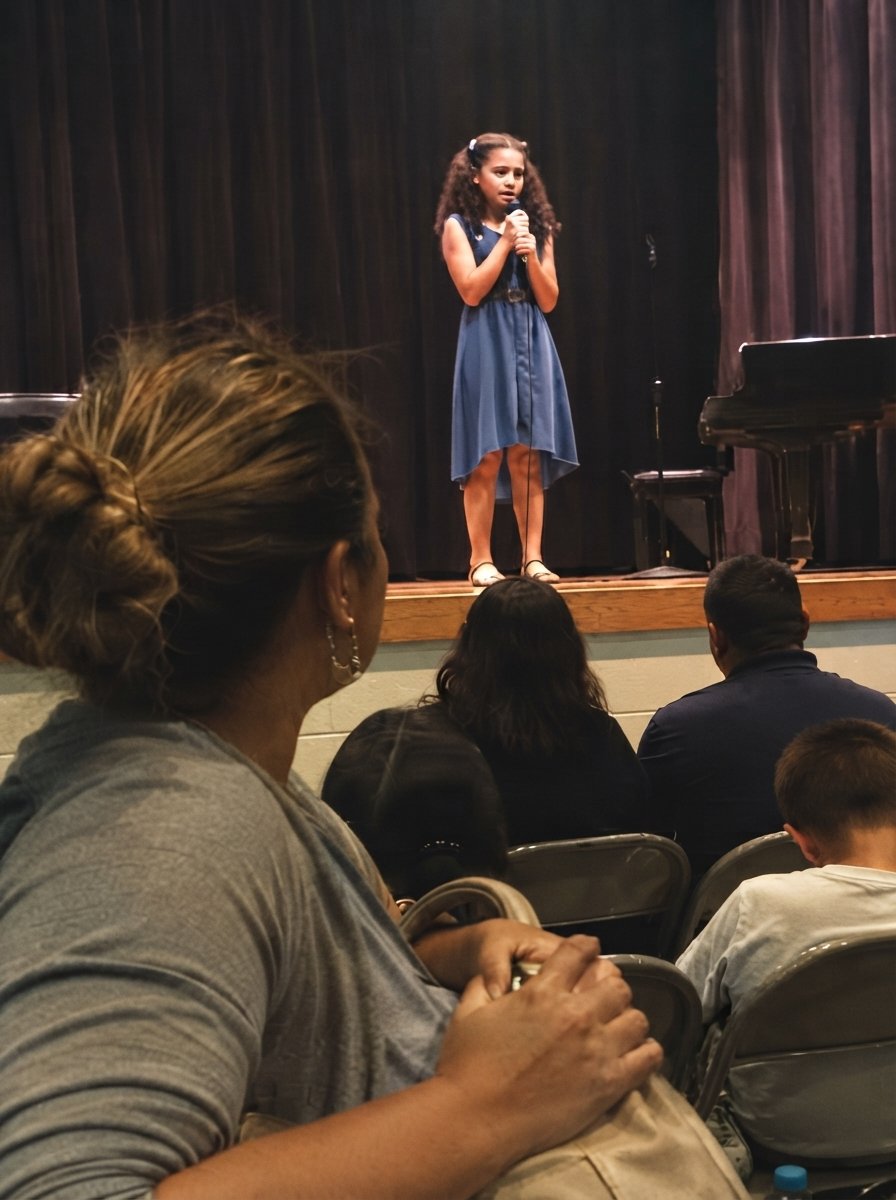
Then Wren walked onto the stage.
This time she wore a green dress.
Her curls were held back with the same silver clips.
She lifted the microphone.
Before the music began, she looked toward Mr. Calloway.
He did not clap.
Not yet.
He simply nodded.
A small gesture that said:
I see you.
Wren smiled.
The piano track began.
She missed the first word.
Maribel’s heart jumped.
Wren closed her eyes.
Then she started again.
Her voice came out raspy.
Thin in places.
Uneven.
But stronger.
Not because it sounded prettier.
Because she was no longer apologizing for the way it sounded.
The room listened.
Really listened.
Nobody laughed.
Nobody whispered loudly enough for Maribel to hear.
Nobody raised a phone and tried to turn the moment into something before Wren had finished living it.
She sang the entire song.
Then came the final note.
It cracked.
Of course it did.
That crack was part of her voice now.
But this time, Wren smiled through it.
The music stopped.
The auditorium became silent.
But this was not the painful silence from one year earlier.
This silence was holding its breath.
Then Mr. Calloway began.
Clap.
Clap.
Clap.
Slow.
Steady.
Certain.
Maribel joined.
Then Nia.
Then Lydia.
Then Ava.
Then the entire auditorium.
Wren did not look shocked.
She did not look relieved.
She looked proud.
Most importantly, she looked like herself.
She did not win the talent show.
A seventh grader performing magic won first place.
Two twins doing comedy won second.
Wren received another inexpensive ribbon.
But when she walked offstage, she went straight to her mother.
“I heard myself that time.”
Maribel hugged her.
“That’s the best prize.”
Wren laughed.
“You’re such a mom.”
“Yes,” Maribel replied. “And you’re welcome.”
Later, they found Mr. Calloway doing exactly what he had been doing after the first talent show.
Stacking chairs.
Wren showed him her ribbon.
“I didn’t win.”
Mr. Calloway examined it as if it were made of gold.
“Depends what you were trying to win.”
Then Nia opened her violin case.
She removed a small silver clip shaped like a musical note.
“This was on my violin case when I was your age,” she told Wren.
“I thought maybe it belonged with someone who understands what it means to start again.”
Wren accepted it carefully.
“Thank you.”
Then she turned toward Mr. Calloway.
“Can I ask you something?”
“Always.”
“Why did you clap first again tonight?”
The old janitor smiled.
“Because I knew everybody else was waiting to.”
Wren thought about his answer.
Then she smiled.
“Maybe someday I’ll clap first for somebody.”
Mr. Calloway’s eyes filled.
“I believe you will.”
Years later, Maribel would still remember those two talent shows.
Not because her daughter became famous.
She did not.
Not because one performance changed the entire world.
It did not.
But one room changed.
A school changed a little.
A mother learned to protect her daughter without choosing for her.
A woman named Lydia learned that good intentions still need permission.
A janitor healed something he had carried for years.
A granddaughter opened an old violin case.
And a twelve-year-old girl discovered that her voice did not have to sound the way it once had to deserve being heard.
Maribel would also remember how close Wren came to never singing again.
Not because she lost a competition.
Because of whispers.
Because of silence.
Because adults forgot children hear more than adults think they do.
Criticism gets in.
Laughter gets in.
Silence gets in.
Applause gets in.
Kindness gets in too.
One clap gave Wren the courage to look up.
One careless video nearly took that courage away.
And that was the lesson Maribel never forgot.
A child’s brave moment is not community property.
A child’s pain is not inspirational content for strangers.
A child’s voice belongs to the child.
If we are fortunate enough to hear it, our job is not to own it.
Our job is to protect the room around it.
So clap when a child tries.
Speak when the room becomes cruel.
Put the phone down when the moment does not belong to you.
And before turning another person’s courage into a lesson, ask whether they ever wanted to teach it.
Because kindness is not only what we choose to do.
Sometimes kindness is what we choose not to take.
And sometimes the most powerful sound in a room is still one good person standing quietly in the back…
Clapping first.