The room seemed to tilt when Moss told me.
“So the baby she lost…”
“Didn’t exist.”
“Blake knew?”
Moss nodded.
“He discovered the fake pregnancy about four months in.”
“Why didn’t he tell anyone?”
“According to him, your mother convinced him Melissa was experiencing a severe psychiatric crisis. She told him exposing her would push her toward suicide.”
Blake had stayed.
Then Lorraine proposed something unimaginable.
Kendra was pregnant. Kendra was having twins. Melissa could still become a mother.
At first, Blake thought Lorraine meant adoption someday.
Then he discovered the nursery.
He demanded it be dismantled.
Lorraine threatened to tell everyone he’d helped fake Melissa’s pregnancy.
She also threatened to accuse him of domestic abuse.
So he began sending money to keep track of where it went.
Eventually, he contacted a private investigator.
The investigator was the person who had anonymously tipped off police about Unit 214.
Blake hadn’t disappeared because he was part of the plan.
He’d disappeared because he’d been trying to escape it.
But one question remained.
“How did they get my medical information?”
Moss looked at me for a long moment.
“We know.”
The answer was so simple I almost laughed.
My mother still had my old iPad.
I’d given it to Dad years ago when I upgraded.
After he died, she’d kept it.
Apparently, the device remained connected to my email account.
Every time Riverbend emailed an appointment confirmation, Mom saw it.
Every time I received a portal notification, she saw that too.
And months before the shower, she’d reset my portal password using the email account saved on the tablet.
Riverbend’s system hadn’t shown an outside login because she had been using an authenticated device connected to my identity.
The sonogram printout had come directly from my portal.
Mom had handed it to Melissa.
But even that wasn’t the worst discovery.
Two days before my scheduled C-section, police arrested Lorraine.
Melissa was taken into custody later that morning.
I expected Melissa to deny everything.
Instead, according to Moss, she broke down within twenty minutes.
“Mom said Kendra didn’t want two babies.”
Those were her first words.
Lorraine had spent months telling Melissa that I was overwhelmed.
That I regretted having twins.
That Travis wanted only one child.
That I had privately agreed to let Melissa raise the second baby.
Then, as Melissa’s obsession grew, Lorraine changed the story.
I had supposedly agreed to give her both.
That’s why Melissa screamed, “You stole my babies.”
She believed I’d made a promise and broken it.
It didn’t excuse the knife.
It didn’t excuse the stalking.
But it changed what I thought I knew.
Melissa wasn’t the architect.
She was unstable, grieving the fertility she had lost, and frighteningly easy for our mother to manipulate.
Lorraine had built the entire fantasy around her.
I thought that was the final truth.
It wasn’t.
The final truth came from a box police found at the very back of Unit 214.
Inside were letters.
Dozens of them.
Not recent letters.
Some were twenty years old.
All written by my father.
Most were addressed to Lorraine.
One contained a sentence Moss warned me about before giving it to me.
You cannot keep trying to replace what we lost with the girls. Kendra is not Emily. Melissa is not Emily. They are our daughters, not second chances.
“Who’s Emily?” I asked.
Moss didn’t know.
Aunt Carol did.
When I called her, she went silent.
Then she started crying.
Emily had been my mother’s first daughter.
She died at eleven months old.
Three years before Melissa was born.
Nobody had ever told us.
Lorraine had removed every photograph.
Every baby book.
Every trace.
Except one.
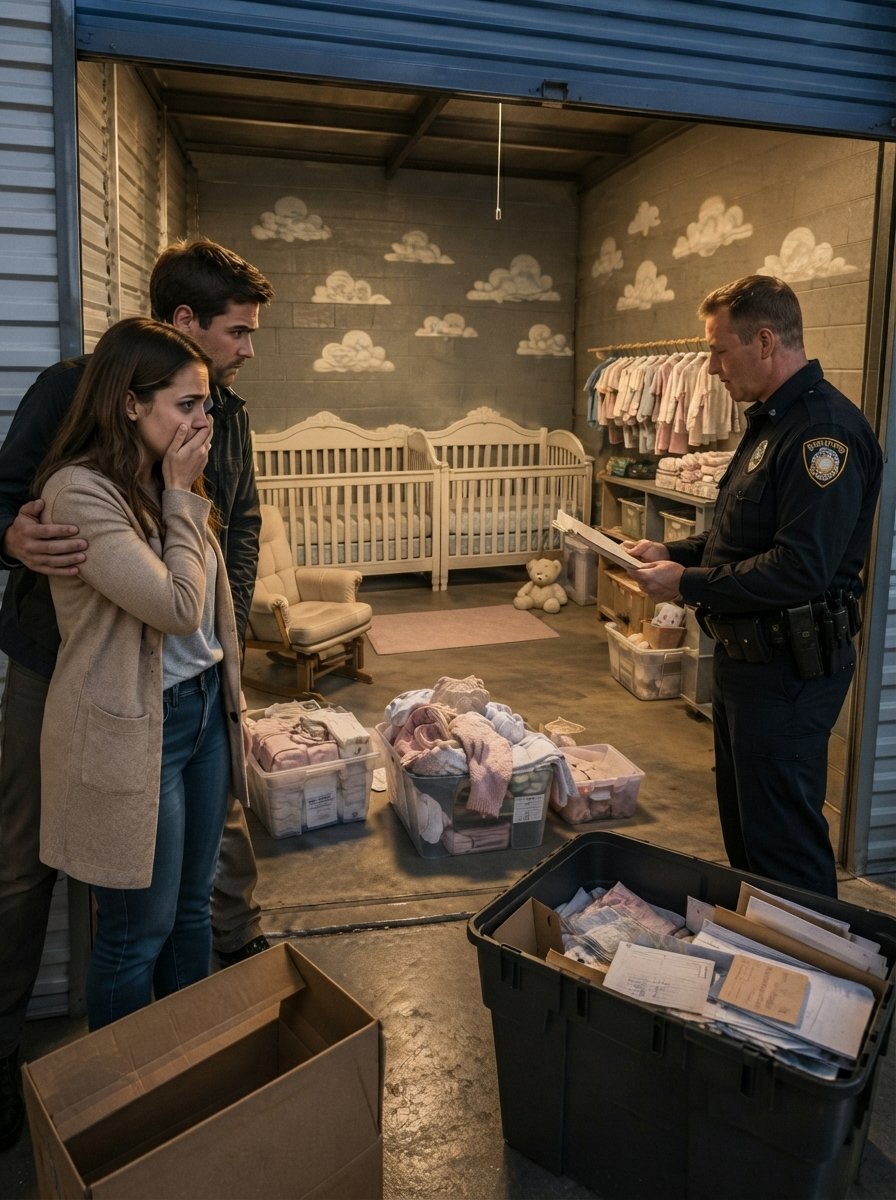
Inside that storage box was a faded photograph of a baby girl sitting beneath a painted wall of white clouds.
The same clouds painted inside Unit 214.
My father had apparently spent decades begging Lorraine to seek treatment.
After Emily died, she became obsessed with recreating milestones.
She dressed Melissa in Emily’s saved clothes.
When I was born, she gave me Emily’s middle name.
Dad eventually threatened to leave if Lorraine didn’t stop.
She hid it better.
But she never stopped.
When Melissa became infertile, something in Lorraine’s carefully controlled world cracked open again.
Then I became pregnant with twins.
And suddenly she had two newborn girls coming into the family.
Two chances.
Two replacements.
Harper and Hazel weren’t intended only for Melissa.
They were intended for my mother.
The night before my C-section, Lorraine called me from jail.
I almost refused the call.
Then I accepted.
For several seconds neither of us spoke.
Finally, she said, “I never wanted to hurt you.”
I laughed once.
It sounded ugly.
“You helped someone stalk me.”
“I helped your sister survive.”
“You stole my medical records.”
“Melissa needed hope.”
“You rented a nursery for my children.”
Silence.
Then she whispered, “They would have been loved.”
My entire body went cold.
“They are loved.”
“That’s not what I meant.”
I gripped the phone.
“What did you mean?”
Her voice softened.
The same voice that had read me bedtime stories.
The same voice that had held me after failed fertility treatments.
The same voice that had promised to keep my twins secret.
“Emily died because I didn’t know enough then,” she said. “I was twenty-two. I trusted doctors. I trusted everyone. I wouldn’t make those mistakes again.”
“They aren’t Emily.”
“I know.”
“No, you don’t.”
“I know they’re not Emily.”
She paused.
Then came the sentence I will remember until the day I die.
“Emily was only one baby. Two would have been better.”
I hung up.
Harper and Hazel were born the next morning at 9:14 and 9:17.
Both healthy.
Both screaming.
Both mine.
When the nurse placed Harper against my chest, I cried so hard I couldn’t speak.
Travis held Hazel beside me.
For months, pregnancy had felt like something being watched.
Tracked.
Claimed.
The moment my daughters arrived, that feeling broke.
Melissa eventually accepted a plea agreement that required long-term psychiatric treatment and barred contact with us.
Blake filed for divorce.
Mom’s case went to trial.
The prosecutor showed photographs of Unit 214.
My stolen mail.
The fake delivery paperwork.
The nursery.
The surveillance records.
Then June introduced the notebooks I’d started after the baby shower.
Page after page.
Date after date.
The same notebook my mother had once mocked me for carrying everywhere.
Pattern is your case.
June had been right.
Lorraine was convicted of stalking, identity-related offenses, conspiracy, theft of medical information, and attempted custodial interference.
But there was one final thing nobody expected.
Six months after the trial, Aunt Carol brought me a sealed envelope she’d found hidden inside one of Dad’s old toolboxes.
It was addressed to me.
Dad had written it shortly before he died.
I sat at our kitchen table while Harper and Hazel slept upstairs and opened it.
Kendra,
If your mother ever becomes too interested in your children, don’t dismiss your instincts because she’s family.
My hands began shaking.
He knew.
He had always known.
Then I reached the final paragraph.
There is something Lorraine never told you about Emily.
I stopped.
Emily did not die from illness.
My heartbeat pounded in my ears.
Your mother fell asleep with her in the bathtub.
The police report from 1976 had called it an accidental drowning.
Lorraine blamed herself.
Dad forgave her.
But after Emily’s death, Lorraine began rewriting the event in her own mind.
First the doctors failed her.
Then the babysitter had distracted her.
Eventually, according to Dad, Lorraine insisted someone had stolen Emily from her, even though she had been the one holding the baby when emergency services arrived.
That sentence explained everything.
Melissa’s pregnancy.
The fake miscarriage.
The nursery.
My mother’s obsession with schedules, hospitals, names and delivery rooms.
For nearly fifty years, Lorraine hadn’t been trying to replace a child she’d lost.
She had been trying to rewrite a story she could not survive remembering correctly.
I thought the letter ended there.
It didn’t.
At the bottom, Dad had added six words.
Ask Carol what Lorraine called you.
I called my aunt immediately.
Carol cried before I finished asking.
“What did Mom call me?”
“Kendra…”
“What did she call me?”
A long silence.
Then Carol whispered:
“Emily.”
My throat tightened.
“What?”
“For almost your entire first year. When nobody else was around, she called you Emily.”
I couldn’t speak.
“Your father threatened to take you and Melissa away. That’s when she finally stopped.”
I looked toward the baby monitor.
Two tiny girls slept safely beneath white blankets.
And suddenly the most frightening part of the entire story became clear.
The nursery in Unit 214 had never truly been built for Harper and Hazel.
Not in Lorraine’s mind.
It was the nursery she had been rebuilding for almost fifty years.
First for Melissa.
Then for me.
Then for my daughters.
A room waiting for the same dead child to come home again and again.
That night, Travis and I removed the wooden name signs from Harper and Hazel’s nursery.
Not because their names frightened me.
Because I wanted nothing in their room that suggested anyone else had a claim on who they would become.
We replaced them with photographs.
Harper laughing.
Hazel asleep against Travis’s chest.
The four of us together.
Messy.
Alive.
Real.
Years later, when my daughters ask why they don’t see Grandma Lorraine, I won’t tell them the whole story yet.
Someday I will.
I’ll tell them that family does not mean ownership.
That grief can explain terrible behavior without excusing it.
That love without boundaries can become something dangerous.
And I’ll tell them about the notebook.
Because there was one lesson I learned before they were even born that I want them to carry forever:
When someone makes you afraid, you do not owe them silence just because you share their blood.
For months, everyone told me I was overreacting.
It was a cake knife.
It was her day.
Melissa was fragile.
Mom was only excited.
Every warning sign arrived wrapped in an explanation.
Every violation came disguised as concern.
If I hadn’t written it down, I might eventually have believed them.
Instead, I trusted the pattern.
I trusted myself.
And when police opened Unit 214, the truth was waiting behind a metal door.
Two cribs.
Painted clouds.
Stolen mail.
My daughters’ names.
And fifty years of a secret my mother had tried to turn into somebody else’s life.
Harper and Hazel will never know that room.
They will never sleep beneath those painted clouds.
They will never be replacements for a dead baby, medicine for someone else’s grief, or characters in a story written before they were born.
They are not Emily.
They are not Melissa’s second chance.
They are not Lorraine’s redemption.
They are Harper and Hazel.
And they are finally, completely, safely their own.