
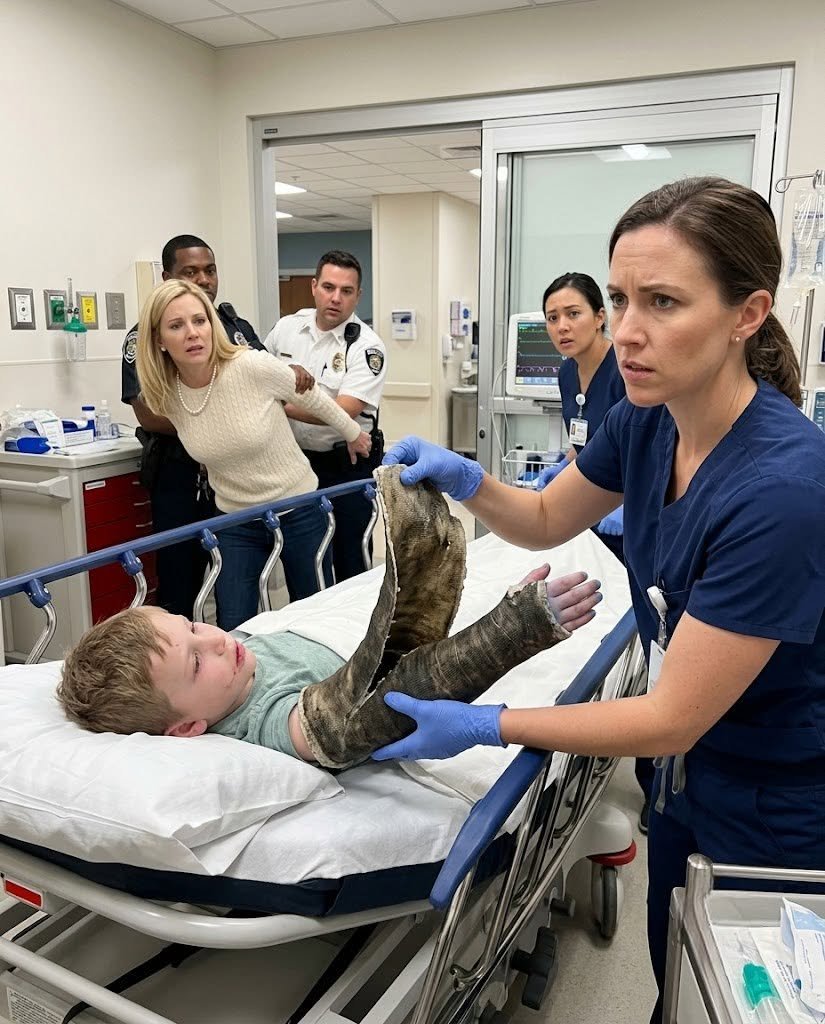
Three years earlier, I had listened longer than my instincts wanted me to.
I had never forgotten that.
Standing beside this boy, staring at a filthy cast pressed into swollen purple skin, I knew I was not going to make the same mistake twice.
“Clara,” I said, keeping my voice level, “call security. Then bring me the cast saw.”
Martha’s reaction was immediate.
She moved toward the bed so fast that her coffee sloshed against the lid.
“You can’t touch him!” she screamed. “I’ll sue this hospital!”
Her polished calm disappeared beneath raw anger.
She reached toward the bed.
Clara stepped directly between Martha and the child.
“Back up, ma’am.”
Martha ignored her.
She tried to move around Clara, raising her voice again as Marcus stayed near the boy and continued preparing the emergency equipment.
The child did not appear to understand the argument unfolding beside him.
That frightened me more than the shouting.
An eight-year-old boy was surrounded by strangers, bright lights, alarms, and adults arguing over his body, yet he barely reacted.
I leaned closer to him.
“Hey, buddy,” I said quietly.
His eyes shifted slightly but did not settle on me.
“We’re going to help your arm.”
I could not promise more than that.
Behind me, Martha’s voice rose again.
“His doctor said not to remove it! You don’t have permission!”
I turned toward her.
“Your son is critically ill.”
“He has the flu!”
“This is not a mild flu.”
“You don’t know that.”
Her insistence had stopped sounding like denial.
It was becoming something else.
She was not asking what we believed was wrong.
She was not asking what would happen if the cast stayed on.
She was not even demanding another doctor.
She was focused on one thing only.
Keeping that cast closed.
Two security guards entered the trauma room.
The space was already crowded, so their arrival forced everyone to reposition around the bed.
Clara stayed between Martha and her son while the guards moved Martha back toward the wall.
She resisted them, twisting and grabbing at the front of her cream sweater as she continued protesting.
Her paper coffee cup was taken out of the way and set aside.
“You cannot do this,” she snapped. “Do you understand me? You cannot do this.”
I did not argue with her anymore.
There was nothing left to debate while her son’s blood pressure was falling.
I turned back toward the bed.
Clara returned to the boy’s side.
Marcus checked the monitor again.
The numbers confirmed what his face already showed.
We needed access to that arm.
We needed to know what was happening underneath the fiberglass.
And we needed to know now.
Clara left the room briefly and came back carrying the cast saw.
The tool itself was ordinary.
Every emergency department sees them.
There was nothing dramatic about placing one on a tray beside a patient with a cast that needed to be removed.
But when Clara set it beside the boy’s arm, Martha stopped fighting the security guards.
Not gradually.
Immediately.
The change was so complete that I looked up.
Seconds earlier, she had been shouting about lawsuits and permission.
Now she was still.
Her hands remained clenched near the front of her sweater, but the anger had gone out of her voice.
Her attention was no longer on me.
It was no longer on Clara.
It was not even on the guards holding her back.
She was staring at the cast saw.
Then her gaze moved to her son’s filthy arm.
For the first time since she had entered the room, genuine fear appeared on her face.
Not fear that her child was dying.
Fear of what we were about to uncover.
“Don’t open it,” she said.
Her voice had dropped so low that I almost did not recognize it as the same voice that had been screaming seconds earlier.
Clara paused with one gloved hand near the equipment.
Marcus looked toward Martha.
I watched her carefully.
“Please,” she whispered. “Don’t open it.”
That plea changed the entire room for me.
Her refusal had never really been about an orthopedic surgeon saying the cast needed two more weeks.
It had never been about antibiotics.
It had never been about a seasonal bug.
She knew something about that cast.
Maybe not everything that was happening beneath it, but enough to fear the moment it came off.
I looked from Martha to the boy.
His cracked lips were slightly parted.
His face looked even smaller against the hospital pillow.
The stained fiberglass covered most of his right arm like a sealed container nobody had been allowed to question.
For a month, according to his mother, it had remained there while the edges frayed, the skin swelled, the fingers turned blue, and that terrible odor grew strong enough to reach an emergency-room hallway before the stretcher carrying him did.
Now the only thing standing between us and whatever was underneath was a thin layer of dirty fiberglass.
Martha seemed to understand that too.
The guards kept her against the wall while Clara positioned herself beside me.
Marcus remained near the boy’s head and the monitor, ready to respond if his condition worsened.
No one had to explain what came next.
I picked up the cast saw.
The boy’s mother stared at my hands.
Her expression had lost every trace of the polished certainty she had walked in with.
“Please,” she said again.
I looked down at the eight-year-old child on the bed, at the blue fingertips and the swollen skin disappearing beneath the filthy edge of the cast.
Whatever Martha was afraid of, protecting her secret was no longer the priority.
Protecting her son was.
I brought the saw toward the stained fiberglass.
And as the first cut began, every person in Trauma Room 2 was about to understand why Martha Harris had been so desperate to keep that cast closed.