
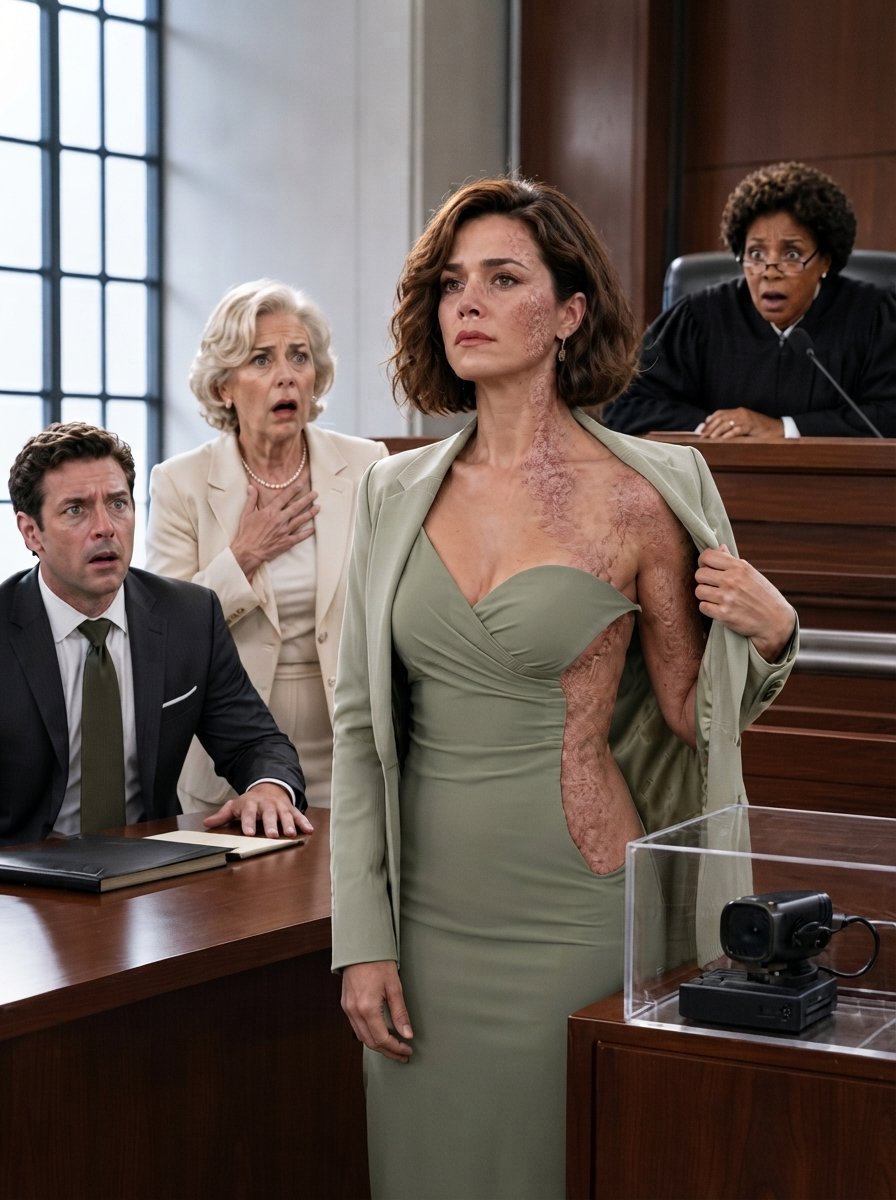
Part 1: The Night They Tried to Make It Look Like an Accident
The scream that came out of me did not sound human.
One second, I was standing beside the stove, refusing to sell the house my father had left me.
The next, my husband’s hands slammed into my back.
I stumbled forward and struck the counter beside a large stockpot filled with boiling soup.
The pot tipped.
Scalding liquid poured across the left side of my face, neck, shoulder, and arm, soaking through my blouse before I could pull away.
I dropped to the floor, clawing desperately at the burning fabric.
The pain was indescribable.
“Help me!” I screamed.
My husband, Julian, stood over me, breathing heavily.
He did not look frightened.
He did not look shocked.
Across the kitchen, his mother, Evelyn, remained seated at the breakfast table.
She watched me writhe on the floor and said coldly,
“Maybe now she’ll stop being selfish.”
I stared at her through tears.
“Call 911!”
Instead of helping me, Evelyn grabbed my phone from the counter and moved it out of reach.
Then she calmly began wiping the surface beside the stove.
Julian lifted the fallen pot and placed it upright again.
They were cleaning.
Removing evidence.
I begged again for an ambulance.
Only when my screaming weakened and my body began shaking uncontrollably did Julian finally make the call.
“My wife slipped in the kitchen,” he told the dispatcher.
“She knocked over a pot of hot soup.”
I lay on the floor listening to him create the lie that was supposed to become the official version of what had happened.
At St. Matthew’s Hospital, doctors immediately began treating the burns.
The left side of my neck and shoulder had been badly injured, and parts of my arm would require months of rehabilitation.
While surgeons and nurses worked around me, Julian transformed himself into the perfect worried husband.
“My poor wife,” he whispered beside my bed.
Then he squeezed my uninjured hand.
Hard.
Too hard.
It was not comfort.
It was a warning.
Evelyn told the same story to the deputy who arrived at the hospital.
According to her, I had been upset.
Careless.
Emotional.
She even suggested that I had become unstable recently.
For nine days, I barely spoke.
Julian believed pain had silenced me.
He was wrong.
My father, Frank Sterling, had taught me something long before he died:
Panic wastes the seconds in which truth can be preserved.
So I waited.
And I remembered.
Several months before his death, my father had installed a small security camera in the kitchen.
Julian had begun “accidentally” breaking things whenever we argued.
A glass here.
A cabinet door there.
A picture frame thrown against a wall.
Dad never trusted those accidents.
Julian knew about the visible camera mounted above the pantry.
What he did not know was that my father had connected it to a concealed recording system inside the detached garage.
From my hospital bed, I quietly began protecting myself.
First, I asked one of the nurses to photograph every visible injury.
Then I requested that access to my medical records be restricted.
After that, I called Sarah Vance, the attorney who had handled my father’s estate.
“Do not contact Julian yet,” I told her.
“What do you need me to do?” she asked.
“Protect the house.”
The house was the reason all of this had happened.
My father had owned it for decades.
When he died, he left it directly to me.
Julian had spent months pressuring me to sell.
At first, he claimed we needed a fresh start.
Then he said the neighborhood was declining.
Later, he insisted the money would help us build a better future.
But something about his desperation had always bothered me.
The more I refused, the angrier he became.
Sarah immediately filed for an emergency order preventing the property from being sold, mortgaged, transferred, or otherwise encumbered.
When Julian received notice of the order, he assumed that was my entire strategy.
He thought I was simply trying to protect the house.
He had no idea a criminal case was quietly beginning to form behind it.
Three weeks after the attack, Julian walked into my rehabilitation room carrying divorce papers.
I was still wearing heavy bandages around my arm and shoulder.
He placed the papers beside me and looked at my scars.
Then he sneered.
“I didn’t marry a damaged woman.”
For a few seconds, I simply stared at him.
This was the man who had promised to love me.
The man who had pushed me toward boiling liquid because I would not give him my father’s property.
And now he wanted a divorce because of the injuries he had caused.
He explained that he wanted the marriage dissolved quickly.
He also wanted the house sold so that what he called “our debts” could be paid.
I signed only the acknowledgment showing that I had received the papers.
Then I looked at him calmly.
“You should do whatever you think is best.”
His smile returned.
He believed I had surrendered.
That evening, Sarah called me from a borrowed phone.
Her voice was tense.
“Elena, I went to the garage.”
My stomach tightened.
“The recorder is gone.”
For one terrible second, I thought we had lost everything.
Then Sarah continued.
“But your father’s system had a cloud backup.”
I stopped breathing.
“The kitchen footage survived.”
She told me that the backup had preserved approximately seventeen minutes from the confrontation.
It had also captured Julian entering the garage later with bolt cutters.
Then Sarah told me what the kitchen microphone had recorded shortly before Julian pushed me.
Julian had said:
“If she won’t sign, Mom, we’ll make it look like an accident.”
I closed my eyes.
For the first time since the attack, I knew I was not going to spend the rest of my life trying to convince people what had happened.
The truth had recorded itself.
I allowed Julian to keep believing the woman he married had been destroyed.
He went to bars.
He posted photographs online.
He told neighbors I had suffered some kind of emotional breakdown.
Meanwhile, I learned how to move my injured arm again.
I learned how to sleep despite the pain.
And quietly, Detective Marcus Miller began building the case.
He met me in a private therapy room at the hospital.
He watched the kitchen footage once.
Then he watched it again with the audio isolated.
The video clearly showed Julian standing between me and the doorway.
It showed Evelyn moving my phone beyond my reach.
It recorded the argument about the house.
And it showed Julian shoving me immediately before the boiling pot tipped.
Afterward, the camera captured Evelyn wiping the counter while I lay injured on the floor.
Detective Miller closed the laptop.
“This was not an accident,” he said.
He paused.
“And the garage footage suggests attempted destruction of evidence.”
The district attorney moved carefully.
Julian had already hired an expensive defense attorney named Grant Holloway.
Holloway claimed the cloud recording could have been manipulated.
Evelyn insisted she had simply panicked and cleaned the kitchen because she was in shock.
But they did not know Detective Miller had found something else.
The visible pantry camera Julian believed had been destroyed was recovered from a trash bag behind one of Evelyn’s rental properties.
Its memory was partially damaged.
Not completely.
Forensic technicians compared what remained on the camera with the cloud backup.
The timestamps matched.
The image sequences matched.
The audio matched.
Julian had tried to destroy the truth.
But he had failed.
And the camera was only the beginning.
Part 2: The Evidence They Couldn’t Erase
By the time Julian formally responded to the criminal investigation, he had convinced himself that confidence could replace evidence.
Grant Holloway attacked the kitchen recording from every direction.
He questioned the timestamps.
He suggested the audio had been edited.
He claimed that because the video had been uploaded to a cloud server, someone could have modified it.
He even suggested that I had staged the confrontation because I knew our marriage was failing.
Detective Miller had expected those arguments.
The forensic examination of the recovered pantry camera destroyed them.
Even though parts of the device had been damaged, technicians recovered enough data to compare it with the cloud version.
The recordings were authentic.
They had not been altered.
Julian had simply failed to destroy every copy.
Then Detective Miller discovered something neither Julian nor Evelyn had expected.
The camera had recorded another conversation.
It happened two nights before the attack.
I had completely forgotten about it.
In the footage, Julian stood beside the refrigerator while Evelyn sat at the kitchen table drinking coffee.
“She won’t sell,” Julian said.
“She will,” Evelyn answered.
“You don’t know Elena.”
Evelyn gave a small laugh.
“Everybody has a breaking point.”
Then Julian lowered his voice.
“I already owe almost ninety thousand.”
My stomach tightened when Detective Miller played that part for me.
Ninety thousand dollars.
Julian had always told me our finances were stable.
He claimed his consulting business was profitable.
Whenever a late payment notice appeared, he blamed bookkeeping mistakes.
Whenever I asked too many questions, he accused me of being controlling.
Sarah immediately requested financial discovery as part of the divorce proceedings.
Within days, the real reason Julian wanted my house became clear.
He had accumulated enormous gambling debts.
There were credit cards I had never seen.
Loans I had never known about.
Private lenders.
False income statements.
Repeated cash advances.
There were even documents showing that Julian had attempted to use my inherited house as collateral.
But he had a problem.
The house had passed directly from my father to me.
Julian could not legally sell or mortgage it without my signature.
That was why he had become obsessed with convincing me.
It had never been about building our future.
It had been about saving himself.
Sarah placed copies of the financial records in front of me.
“He was desperate,” she said.
“And desperation gives the prosecution motive.”
Loan after loan contained Julian’s signature.
For years, I had believed his anger came from pride.
Now I understood.
It came from fear.
He needed money.
And he believed my father’s house was his way out.
Evelyn’s involvement also became impossible to deny.
Bank records showed repeated transfers from her accounts to Julian’s creditors.
She knew about the gambling.
She knew about the loans.
She knew exactly how much trouble her son was in.
She had not simply been a mother who witnessed her son lose control.
She had participated in the pressure campaign.
Detective Miller obtained warrants for Julian’s phone and laptop.
Most of the important messages had been deleted.
Julian apparently believed deleting a message erased it forever.
It did not.
A forensic analyst recovered fragments of conversations between Julian and Evelyn.
Eleven days before the attack, Evelyn had written:
If she signs, everything is solved.
Julian replied:
She keeps talking about what her father wanted.
Evelyn answered:
Then stop asking nicely.
Another message had been sent the morning I was burned.
Julian wrote:
Today. I’m done waiting.
My hands shook as I read it.
Sarah reached toward me.
“You don’t have to read the rest.”
“Yes,” I whispered. “I do.”
I needed to know exactly who I had shared my home with.
The criminal investigation expanded.
Julian now faced serious assault charges along with charges connected to obstruction and evidence destruction.
Evelyn faced charges related to the cover-up, tampering with evidence, and conspiracy.
Still, their attorneys insisted everything had been misunderstood.
Then came the divorce hearing.
I had dreaded that day for weeks.
Not because I believed Julian would get the house.
Sarah was confident the inheritance records protected it.
I dreaded seeing him.
My neck had begun healing, but I still wore compression garments beneath my clothes.
Some mornings, my fingers barely closed.
Physical therapy helped, but every session felt like teaching my body that danger had ended.
The night before court, I stood in front of my bedroom mirror.
For months, I had avoided looking directly at my scars.
That night, I made myself look.
They were there.
So was I.
The following morning, Sarah drove me to the courthouse.
Julian arrived in a charcoal suit.
He looked as though he were attending a business meeting instead of facing the woman he had nearly killed.
Evelyn walked beside him.
When she saw me, she smiled.
It was not kindness.
It was confidence.
She still believed I was afraid of her.
The divorce hearing began quietly.
Holloway argued that Julian had contributed to the house through renovations and household expenses.
Therefore, he claimed, Julian should receive part of its value.
Sarah responded with deeds, inheritance documents, bank records, and receipts.
Almost every major improvement had been paid from my father’s estate or my separate funds.
Then Holloway made a mistake.
He told the judge that Julian had always been a supportive husband.
He suggested the criminal accusations were merely part of an emotional divorce.