
Marcus’s car.
Marcus opening the passenger door.
Sylvia standing beside him in a wool coat.
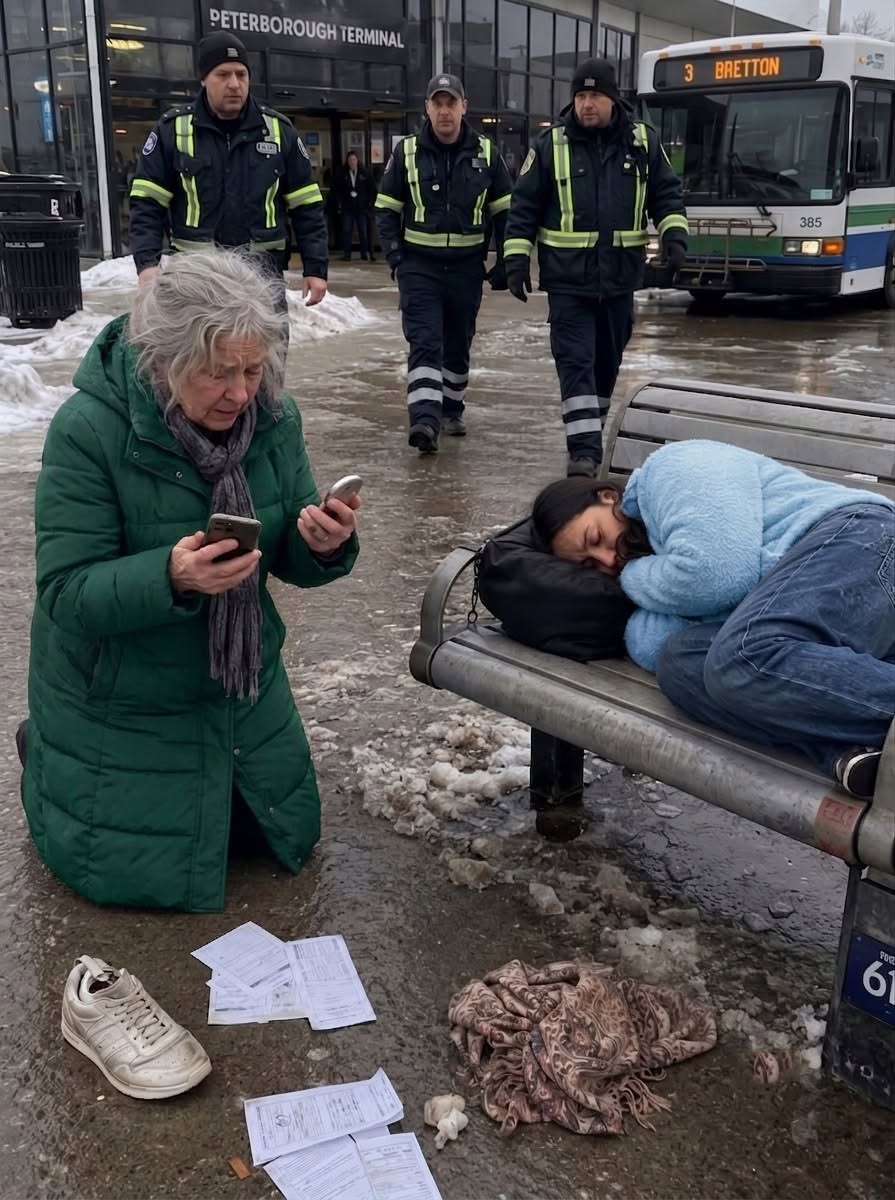
Chloe collapsing against the bench.
Marcus stepping away.
Then Sylvia bending down.
Not to help Chloe.
To remove something from her hand.
Her wedding ring.
The detective stared at the image.
“She took the ring.”
“She took control,” I said.
Then Marcus called me again.
I let the phone ring twice.
The detective looked at me.
I answered on speaker.
“Eleanor,” Marcus snapped. “Where are you?”
I said nothing.
“Do not make a scene,” he continued. “Chloe embarrassed herself last night. She was drunk. She fell. She needs help, but not the kind you’re trying to make this into.”
The detective’s eyes narrowed.
I remained silent.
Marcus kept talking because silence unsettles arrogant men.
“I have important people in my home today. If you show up here with some sob story, I will make sure Chloe loses everything. Do you understand me? She is unstable. I have witnesses.”
Then Sylvia’s voice came from behind him.
“Tell that old woman she should be grateful we didn’t call the police on her daughter.”
The detective raised one finger, signaling for me to keep Marcus talking.
So I did.
“What did she do to the rug, Marcus?”
He exhaled as if I had finally decided to be reasonable.
“She bled on it.”
The entire room became silent.
Even a nurse at the counter looked up.
Marcus realized his mistake too late.
“After she fell,” he added quickly.
The detective wrote two words in his notebook.
Admission heard.
For the first time that morning, I smiled.
There was no warmth in it.
At 8:03 a.m., a tactical supervisor arrived at the hospital.
He asked simple, direct questions.
“Is a weapon likely still inside the residence?”
“Yes.”
“Has the injured victim identified the suspects?”
“Yes.”
“Is there evidence of witness intimidation?”
“Yes.”
“Are guests currently inside the house who could be endangered or used as cover?”
“Yes.”
“Is probable cause forming for immediate intervention?”
The detective looked through the medical photographs, terminal images, messages, and notes from the phone call.
“Yes,” he said.
I didn’t ask to accompany them.
I knew better.
Whatever title I had once held, I was now the victim’s mother.
My place was beside Chloe.
But when the supervisor stepped into the corridor, I followed him far enough to say one thing.
“He thinks she has nobody who can hurt him legally.”
The supervisor turned toward me.
“Then he’s about to be corrected.”
At 8:41 a.m., officers approached Marcus’s house.
I learned what happened later through police reports, witness statements, and body-camera footage.
The dining room was filled with guests.
The turkey was on the table.
Candles were burning.
And a woman who appeared in none of the family photographs sat beside Marcus.
Chloe’s chair had not been left empty.
It had been removed.
That detail stayed with me.
An empty chair can accuse people.
Removing it allows them to pretend nobody ever belonged there.
Sylvia was carving the turkey when the first knock came.
According to witnesses, she rolled her eyes and told a cousin to answer the door.
Marcus kept smiling.
Then came a second, harder knock.
“Police.”
One guest later said Marcus stood so quickly that his chair slammed into the wall.
Another remembered Sylvia shouting, “Nobody open that door!”
Then the officers entered.
Not chaotically.
Purposefully.
Body-camera footage captured the instructions clearly.
“Hands where we can see them.”
Guests were ordered away from the table.
Marcus demanded to know who had authorized the entry.
Sylvia screamed about lawyers.
The mistress sat frozen in her chair with a napkin across her lap.
And Chloe’s missing shoe was found beside the sideboard.
Despite the expensive furniture, crystal glasses, and catered meal, the room suddenly looked cheap once the truth entered it.
Marcus tried charm first.
Then anger.
Then status.
Finally, fear.
Sylvia held out longer.
Women like her often do.
She kept her chin raised while officers photographed the rug, the hallway, a golf club inside the mudroom, and a stain someone had missed beside the baseboard.
She claimed Chloe had been drinking.
She said Chloe had attacked them.
She said I was confused.
Then an officer showed her the terminal photograph of her removing Chloe’s wedding ring.
That was when Sylvia’s face changed.
It didn’t collapse.
Not yet.
It simply emptied.
The ring was later recovered from her handbag.
At 9:18 a.m., the hospital called me.
Chloe had suffered internal injuries, several broken ribs, and a concussion.
But she was alive.
I sat down in the hospital corridor because my knees could no longer hold me.
Alive is such a small word until it becomes the only word that matters.
When Chloe woke that afternoon, her first question wasn’t about Marcus.
It wasn’t about Sylvia.
It wasn’t even about her injuries.
She looked at me and whispered, “Did I ruin Thanksgiving?”
That is what abuse does.
It teaches the wounded person to apologize for bleeding.
I took her hand between both of mine.
A hospital band circled her wrist. Dried blood remained near her mouth, and beneath the white blankets, she looked impossibly young.
“No, baby,” I said. “They ruined a crime scene. There’s a difference.”
Her mouth trembled.
Then she cried.
Quietly.
Chloe never made much noise while breaking.
I carefully sat on the edge of the bed and held her around the tubes.
The months that followed were not simple.
Stories like ours do not end because one door opens and justice walks through cleanly.
There were witness statements.
Court hearings.
Medical appointments.
Insurance documents.
Photographs sealed into evidence.
A protective order.
Divorce proceedings.
Eventually, Chloe’s engineering mind returned before her body fully healed.
One morning she placed a large folder on my kitchen table.
She had divided it into sections written in blue marker:
POLICE REPORT
HOSPITAL RECORDS
TIMELINE
ATTORNEY
I hated that she needed that folder.
I loved that she had created it.
Marcus eventually accepted a plea after the recordings, terminal camera footage, medical records, photographs, and witness accounts left him almost no space to continue pretending he was innocent.
Sylvia blamed everyone except herself.
But the wedding ring found inside her handbag became the one fact no version of her story could erase.
The mistress claimed she had known nothing about what happened before Thanksgiving dinner.
Perhaps that was true.
But I believe she understood enough to remain sitting at a table where another woman’s chair had been deliberately removed.
That was its own kind of testimony.
Chloe recovered slowly.
Some mornings, simply lifting one arm brought tears to her eyes.
Some nights, the sound of a car door closing outside convinced her body that Marcus had returned.
So we created routines around the fear without calling them fear.
Tea before bed.
The porch light left on.
A spare key to my house.
And a permanent place at my Thanksgiving table that no one would ever remove.
The following Thanksgiving, Chloe arrived carrying sweet potatoes.
She had deliberately made them too firm.
She placed the dish on my kitchen counter and looked at me.
“Go ahead,” she said. “Complain.”
I laughed.
So did she.
There was still darkness beneath her eyes.
Some days, she touched her ribs before standing.
But she was alive.
She was home.
And she was laughing in my kitchen while snow tapped softly against the windows.
For several seconds, I could smell coffee, cinnamon, and pumpkin pie again without fear hiding underneath them.
I still think about that Thanksgiving morning.
The phone ringing at 5:02.
Marcus calling my daughter garbage.
Sylvia carving a turkey while Chloe froze alone at a bus terminal.
The weight of my old badge in my hand, somehow heavier than metal should have been.
People sometimes ask whether I regret never telling Marcus what I had once done for a living.
I don’t.
If Marcus had known I was a former federal prosecutor, he might have been more careful.
He might have hidden his actions better.
He might have chosen another place to leave Chloe.
He might have controlled what he said on the phone.
He might even have remembered to move her shoe before taking that photograph.
Instead, Marcus revealed exactly who he was because he believed there was no powerful person standing behind my daughter.
He was wrong.
Chloe had evidence.
She had the truth.
And she had a mother.
When the world tried to make my daughter small enough to disappear, I made certain that every camera, every report, every witness, and every courtroom heard her name.