
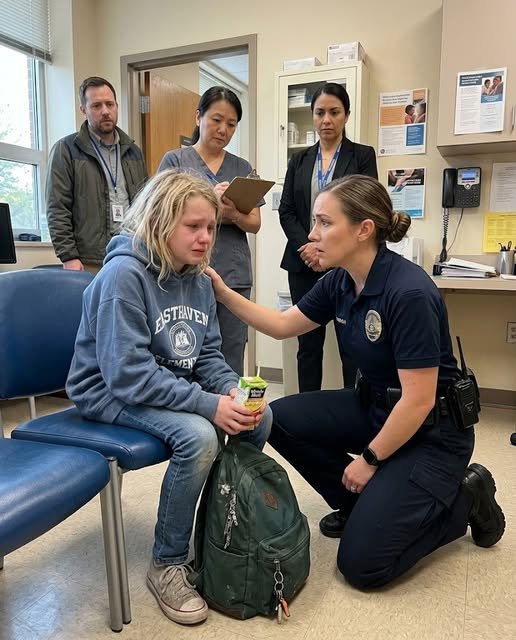
My mom went on a month-long trip and left me with only $20 when I was 11. When she finally came home… she didn’t expect to find the police waiting at the door…
“Are you really leaving me alone with just that?” I asked, staring at the wrinkled twenty-dollar bill my mother had pressed into my hand.
Sarah didn’t even stop turning the deadbolt.
It was Thursday morning in our apartment complex. The hallway smelled like old carpet, burnt toast drifting from somebody’s kitchen, and the sharp lemon cleaner the landlord used whenever he thought someone important might stop by.
My mother’s suitcase wheels scraped across the concrete outside our door.
She had two hard-shell suitcases packed so full that the zippers bowed at the corners, plus a smaller bag hanging from one shoulder.
Every time she moved, the gold zipper on her jacket caught the hallway light.
I was eleven years old, still wearing yesterday’s school hoodie because I had slept in it.
The afternoon before, Sarah had pulled me out of school early and told the office we were going to spend some mother-daughter time together before her trip.
There had been no mother-daughter time.
She spent the afternoon opening drawers, making piles on her bed, charging devices, and checking something on her phone every few minutes.
By dinner, clothes covered the couch.
By bedtime, she was still packing.
Videos played from her phone while she folded shirts and stuffed shoes into plastic bags.
Every so often, a message would arrive and she would smile or laugh at something I wasn’t allowed to see.
I sat on the couch with cartoons running in front of me, pretending I cared what was happening on the screen.
Mostly I listened to zippers.
Every zipper that closed made the trip feel more real.
Finally, sometime after midnight, I asked where exactly she was going.
She said Europe like that was supposed to explain everything.
Spain.
Italy.
France.
The names sounded like things from a textbook or a television show.
I didn’t really understand the distance between those places and our apartment.
I understood one thing.
They were far away.
Now, standing beside the front door the next morning, I unfolded the twenty-dollar bill she had given me.
“That’s all?” I asked.
Sarah gave me a look that made me immediately wonder whether I had said something wrong.
“There’s food,” she said.
“How much?”
“There’s instant soup, peanut butter, bread, and some canned beans. You’ll be fine.”
I looked toward the kitchen.
The bread had already been sitting there for days.
There were a few cans in the cabinet, but I didn’t know how far they would stretch.
I knew twenty dollars wasn’t much because I had seen how quickly money disappeared at the grocery store.
Sometimes Sarah would complain that one bag of groceries cost almost everything she had brought with her.
Now I was supposed to make one wrinkled bill last for whatever came next.
“How many days are you going to be gone?” I asked.
She exhaled loudly.
“A few weeks.”
“A few?”
“I got an opportunity, Emily, and I deserve one good thing for once.”
She said it like my question had taken something away from her.
I stared at the twenty again.
I wanted to ask who would take me to school if I missed the bus.
I wanted to ask what I was supposed to do if I got sick.
I wanted to ask who I should call if something broke or someone tried the door at night.
Instead, I asked, “What if I need something?”
“You have a phone.”
Her answer came quickly enough that it sounded prepared.
Then she stepped closer, reached up, and adjusted the collar of my hoodie.
For half a second, the gesture almost felt normal.
Then she lowered her voice.
“Listen to me, Emily.”
I did.
“Lock the door. Don’t tell anyone I’m gone.”
I stared at her.
“Not your teacher,” she continued. “Not the office. Not that woman downstairs. People love getting involved, and you are not going to get me in trouble.”
That part stayed with me more clearly than anything else she said.
Not whether I would be okay.
Not when she would call.
Not what to do if I ran out of food.
Don’t get me in trouble.
I nodded because I had spent most of my childhood learning that nodding ended conversations faster than arguing.
Sarah kissed my forehead.
Then she pulled the door open, dragged both suitcases into the hallway, and started toward the stairs.
I stood in the doorway watching the cases bump against each step.
At the bottom, she looked back once.
“Lock it.”
I closed the door.
The deadbolt clicked.
I stood there with the twenty-dollar bill still in my hand until I could no longer hear her suitcase wheels outside.
For the first two days, I did exactly what she told me.
I didn’t tell anyone.
I locked the door every time I came inside.
I checked it again before bed.
I counted the food.
The bread was already hard around the edges, so I ate the softer pieces first.
I spread peanut butter thin because I thought that would make the jar last longer.
I heated instant soup while the power still worked and tried to save the canned beans for later.
When the milk began to smell sour, I poured it out.
After that, I drank tap water.
The apartment felt different without another person in it.
During the day, I could almost pretend nothing had changed.
Cars moved through the parking lot.
Doors opened and closed down the hallway.
Someone upstairs dropped things constantly.
A television played too loudly through one wall.
Those were normal noises when my mother was home.
At night, they stopped feeling normal.
The refrigerator hummed too loudly.
Pipes knocked inside the walls.
Footsteps outside our door became something I had to interpret by myself.
Was somebody just walking home?
Had they stopped outside our apartment?
Was the door locked?
Had I checked it?
I started pushing a kitchen chair under the doorknob before I went to sleep.
It wasn’t something Sarah had told me to do.
I had seen it in a movie once.
I didn’t know whether it would actually stop anyone.
I only knew I slept a little better when the chair was there.
I kept my phone close, too.
At first, I expected Sarah to call all the time.
She didn’t.
Sometimes a message appeared.
Be good.
Everything okay?
Don’t forget to lock up.
I learned quickly that she did not want detailed answers.
If I wrote too much, I worried she might get angry.
So I kept my replies short.
Yes.
Okay.
Fine.
Those three words became my whole life.
On the fourth day, the power went out.
There was no warning that I understood.
One minute the refrigerator was humming and the lamp beside the couch was on.
The next minute everything stopped.
The silence frightened me more than the noise ever had.
I flipped the light switch twice.
Nothing.
I checked the kitchen.
Nothing there either.
I looked out into the hallway and saw light farther down, which told me the whole building had not lost power.
I didn’t know why ours was off.
I didn’t know who to ask.
And Sarah had been very clear about involving other people.
So I sat on the kitchen floor and counted my money.
Nine dollars and some coins.
That was what remained from the twenty.
I had spent part of it on a few things I thought I needed, trying to be careful every time I handed over a dollar.
Now I had to choose what came next.
Food mattered.
Light mattered too.
I wondered whether I should buy candles.
Then I remembered people saying candles could start fires.
What happened if there was a fire and I was alone?
I put the money back into the small pocket of my backpack and decided not to buy anything that night.
The refrigerator warmed slowly.
I kept opening it even though I knew that probably made things worse.
Eventually I stopped because there was almost nothing inside worth saving.
That night, with the apartment dark, I moved the kitchen chair under the doorknob earlier than usual.
I left my shoes beside the couch in case I had to get out quickly.
Then I lay down fully dressed.
Eleven-year-olds are supposed to worry about homework, lunch tables, and whether somebody will laugh at their clothes.
I was trying to decide how much bread I could eat without running out before my mother came home.
By Monday morning, I knew I had to go back to school.
I had already missed too much.
Sarah had warned me not to make anyone suspicious, and suddenly staying away seemed more dangerous than showing up.
I missed the bus.
Normally that would have meant calling my mother.
Instead, I walked.
I was still wearing the same hoodie.
I had washed what I could in the sink, but I knew I didn’t look right.
My hair was pulled back badly.
My stomach hurt.
When I reached the school office, the clock said 8:12 a.m.
I signed myself in late.
The secretary looked at me, then at the empty space where a parent usually stood.
I kept my eyes down while she pushed a late slip across the counter.
“Everything okay, Emily?”
“Yeah.”
The word came out too fast.
I took the slip and went to class.
Mrs. Miller was already teaching when I entered.
She stopped long enough to take the paper from me.
Then she looked at my face.
Not a quick teacher glance.
A real look.
I knew immediately that she had noticed something.
“Emily, honey,” she said quietly, “is your mom okay?”
My chest tightened.
“She’s working.”
That was the sentence Sarah had made me practice.
If anyone asked where she was, she was working.
If anyone asked why she wasn’t answering, she was busy.
If anyone asked whether I was alone, I was supposed to change the subject.
Mrs. Miller nodded, but her expression didn’t change.
I went to my desk.
For the next few hours, I tried to act normal.
I copied notes from the board.
I opened the right books.
I answered when my name was called.
But I kept thinking about the power being off at home.
I kept thinking about the food left in the cabinet.
I kept thinking about how long “a few weeks” really meant.
At lunch, I carried my tray to the table and sat down.
The smell of hot food should have made me hungry.
Instead, my hands began shaking.
I picked up the carton of milk and lost my grip.
It tipped across the tray and spilled over the edge.
A couple of kids reacted, but I barely heard them.
My stomach rolled.