By 1:36 p.m., I was in the girls’ bathroom throwing up what little I had eaten that morning.
I stayed there after I was done because I didn’t want to return to class.
The tile was cold through my jeans.
I sat with my forehead against the stall wall and tried to breathe quietly.
That was where Mrs. Miller found me.
She didn’t stand over me and demand an explanation.
She crouched nearby.
That somehow made it harder to lie.
“Emily?”
I wiped my mouth with toilet paper.
“I’m okay.”
“No, sweetheart. I don’t think you are.”
I stared at the floor.
She waited.
Adults usually filled silence when they wanted something from me.
Mrs. Miller didn’t.
Finally, she asked, “When did you last see your mom?”
I knew the correct answer.
This morning.
Sarah had prepared me for questions like that.
I opened my mouth.
“This…”
The word stopped.
Mrs. Miller’s expression softened.
I tried again.
“This morning.”
It sounded wrong even to me.
She did not accuse me of lying.
She just said, “Come with me.”
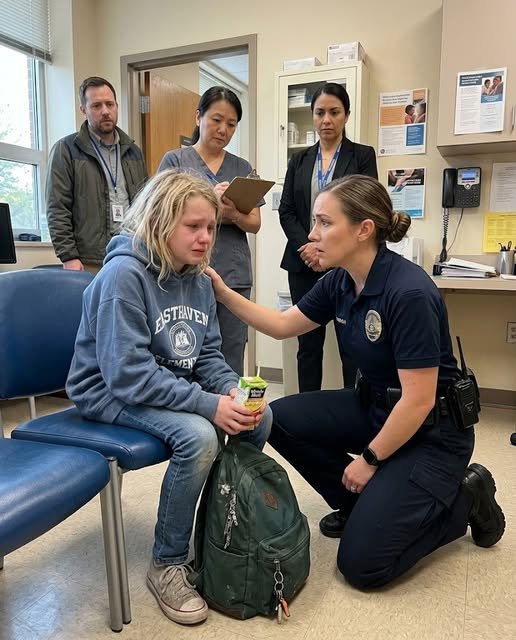
Half an hour later, I was sitting in the nurse’s office with a juice box held between both hands.
A granola bar rested on a paper towel beside me.
My backpack stayed between my feet.
I kept one shoe pressed against it because for some reason I felt safer knowing exactly where it was.
Mrs. Miller stood near the desk with my attendance printout.
The nurse had a clipboard.
I watched them speak quietly to each other.
I couldn’t hear every word, but I heard my name.
I heard absence.
I heard contact.
When the clipboard was set down, I saw blue writing across one section.
“6 school days irregular contact.”
The words frightened me because they looked official.
Until then, my problem had existed only inside our apartment and inside my head.
Now someone else had written part of it down.
At 2:09 p.m., the nurse made a call.
She stepped a little away from me while speaking, but I could tell from her voice that this was not an ordinary call home.
At 2:22 p.m., the secretary came in carrying my emergency contact sheet.
She placed it beside the clipboard.
Names and phone numbers were checked.
Questions were asked quietly.
Someone tried calling Sarah.
I stared at the straw in my juice box.
I wanted my mother to answer.
I also didn’t.
If she answered, maybe everything could still be explained away.
Maybe she would tell them I was dramatic.
Maybe she would tell them I was confused.
Maybe she would be furious that I had failed to keep the secret.
The longer the adults worked around me, the harder it became to remember why protecting her had ever seemed like the safest choice.
At 2:41 p.m., the office door opened.
A police officer entered with a woman from child protective services.
My entire body went cold.
For a second, I was sure I was the one in trouble.
Sarah’s warning came back immediately.
People love getting involved, and you are not going to get me in trouble.
The officer did not stand over me.
She walked closer and knelt so I would not have to tilt my head back to see her.
“You are not in trouble,” she said gently.
I didn’t answer.
“I need you to tell us the truth.”
I tightened both hands around the juice box until the cardboard bent slightly beneath my fingers.
Mrs. Miller remained near the door.
The nurse stood beside the desk.
No one was yelling.
No one was threatening me.
That made the choice feel strangely bigger.
For days, I had believed the dangerous thing was speaking.
If I told someone Sarah was gone, I would be betraying her.
I would be causing trouble.
I would be the reason strangers became involved in our lives.
But sitting in that office, with adults calmly checking dates and phone numbers, I realized something I had not allowed myself to think inside the apartment.
I had already been scared every day.
I had been scared when the food got lower.
Scared when the power went out.
Scared when footsteps stopped outside the door.
Scared when I felt sick.
Scared when I walked to school alone.
Keeping the secret had not made me safe.
It had only made me alone with the fear.
The officer waited.
I looked down at the juice box in my hands.
Then I looked at the office phone.
Then at Mrs. Miller.
She wasn’t smiling.
She wasn’t pushing me either.
She was simply there.
For the first time since Sarah rolled those suitcases away, staying quiet frightened me more than speaking.
“My mom left me alone,” I whispered.
The officer leaned slightly closer, making sure she had heard correctly.
I swallowed.
“She gave me twenty dollars and told me not to tell anybody.”
Nobody congratulated me for saying it.
Nobody turned it into a dramatic moment.
The nurse quietly moved the granola bar closer.
Mrs. Miller lowered her eyes toward the attendance sheet.
The officer’s expression changed in a way I could not fully understand at eleven.
Not shock exactly.
Something more focused.
She asked when Sarah had left.
I told her Thursday.
She asked whether any adult had stayed overnight.
I said no.
She asked whether anyone had been checking on me.
I shook my head.
She asked about food.
I told her about the soup, peanut butter, bread, and canned beans.
Then I remembered the power.
“Our electricity went off,” I said.
“When?”
“Yesterday.”
“Did your mom know?”
“I don’t know.”
“Did you call her?”
I stared at my backpack.
“I didn’t want to make her mad.”
The woman from child protective services wrote something down.
The officer did not react dramatically.
She kept her voice steady.
That steadiness helped more than sympathy would have.
She asked whether Sarah had told me when she was coming home.
I said no.
She asked whether I knew where she was staying.
I said Europe.
“Do you know where in Europe?”
“Spain. Italy. France.”
The three names sounded even stranger in that little school office than they had in our apartment.
The officer glanced toward the other woman, then back at me.
She asked if my mother had said exactly how long the trip would last.
I tried to remember the words from the hallway.
A few weeks.
I had accepted that answer because I did not know what else to do with it.
Now, with adults building a timeline around me, the vagueness suddenly mattered.
A few weeks could mean two.
It could mean three.
It could mean longer.
My mother had left an eleven-year-old with twenty dollars, a shrinking amount of food, instructions to lie, and no date I could circle on a calendar.
The officer rested one hand on her knee.
Then she asked the one question I hadn’t prepared a lie for.
“How long did she say she’d be gone?”