
One Time Access
While I was nearly three thousand miles away on assignment in London, my younger sister broke into my penthouse, smiled up at my security camera, and announced, “We live here now.” She thought she could take my home while I was gone, because my family had always believed that everything I owned belonged to all of them. What she did not know was that I was a federal law enforcement officer, and that within minutes every screen in that apartment would light up with the plan they had been quietly building for weeks.
At 2:16 in the morning, the heat in my London hotel room clicked softly through the vent while rain tapped the glass twenty floors above the street. My phone lit the nightstand with a single message from my younger sister, Paige.
Send me the door code, Marissa. I’m outside with the kids.
I sat up so fast the sheets twisted around my legs. I was thirty four years old, halfway across the Atlantic on an overseas federal assignment, and my family still believed I pushed paperwork for some dull government office. I had never corrected them, because my work was not a subject for family discussion. My home was not supposed to be one either.
A second text arrived before I could answer.
Mom and Dad said this has gone on long enough. You don’t need that huge place all to yourself. We’re moving in tonight.
She meant my penthouse in Arlington. The home I had bought six years earlier, with my own money, long before Paige ever asked to borrow it, stay in it, store things in it, or explain to me why the fact that I owned it and she did not was somehow an injustice being done to her.
That was how my family had always worked. If Paige missed rent, I was expected to cover it. If my parents needed a repair, I wrote the check. If I hesitated, I was cold, I was selfish, I thought I was better than them. Generosity in my family was never treated as something I chose to give. It was treated as a door they were entitled to keep opening, and the only rude thing a person could do was try to close it.
I opened the security app.
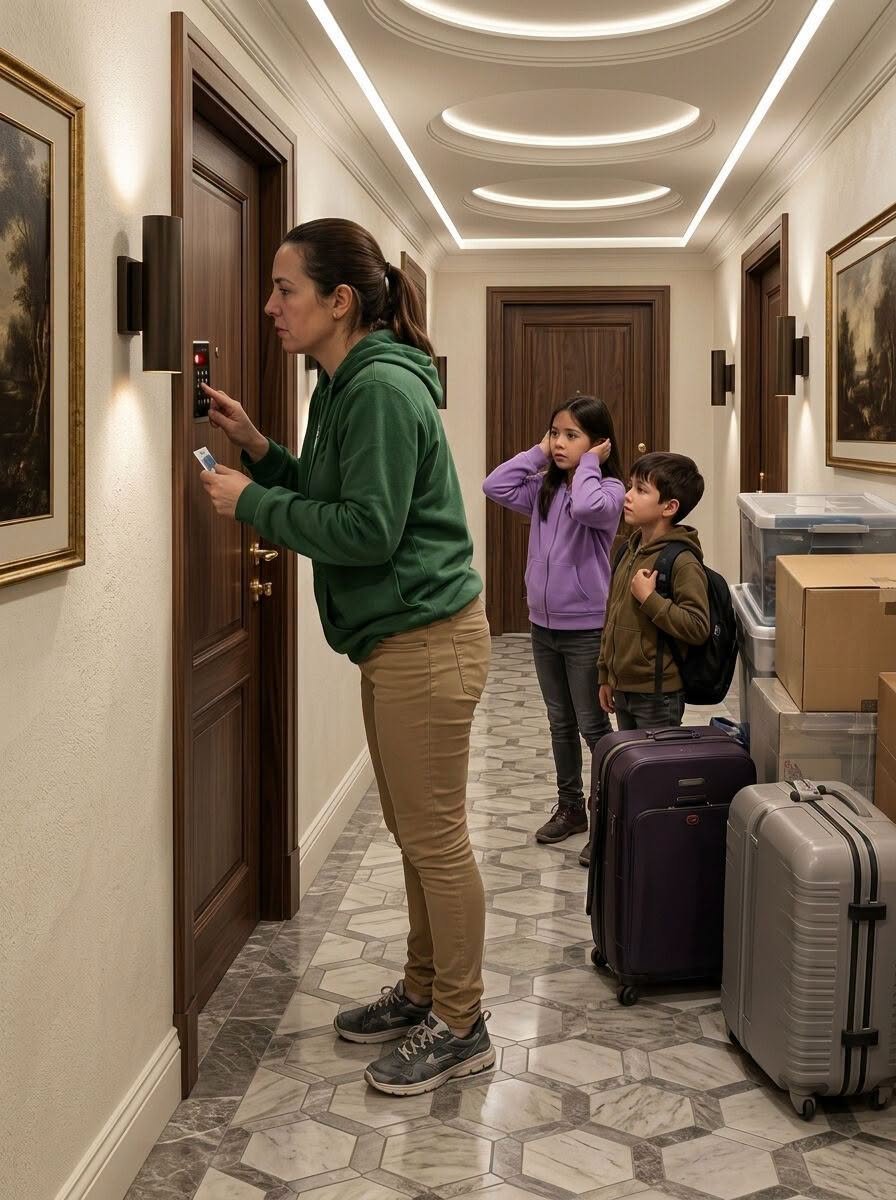
The hallway camera came up in sharp blue gray light. Paige stood outside my door with her two exhausted children, three suitcases, a stack of plastic storage bins, and the calm, satisfied expression she wore whenever our parents had already promised her that I would give in. Her son, Ethan, was nine and stood a little apart from her with his shoulders up around his ears. Her daughter, Lily, was six and half asleep on her feet, leaning against a suitcase.
Last chance, Paige texted. Give me the permanent code or I’m calling a locksmith.
My fingers stayed steady. Nine years of training does that.
You do not have permission to enter my home. Leave now.
A laughing emoji appeared.
Then Paige turned to the keypad and entered six numbers.
Months earlier I had created a one time service code for a maintenance appointment that ended up being canceled. I had forgotten to delete it. The system recognized the sequence and flashed a warning across the panel.
ONE TIME SERVICE ACCESS. ENTRY RECORDED. NO RESIDENCY RIGHTS GRANTED.
Paige pressed Accept without reading a single word of it.
The lock clicked.
She tipped her face up toward the hallway camera, and she smiled, and she said, “We live here now.”
I want to describe that smile, because I have thought about it a great deal since. It was not cruel exactly. It was worse than cruel. It was certain. It was the smile of a person who has never once in her life had a boundary hold, and who has therefore concluded that boundaries are just things other people say before they eventually do what you want. She smiled at my camera the way you smile at a security guard you know is not going to stop you.
The interior cameras activated the moment the door opened. I watched her drop her purse on my entry table, send the children upstairs with the luggage, and walk into my bedroom and set her coat on my bed as casually as a person choosing a seat at a restaurant.
Then she called our mother, and because Paige had never in her life met a speakerphone she did not use, my mother’s voice came through the apartment’s audio system, thin and unmistakable.
“We’re inside,” Paige said.
“Good,” my mother said. “Once you’ve been there a few weeks, Marissa won’t have the heart to put the children out on the street. She talks tough but she always folds. She’s always folded.”
My chest went cold.
Because that was the part that turned a bad night into something else. This was not a desperate decision made in a parking lot at two in the morning. My father, my mother told Paige, had already spoken to a lawyer about what it would take to establish residency, about how many weeks it took before a person could not simply be removed, about tenant protections and notice periods. There was a timeline. There were two children being used as the instrument of it. My home had been discussed, planned around, and quietly reassigned, like an asset in an estate, while I was overseas doing a job none of them understood.
Here is a thing I have learned in my work, and it is true of federal fraud and it was true of my family. People who trample your boundaries almost never believe they are stealing. They construct a story in which they are correcting an unfairness, and that story is what lets them take from you with clean hands and a clear conscience. My family did not think they were breaking into my home. They thought they were fixing the injustice of me having one.
Every instinct I had wanted to call Paige and tell her exactly what she had done. I wanted to wake my parents and play them the recording of their own voices. I wanted to shout, three thousand miles away, into a phone.
I did none of that. I stayed quiet and I watched, because watching is the job, and because I had learned long ago that the loudest person in a confrontation is almost never the one in control of it.
Paige moved down the office hallway and stopped at the reinforced door that protects my work area. That door is not a normal part of a residence. It exists because of what I do, and it is tied into a federal security system for exactly the reasons that were about to become relevant.
She tried my birthday on the keypad. Denied.
She tried our mother’s birthday. Denied.
Ethan stood behind her holding the strap of his backpack, his whole small body tense. Paige scanned the hallway, and her eyes landed on the fireplace set, and she picked up the iron poker and held it out to her son.
“Bring me that.”
He hesitated. I watched a nine year old boy hesitate, and I want it on the record that he hesitated, because it matters for what came later.
Paige did not hesitate. She took the poker back out of his hands and swung it herself.
The first swing hit the keypad with a hard metallic crack. Ethan flinched and stepped back into the wall. The second swing landed higher, denting the casing, and it did the thing Paige could not possibly have known it would do, which was trip a silent federal alert tied to the protected workspace.
A red banner filled my laptop screen.
PROTECTED WORKSPACE BREACH DETECTED. REMOTE RESPONSE ACTIVATED.
At 2:21 London time, I called the operations center.
“This is federal law enforcement officer Marissa Keane,” I said. “Unauthorized entry at my residence, protected workspace breach in progress. The intruder is my sister. There are two minor children on scene. I need the response to account for the children.”
I said that last part twice. I need to be honest that in the first few seconds, watching my sister swing a poker at a federal keypad, some cold part of me had wanted the full weight of everything to come down on her. And then I looked at Ethan pressed against the wall, and at Lily’s small hands, and I made myself say it clearly and say it twice. Account for the children. Whatever else happened that night, two kids were going to walk out of my home without a memory that broke them. That was the one thing I decided I would control.
The controller verified my identity, documented the live feed, and initiated the residence response. Process has a sound, when you know what comes next. Clipped questions. Keys moving. A voice repeating the address, calm enough to make panic pointless.
Minutes later, the apartment lights shut off.
Then every television, every wall panel, every display screen in the penthouse powered on at once, and the same message filled all of them.
UNAUTHORIZED ENTRY RECORDED. LAW ENFORCEMENT HAS BEEN DISPATCHED.
And then the footage began to play.
This was the part I had built the system to do, years earlier, for a very different threat than my own sister. Paige watched herself enter with the service code. She watched the warning she had ignored scroll past. She heard her own voice say we live here now. She watched herself put a poker into her son’s hands and then take it back and swing it at the keypad while her children stood behind her.
Nobody in that apartment moved.
Ethan stared at the poker where it had fallen on the carpet. Lily pressed both hands over her ears and started to cry the silent, frightened way children cry when they can tell something is very wrong but not what. Paige reached for her phone, to call me, I think, to start the negotiation, to find the version of the night where I folded.
Before she could, the elevator chimed in the private hall.
She looked toward the door. And the elevator opened, and for the first time that night, Paige’s smile was gone.
The first person out was a uniformed Arlington County police officer, because a federal alert at a residence routes local law enforcement first, and they had been four minutes away. Behind her came a second officer. They were calm and unhurried and they had been briefed, on the way up, by the operations center, which had relayed exactly one instruction from me above all the others.
There are two kids in there. Go gentle.
They went gentle.
End Part Here: My Sister Took Over My Penthouse While I Was in London but She Forgot I Was Federal Law Enforcement