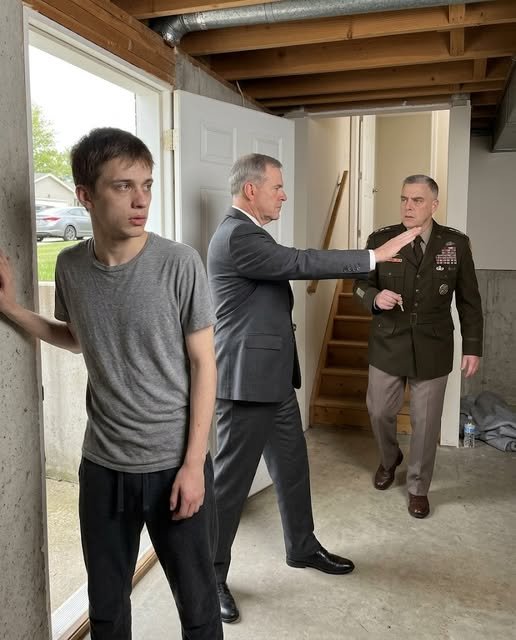
The small black notebook became one of the most important pieces of evidence.
It showed how Daniel viewed people.
Not as colleagues.
Not as soldiers.
As tools.
Useful.
Dangerous.
Obedient.
Difficult.
Some needed rewards.
Others needed pressure.
And when investigators reached the page with my name on it, Daniel could no longer easily argue that the basement was simply an isolated family disagreement.
The same patterns existed at home.
Control.
Isolation.
Dependency.
Fear.
After Daniel left the house, Mom and I moved anyway.
Neither of us wanted to stay.
We rented a small two-bedroom apartment across town.
The kitchen was tiny.
The pipes rattled.
Our upstairs neighbor walked like he wore concrete shoes.
I loved every inch of it.
On our first night, Mom gave me a key.
A normal silver apartment key.
“No one else has one,” she said.
I closed my hand around it.
For several seconds, I couldn’t speak.
“You okay?” she asked.
“Yeah.”
And this time, I meant it.
I kept the old basement key too.
Not because I wanted to remember being trapped.
Because I wanted to remember the door opening.
There was a difference.
The case eventually became public.
Daniel’s photograph appeared on television.
People debated his career.
His medals.
His decades of service.
Some said one mistake should not erase everything he had accomplished.
I stopped watching.
Because it had never been one mistake.
A reputation is what people see.
Character is what remains when the audience leaves.
Months later, Daniel’s attorney contacted me.
He wanted me to write a statement asking for leniency.
At first, I said no.
Then I changed my mind.
I wrote one page.
I did not insult Daniel.
I did not ask anyone for revenge.
I described the basement.
The locked door.
The empty water bottle.
The forged enlistment packet.
The notebook.
Then I wrote:
I am not asking anyone to punish Daniel Mercer because he failed to make me obey him. I am asking that he be judged by the same standard he demanded from everyone else: accountability for his own decisions.
I sent it.
That was the last statement I made about his case.
Several weeks later, the final decision came.
Daniel lost his position permanently.
His career ended under formal disciplinary action, with findings of misconduct attached to the record he had spent decades trying to control.
Mom cried when we heard.
I didn’t.
I expected to feel victorious.
Instead, I felt exhausted.
Daniel had been in my life since I was nine.
Even when someone hurts you, losing the person you once hoped they could become can still feel like grief.
Mom sat beside me.
“He chose this,” she said.
“I know.”
“You didn’t destroy his career.”
“I know.”
But sometimes knowing something and believing it take different amounts of time.
That fall, I enrolled in college.
For years, I had wanted to study architecture.
Daniel hated the idea.
He called it impractical.
Soft.
A waste of potential.
I applied anyway.
The day my acceptance email arrived, Mom and I were sitting on the apartment floor because we still didn’t own a dining table.
She read the message over my shoulder.
“You got in.”
“I got in.”
She screamed.
Our upstairs neighbor banged on the floor.
Mom started laughing.
For the first time in years, noise inside our home did not frighten either of us.
College gave me something I had never really experienced before.
Ordinary freedom.
I could stay late at the library.
Choose my classes.
Change plans.
Make friends.
Nobody checked my phone.
Nobody inspected my room.
Nobody demanded an explanation for every decision.
Then, during my second semester, something unexpected happened.
A military recruiter visited campus.
I saw the uniform from across the student center.
For several seconds, I couldn’t move.
The brochures.
The photographs.
The uniform.
Everything pulled me back toward Daniel’s enlistment packet.
I almost walked away.
Then I stopped.
Daniel had spent years convincing me that the military belonged to people like him.
Maybe that was another thing he had been wrong about.
I approached the table.
The recruiter smiled.
“Interested?”
“I don’t know.”
“That’s allowed.”
Those two words surprised me.
He didn’t pressure me.
He didn’t tell me who I should become.
He simply explained the available programs and gave me information.
I brought the brochures home.
Mom saw them on my desk.
“Evan…”
“I’m not enlisting.”
She relaxed.
“Okay.”
“Not now.”
Her eyes widened again.
“Relax.”
“I am relaxed.”
“You look like you’re about to burn the brochures.”
She sat beside me.
“Why are you even considering it?”
I thought carefully.
“Because I need to know whether I hated the military—or whether I hated having no choice.”
Mom looked at me for a long moment.
Then she nodded.
“That’s fair.”
I spent the next year finding my answer.
I spoke to veterans.
ROTC students.
Officers.
Some were patient.
Some were funny.
Some openly criticized bad leadership.
For the first time, I saw military service without Daniel standing in front of it.
Eventually, I made my choice.
I stayed in college.
Finished my architecture degree.
And after graduation, I joined the Army Reserve as an engineering officer.
Not because Daniel had been right.
Because he had been wrong about the most important thing.
Duty forced upon someone is not duty.
It is obedience.
Service only has meaning when it is chosen.
Mom cried at my commissioning ceremony.
Again.
Afterward, she hugged me.
“Are you sure?”
I laughed.
“You’ve asked that fifty times.”
“I’m your mother.”
“So?”
“So you’re allowed fifty-one.”
She smiled.
Then she became serious.
“You know you never had to prove anything.”
“I know.”
And that was exactly why I could finally wear the uniform.
Years later, I worked on the construction of a rehabilitation facility for veterans.
One morning, a young soldier approached me with a clipboard.
“Sir, need your signature.”
I stared at the line.
For half a second, I saw Daniel’s forged enlistment packet again.
My name written by someone else.
A future chosen without me.
Then I took the pen.
I signed.
My signature was faster now.
Messier.
Different.
Mine.
That evening, I visited Mom.
Halfway through dinner, she asked,
“Do you ever think about him?”
I knew exactly who she meant.
“Sometimes.”
“Do you hate him?”
I thought about it.
“No.”
She looked surprised.
“I did for a long time.”
“What changed?”
I looked toward the small wooden box on her bookshelf.
The old basement key was still inside.
“He doesn’t get that much space in my life anymore.”
I stood and took the key.
The cold brass rested in my palm.
Once, it represented everything Daniel controlled.
Food.
Freedom.
The door.
My future.
Mom and I walked to the pedestrian bridge behind her apartment.
A river moved quietly beneath us.
I held the key over the railing.
Mom looked at me.
“You sure?”
I smiled.
This time, that question did not frighten me.
Because the decision belonged to me.
“Yes.”
I opened my hand.
The key fell.
For a second, it flashed beneath the setting sun.
Then it disappeared beneath the water.
Mom slipped her arm through mine.
Neither of us spoke.
We didn’t need to.
My stepfather once believed he could decide what kind of man I would become by locking a door.
He believed hunger would create obedience.
He believed fear would create discipline.
He believed rank gave him the right to choose my future.
He was wrong.
Years later, I did wear a military uniform.
But not because he forced me.
Not because I surrendered.
And not because I needed to prove him right.
I wore it because, when the choice finally belonged completely to me—
I chose for myself.
And that made all the difference.
THE END