
MY RICH NEIGHBOR’S BLACK-BELT SON CHALLENGED ME TO A FIGHT
PART 1 — THE CHALLENGE
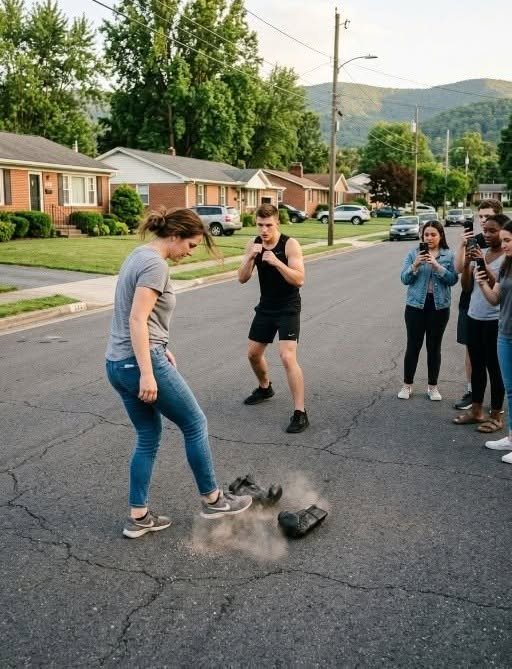
The MMA gloves landed an inch from my sneakers.
The entire street went quiet enough for me to hear ice cracking inside someone’s plastic cup of lemonade.
Logan Whitmore stood ten feet away, rolling his shoulders beneath a sleeveless black training shirt.
At twenty-two, he was undefeated in three amateur cage fights, recently promoted to black belt, and followed online by thousands of people who believed a few edited highlight videos told them everything they needed to know about strength.
His father was filming.
Half the neighborhood was watching.
Logan smiled at me like he already knew how the video would end.
“Come on, Colonel,” he said. “Show everybody what you’ve got.”
I looked down at the gloves.
Then at the phones rising around us.
“Are you sure?” I asked.
My name is Claire Bennett.
I was forty-two years old, a single mother, and a colonel in the United States Army.
For more than two decades, I had trained soldiers, led demanding operations, and made decisions in places where one careless mistake could cost far more than pride.
But none of my neighbors knew much about that.
On Juniper Hollow Drive, I was simply the quiet woman who lived in the blue house at the end of the cul-de-sac.
I cut my own grass.
I drank coffee on the porch before sunrise.
And I drove an old pickup truck with a dent across the tailgate.
I had moved to Silver Creek, Colorado, in June, shortly after my fifteen-year-old son, Noah, finished ninth grade.
The real estate listing promised mountain views, good schools, and peaceful streets.
Peace was the only feature that mattered to me.
After years of waking to radios, engines, boots, and voices delivering information nobody wanted to hear, silence had become something sacred.
The house next door belonged to Grant Whitmore.
Grant was a wealthy real estate developer whose white SUV was always polished, whose lawn was always perfect, and whose conversations somehow always returned to money.
His son, Logan, had recently moved home after leaving college.
According to Grant, Logan was “pursuing professional fighting.”
According to everyone else, he spent most afternoons blasting music from the garage and recording himself hitting pads while smaller men held them.
I noticed Logan before he noticed me.
That was often how it worked with people like him.
They were so focused on being watched that they rarely watched anyone else.
For three mornings in a row, Logan started his motorcycle at six and let the engine roar beneath my bedroom window.
He parked across two spaces near the community mailbox.
Once, I watched him shove past a delivery driver because the man’s cart blocked the sidewalk for a few seconds.
Nobody confronted him.
Silver Creek was the kind of neighborhood where people smiled while collecting their mail and complained after closing their doors.
Everyone believed in courtesy until courtesy required courage.
Then one morning, Logan finally noticed me.
I ran every day at five-thirty, before sunlight reached the rooftops.
That morning, Logan stood in his driveway with a friend as I passed in an old gray shirt and running shorts.
“She doesn’t look like she could survive one round,” he said loudly.
His friend laughed.
I kept running.
I had heard worse things from tougher people in places where mistakes carried consequences Logan had never needed to imagine.
A twenty-two-year-old trying to impress his friend on a suburban driveway wasn’t enough to make me stop.
That seemed to bother him more than an argument would have.
Logan wanted a reaction.
He wanted me to turn around.
Challenge him.
Give him something he could turn into another story about himself.
I gave him nothing.
Restraint is often misunderstood by people who have never needed it.
They think silence means you have no answer.
They never consider that maybe you know exactly what you could do—and have simply decided they are not worth doing it to.
So I continued my routine.
I ran before dawn.
Made coffee.
Checked on Noah.
And went about my day while Logan performed for anyone willing to watch.
I might have continued ignoring him forever.
Then his attention shifted from me to my son.
And that changed everything.
PART 2 — HE PICKED THE WRONG TARGET
At first, Logan’s attention toward Noah was subtle.
Whenever Noah walked to the community mailbox, Logan somehow happened to be outside.
When Noah rode his bicycle past the Whitmore house, Logan made comments loud enough for him to hear.
“Careful, kid. Don’t fall.”
“Your mom make you wear that helmet?”
“You ever do anything without asking permission first?”
Noah ignored him.
That made me proud.
It also made me uneasy.
My son was fifteen.
He was tall for his age but still growing into himself.
Quiet.
Thoughtful.
More interested in robotics than football.
Noah had never cared about proving he was tougher than anyone else.
Logan seemed to view that as weakness.
One Saturday afternoon, Noah walked through the front door without his bicycle.
I looked up from the kitchen counter.
“Where’s your bike?”
He hesitated.
That hesitation told me more than his answer.
“Noah.”
He dropped his backpack beside the stairs.
“Logan has it.”
I put down the knife I had been using to cut vegetables.
“Why?”
“He said I scratched his motorcycle.”
“Did you?”
“No.”
I believed him immediately.
Not simply because he was my son.
Noah was terrible at lying.
His left eyebrow always moved when he tried.
It hadn’t moved.
“What happened?”
“I was riding past his driveway. He stepped in front of me, so I stopped. Then he said my handlebar scratched his motorcycle.”
“Did it?”
“I was six feet away.”
I folded the dish towel in my hands.
“And then?”
“He took my bike and said he was keeping it until you paid for the damage.”
That changed things.
“Did he touch you?”
Noah looked away.
There it was.
“Noah.”
“He pushed my shoulder.”
“How hard?”
“Mom, I’m fine.”
I hated that phrase.
I’m fine.
I had heard soldiers say it with serious injuries.
I had heard families say it outside hospital rooms.
I had said it myself when I was anything but fine.
“Show me.”
Noah reluctantly pulled up his sleeve.
A faint red mark showed near his upper arm.
It wasn’t a serious injury.
But that wasn’t the point.
Logan Whitmore was twenty-two.
My son was fifteen.
And Logan had put his hands on him.
I felt anger rise.
Then training pushed it down.
Anger was information.
Not instruction.
“Stay here.”
Noah’s eyes widened.
“Mom.”
“I’m getting your bike.”
“Please don’t make it weird.”
I almost smiled.
Teenagers had extraordinary priorities.
“I’ll do my best.”
I walked next door.
Logan was standing in the driveway with two friends.
Noah’s bicycle leaned against the garage.
Grant Whitmore stood beside his SUV talking on the phone.
When Logan saw me, he smiled.
“Well, look who finally came over.”
I stopped at the edge of the driveway.
“That bicycle belongs to my son.”
Logan crossed his arms.
“Your son damaged my motorcycle.”
“No, he didn’t.”
“You weren’t there.”
“Neither was the scratch.”
One of his friends laughed.
Logan’s smile disappeared.
Grant ended his call.
“What seems to be the problem?”
“Your son took Noah’s bicycle and put his hands on him.”
Grant looked at Logan.
Logan shrugged.
“The kid got mouthy.”
“Noah says you pushed him.”
“He needed to learn respect.”
I stared at Logan for several seconds.
Then walked toward the bicycle.
He stepped in front of me.
“Move,” I said.
He laughed.
“You always talk like that?”
“Only when necessary.”
He widened his stance.
Behind him, one of his friends had already pulled out a phone.
Of course.
Everything eventually became content.
Grant raised one hand.
“Claire, perhaps everyone should calm down.”
“I am calm.”
That seemed to bother them.
People who rely on intimidation often become uncomfortable when anger never arrives.
Logan tilted his head.
“My dad says you think you’re better than everyone around here.”
“I don’t think about you enough to believe that.”
His friends laughed.
Logan turned red.
“You got something you want to prove?”
“No.”
“I think you do.”
“I came for Noah’s bicycle.”
We stared at each other.
Finally, Logan stepped aside.
I took the bicycle.
For a moment, I thought it was over.
Then Logan said,
“Maybe your kid should learn to defend himself instead of hiding behind his mommy.”
I stopped.
Slowly, I turned.
“Stay away from my son.”
Grant scoffed.
“Oh, come on. Boys roughhouse.”
“Your son is twenty-two.”
Grant’s expression changed.
“My son is fifteen.”
One of Logan’s friends lowered his phone.
Logan didn’t.
“Maybe Noah wouldn’t be so soft if you stopped babying him.”
My voice remained level.
“This is the only warning you’re getting.”
Then I took Noah’s bicycle home.
I didn’t threaten Logan.
I didn’t tell him who I was.
And I certainly didn’t tell him everything I had done during my military career.
That night, Noah found me sitting on the porch.
“Are you mad?”
“At you?”
He nodded.
“No.”
“I should’ve stood up to him.”
I looked at my son.
“Standing up for yourself doesn’t always mean fighting.”
“But you would’ve fought him.”
“If there was no other choice.”
Noah frowned.
“What if someone thinks you’re weak because you walk away?”
“Then they think I’m weak.”
“That doesn’t bother you?”
“No.”
“How?”
I looked toward the mountains.
“Because I don’t need strangers to tell me what I am.”
He sat beside me.
After a while, he asked,
“What exactly did you do in the Army?”
I looked at him.
He knew pieces of my career.
Deployments.
Training.
Ranks.
Long absences when he was younger.
But I had deliberately kept much of that life outside our home.
“You know enough.”
“That sounds classified.”
I laughed.
“It means go finish your homework.”
He groaned and went inside.
I wished the confrontation had ended there.
It didn’t.
Two weeks later, our neighborhood held its annual summer block party.
Folding tables filled the cul-de-sac.
Grills smoked beside driveways.
Children drew on the pavement with chalk.
Coolers were everywhere.
I almost stayed home.
Noah wanted to go.
So we went.
For the first hour, Logan ignored us.
Then someone mentioned his fighting career.
That was all he needed.
Within minutes, he had an audience.
Grant proudly announced that his son had recently earned his black belt.
Someone asked Logan for a demonstration.
Training pads appeared.
Phones came out.
Logan started showing combinations while Grant narrated as though his son was already fighting for a world championship.
I stayed near the lemonade table.
Then Logan saw me.
His posture changed instantly.
“Claire!”
Several people turned.
I continued pouring my drink.
Logan walked into the center of the street.
“You still think fighting doesn’t prove anything?”
“I don’t remember discussing fighting with you.”
He smiled.
“Come on. You act like you’re tougher than everybody.”
“No. You keep deciding that for me.”
Grant laughed.
“Maybe she’s intimidated.”
I looked at him.
“By what?”
Several people laughed.
Logan’s face hardened.
He walked toward his gym bag and pulled out a pair of MMA gloves.
Then he threw them at me.
They landed inches from my sneakers.
The street fell silent.
“Come on, Colonel,” he said mockingly.
I froze.
Nobody in the neighborhood knew my rank.
Nobody except Noah.
Then I understood.
Grant had researched me.
Probably after our driveway confrontation.
Logan smiled.
“Yeah. We looked you up.”
His father raised his phone and began recording.
“Twenty years in the Army,” Logan said. “Big deal.”
He pointed toward the gloves.
“Let’s see what that actually means.”
I looked around.
Parents.
Children.
Teenagers.
Phones.
A public street.
No referee.
No safety equipment.
No reason whatsoever for two adults to fight.
“Are you sure?” I asked.
Logan laughed.
“Absolutely.”
I bent down.
But instead of putting the gloves on, I picked them up and handed them back.
“No.”
Several people murmured.
Logan grinned.
“Knew it.”
I turned toward Noah.
Then Logan grabbed my shoulder.
Everything changed.
Not emotionally.
Mechanically.
His hand touched me.
My body responded.
I turned.
Redirected his arm.
Shifted my weight.
And less than two seconds later, Logan was on one knee with his wrist controlled behind him.
No punch.
No kick.
No dramatic throw.
Just balance.
Position.
Leverage.
Control.
The entire street became silent.
Logan tried to rise.
I adjusted slightly.
He stopped.
“Don’t,” I said.
He froze.
I immediately released him and stepped away.
His face burned with humiliation.
Grant lowered his phone.
Nobody laughed.
I looked directly at Logan.
“I said no.”
Then I turned toward the crowd.
“This is what restraint looks like.”
I started walking home with Noah.
Behind me, Logan shouted,
“You got lucky!”
I stopped.
His pride had survived.
That was unfortunate.
“Tomorrow,” he shouted. “My gym. We spar properly.”
Grant’s phone rose again.
“No tricks,” Logan said. “No running away. You versus me.”
Every intelligent part of me told me to ignore him.
Then Noah whispered,
“Mom, don’t.”
I looked at my son.
Suddenly, this wasn’t about Logan.
It was about what Noah would learn from what I did next.
I turned back.
“No.”
Logan smiled.
Then I added,
“But if your coach agrees to a controlled demonstration, with proper protective equipment and his rules, I’ll attend.”
Logan’s smile widened.
He thought I had accepted his challenge.
What he didn’t realize was that I had just changed all the rules.
PART 3 — FINAL: REAL STRENGTH
By noon the next day, Logan’s gym was packed.
That told me everything I needed to know.
Grant had advertised the event.
Of course he had.
Online, he announced that his twenty-two-year-old black-belt son was going to “test a retired Army colonel.”
Technically, I wasn’t retired.
But accuracy had never been the Whitmore family’s strongest quality.
When Noah and I arrived, the parking lot was full.
People from the neighborhood stood near the entrance.
Several of Logan’s friends were already filming.
I almost turned around.
Then the gym owner approached me.
His name was Marcus Reed.
Early fifties.
Former collegiate wrestler.
Thick neck.
Calm eyes.
The kind of man who didn’t need to tell anyone he knew what he was doing.
He shook my hand.
“Colonel Bennett.”
“Claire is fine.”
He glanced toward the crowd.
“I want to make something clear.”
“So do I.”
“This is not a fight.”
“Agreed.”
“Controlled technical sparring only.”
“Good.”
“No ego.”
I looked across the gym.
Logan was bouncing on his toes while two friends filmed him.
“That rule may be difficult.”
Marcus almost smiled.
“I’ve noticed.”
Then he lowered his voice.
“Grant told me you challenged Logan.”
“No.”
Marcus’s expression changed.
I explained everything.
The bicycle.
Noah.
The block party.
The gloves.
Logan grabbing my shoulder.
By the time I finished, Marcus was no longer smiling.
“I wish I’d known that before agreeing to this.”
“We can cancel.”
He looked toward Logan.
Then toward the teenagers gathered around the mat.
“No.”
His voice became thoughtful.
“Maybe we can teach something.”
That was why I stayed.
Marcus gathered everyone together.
“Three rounds,” he announced. “Two minutes each. Light contact. Technical work. If either person loses control, I stop it.”
Logan looked disappointed.
“Come on, Coach.”
Marcus stared at him.
“Do you have a problem with my rules?”
“No.”
“Then glove up.”
I put on borrowed protective gear and boxing gloves.
Logan did the same.
Noah stood against the far wall with his arms crossed.
He looked more nervous than I felt.
The first round began.
Logan came forward immediately.
Fast.
Aggressive.
And, to his credit, technically competent.
His jab was sharp.
His footwork was good.
His combinations were polished.
He had trained seriously.
That mattered.
I wasn’t going to pretend that military experience somehow made a person automatically superior to a trained combat athlete inside his own sport.
Logan’s problem wasn’t skill.
It was patience.
He wanted a highlight.
He wanted applause.
Most importantly, he wanted to embarrass me.
So he overcommitted.
I moved.
Covered.
Changed angles.
Let him spend energy.
Thirty seconds passed.
Then a minute.
His breathing changed.
“You gonna fight back?” he asked.
Marcus immediately warned him.
“No talking.”
Logan ignored him.
“Come on, Colonel.”
I kept moving.
He threw another combination.
I defended and moved away.
The first round ended.
Logan returned to his corner visibly irritated.
Grant looked even worse.
“You’re letting her run!” he shouted.
Marcus turned.
“Parents don’t coach from the floor.”
Grant went quiet.
Round two began.
This time Logan rushed harder.
Exactly as I expected.
Pressure reveals habits.
Logan threw a heavy right hand.
I moved outside it.
He turned too hard.
For half a second, his balance disappeared.
That was enough.
I closed the distance, controlled his upper body, and guided him safely toward the mat.
Nothing dramatic.
Nothing reckless.
Logan scrambled back up.
His face turned red.
He charged again.
This time I met him.
Short controlled contact.
A pivot.
A quick touch to the body.
Then I moved away.
Logan swung at empty air.
The crowd became quiet.
He wasn’t being destroyed.
That wasn’t the lesson.
He was being forced to think.
And he hated it.
He came forward again.
I controlled the distance and put him off balance.
Marcus called,
“Break!”
I released Logan immediately.
Logan shoved me after the command.
The gym went silent.
Marcus stepped forward.
“One more time and we’re done.”
End Part Here: My Rich Neighbor’s Black Belt Son Threw His MMA Gloves At My Feet And Challenged Me To Fight In Front Of The Whole Neighborhood