
The first time my mother saw me after fifteen years, she didn’t cry.
She didn’t hug me.
She didn’t even smile.
She looked past the duffel bag at my feet, glanced toward my father, and asked, “How long are you staying?”
That was when I understood something I had spent half my life refusing to accept.
My family hadn’t simply learned to live without me.
They had practiced it.
My name is Erin Callahan.
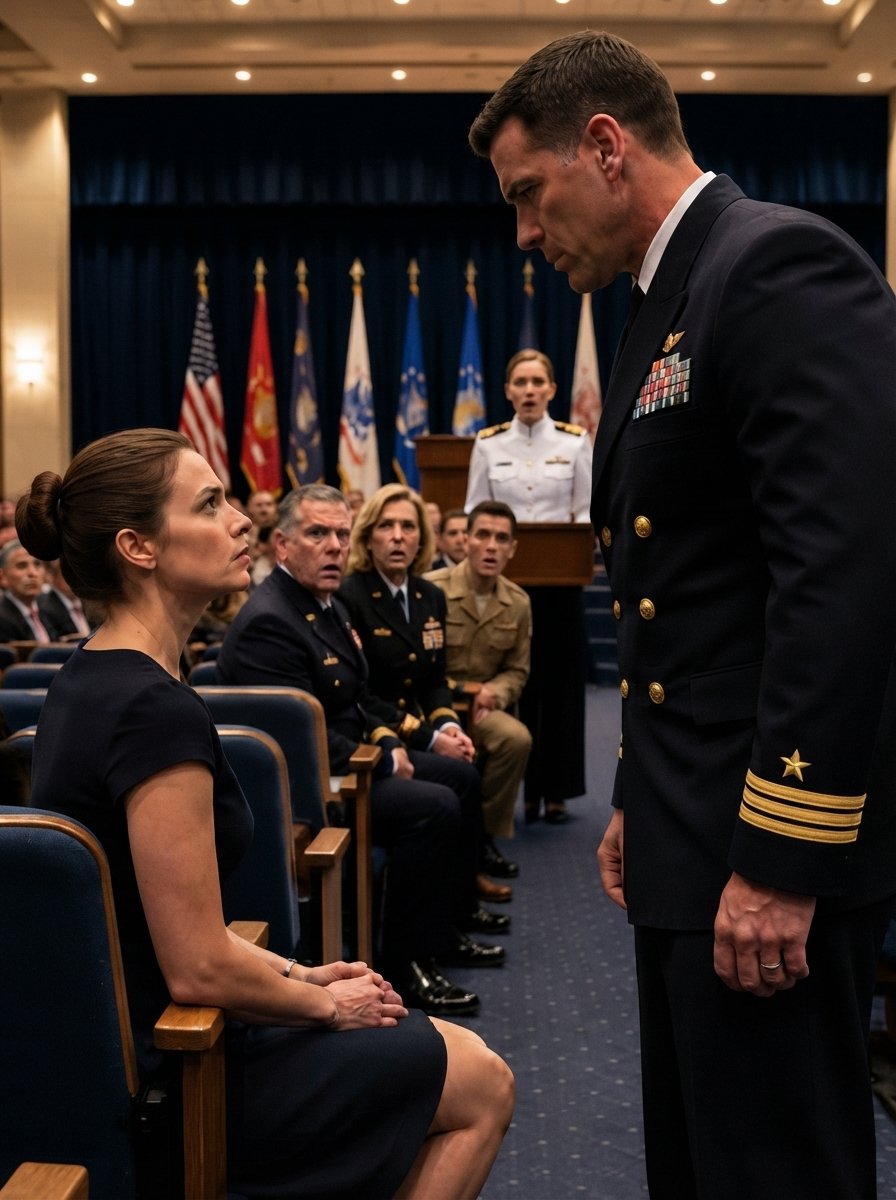
And three days after I came home, I sat alone in the last row of my younger sister’s Navy ceremony while my parents occupied seats near the front.
Then a decorated admiral entered the auditorium.
He looked across hundreds of people.
Saw me.
Stopped walking.
And came straight toward my chair.
“Ma’am,” he said carefully, while my mother turned white, “are you Commander Erin Callahan?”
The auditorium went silent.
But to understand why those five words terrified my family, you have to understand what happened when I came home.
The Callahan house hadn’t changed much.
The porch swing still hung slightly crooked. The brass numbers beside the front door were still polished every Sunday. Inside, everything smelled like lemon furniture polish and whatever my mother had roasting in the kitchen.
My father opened the door.
Robert Callahan had spent twenty-eight years in the Navy. Even retired, he stood like someone was inspecting him.
His eyes traveled from my boots to my face.
“So,” he said.
A pause.
“You’re still alive.”
“Good to see you too, Dad.”
Something moved behind his eyes.
Then disappeared.
He stepped aside.
The living room told me everything else.
My brother Matthew’s deployment photograph stood on the mantel.
Caitlyn’s Navy portrait had been placed beneath a small picture light.
My mother’s old service photograph stood beside Dad’s retirement shadow box.
And above the fireplace hung my father’s command portrait, surrounded by plaques, ribbons, challenge coins, medals and framed commendations.
I searched every wall anyway.
There wasn’t one photograph of me.
Not from childhood.
Not from high school.
Not from Annapolis.
Nothing.
Mom appeared carrying a stack of napkins.
“Your room’s full.”
“Full?”
“Wedding things. Caitlyn’s decorations.”
She said it as though that settled the matter.
“We put a cot in the garage.”
I laughed because I genuinely thought she was joking.
She wasn’t.
That night I slept beside bubble-wrapped centerpieces and plastic containers labeled CAITLYN – TABLE DECOR.
My duffel rested on the concrete floor.
Dust remained embedded in its seams from countries I was forbidden to mention.
There were things inside that bag my family would never understand.
A photograph of six people whose faces I couldn’t show anyone.
A folded flag.
Two letters I had carried through four deployments.
And a small brass compass belonging to a man who had died with my hands pressed against his chest.
At 2:13 a.m., I stared into the darkness.
Fifteen years earlier, I had left this house as a twenty-four-year-old lieutenant with an assignment I couldn’t explain.
Now I had returned at thirty-nine.
And my family had apparently decided that whatever I had become wasn’t worth asking about.
Dinner was worse.
Every chair at the main table was occupied when I entered.
Mom pointed to a folding card table beside a broken air vent.
A paper plate waited there.
Half a slice of cold pizza.
One of my teenage cousins stared at me.
“Are you Caitlyn’s friend?”
Caitlyn answered before I could.
“Oh, that’s Erin.”
She lifted her wineglass.
“My sister.”
The cousin looked embarrassed.
“I didn’t know you had another sister.”
Caitlyn laughed.
“Most people don’t.”
My father kept eating.
Then Caitlyn added, “She was in the Navy once.”
Once.
“I think she quit or something.”
Matthew looked down at his plate.
My mother rearranged her napkin.
Caitlyn continued.
“Now she does yoga, charity work overseas… I don’t know. She kind of wanders around.”
People laughed politely.
I didn’t.
I’d spent years learning to remain calm while armed men shouted in languages I barely understood.
I’d made decisions while aircraft circled overhead and people’s lives depended on whether I spoke three words or four.
Yet hearing my sister reduce fifteen years of my life to “she kind of wanders around” hurt more than I expected.
Mostly because no one corrected her.
I looked at Dad.
His jaw tightened.
But he said nothing.
That silence told me something.
He knew more than he was saying.
I just didn’t yet know how much.
At Caitlyn’s engagement party the next evening, the woman checking guests couldn’t find my name.
“Are you somebody’s plus-one?”
“I’m her sister.”
The woman searched again.
Finally she handed me a blank sticker.
“Sorry.”
I wrote ERIN with a marker and stuck it to my dress.
Inside the VFW hall, my family’s military photographs stood arranged near the entrance.
Dad.
Mom.
Matthew.
Caitlyn.
There was a perfect empty space beside them.
I stared at it until my mother noticed.
“We didn’t have a recent picture of you.”
“You have my academy graduation photo.”
She looked uncomfortable.
“I don’t know where it is.”
That was a lie.
My mother catalogued Christmas ornaments by year.
She knew where everything was.
I almost left.
Then I noticed my father watching me from across the room.
Not with anger.
With something stranger.
Fear.
Two days later Caitlyn texted me.
If you’re still here, doors open at 1300.
That was my invitation.
I went anyway.
A young ensign at the auditorium entrance couldn’t find my name on the manifest.
Eventually he sent me to the final row.
Meanwhile, my parents sat near the stage.
Caitlyn walked to the podium in dress whites, polished and perfect.
She thanked Dad.
She thanked Mom.
She thanked Matthew.
Then she spoke about “a family tradition of service.”
I almost smiled.
I was apparently not part of that tradition.
Then the auditorium doors opened.
The man who entered wore full dress uniform.
Vice Admiral Thomas Mercer.
I knew him immediately.
Apparently, he knew me too.
He stopped after three steps.
His gaze locked onto mine.
Then he walked toward me.
I felt the room changing before anyone spoke.
My father turned.
His face hardened.
My mother looked confused.
Then afraid.
Caitlyn stopped midsentence.
Admiral Mercer reached the last row.
“Ma’am?”
I stood.
He stared at me.
“Are you Commander Callahan?”
There was no reason to lie anymore.
“Yes, Admiral.”
My mother’s lips parted.
Caitlyn gripped the podium.
Then Mercer smiled.
And saluted me.
“It’s good to see you again, Commander.”
Hundreds of people watched me return the salute.
Whispers erupted.
Commander?
Callahan?
My sister?
Caitlyn looked toward Dad.
“What’s happening?”
He didn’t answer.
Mercer did.
He turned slightly toward the room.
“For those wondering, Commander Callahan has spent the better part of fifteen years serving with Naval Special Warfare and joint special operations commands.”
The whispers died.
“Several of her assignments remain classified.”
Mom sat perfectly still.
“Commander Callahan commanded elements responsible for operations across three combat theaters. Her record includes multiple commendations, two Purple Hearts, and a Navy Cross recommendation that remains under review.”
Caitlyn stared at me like she had never seen me before.
“You said you left.”
I looked at her.
“No.”
My voice remained quiet.
“You decided I left.”
Dad stood.
“Admiral Mercer.”
Something about his tone made Mercer look at him.
“Captain Callahan.”
Dad had retired as a captain.
Mercer’s expression cooled.
And suddenly I knew this was not a chance reunion.
“Why are you here?” Dad asked.
Mercer didn’t answer immediately.
Instead he looked at me.
“Commander, did they tell you?”
My stomach tightened.
“Tell me what?”
Dad whispered, “Thomas.”
Mercer ignored him.
“The Night Lantern investigation was reopened six months ago.”
The room seemed to tilt.
My hand closed around the seat in front of me.
Night Lantern.
I hadn’t heard those words spoken outside a secure facility in fourteen years.
My mother rose slowly.
“No.”
Mercer turned toward her.
And something passed between them.
Recognition.
Not casual recognition.
History.
My blood went cold.
Operation Night Lantern had nearly killed me.
Seven of us went in.
Five came out.
We were supposed to extract an American intelligence source from a coastal compound before sunrise.
Someone leaked our route.
The enemy was waiting.
Chief Daniel Reyes died before we reached the second building.
Lieutenant Aaron Blake died in my arms twelve minutes later.
Aaron wasn’t just another officer.
He was the man I had planned to marry.
Nobody in my family ever knew.
The mission disappeared into classified reports.
So did I.
Officially, my assignment history became a blank page.
My parents knew only that I remained in government service and that they were never to discuss me publicly.
At least, that’s what I believed.
For fifteen years, I told myself their coldness came from resentment.
Dad hated secrets.
Mom hated unpredictability.
I was the daughter who stopped calling from recognizable phone numbers.
Eventually they stopped asking.
But Night Lantern?
Why would Mercer mention Night Lantern here?
At Caitlyn’s ceremony?
My father moved toward the aisle.
“Not here.”
Mercer’s voice hardened.
“It happened because of this family, Robert. Here is exactly where it belongs.”
Every sound in the auditorium disappeared.
I stared at Dad.
“What did you do?”
His face broke.
For the first time in my life, my father looked old.
“Erin—”
“What did you do?”
“I didn’t leak the operation.”
My eyes shifted to Mom.
She was backing away from her seat.
Mercer said nothing.
He didn’t need to.
I understood.
“No.”
Mom shook her head.
“Erin, please.”
“No.”
She reached toward me.
I stepped back.
“What did you do?”
She started crying.
Not graceful tears.
Ugly, shaking ones.
“I was trying to bring you home.”
Fifteen years earlier, my mother had still been working as a civilian intelligence liaison.
She knew I had entered a special operations selection pipeline.
She hated it.
Dad had been proud.
Mom had been terrified.
So she called an old intelligence contact and asked him to interfere.
Not to hurt me.
Not to expose anyone.
Just to have me reassigned.
She gave him my unit designation.
A deployment window.
A region.
Information she should never have shared.
She believed he was still one of ours.
He wasn’t.
The man had been compromised two years earlier.
Within forty-eight hours, hostile intelligence knew enough to predict our route.
Night Lantern became an ambush.
Two Americans died.
My mother learned about the investigation before I returned home.
And she panicked.
The investigators couldn’t prove where the leak originated.
Not then.
So she buried everything that might connect me to special operations.
Photographs disappeared.
Letters vanished.
Whenever relatives asked, she told them I’d left the Navy.
Whenever Caitlyn asked about me, Mom said I “wandered.”
And Dad?
Dad had discovered the truth three years later.
I turned toward him.
“You knew.”
His eyes filled.
“Yes.”
“And you protected her.”
He lowered his head.
That hurt more than anything.
More than the garage.
More than the empty wall.
More than Caitlyn’s jokes.
My father hadn’t erased me because he believed I was a failure.
He had erased me because admitting who I was might expose what my mother had done.
“I was a coward,” he whispered.
I wanted to hate him.
Maybe part of me always would.
Then Matthew stood.
“Wait.”
He looked at Mom.
“You told us Erin refused to come home.”
Mom didn’t answer.
“You said she didn’t want us.”
Nothing.
His face changed.
“Those birthday cards…”
Dad closed his eyes.
“What cards?” I asked.
Matthew looked at me.
“Dad wrote you every year.”
I stopped breathing.
Dad walked out of the row.
“There’s something you need to see.”
We left the auditorium twenty minutes later.
The ceremony had effectively ended.
Two NCIS investigators remained with my mother.
Caitlyn followed us in stunned silence.
Dad drove home.
Nobody spoke.
In the garage, he moved Caitlyn’s wedding decorations aside.
Then he knelt beside the cot where I’d slept.
He lifted the mattress.
Underneath was a wooden box.
My name was carved into the lid.
ERIN MICHELLE CALLAHAN
Inside were photographs.
Hundreds.
Every picture missing from the house.
My academy graduation.
My commissioning.
Me and Matthew as children.
Me carrying Caitlyn on my shoulders when she was six.
Beneath them were letters.
Dozens.
All addressed to me.
None sent.
Dad touched the stack.
“I wrote them.”
“Why didn’t you send them?”
“Your mother said anything connecting us to you could compromise your cover.”
He laughed bitterly.
“I believed her.”
I picked up one.
The paper shook in my hand.
“Dear Erin, today would have been your grandmother’s eighty-second birthday…”
I couldn’t keep reading.
Caitlyn stood behind me crying.
“I didn’t know.”
I turned.
“You never asked.”
She flinched.
“I know.”
For once, she had nothing clever to say.
Then her phone rang.
She looked at the screen.
“It’s Admiral Mercer.”
I nodded.
“Answer it.”
She did.
“Yes, sir.”
Her expression changed.
“Yes, sir.”
Then she stared at me.
“Understood.”
She ended the call.
“What?”
Caitlyn swallowed.
“There’s apparently been a change to my orders.”
Dad frowned.
“What change?”
She looked genuinely frightened.
“I wasn’t supposed to receive my duty station until next month.”
“And?”