
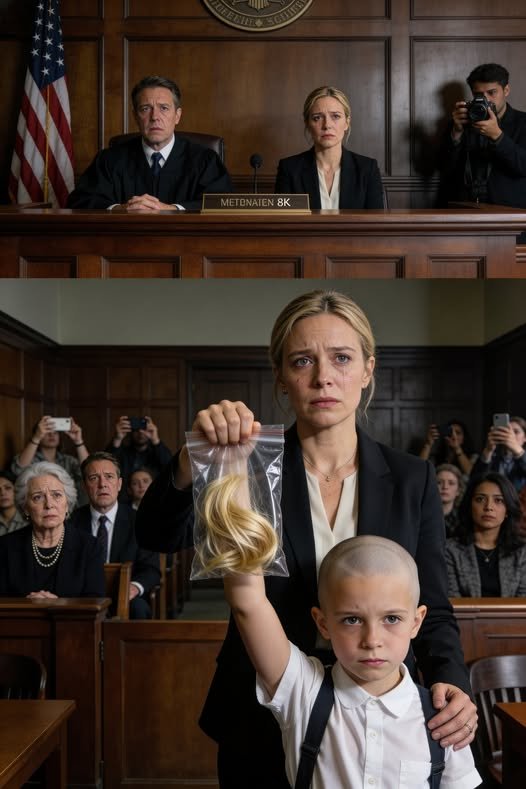
My daughter’s hair scattered across that carpet.
Her hands covering her head.
Her body shaking.
The courtroom was smaller than I expected.
Judith arrived wearing a navy suit with gold buttons.
She looked offended.
Not ashamed.
Dustin arrived with her.
He sat beside his mother.
Not beside his wife.
Not beside his daughter.
That alone told me everything.
Judge Patricia Hawthorne read the medical records and reports.
She studied the photographs.
Then she looked at Judith.
“Mrs. Cromwell, did you shave this child’s head?”
Judith stood.
“I corrected my granddaughter’s vanity.”
The judge’s face remained expressionless.
“Did you shave her head against her will?”
“Her father gave me permission.”
Judge Hawthorne turned toward Dustin.
“Mr. Cromwell?”
He adjusted his tie.
“I trusted my mother’s judgment.”
“Did you know she intended to shave your daughter’s head?”
“I knew she planned to cut her hair.”
“Cut it or shave it?”
Dustin hesitated.
“I told her to do what she thought was necessary.”
The judge leaned back.
“Would you consider it acceptable if someone restrained you and shaved your head as punishment?”
“That’s different.”
“Because you’re an adult?”
“Yes.”
“And your daughter is a child,” Judge Hawthorne said. “A child with even less ability to defend herself. A child who trusted you to protect her.”
Dustin’s face reddened.
Judith interrupted.
“Your Honor, children need discipline. This generation treats every unpleasant lesson like abuse.”
The judge’s voice sharpened.
“An unpleasant lesson is losing dessert.”
The courtroom went silent.
“What happened here required medical attention, triggered a mandated report, and left an eight-year-old child unable to speak. Do not minimize it in my courtroom.”
Meadow’s fingers tightened around mine.
The judge granted the protection order.
Judith was forbidden from having unsupervised contact with Meadow.
Then the judge looked at Dustin.
“Mr. Cromwell, rebuilding your relationship with your daughter will depend on your ability to recognize the harm done and participate in therapy and parenting education.”
She paused.
“You can support the protection order and begin rebuilding trust, or you can align yourself with your mother’s actions.”
Dustin looked toward Meadow.
For one tiny second, I hoped he would finally understand.
Then Judith touched his sleeve.
His face hardened.
“I stand with my mother,” he said.
“Bethany is turning my daughter against us. Family loyalty matters.”
The judge brought down the gavel.
Meadow squeezed my hand.
But she didn’t cry.
SIX MONTHS LATER
Our apartment is smaller than our old house on Maple Street.
Meadow calls it our safe house.
Her hair now reaches just below her ears.
Soft.
Wavy.
Golden.
Sometimes she touches it just to make sure it is still there.
But she no longer sleeps wearing hats.
Last week, she picked up a purple ribbon.
“Mommy?”
“Yes?”
“Is my hair long enough for a tiny braid?”
I smiled.
“Maybe the tiniest braid in the world.”
Later, I locked myself in the bathroom and cried where she couldn’t see me.
The divorce was finalized in October.
Dustin kept the house.
I kept peace.
He now has supervised visits with Meadow every other Saturday at a family center.
She is polite to him.
She shows him spelling tests.
Soccer stickers.
Schoolwork.
She answers his questions when the counselor encourages her.
But she doesn’t hug him.
And she no longer calls him Daddy.
She calls him Dustin.
The first time she did it, he looked as though someone had struck him.
Maybe that was the moment he finally understood something.
Betrayal doesn’t always scream.
Sometimes it simply changes what a child calls you.
Judith still sends letters.
I don’t open them.
Francine stores every envelope in a folder in case we need evidence for another protection order.
One envelope was addressed directly to Meadow.
When she saw Judith’s handwriting, her face turned pale.
“Do I have to read it?”
“No.”
I knelt beside her.
“You never have to accept words from someone who hurt you.”
She nodded.
Then she went back to her homework.
Dr. Norton says Meadow is healing.
Not forgetting.
Healing.
There is a difference.
THE TINIEST BRAID
One afternoon, Meadow’s teacher stopped me during pickup.
She had tears in her eyes.
“I think you should read this.”
She handed me an essay Meadow had written about heroes.
There was one sentence near the bottom.
My hero is my mom because she picked me instead of picking easy.
I made it to the car before I started crying.
Then I sat behind the steering wheel for nearly ten minutes because I couldn’t see well enough to drive.
That night, Meadow sat in front of the mirror while I carefully created what truly might have been the smallest braid in history.
“Mommy?”
“Yes, baby?”
“I think I forgive Grandma Judith.”
My hands stopped.
Meadow met my eyes through the mirror.
“Not because what she did was okay. It wasn’t.”
She touched her chest.
“But being angry all the time makes this feel heavy. Dr. Norton says forgiveness can be something I keep for myself.”
I swallowed.
“That’s a very grown-up thing to understand.”
“I’m still not seeing her.”
“You don’t have to.”
“And I’m growing my hair long again.”
“Because you want to?”
This time, Meadow smiled.
It wasn’t exactly the carefree smile she had before.
It was stronger.
“Because I want to.”
Then she added,
“And if I cut it someday, that will be my choice too.”
I tied the purple ribbon carefully around the end of her tiny braid.
Meadow studied herself in the mirror.
Then she lifted her chin.
“I’m valuable even without it.”
That was when I knew Judith had failed.
She believed taking Meadow’s hair would teach her humility.
Instead, my daughter learned ownership.
She learned that her body belonged to her.
She learned that love without safety isn’t enough.
She learned that forgiveness does not require access.
And she learned something about me too.
A mother can lose a marriage.
A house.
Half her family.
And still save the thing that matters most.
Her child.
Some people still whisper that I destroyed my family over a haircut.
They didn’t see Meadow sitting on that bedroom floor.
They didn’t see the cuts on her scalp.
They didn’t hear the terrible silence that followed.
They didn’t watch an eight-year-old child realize her father had chosen the person who hurt her.
So no.
I didn’t destroy my family.
I saved my daughter.
And if the entire world asked me to choose again, I would open that bedroom door, walk through those piles of golden hair, lift my trembling child into my arms, and leave every unsafe bridge behind us without looking back.
Because hair grows back.
Trust is harder.
And when a child finally learns that the word “no” belongs to her, no one has the right to take it away again.
THE END