Because I still didn’t completely understand it myself.
At the hospital, everything became bright, quiet, and clinical.
Forms.
Questions.
Doctors.
Soft voices.
A child specialist named Dr. Han spoke to Sophie at eye level and gave her a stuffed fox to hold.
“Nobody here will make you keep scary secrets,” Dr. Han told her. “And you can tell us if you’re uncomfortable.”
Sophie nodded cautiously.
Hours later, Detective Alvarez returned.
Her expression told me the news wasn’t good.
“The liquid from the bottle appears to contain a sedative mixture,” she said.
I stared at her.
“He was drugging her?”
“We’re waiting for the complete laboratory results,” she explained carefully. “But preliminary findings suggest he was giving her something that could make her drowsy and easier to control.”
The room seemed to tilt.
Emma grabbed my arm.
Detective Alvarez continued.
“We also found a notebook hidden in the bathroom vanity.”
“What was inside?”
“Timed routines. Instructions. Reward-and-punishment language. Notes about keeping secrets.”
I closed my eyes.
The detective explained that the material appeared consistent with grooming and coercive behavior.
Suddenly, everything made sense.
The tiredness.
The vomiting.
The strange towel.
The locked bathroom door.
The secrets.
And Sophie’s fear.
I looked through the hospital room window at my little girl lying beneath a blanket with the stuffed fox tucked beside her.
Then the guilt hit me.
“How did I not see this sooner?”
Detective Alvarez looked at me.
“People who do these things can work very hard to appear trustworthy to everyone around them.”
Before sunrise, Mark was formally charged.
By morning, the man everyone in our neighborhood had once praised was appearing in police updates.
Neighbors stood in their driveways whispering.
Some sent flowers.
Some brought food.
Others sent messages claiming they had always thought something about Mark seemed strange.
And then came the messages that hurt.
Are you sure?
Children misunderstand things.
Maybe he was only trying to help her.
He always seemed like such a good father.
That was when I understood something frightening.
People like Mark depend on secrecy.
But sometimes they also depend on everyone around them wanting so badly to believe that terrible things only happen in terrible-looking homes.
Our home never looked terrible.
That was the problem.
Sophie began therapy that same week.
Her counselor taught her words and rules every child deserves to understand.
Her body belonged to her.
Scary secrets should always be told to a trusted adult.
She was allowed to say no when something frightened or hurt her.
And nothing that had happened was her responsibility.
For a while, Sophie and I stayed with Emma.
At night, Sophie sometimes woke crying.
“He said I was bad,” she whispered once.
I held her tightly.
“No,” I told her. “You were never bad.”
A few weeks later, Detective Alvarez called me back to the station.
Investigators had finished examining more of Mark’s electronic devices.
“We found searches,” she explained. “Information about manipulation, sedative dosing, and ways to hide what he was doing.”
For months, I had tortured myself with questions.
Maybe I misunderstood.
Maybe there was another explanation.
That evidence ended those doubts.
Mark knew exactly what he was doing.
At the preliminary hearing, he wore a plain suit and kept his expression calm.
His attorney described him as a devoted father caught in a terrible misunderstanding.
Then Sophie’s recorded statement was played.
Her little voice filled the courtroom.
“He said Mommy would be mad.”
She paused.
“He said if I told, I would ruin our family.”
Nobody moved.
The courtroom became completely silent.
For the first time, Mark lowered his eyes.
Outside the courthouse, reporters were waiting.
The case had spread beyond our neighborhood.
One reporter asked me a question I will never forget.
“What would you say to parents who believe something like this could never happen in their home?”
I looked directly into the camera.
“Danger doesn’t always look dangerous,” I said. “Sometimes it looks helpful. Sometimes it looks trustworthy.”
I paused.
“And sometimes it looks like family.”
Months passed.
Slowly, pieces of my daughter returned.
Her laughter came first in small bursts.
Then she started singing again.
One afternoon, Sophie and I planted lavender beside Emma’s back porch.
“Why lavender?” she asked while digging in the soil with a plastic shovel.
“Because it grows back,” I told her.
She looked at me seriously.
“Even when it gets hurt?”
I swallowed hard.
“Yes, sweetheart. Even after difficult seasons.”
She pressed the soil around the roots with both hands.
Then she smiled.
A real smile.
Nearly a year after the night I called 911, Sophie asked me to throw away her old stuffed rabbit.
The bent-eared rabbit had been with her through everything.
“Are you sure?” I asked.
She hugged the stuffed fox Dr. Han had given her.
“I don’t need him to make me brave anymore.”
I kissed the top of her head.
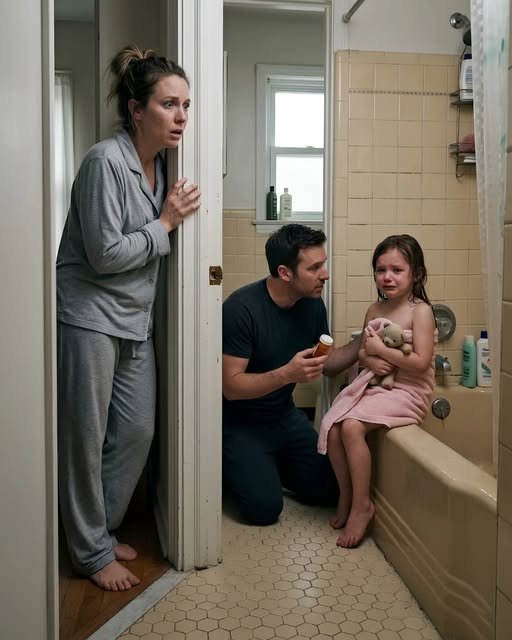
That evening, Sophie took a bath.
The bathroom door stayed open.
Toy boats floated through clear water.
There was no locked door.
No timer.
No cup.
No secrets.
From the hallway, I heard her singing to herself again.
She was completely off-key, making up half the words.
It was the most beautiful sound I had ever heard.
When she climbed out of the bathtub wrapped in a yellow towel, she looked up at me.
“Mommy?”
“Yes?”
“I told the truth.”
I knelt beside her and touched her damp cheek.
“Yes, you did.”
She smiled.
“And the truth helped us get out?”
My eyes filled with tears.
“Yes,” I whispered. “It did.”
Later that night, after Sophie had fallen asleep, I sat alone beside the window.
Rain moved softly across the yard.
I thought about that half-open bathroom door.
The kitchen timer.
The paper cup.
And the frightening second life that can exist behind the walls of a perfectly ordinary home.
Then I remembered something more important.
Sophie’s small voice saying:
“No more games.”
People sometimes ask me when I first knew something was wrong.
I think they are asking the wrong question.
I didn’t understand soon enough.
I understood when I finally stopped searching for comfortable explanations and started listening to what my daughter’s fear was trying to tell me.
And once I saw the truth clearly, there was only one thing left to do.
I picked up the phone.