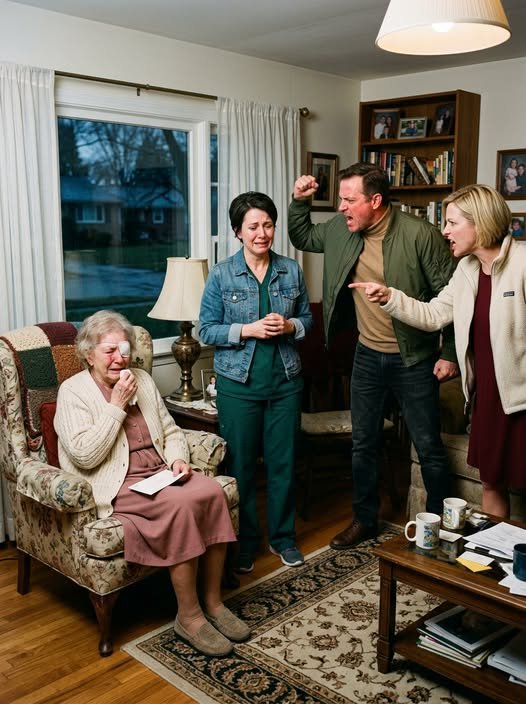
“She came into our home when she was eight years old after losing her mother. She cried herself to sleep for months. Your father sat outside her bedroom until she felt safe. I packed her lunches. I took her to school. I held her when she was sick. I watched her graduate from nursing school.”
My voice shook.
But I did not lower it.
“She is not almost my daughter.”
“She is not less my daughter.”
“She is my daughter.”
Brandon lowered his eyes.
“And when I was frightened and needed help,” I continued, “she did not calculate whether saving my eyesight would interfere with buying a vacation house.”
Sophie wiped away a tear.
I took her hand.
Brandon sat silently for a while.
Then he stood.
“I should go.”
I nodded.
At the doorway, he stopped.
“Are you cutting me out of your will?”
For some reason, that question almost made me smile.
“No.”
He turned around.
“You are still my son.”
His shoulders relaxed.
“But I am changing how everything will be divided.”
His expression became tense again.
“I’m leaving the house to Sophie.”
His face fell.
“She is the one who checks on this house. She helps with repairs. She takes me to appointments. She brings groceries when I’m sick.”
“What do I get?”
“After my expenses are settled, whatever remains in my savings and investments will be divided equally between the two of you.”
Brandon stared at me.
“So Sophie gets more.”
“She has given more.”
I didn’t say it to punish him.
That was why it hurt.
He nodded once.
Then he walked out.
For several months, Brandon and I barely spoke.
Meanwhile, my eyesight continued improving.
Slowly at first.
Then dramatically.
The morning I could finally read the clock across my bedroom without squinting, I cried.
Sophie was the first person I called.
Dr. Grant told me the procedure had worked as well as anyone could have hoped.
I could read again.
I could drive again.
I could even clearly see the bright yellow paint Paul had chosen for our house twenty years earlier.
Life became ordinary again.
And after nearly losing my sight, ordinary felt magnificent.
Nearly six months later, Brandon appeared at my door.
Alone.
He was carrying a grocery bag.
“No checkbook?” I asked.
A small, embarrassed smile appeared on his face.
“No checkbook.”
Inside the bag were ingredients for Paul’s beef stew.
“I thought maybe you could teach me how Dad used to make it.”
“He never followed a recipe.”
“I know.”
I stepped aside.
That afternoon, we cooked.
Badly.
Brandon cut the carrots too large.
I added too much salt.
We argued about whether Paul used rosemary.
Halfway through, Sophie arrived.
She laughed when she saw our disaster in the kitchen.
Brandon became quiet.
Then he wiped his hands on a towel.
“Sophie.”
She stopped.
“I owe you an apology.”
She waited.
“For what I said that day.”
He glanced toward me.
Then back at her.
“You’re my sister. Mom should never have needed to remind me of that.”
Sophie watched him for several seconds.
“Thank you.”
She didn’t hug him.
She didn’t need to.
Some wounds are not healed by one apology.
They heal because the person who apologized begins behaving differently.
And Brandon did.
He started visiting more often.
Not every day.
Not even every week.
But enough for me to notice.
He called before my medical appointments.
He repaired the loose porch railing without being asked.
When my refrigerator stopped working the following year, he arrived with a repairman instead of advice about managing money.
Courtney rarely accompanied him.
That was perfectly fine with me.
One afternoon, Brandon handed Sophie an envelope.
Inside was $3,500.
She pushed it back.
“That money was for Mom.”
“I know.”
“She doesn’t owe me anything.”
“I know.”
“Then keep it.”
They both looked toward me.
“Donate it,” I said.
So we did.
The money went to a local organization helping older adults pay for medical treatments their insurance would not fully cover.
Then Brandon quietly donated another $3,500 of his own.
I never asked whether he did it because of guilt.
Sometimes the reason behind a good action matters less than what the action becomes.
Two years later, Sophie framed the note she had placed in that first envelope.
It still hangs in my hallway.
Mom, you saved my life when I had no one. Let me save your sight now.
People occasionally ask whether Brandon and I repaired our relationship.
Yes.
We did.
But we didn’t repair it by pretending nothing had happened.
I never forgot the phone call.
I never forgot Courtney telling me to stop asking her husband for money.
I never forgot sitting alone with that medical estimate, realizing that only $3,500 stood between me and the possibility of darkness.
But I learned something more valuable than money.
Family is not measured by blood.
It is not measured by inheritance.
It is not measured by who owns the largest house, drives the most expensive car, or has the most successful career.
Family is measured by who shows up when everything becomes dark.
When my eyesight was disappearing, one of my children told me he couldn’t spare a dime.
The other drove through the rain and placed a sealed envelope on my kitchen table.
Years later, whenever someone tells me how lucky I am that my vision was saved, I smile and agree.
Because they are right.
I am lucky.
But the greatest thing I regained was not simply my eyesight.
For the first time in years, I could finally see my family clearly.