
My Father Put Me in a 14-Day Coma After I Caught Him With Another Woman
My father put me into a fourteen-day coma after my phone caught him kissing another woman outside a motel.
When I finally opened my eyes, the first thing I smelled was antiseptic.
The second was cold coffee.
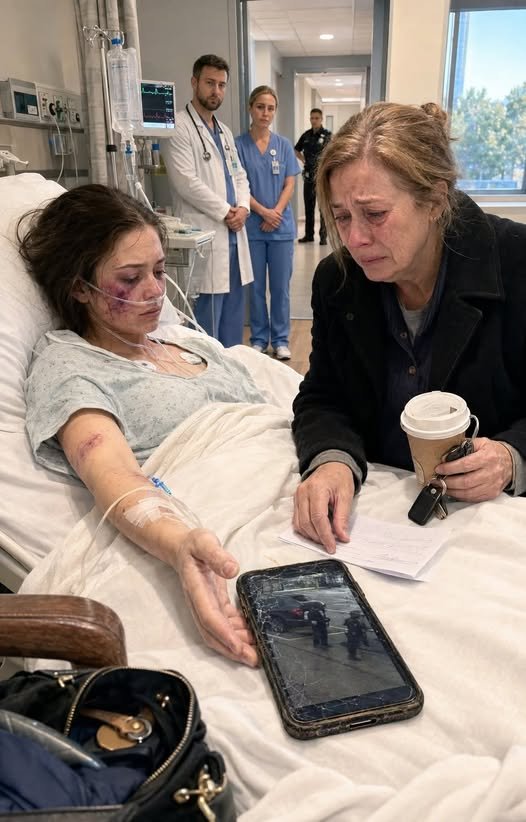
My mother had been holding the same paper cup for so long that the bottom had softened between her fingers.
She leaned over my hospital bed and whispered my name.
There was relief on her face.
But there was something else too.
Fear.
Quiet, practiced, familiar fear.
My throat burned when I tried to speak.
Every breath pulled painfully against my ribs, and even turning my head made the room tilt.
Still, there was only one question I needed answered.
“Where is he?”
My mother did not ask who I meant.
She glanced toward the closed hospital door and lowered her voice.
“He told everyone you slipped near the curb,” she said. “He said you were angry, ran after him, and fell.”
For several seconds, her words floated in front of me.
A curb.
A fall.
An accident.
It would have been easier to believe.
Then the memories started coming back.
Not all at once.
In broken pieces.
The buzzing motel sign.
Rows of cars beneath harsh white lights.
My phone warm in my hand.
My father standing beside our family SUV.
And a woman who was not my mother wrapped in his arms.
He was kissing her.
My phone had already been recording.
Earlier that evening, Mom had asked me where Dad was. I had seen his SUV from the road and decided to find out.
I wasn’t looking for proof of an affair.
I was looking for another explanation.
Maybe he had a work meeting.
Maybe the car had broken down.
Maybe there would be another weak excuse that allowed all of us to get through dinner without saying what we already suspected.
Then my father turned toward me.
He saw me.
More importantly, he saw the red recording dot glowing on my phone screen.
His arm immediately dropped from the woman’s waist.
She stepped backward and pulled her coat closed.
Then Dad began walking toward me.
He did not shout.
He did not run.
That calmness frightened me more than anger would have.
“Turn it off,” he said.
I backed away.
“Mom deserves to know.”
Something changed in his face.
Only for a second.
Then I remembered the sound of my phone hitting the pavement.
After that, everything disappeared.
The next clear memory I had was waking in the hospital.
My mother must have seen the realization spreading across my face.
Without saying anything, she reached into her coat and placed my phone on the blanket.
The screen was cracked from corner to corner.
Part of the case had split near the volume buttons.
Dust from the motel parking lot was still trapped along the rubber edges.
“Your father brought it home,” she said. “He told me to throw it away.”
I stared at the phone.
It still powered on.
The battery symbol flashed red.
Dad had deleted the video from the device.
He had even emptied the trash folder.
What he had not realized was that the recording had already uploaded automatically to the account connected to my phone.
The timestamp matched the night I was found.
My mother opened the video.
The beginning showed exactly what I remembered.
Dad stood beside the SUV with one arm around the woman’s waist.
She laughed.
He leaned toward her.
They kissed again.
Then Dad suddenly looked directly toward the camera.
Toward me.
He released her and walked across the parking lot.
His voice came through the damaged phone speaker.
Low.
Controlled.
“You send that to your mother, and you’ll destroy this family.”
My own voice answered from behind the camera.
“You already did.”
Then the picture spun sideways.
Shoes crossed the screen.
The phone scraped across the pavement.
There was a sharp breath.
And Dad’s voice changed.
The rest of the recording was mostly sound.
My mother stopped the video before reaching the part neither of us was ready to hear again.
The hospital room suddenly felt too bright.
I looked at her.
“You believe me now?”
Her fingers tightened around the paper coffee cup.
“I believed you before you woke up,” she whispered.
That answer hurt in a different way.
My father had attacked me.
But my mother had known he was lying.
She had sat beside my hospital bed for fourteen days knowing the story about the curb was false.
For fourteen days, doctors had examined me, adjusted medications, discussed swelling, and warned her about possible complications.
And whenever anyone asked what happened, she repeated Dad’s story.
I struggled to speak.
“What did you tell the police?”
She lowered her eyes.
I already knew the answer.
She had told them she saw nothing.
She repeated Dad’s claim that I had followed him while angry, ran near a curb, and fell.
She told herself she wasn’t accusing me of lying because I had been unconscious.
I wasn’t there to contradict anyone.
But by staying silent, she had helped him erase my version of the night before I was even able to speak.
“Why?” I asked.
She placed the coffee cup on the rolling tray.
It leaned slightly because the bottom had softened.
“I was scared.”
I waited.
Then she finally told me everything.
Weeks earlier, she had confronted Dad about the affair.
She had found unexplained charges.
Messages disappeared whenever she entered the room.
She eventually asked him directly whether another woman existed.
At first, he denied everything.
Then he blamed stress.
Then he admitted there was someone but insisted she meant nothing.
Finally, he cried.
He begged Mom not to destroy the family.
He promised the affair was over.
Mom stayed.
She stayed because every bill, account, insurance payment, and mortgage payment went through him.
He controlled the passwords.
He kept the important paperwork somewhere she could not easily reach.
For years, he had made every normal expense sound like a favor she owed him for.
A tank of gas became evidence that she was careless.
A grocery receipt became proof she couldn’t manage money.
A medical bill became a warning that one mistake could cost them the house.
Dad never needed to lock the front door.
He had convinced her that the world outside it was more dangerous than he was.
Then Mom told me what happened while I was unconscious.
Dad had stood beside my hospital bed and asked for my phone passcode.
He said he needed it to contact my friends.
He said he wanted to protect my privacy.
Mom gave it to him.
She watched him unlock my phone.
She watched him find the video.
And she watched him delete it.
When Dad told her there had never been a recording, she didn’t believe him.
She simply didn’t challenge him.
“He said the video would make everything worse,” she whispered. “He said people would misunderstand what happened.”
“What was there to misunderstand?”
She looked at the cracked phone lying on my blanket.
“Nothing.”
That one word sounded like the first completely honest thing she had allowed herself to say in years.
Dad had also told her the hospital bills would destroy them.
He said they would lose the house if she contradicted him.
He said the police would drag the family through an investigation while I was unconscious.
He told her I would wake up and blame her for destroying our home.
My hand felt heavy, but I pushed the cracked phone toward her.
“And what do you think I blame you for now?”
She didn’t defend herself.
She didn’t tell me she had done her best.
She didn’t ask me to understand how frightened she had been.
Instead, she reached into her purse and pulled out a folded statement.
She placed it beside my hospital wristband.
Her signature was already at the bottom.
“I’m correcting what I told them,” she said. “I’m telling them about the phone, the video, and what he made me do. Even if I lose the house.”
I stared at the paper.
For years, my mother had measured almost every decision against one fear.
Losing that house.
It wasn’t a mansion.
The porch railing needed painting.
One kitchen drawer never closed properly.
The air conditioner groaned every summer.
But it was the home where she had raised me.
And my father had turned that ordinary house into the strongest threat he owned.
He didn’t need to say he would hurt her.
He only needed to remind her that he controlled the roof, the driveway, the groceries, the insurance, and everything familiar she believed protected us from disaster.
Now she sat beside me with a signed statement that might cost her all of it.
I wanted that decision to repair everything.
It didn’t.
Her choice mattered.
But it could not give me back the fourteen days I had lost.
It could not erase the fact that my father had entered my hospital room while I was helpless and used my passcode to destroy evidence.
And it could not erase the fact that my mother had allowed him to do it.
“Why now?” I asked.
Her answer took time.
“Because I kept waiting for the safest moment,” she said. “Then I looked at you lying here and realized there was never going to be one.”
She reached into her coat pocket.
Her car keys rested in her palm.
I recognized the worn keychain immediately.
They were the same keys she used to hide beneath the flour canister whenever Dad became angry and started checking her purse.
When he was upset, he sometimes took her keys and told her she didn’t need to go anywhere until she had “calmed down.”
Months earlier, she had begun hiding a spare set.
At the time, she called it being prepared.
Now I understood.
Those spare keys had been the smallest version of escape she could allow herself to imagine.
Then Mom told me something that changed the entire meaning of what had happened outside the motel.
That morning, before I found Dad with the other woman, Mom had packed a duffel bag.
Inside she placed clothing, medication, a phone charger, and every important document she could find.
She hid the bag inside her car.
She never told me.
She was afraid I would try to help.
And if I tried to help, Dad might notice.
Her plan had been simple.
She wanted to leave quietly once she found somewhere safe to go.
But Dad discovered the bag.
He searched through it.
He realized Mom was preparing to leave him.
So when he later saw me standing outside that motel with a phone in my hand, he believed I knew everything.
He believed I had helped Mom pack.
He believed I knew where she planned to go.
To him, the recording wasn’t only proof of an affair.
It was proof that he was losing control over both of us.
“He wasn’t only trying to hide the affair,” Mom whispered. “He thought you were helping me escape.”
The words changed the shape of the memory.
I had believed Dad attacked me because I caught him cheating.
That was true.
But it wasn’t the whole truth.
He attacked me because I had become part of a future he could no longer control.
The phone in my hand represented more than exposure.
It represented Mom making a decision without his permission.
It represented me believing her.
It represented the possibility that his money, threats, and carefully managed explanations were no longer enough to keep us exactly where he wanted us.
Mom closed her fingers around the keys.
“I should have left sooner,” she said.
“Yes.”
She flinched.
But she nodded.
I didn’t tell her everything was okay.
It wasn’t.
I didn’t forgive her in that hospital room.
Forgiveness given too quickly would have been another lie told simply to keep the family comfortable.
Instead, I gave her something smaller.
And harder.
“Go correct the statement.”
She stood.
At the door, she stopped.
“Are you afraid he’ll come back?” she asked.
I looked at the cracked phone beside my wristband.
“I’m afraid you’ll change your mind.”
Pain crossed her face.
Then she reached into her purse.
She removed the house key from her key ring and placed it on top of the signed statement.
“I’m not going back there tonight,” she said.
Then she left the hospital room carrying only her car keys and the ruined cup of coffee.
For the first time since I woke up, the sound of a closing door didn’t feel like someone abandoning me.
It felt like someone finally doing what she said she would do.
Later, Mom returned.
The coffee cup was gone.
So was the folded statement.
She didn’t make a dramatic speech about courage.
She didn’t promise that everything would suddenly be fixed.
She simply sat beside my bed and told me she had corrected her account.
She told investigators that Dad had asked for my passcode.
That he had accessed my phone while I was unconscious.
That he had found the video.
That he had deleted it.
She also showed them where the uploaded copy remained stored.
From that point forward, the people investigating what happened would decide what came next.
For once, Dad would not be the only person deciding which version of the night became official.
Mom looked at me.
“Do you want me to stay?”
It was such a simple question.
But it was different from every question she had asked for years.
She didn’t ask what would keep Dad calm.
She didn’t ask what would save the house.
She didn’t ask what would make the family look normal.
She asked what I wanted.
“Stay,” I said.
So she stayed.
Not as someone who had already been completely forgiven.
Not as someone whose fear erased the choices she had made.
She stayed as a woman who had finally told the truth and understood that telling it was only the beginning of repairing what her silence had damaged.
The next morning, sunlight reached the edge of my hospital blanket and reflected through the cracks in my phone screen.
Mom picked up the spare charging cable and connected it carefully.
She pressed the damaged case together until the charger stayed in place.
Then she set the phone on the tray between us.
No one hid it.
Beside it rested the house key she had removed from her ring.
For years, those keys had represented permission.
Whether Dad allowed her to leave.
Whether he allowed her to come home.
Whether she could move through her own life without being questioned.
Now one key rested openly on the hospital tray.
The others remained in her hand.
She was still afraid.
I was still hurt.
We didn’t have easy answers for the bills.
Or the house.
Or what would happen to Dad.
And we certainly didn’t have an easy answer for the damage between us.
But when the hospital door opened that morning, Mom didn’t hide the phone.
She didn’t reach for the house key.
She simply moved her chair closer to my bed.
And left both of them exactly where everyone could see them.