
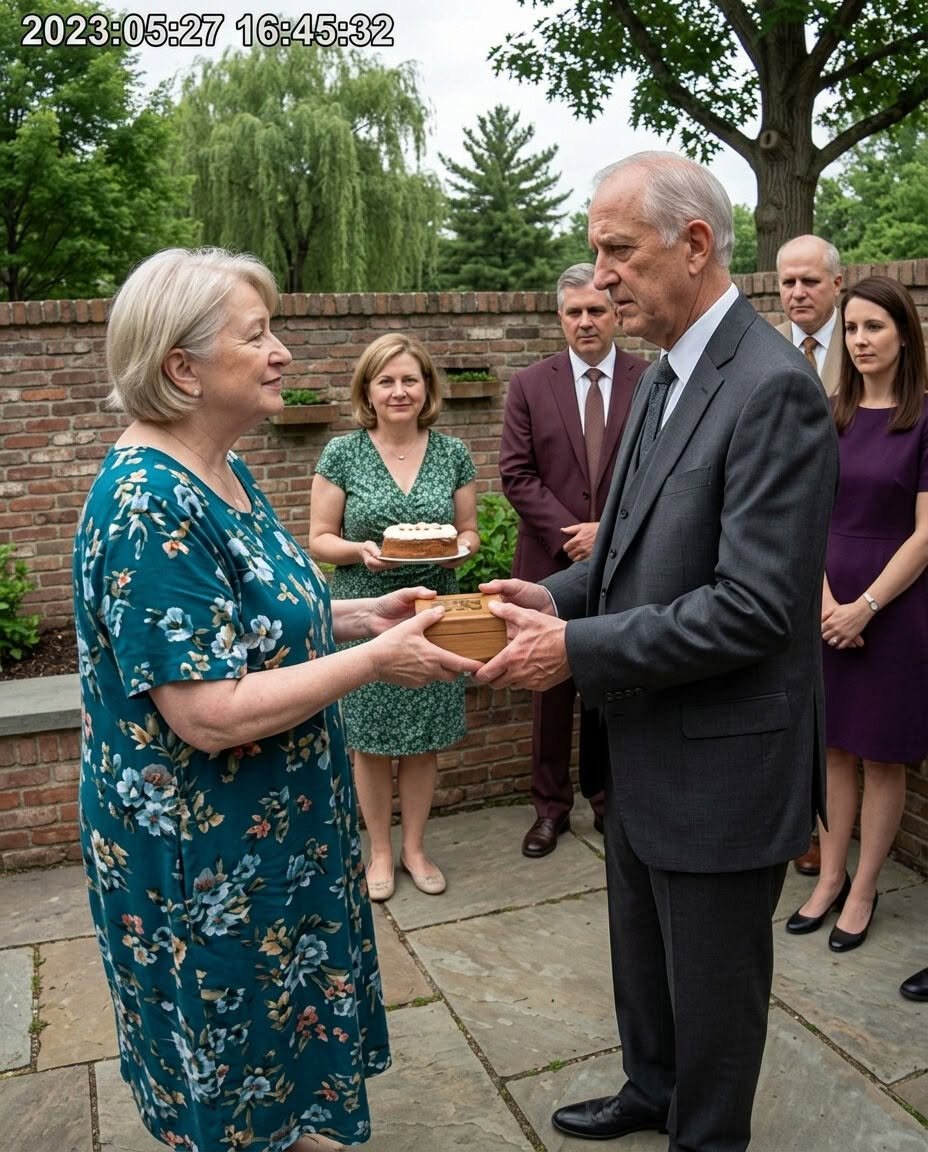
73-Year-Old Woman’s Birthday Party Takes Shocking Turn — Husband’s “Foundation” Speech Triggered a $3 Million Asset Takeover
How One Box with a House Key and Divorce Papers Dismantled 50 Years of Marriage Built on Secret Deception and a Murder Plot for Her Mind
The Foundation’s Birthday
The morning of my seventy-third birthday smelled of freshly brewed Ethiopian Yirgacheffe coffee and the petunias in my garden. I woke up, as always, without an alarm at exactly 6:00 a.m., watching the Georgia sun brush the tops of old pecan trees outside my screened-in porch. This house, this getaway home on the outskirts of Atlanta, was my unrealized concert hall.
A long time ago, in another life, I was a young, highly promising architect with the project of my dreams laid out before me: a new performing arts center downtown. My name was on the plans. I was chosen.
I was funded. Then came Langston with his first “genius” business idea: imported high-end woodworking machinery that was supposed to make us rich. I liquidated the inheritance meant for my dream, for my future, and dropped every dime into his business.
It crashed and burned within a year, leaving behind only debt and a garage full of expensive machines no one wanted. Instead of a concert hall, I built this house—pouring everything I had into it. The remnants of my talent, all my strength, all my unspent love for form and line.
This home became my quiet masterpiece, my private museum. A masterpiece no one else, except me, ever really saw. “Aura, you seen my blue polo?
The one that looks best?” My husband’s voice yanked me from my memories. Langston stood in the doorway, already dressed in slacks, frowning, focused only on himself. His thinning hair was combed carefully over the bald spot he pretended not to have.
Not a word about my birthday. Not a single glance at the festive linen tablecloth I’d taken out of the hall closet yesterday. Seventy-three years old.
Fifty years together. For him, this was just another Thursday. He loved calling me his “foundation.” “You are my foundation, Aura,” he would sometimes say after his third snifter of cognac, like it was a compliment.
He had no idea how right he was. And he had no idea what foundations could do when they decided to stop supporting the structure built on top of them. The Phone Call
The phone rang.
My elder daughter, Zora. “Hey, Mom. Happy birthday, of course.
Listen, we’re stuck in dead-stop traffic heading out to the house. It’s awful. Could you start setting out the food, please?
We don’t want to show up and nothing’s ready. And keep an eye on Dad so he doesn’t drink too much before we get there. You know how he is.”
She spoke fast, already irritated, as if my birthday were just another item in her overcrowded calendar, wedged between a client call and her son’s soccer practice.
I wasn’t the birthday girl. I was the catering staff for the event held in my honor. By five in the afternoon, the house was full of guests—old friends, relatives, neighbors, Langston’s business associates.
I smiled, accepted congratulations, and poured sweet tea. I played my part: the happy wife, the devoted mother, the gracious mistress of this big, welcoming Southern home. A role I had written and rehearsed for half a century.
Langston was in his element, moving from group to group, bragging about his successes at work, saying “My house, my trees,” while nobody contradicted him. No one knew that this house, just like our condo in Buckhead and all our savings, had been registered only in my name—at the insistence of my wise father, who’d worked thirty years in a downtown bank and trusted contracts more than promises. My younger daughter, Anise, arrived and was the only one who hugged me truly, tightly.
She looked into my eyes and quietly asked, “Mom, are you okay?”
She’d always felt more than the others. For a long time she had looked at her father with quiet, cold disapproval that he, in his self-absorption, simply never noticed. Then the moment I had been waiting for—and dreading—for a whole year finally came.
Langston took a glass of champagne and tapped it with a knife, calling for silence. The guests fell quiet, expecting a toast. He stood in the center of the lawn, tall, still handsome at seventy-five, with the posture of a man convinced that the world owed him an audience.
The Great Reveal
“Friends, family,” he began loudly, with a theatrical pause. “Today we celebrate the birthday of my dear Aura, my rock, my faithful companion.” He looked at me with nothing but self-satisfaction and ownership, as if I were a house he’d successfully flipped. “But today,” he went on, “I want to do more than just wish her well.
I want to finally be honest with all of you, with myself, and with her.”
The guests exchanged glances. I stood motionless, feeling dozens of curious eyes on me. Anise froze beside me; her hand found mine and tightened.
“Friends,” Langston continued, his voice trembling with poorly concealed triumph, “for thirty years I have lived two lives, and today I want to make things right.”
He signaled to someone standing near the gate. A woman in her early fifties stepped into the circle of light spilling from the porch. She was well-kept, with salon hair, a fitted dress, and a hard, appraising look.
I recognized her immediately. Ranata. She had once been my subordinate at the architectural firm.
I had trained her, corrected her drafts, advised her to go back to school. Behind her stood two young people with confused and defiant faces—the boy’s jaw looked like Langston’s, the girl had my daughters’ age. “Aura has been such a stable foundation,” he said, looking over my head at the guests.
“So stable that, as it turns out, I could build not just one, but two houses on it. This foundation has supported all of us. So please welcome my true love, Ranata, and our children, Keon and Olivia.
It’s time for all my successes to be shared by my whole family.”
He said this and physically placed Ranata beside me, so close I could smell her sharp perfume. He set her there like he was arranging us for a family portrait—wife on the left, mistress on the right. His two worlds colliding in my backyard on my birthday.
The Hidden Financial Reality
What Langston didn’t know about “his” empire:
- The house: Registered solely in Aura’s name (father’s insistence)
- Buckhead condo: Aura’s name only
- All savings accounts: Aura’s legal ownership
- Business assets: Built with Aura’s liquidated inheritance
- Total assets under Aura’s control: Over $3 million
Langston’s actual ownership: Zero legal claim to any property
The Cold Click
My elder daughter, Zora, gasped. Anise squeezed my hand until my knuckles turned white. Laughter and conversation died mid-sentence.
Someone dropped a fork onto a plate; the tiny sound rang out like a shot. A ringing, unbelievable silence settled over the lawn. In that moment, I didn’t feel the ground vanish beneath my feet or my heart split in two.
No. I felt something else entirely—something very calm and final. A cold, distinct click.
It was like the key of a heavy rusted lock that had resisted for decades finally turned, and the massive steel door slammed shut forever. I stood between my husband and his woman like the central support of a bridge spanning the two shores of his lie. The world around us seemed frozen.
I saw our neighbor, Marie, with a cocktail glass suspended halfway to her lips. I saw my son-in-law turn pale and instinctively step back, as if afraid of being hit by the wreckage of a collapsing life. I slowly turned my head and smiled.
Not bitterly, not vengefully. I smiled that polite, slightly detached smile with which the lady of the house greets latecomers. Then I walked to the small patio table where my gift for him lay: a single box tied with a dark navy silk ribbon.
The wrapping paper was thick, ivory-colored, unadorned, strictly elegant. A year ago, when I first discovered everything, I had spent hours choosing that paper. It mattered to me that everything be impeccable.
The Gift
I picked up the box. It was light, almost weightless. “I knew, Langston,” I said.
My voice did not tremble. It sounded level and calm, almost soft. “This gift is for you.”
I held out the box.
He hesitated. His script, so carefully directed, had glitched. This scene wasn’t in it.
He mechanically released Ranata’s shoulder and took the box from me. His fingers brushed mine—warm, slightly damp. I pulled my hand away.
He probably decided it was some pathetic gesture, an attempt to save face. Maybe an expensive watch, cufflinks, a parting gift to prove I was “still dignified.”
He pulled at the bow. The silk ribbon slid onto the grass like a dark snake.
He tore off the paper and opened the plain white cardboard box. I watched his face. Inside the emptiness where my heart had once lived, nothing stirred.
I was a front-row spectator at a play whose ending I already knew. At the bottom of the box, resting on white satin, lay a single simple house key. A standard American key that still smelled faintly of new metal.
Next to it was a sheet of thick paper folded into quarters. Langston took it out and unfolded it. I watched his eyes dart over the lines, first quickly, then slower, as if each word slammed into him.
I knew those words by heart. I had helped my lawyer craft them:
Notice of termination of marriage due to long-term marital infidelity, based on documents of sole property ownership. Immediate freeze of all joint accounts and assets.
Order to cease and desist. Access revoked to property located at: Decar Street, Atlanta, GA — the house. The Buckhead condo, Atlanta, GA — the apartment.
His left hand began to tremble; a fine, almost imperceptible shake that traveled up to his shoulder. Then his right hand began to tremble too. The paper rustled in his grip like a dry leaf in November wind.
He looked up at me. The self-satisfaction was gone. The triumph had vanished.
Looking at me now was a confused, aging man with an ashen face. In his eyes there was no anger, no indignation—only pure animal bewilderment. It was as if he had been walking on solid, reliable ground his whole life, and suddenly it opened beneath his feet into a bottomless chasm.
The Tableau Collapses
Ranata, standing beside him, understood nothing yet. She looked nervously at Langston’s shifting expression. “Langst, what is it?
What is that?” she whispered, trying to peek at the document. He didn’t answer. He just stared at me while his world—so comfortable, so secure, built on my life, my money, and my silence—came apart in real time in front of all his friends and family.
I held his gaze and then, slowly, turned to Anise. She was looking at me, tears standing in her eyes—not of pity, but of pride. She understood everything.
“It’s time,” I said quietly. Anise understood without another word. We turned and walked toward the house.
We didn’t run. We walked steadily, with dignity, away from the frozen tableau on the lawn. Guests parted before us like water before an icebreaker, avoiding our eyes, mumbling to each other.
Langston remained in the center, the white sheet trembling in his hands, next to the woman for whom he had staged this grand reveal—a reveal that had just exploded in his face. From inside the house, I raised my voice just enough to carry outside: “Dear friends, thank you for coming to share this day with me. Unfortunately, the celebration is over.
Please feel free to finish the cobbler and have a drink. All the best.”
A quiet, hasty exodus began. Ten minutes later, all that remained in the garden were abandoned plates, half-empty glasses, and trampled flowers on the lawn.
The Machine in Motion
Through the window I saw Langston finally snap out of his stupor. He grabbed Ranata’s arm and dragged her toward the gate, stumbling, looking back at the house with pure animal rage on his face. He was no longer the master of the house.
He was an exile. When the last car drove away, Anise came up and hugged me. “It’s all right, darling,” I said.
“Everything is exactly as it should be. Will you help me clear the table?”
Later that night, my cell phone vibrated. Langston’s name flashed on the screen.
Anise put it on speaker. His voice shattered the night’s silence, distorted with rage, breaking into a rasp. “Aura, are you out of your mind?
What kind of circus did you pull? You humiliated me in front of everyone. I’m trying to pay for a hotel and my cards are blocked.
My cards. Do you understand what you’ve done? I’m giving you until morning.
Until morning to turn everything back on. Call the bank and say it was a mistake. Otherwise I swear you’ll regret it.
You will bitterly regret this.”
The message cut off. We sat in silence. “He still doesn’t understand,” I said.
“He and Ranata think this is a fit. A woman’s tantrum. A silly little bluff that’ll be over by morning when I ‘come to my senses.’ They didn’t see the planning, the preparation, the cold fury that’s been hardening in me for a year.”
The drive into Atlanta the next morning was quiet.
I had an appointment with my attorney at ten. Yesterday hadn’t been the beginning. It had been the end.
The final period I’d been working toward for an entire year. The Attorney’s Office
Attorney Victor Bryant’s office was in an old Atlanta building off Peachtree Street—heavy mahogany doors, polished brass handles, the faint scent of expensive cologne and old books. He had worked with my father years ago, which is why I sought him out.
“Aura Dee,” he began, “as we agreed, all initial notices have been sent. Accounts and assets are frozen. The process has been launched.
Has Langston or his representatives contacted you?”
“There was a voicemail,” I replied calmly. “Threats, accusations of hysteria.”
“That’s predictable. He hasn’t grasped the seriousness yet.” Victor paused, then opened a desk drawer and took out a thin, unmarked file.
“But there’s something else. I felt it necessary to conduct an additional check. And my concerns were, unfortunately, justified.”
He slid several sheets toward me.
“This is a copy of a petition your husband filed two months ago with the county behavioral health unit. An official request for a compulsory psychiatric assessment regarding your competency.”
Time stopped. I heard Anise gasp beside me, but I simply stared at the document—the neat form, the typewritten text, and beneath it Langston’s sprawling, familiar signature.
“This is the first legal step toward having a person declared incompetent and obtaining guardianship over them—and consequently full authority to manage all of their assets.”
The Murder of a Self
I began to read the list of so-called symptoms my husband had allegedly observed:
Frequently misplaces personal items. Cannot recall where she placed her glasses, keys, or documents, which suggests a progressive loss of short-term memory. I remembered hunting for my reading glasses a week ago, only to find them perched on my head.
Anise and I had laughed about it. He hadn’t been laughing. He’d been collecting evidence.
Shows signs of social isolation and apathy, refuses to meet friends, spends long periods alone in the garden, and converses with plants, which may indicate detachment from reality. My garden. My only sanctuary.
My quiet hours among the peonies and roses when I could finally breathe. He had turned even this into a symptom, a weapon pointed at my mind. Every line was poison—a grain of truth twisted beyond recognition, mixed with blunt lies.
Every small moment of fatigue, every bit of age-related forgetfulness, every private habit had been carefully inverted and presented as evidence of my insanity. In that silence, I understood this wasn’t just betrayal. Infidelity is betrayal of love.
This was the attempted murder of a self. He didn’t just want to leave for another woman. He wanted to erase me.
To strip me of my home, my money, my name, my mind. To lock me away as a voiceless shadow in some quiet facility while he and his “true love” enjoyed everything I had spent my life building. The last warm ember in my soul—some small piece of pity I had unknowingly saved for him—didn’t simply dim.
It turned to ice. The Systematic Demolition Plan
While Victor’s team executed Aura’s counterstrike:
- Breakfast scene: Process server delivers divorce papers to Langston at hotel
- Buckhead condo: New locks installed, Langston’s keys useless
- Car repossession: SUV towed (registered in Aura’s name)
- Credit cards: All accounts frozen, no hotel payment possible
- Bank accounts: Complete asset freeze under court order
From mansion master to sidewalk exile in 24 hours
The Execution
Victor worked quickly, with the cold precision of a surgeon removing a tumor. While Anise and I drove back toward the house, his couriers were already delivering notices across Atlanta.
The first blow landed where Langston least expected it—at breakfast in an expensive Midtown hotel. He and Ranata were likely still dissecting my “ridiculous stunt” when a man in a sharp suit approached their table and silently set a thick envelope in front of Langston. Inside were divorce papers, a court order prohibiting him from contacting me except through attorneys, and a mandate forbidding him from entering any property registered in my name.
Reality met him at the Buckhead condo. They must have driven there next, ready to stage a scene, but he stood in the hallway, jabbing his key into the new shiny lock. It didn’t turn.
The heavy leather-upholstered door I’d chosen thirty years ago stayed mute and indifferent. It no longer recognized him. The last, most humiliating blow waited outside the condo.
As he was about to drive off, he saw a tow truck pull up to his car—the gleaming black SUV I’d given him for his birthday three years earlier. Two workers efficiently hooked up the vehicle and began hoisting it onto the platform. The foreman handed him a clipboard.
Official notice of return of property to its lawful owner. My name was on the form. Aura Day Holloway.
Owner. Blocked cards are an inconvenience. Divorce papers are a scandal.
End part Here: On My 73rd Birthday, My Husband Revealed His Secret Family — But My Gift to Him Made His Hands Shake