She was fifteen years old, in pain, lying on a medical table, and still believed that whatever the doctor found might be her fault.
“No, sweetheart,” I said. “You are not in trouble.”
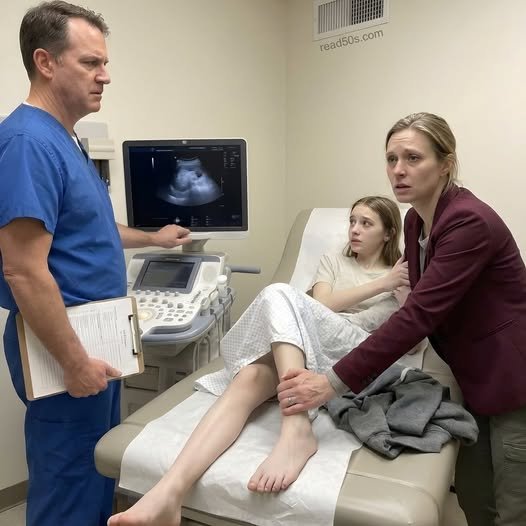
Dr. Lawson approached the monitor.
He studied the scan as though deciding what he could responsibly say before receiving every answer.
“The ultrasound shows that there is something inside her.”
For one second, the room stopped being a room.
The lights felt too bright.
The machine sounded too loud.
My hand found Maya’s ankle beneath the paper sheet because I needed physical proof that she was still beside me.
“Inside her?” I repeated. “What does that mean?”
Maya gripped my sleeve.
The doctor turned the monitor slightly.
I had no medical training and could not interpret the shadows on the screen.
But one area looked different.
It had a shape.
A boundary.
A presence that tightened my chest before anyone explained it.
I remembered every time Maya had pressed a hand against her stomach.
Every cold dinner.
Every exhausted afternoon.
Every dizzy pause on the stairs.
Every time Robert had accused her of performing.
I thought about the orange insurance sticker that had frightened me and felt ashamed that money had occupied even one corner of my mind.
Whatever was on that screen had been growing inside my child while we argued about whether her pain deserved a medical bill.
“Is it bad?” Maya whispered.
Dr. Lawson placed the clipboard beside the machine.
“I need to confirm several things before I name it.”
“Confirm what?”
He checked Maya’s intake form.
“Before we order additional imaging, we need a pregnancy test. That is standard for a patient her age.”
Maya’s face flushed.
“I’m not pregnant.”
“I believe you,” he said. “But we need the result documented before using certain imaging.”
It was the first time that day a man had said those words to her.
I believe you.
The test was negative.
A short time later, a CT scan confirmed what the ultrasound had suggested.
Maya had a large mass arising from her right ovary.
It measured almost eighteen centimeters.
The weight of it had caused the ovary to twist, restricting its blood supply.
“That explains the severe pain, nausea, dizziness, and loss of appetite,” Dr. Lawson said. “Her bloodwork also shows significant anemia.”
I struggled to breathe.
“Is it cancer?”
“We don’t know yet. Many masses in young patients are benign. We won’t know exactly what it is until surgery and pathology.”
“Surgery?”
“This cannot wait.”
He looked at Maya.
“The twisting is an emergency. If the tissue has lost its blood supply, it can become dangerous. The surgical team is being contacted now.”
Maya stared at him.
“Am I going to die?”
“No,” he answered carefully. “You came here, and now we know what we’re treating. But we need to move quickly.”
Then he looked at me.
“If you had waited much longer, this could have become far more serious.”
I thought of Robert’s voice.
She’s faking it.
Don’t waste money.
She wants attention.
Then my phone began ringing.
Robert’s name appeared on the screen.
This time, I answered.
The Question That Changed Everything
“Where are you?” Robert demanded.
“At Riverside Medical Center.”
“You took her to the hospital after I told you not to?”
I looked through the glass as nurses began preparing Maya for emergency surgery.
“She has an eighteen-centimeter ovarian mass. It has twisted one of her ovaries and cut off the blood supply.”
Silence followed.
Then Robert asked the question that ended something inside me.
“How much is this going to cost?”
I slowly lowered the phone.
For a moment, I could not believe he had said it.
Then I realized I believed it completely.
“Your daughter may lose an organ,” I said. “And you are still asking about money.”
“That isn’t what I meant.”
“It is exactly what you meant.”
I ended the call.
Maya was watching me from the bed.
“Is Dad coming?”
“I don’t know.”
“Is he mad?”
I placed my phone inside my bag.
“His feelings are not your responsibility.”
A nurse handed me the surgical consent forms.
My hands shook as I signed them.
Then I walked beside Maya’s bed until the double doors separated us.
For the first time in weeks, someone was finally taking her pain seriously.
I only prayed we had not arrived too late.