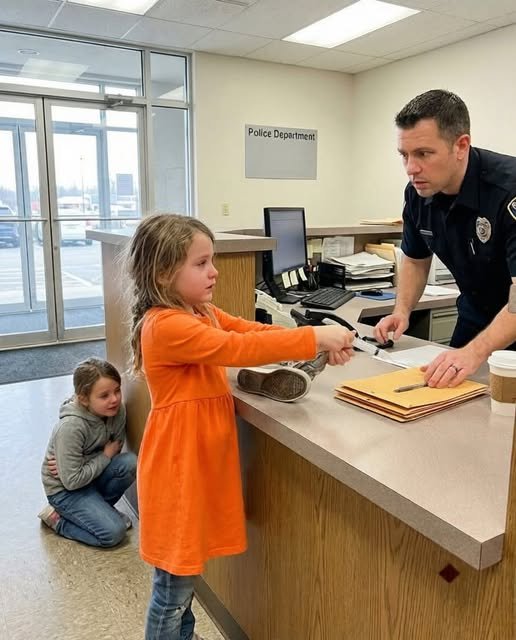
The police station was quiet that afternoon, the kind of lull that comes between paperwork and patrols. Officers shuffled reports, phones rang occasionally, and the hum of fluorescent lights filled the air. Then the glass doors opened, and a three-year-old girl entered, clutching the hand of a nervous couple. Her eyes were red from days of crying, and her cheeks blotchy, but her steps were determined. She marched straight toward the front desk as if she had rehearsed this moment.
“Excuse me,” she said in a trembling but clear voice, “I need to confess something serious.”
The officer at the desk froze. Conversations stopped. Even the sound of typing halted. A child asking to confess? The words hung in the air like a riddle no one knew how to answer.
Officer Daniels, a veteran with twenty years on the force, rose from his chair. He had seen hardened criminals break down in tears, but never a toddler demanding to confess. He knelt so his eyes met hers, softening his voice.
“Sweetheart,” he said gently, “what do you want to tell me?”
The girl’s lip quivered. She looked back at the couple—her foster parents—who nodded encouragingly. Then she whispered, “I stole something.”
The Story Behind the Confession
The room went still. Officers exchanged glances. Daniels tilted his head. “What did you steal?”
Her tiny hands clenched into fists. “I stole…a hug.”
For a moment, no one spoke. The phrase was so unexpected, so innocent, that it silenced the entire station. Daniels blinked, unsure if he had heard correctly. “A hug?” he repeated.
The girl nodded fiercely, tears welling again. “From my mommy. But she’s not here anymore. And I keep thinking it was wrong, because I didn’t ask first. I keep crying and crying, and I can’t stop. I thought maybe the police could help me say sorry.”
Her foster mother covered her mouth, fighting back sobs. Her foster father placed a hand on her shoulder. The officers nearby shifted uncomfortably, their tough exteriors cracking. This wasn’t a crime. This was grief, raw and unfiltered, pouring out of a child who barely understood the world.
Daniels gently guided her to a bench. “Can you tell me about your mommy?” he asked.
The foster parents explained. The girl’s mother had passed away suddenly two weeks earlier. Since then, the child had been inconsolable. She cried day and night, repeating the same phrase: I stole a hug. No amount of comfort seemed to ease her guilt. She believed that taking a hug without permission had somehow caused her mother to leave. In her three‑year‑old mind, the logic made sense. She needed to confess, to make it right.
Daniels felt his throat tighten. He had children of his own. He understood the way kids carried invisible burdens, twisting small moments into heavy guilt. He looked around the station. Every officer was listening now, their hearts caught in the same grip.
Daniels took her hand. “Sweetheart, hugs aren’t stealing. Hugs are gifts. Your mommy loved you, and she gave you that hug because she wanted you to have it forever.”
The girl shook her head stubbornly. “But I didn’t ask.”
Another officer, a young woman named Lopez, stepped forward. She knelt beside Daniels. “Do you know what police officers do?” she asked. “We protect people. And we know the rules. I promise you—hugs don’t need permission when they come from love. Your mommy wanted you to hug her anytime.”
The girl’s eyes widened. “Really?”
“Really,” Lopez said firmly. “And you didn’t steal anything. You kept something precious. That hug is still with you.”
Daniels stood and looked around. “I think we need to prove it to her,” he said. He opened his arms. “May I give you a hug?”
The girl hesitated, then nodded. Daniels scooped her up gently, holding her close. She buried her face in his shoulder, and for the first time in days, her sobs quieted. Lopez hugged her next. Then another officer. Soon, the entire station lined up, each offering a hug, each reinforcing the truth: hugs are not stolen—they are shared.
Her foster parents joined, tears streaming down their faces. The little girl’s trembling eased. Her breathing slowed. She looked up at Daniels with a shy smile. “So…I didn’t do something bad?”
“No,” Daniels said, his voice thick with emotion. “You did something wonderful. You loved your mommy. And that’s the best thing anyone can do.”
The Ripple EffectWord spread quickly. A clerk posted about the moment on the station’s community page. Within hours, comments poured in—neighbors, teachers, parents, strangers—all moved by the child’s confession. People shared stories of their own children’s innocent misunderstandings, of grief expressed in unexpected ways. The post was shared thousands of times, turning a small police station into a symbol of compassion.
The next day, families arrived at the station with flowers, cards, and stuffed animals. They wanted the little girl to know she wasn’t alone. Some brought cookies. Others simply offered hugs. The lobby transformed into a sanctuary of kindness.
For the girl, the change was profound. She stopped crying at night. She began to laugh again, to play with her foster parents, to sleep peacefully. She carried a stuffed bear given by one of the officers, calling it her “hug bear.” Whenever she felt guilty, she hugged the bear tightly, reminding herself that love isn’t stealing.
Her foster parents later said that the police station had given them more than comfort—it had given them hope. They had worried the child’s grief would scar her permanently. Instead, the officers’ compassion turned her pain into healing.
Weeks later, Daniels reflected on the moment. “We train for emergencies, for danger, for crime,” he said. “But sometimes the most important thing we do is listen. That little girl reminded us that love is the law we should all live by.”
Lopez agreed. “She thought she was confessing a crime. But she taught us a truth: hugs, kindness, and love are never stolen. They’re shared. And they last forever.”
Epilogue: The Girl’s Promise
Months passed. The girl grew stronger, her laughter filling her foster home. One afternoon, she returned to the station with her foster parents. She wore the same checkered dress, but this time her eyes sparkled. She ran to Daniels and hugged him tightly.
“I have a new confession,” she announced proudly.
Daniels smiled. “What is it?”
“I promised my mommy I’ll give hugs to everyone who needs them. Because hugs are gifts. And I want to share them forever.”
The officers cheered. The foster parents cried. And the little girl, once burdened by guilt, became a beacon of love.
Part 2: The Letter Inside the Hug Bear
The little girl’s name was Mia.
After her second visit to the police station, everyone noticed how different she seemed. The child who had once walked through the glass doors with red eyes and trembling hands now skipped across the lobby, holding her stuffed “hug bear” beneath one arm.
She hugged Officer Daniels first.
Then Officer Lopez.
Then the clerk at the front desk, who pretended to complain that Mia’s hugs were becoming too strong.
“They’re supposed to be strong,” Mia said seriously. “That’s how they stay with you.”
The officers laughed, but Daniels had to look away for a moment.
Mia had no idea how deeply her words affected them.
During the weeks following her first visit, the station had received hundreds of cards from people who had read about her story. Some came from parents who had lost children. Others came from children who had lost parents. There were letters from teachers, nurses, firefighters, grandparents, and even soldiers stationed overseas.
Most contained the same message:
You did not steal your mother’s hug. You are carrying her love.
The officers placed the cards in a large decorated box, planning to give them to Mia when she was older. Her foster parents, Rachel and Thomas, agreed that she was too young to understand all of them now.
Still, every time she visited, Lopez read one short letter aloud.
On that particular afternoon, Mia sat cross-legged on the floor while Lopez opened a pale blue envelope.
The letter was from an eight-year-old boy whose father had died the previous year.
He wrote that he had once felt guilty because he had been angry with his father the morning before the accident. After reading Mia’s story, he finally told his mother about his guilt.
His mother helped him understand that one angry moment could not erase years of love.
At the bottom of the letter, the boy had written:
Mia, you helped me stop being afraid. So I am sending you one of my hugs. You don’t have to give it back.
Mia listened carefully.
Then she pressed both hands against her heart.
“Where does the hug go when it gets here?” she asked.
Lopez smiled. “Right there.”
Mia nodded as if this confirmed something important.
But as Rachel helped her put on her coat, Officer Daniels noticed that Thomas remained near the front desk. His expression was tense.
“Is something wrong?” Daniels asked.
Thomas glanced toward Mia to make sure she could not hear.
“We received a call this morning,” he said quietly. “From a lawyer.”
Daniels straightened.
“What kind of lawyer?”
“A family attorney. Someone has come forward claiming to be Mia’s biological father.”
For several seconds, Daniels said nothing.
When Mia’s mother died, no father had been listed as actively involved in her life. According to the information Rachel and Thomas had received, Mia’s mother had raised her alone. The child entered temporary foster care because no appropriate relative could immediately be found.
“Has he provided proof?” Daniels asked.
“Not yet,” Thomas replied. “But he knew Mia’s full name, her mother’s birthday, and details about the hospital where Mia was born.”
Rachel joined them, lowering her voice.
“He says he only recently learned that Mia’s mother had died. He claims she kept the child from him.”
Daniels looked across the lobby.
Mia was standing beside a bulletin board, explaining to Officer Lopez that her hug bear needed a police badge.
The thought of another sudden separation made Daniels uneasy.
Rachel and Thomas had cared for Mia through the worst days of her grief. They had held her during nightmares, listened to her repeat the same painful confession, and patiently taught her that she was safe.
Now a stranger might enter her life and take her away.
“We knew foster care might be temporary,” Rachel said, her eyes filling with tears. “We promised ourselves we would support whatever was best for her. But we don’t know this man. We don’t know why he disappeared.”
Daniels understood the fear behind her words.
“Let the investigation find the truth,” he said. “Don’t make promises to Mia until you have facts.”
Rachel nodded.
But Mia had already noticed the adults whispering.
She walked over, dragging the hug bear by one paw.
“Are you talking about me?”
Rachel knelt immediately.
“We’re talking about some grown-up paperwork.”
Mia frowned.
“Am I in trouble?”
“No,” Rachel said quickly. “You are never in trouble for grown-up paperwork.”
Mia looked uncertain but allowed Rachel to take her hand.
Before leaving, she turned back toward Daniels.
“Will you still be here next time?”
“I’ll be here,” he promised.
“Even if something changes?”
The question surprised him.
Daniels knelt so they were eye to eye.
“Some things can change,” he said gently. “But people who care about you don’t stop caring just because life changes.”
Mia considered his answer.
Then she hugged him.
That evening, Daniels remained at his desk after the station had emptied. He told himself he was finishing reports, but his mind kept returning to Mia’s question.
Even if something changes?
Two days later, the biological father arrived at the station.
His name was Andrew Carter.
He was thirty-two years old, tall, exhausted, and visibly nervous. He carried a folder of documents and an old photograph of himself standing beside Mia’s mother.
In the photograph, both were young and smiling.
Andrew asked to speak privately with Daniels and Lopez.
“I’m not here to cause trouble,” he said. “I’m here because my daughter is alive, and I didn’t know where she was.”
Daniels studied him carefully.
“Why weren’t you involved in her life?”
Andrew lowered his head.
“Because I made mistakes. Mia’s mother and I separated before Mia was born. I was drinking heavily. I missed appointments. I broke promises. Eventually, she stopped answering me.”
“Did you try to find them?”
“For a while. Then I was arrested.”
He pushed a document across the table.
It showed that Andrew had served eighteen months for driving under the influence and property damage. After his release, he entered a rehabilitation program, found steady employment, and remained sober.
“I wrote letters,” he continued. “They came back unopened. I thought she had moved overseas with her sister. I didn’t know Mia’s mother had returned here.”
Lopez’s expression remained cautious.
“How did you learn she died?”
“A former neighbor saw the police station’s community post. She recognized the story. She contacted me.”
Andrew’s voice broke.
“I saw the picture of that little girl holding the bear. Her face was blurred, but I knew the dress. Her mother sent me a photograph of Mia wearing it more than a year ago.”
He opened the folder and removed a printed email.
Attached was a photograph of Mia in the same checkered dress.
End Part Here: “Daddy put something inside my sister’s belly,” a seven-year-old girl told the desk officer. Then she clarified