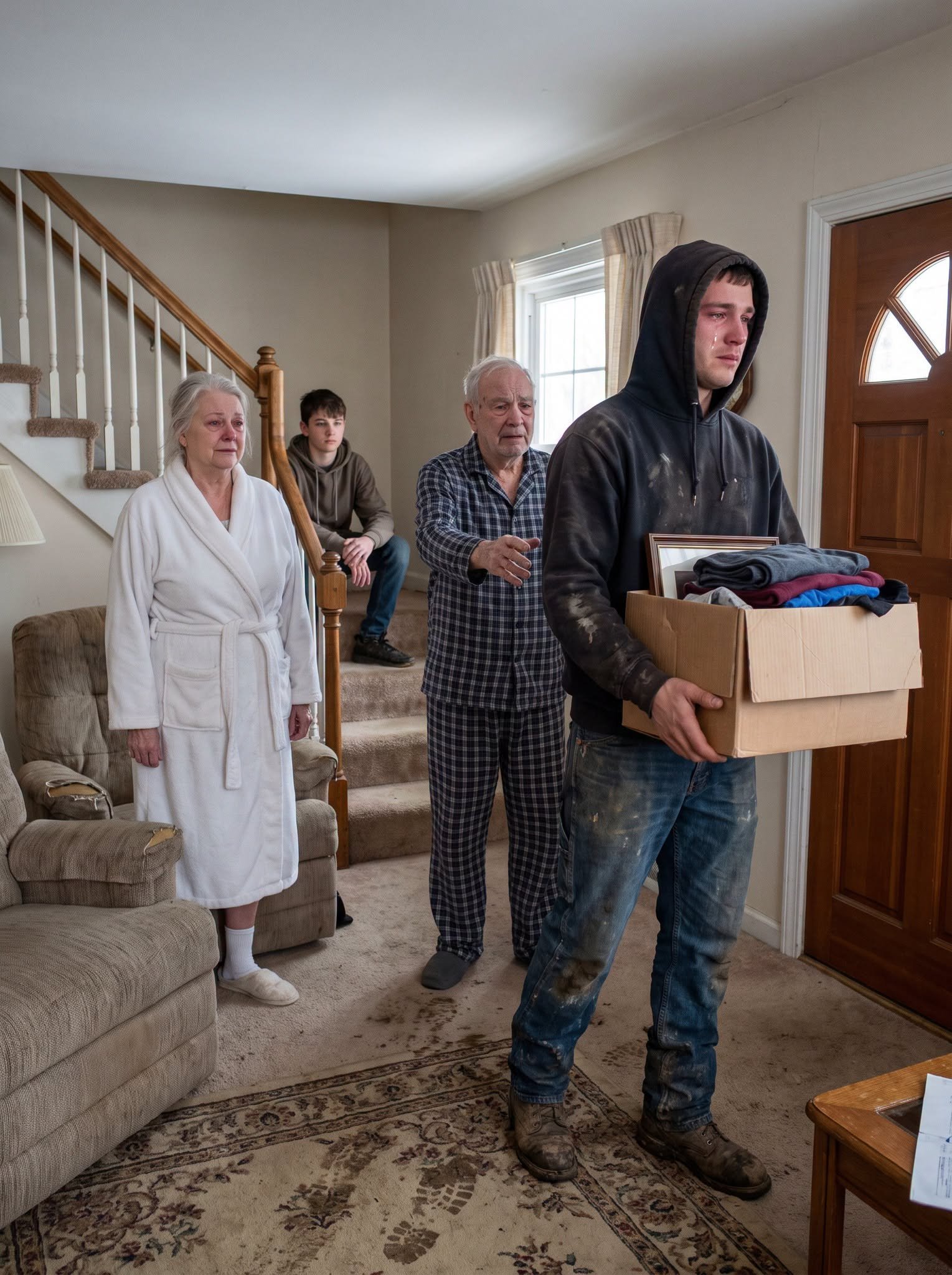
I looked at my mother, arms crossed, already agreeing with him before he’d finished the sentence. I looked past both of them at Jake in the recliner, headset on, laughing at his screen, oblivious to the fact that the man financing every second of his comfortable ignorance was standing eight feet away being told to leave.
And I said, “Okay.”
I went upstairs, not to argue, not to pack in some dramatic rush, but because there was almost nothing left up there that was mine. I’d already moved it. I zipped up the last duffel bag, the one with a few remaining shirts and the old photo of my grandfather and me at the county fair that I kept on my nightstand, and I carried it down the stairs past both of them without another word.
I didn’t slam the door. I didn’t say anything cutting on my way out, though God knows I had four years of material to draw from. I just walked out to my truck, set the bag on the passenger seat, and drove the eleven minutes out to Route 12 in the dark, past the Millbrook water tower and the old grain elevator lit up against the night sky, out to the little apartment above Earl Henderson’s machine shed where, for the first time in longer than I could remember, nobody was waiting up to hand me a bill I hadn’t agreed to.
The mortgage was due the next morning. And for the first time in four years, I wasn’t the one paying it.
What the Morning Brought
I won’t pretend I felt triumphant lying in that unfamiliar bed that first night, listening to Earl’s dog bark at something out past the machine shed. Mostly I felt hollowed out, the way you feel after a long shift when the adrenaline finally drains and what’s left underneath is just tired. I kept my phone face down on the nightstand and told myself I wouldn’t check it until morning.
I checked it at six a.m. anyway.
Four missed calls from my mother between eleven the night before and five that morning. Two voicemails I didn’t listen to right away. A single text from my father, sent at 11:47 p.m., that read: You need to come back and talk about this like an adult.
I got up, made coffee in Earl’s slow-heating little kitchen, and went to work. I didn’t call back. Not because I wanted to hurt them, but because I honestly didn’t know yet what I would say, and I’d learned enough in four years to know that answering my father angry never went anywhere good for either of us.
The calls kept coming through the morning. By noon my mother had left a third voicemail, her voice tight in a way I recognized, the tone she used when something had gone sideways and she needed somebody to fix it fast. I finally listened to it standing in the shop parking lot on my lunch break, leaning against my truck with a sandwich I wasn’t eating.
The mortgage company had called the house. The payment hadn’t come in, and there’d been a note on the account already from a previous late payment, months back, that I hadn’t known about, that put them one missed payment away from a real problem with the bank. My mother’s voice cracked halfway through explaining it, and underneath the panic I could hear the thing she wasn’t quite willing to say outright: that they needed my eight hundred dollars, not eventually, but that day, and they needed me to understand that this was urgent in a way my previous four years of on-time payments apparently hadn’t been.
I sat with that voicemail for a long time before I called my mother back.
When she answered, she didn’t say hello. She said, “Mike, we need to talk about the mortgage.”
“I know,” I said. “I saw the transaction on your laptop a few days ago. Eight hundred dollars, exactly what I’d been paying you. That wasn’t rent, was it. That was never rent.”
The silence on the other end of the line told me everything I needed to know, more clearly than any answer she could have given me.
“It’s complicated,” she finally said.
“It’s really not,” I told her. “You told me for four years I was paying my share of a household I was helping to run. I was paying your whole mortgage while Jake paid nothing and got a gaming setup worth more than my scanner, and last week your husband broke my equipment and told me to get out if I didn’t like being treated that way. I got out. I don’t think I owe you an explanation for taking him at his word.”
She started to cry, and for a moment the old reflex in me, the one built over twenty-five years of wanting more than anything to be the good son, wanted to cave, to say I’d figure something out, to drive over with an envelope like I always had. I let that reflex pass through me and out the other side without acting on it. It was the hardest thing I did all year.
“I’m not moving back,” I told her. “And I’m not sending eight hundred dollars a month to a house I don’t live in anymore. If you and Dad need to talk about the mortgage, that’s between you and the bank, or you and Jake, since he’s twenty and hasn’t contributed a dollar to that house in his whole life.”
The Reckoning
What happened over the following month, I heard about mostly secondhand, some from my mother in phone calls that slowly shifted from panic to something more like honesty, and some from my aunt Diane, my mother’s sister, who ran the register at the diner in town and heard most of Millbrook’s business whether she wanted to or not.
My father, it turned out, had let the mortgage slide twice before, quietly, without telling my mother the full extent of it, covering the gap with a credit card that was closer to its limit than either of them had let on. My eight hundred dollars a month hadn’t just been convenient. It had been load-bearing, in the most literal sense, holding up a financial structure that had no real foundation under it once you took my payment away.
Without it, the truth came out fast. My father had to go back to the bank and explain himself. My mother picked up a fourth day of house cleaning. And Jake, for the first time in his life, was told in plain language that his gaming equipment, the streaming lights, the three monitors, all of it, was going up for sale, and that he was expected to find a job that paid actual money before the end of the month, community college or no community college.
I want to tell you Jake took that well. He didn’t. My aunt Diane told me he sulked for two weeks, told our parents it wasn’t fair, that this was somehow my doing, that I’d abandoned the family over “a couple of tools.” It took my father, of all people, sitting him down at that same kitchen table and telling him flatly that his brother had carried this family for four years and gotten his equipment smashed for it, before Jake’s version of events started to crack.
He called me himself, about five weeks after I moved out. I almost didn’t answer.
“I got a job,” he said, no preamble, sounding younger than twenty on the phone somehow. “At the tire shop in town. It’s not much. But I wanted you to know.”
“Okay,” I said, echoing the word that had gotten me out of that house in the first place, though I didn’t mean it the same way this time.
“I’m sorry about your scanner,” he added, quieter. “I looked up what a new one costs. I want to pay you back. It’s going to take me a while, but I want to.”
I told him I’d think about it. It took him four months, working weekends at that tire shop stacking and mounting tires, but he did pay me back, in cash, in an envelope, the same way I’d handed money over for four years, except this time the debt ran the other direction, and this time it actually got settled instead of quietly growing.
My father never apologized outright, not in so many words, not the way I might have wanted him to in some version of this story where everything wraps up clean. What he did instead, about two months after I moved out, was show up at Earl Henderson’s place on a Sunday afternoon in his old work coat, stand in the gravel drive, and ask if I had a minute to look at his truck, which had been throwing a check engine light he couldn’t afford to have diagnosed at a real shop.
I looked at it. Bad oxygen sensor, twenty-minute fix, parts I had sitting in my own storage bay. I didn’t charge him.
We didn’t talk about the mortgage that day, or the garage, or four years of notes on the fridge. We just stood in Earl’s driveway while I worked, the way we used to stand together in the garage back before all of it, and for about twenty minutes it felt almost like being father and son instead of landlord and tenant.
It wasn’t everything. I want to be honest about that too. Things between us have never gone back to what they might have been if none of it had happened, and I’ve made my peace with that. I go to Sunday dinner at my parents’ house about twice a month now, on my own schedule, on my own terms, and I don’t bring an envelope with me anymore. My mother has stopped leaving notes on any fridge, mine or theirs. My father, slowly, in his own stubborn way, has started asking me questions about my work instead of just nodding at whatever I tell him about it.
A Year Later
I’m writing this almost a year out from that night in the kitchen. I still work at Koenig’s, though these days I run the diagnostic bay myself, the shop having finally invested in equipment good enough that I don’t have to worry about a wedged garage door taking it out again. Carol Alderman, the farmer’s wife who tipped me five hundred dollars that harvest, still brings her grain truck to me every fall, and last year she brought her niece’s car in too, told the girl I was the only mechanic in three counties she trusted with anything that mattered to her.
I still live above Earl Henderson’s machine shed. I’ve put a lease renewal signature on that apartment twice now, and Earl’s blue heeler has taken to sleeping on my porch most evenings like she’s decided I belong there. I’ve started saving, actually saving, for the first time in my adult life, toward a down payment on a small place of my own out past the edge of town, something with a real garage where nobody’s friends can prop the door open with my equipment.
Jake works full time at the tire shop now, and he’s talked, a little sheepishly, about maybe going back to school for something practical, diesel technology or small engine repair, something with his hands instead of a screen. I don’t know if he’ll follow through. I’ve learned not to hold my breath on that front. But he calls me now and then, just to talk, and last month he asked me to teach him how to change his own oil instead of paying somebody else to do it, and I drove out to Cedar Route on a Saturday and stood in that same garage with him, the one where it all fell apart, and showed him how.
The toolbox is still there, the same one that got tipped over that Friday night. I fixed the dent in the side panel myself. The scanner, the one that got cracked, sits on a shelf in my new storage bay now, broken screen and all. I kept it. Not out of bitterness, or at least I don’t think that’s why anymore. I kept it because every time I see it I remember exactly what four years of being treated like income instead of family finally cost the people who built that arrangement, and exactly what one word, said calm and quiet in a kitchen on Cedar Route, was enough to end it.
If you don’t like it, move out, my father told me that night, certain I’d fold the way I always had.
I didn’t fold. I just said okay, and for the first time in four years, I meant it completely, and I meant it for myself.