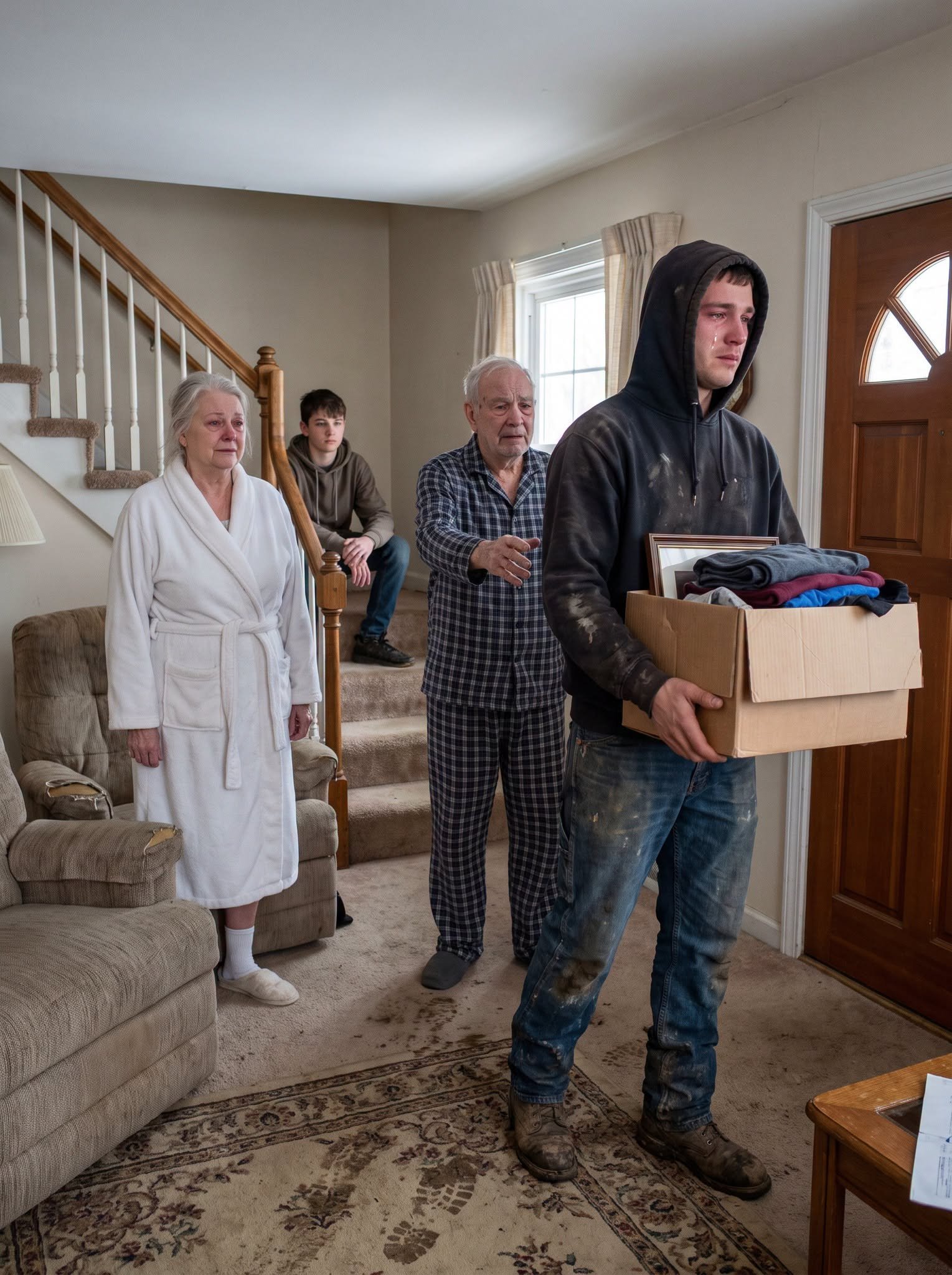
My father stood in the kitchen with his arm out, pointing toward the stairs like he was showing a stranger the door, and said, “If you don’t like it, move out.” He said it the way you’d challenge a kid to a fistfight you already knew you’d win. Like he’d said it a hundred times in his head before he ever said it out loud to me.
My mother stood next to him with her arms crossed over her housecoat, chin up, already on his side before she even knew what the fight was about. In the living room my younger brother Jake sat sideways in the recliner with his headset on, laughing at something on his screen, not even looking up. Probably a headset I’d paid for, one way or another, same as the couch he was sitting in and the router that kept his stream from lagging.
They expected the same thing they always got out of me. An argument. An apology. A promise to do better. And then, on the first of the month, the same $800 folded into an envelope and left on the kitchen counter like tribute.
I looked at both of them for a second. Then I said, “Okay.”
One word. That was it.
What neither of them knew, standing there in that kitchen in Millbrook, Ohio, on a Tuesday night in March with the porch light throwing long shadows across the linoleum, was that I had already signed a lease two days earlier. And that their mortgage, the one due on the first of every month like clockwork, was due the very next morning.
My name is Mike Reynolds. I was twenty-five years old, and that was the night I finally understood the difference between helping your family and being used by it. It took me four years to learn it, and it cost me almost everything I had before I did.
The Arrangement
I grew up in that house on Cedar Route, a mile and a half outside town where the pavement turns to gravel and the mailboxes lean at an angle from forty years of snowplows clipping them. My dad, Gary Reynolds, worked at the co-op grain elevator for twenty-two years before his knees gave out and he went on disability. My mother, Sharon, cleaned houses for people in town three days a week and complained about her back the other four. It was not a rich house. It was not even, most months, a comfortable one. But it was ours, or at least I always thought it was ours, the way a kid thinks about the place he grew up in, without ever once wondering whose name was actually on the deed.
I started paying them rent the month I turned twenty-one. Eight hundred dollars, first of every month, no exceptions. At the time it seemed fair enough. I was working full time by then, I had a truck payment and a cell phone bill and I was eating their food and using their water and their electricity, and my dad sat me down at that same kitchen table and told me that in his house, adults contributed. I didn’t argue. I’d been raised to believe that contributing was what decent people did, and I wanted, more than almost anything else in those years, to be a decent person in my father’s eyes.
For a while, that eight hundred dollars felt like exactly what it was supposed to be: my share. Rent, groceries, the electric bill I was helping to keep the lights on for. I didn’t mind it. I actually took a kind of pride in it, walking into that kitchen on the first of the month with cash folded in an envelope, watching my dad nod like I’d finally become something worth having around.
But the arrangement didn’t stay simple. It never does, once somebody figures out you’ll pay without asking too many questions.
It started small. A note on the fridge, held up by the magnet shaped like a combine that had been there since I was in grade school. Laundry fee, thirty dollars. I didn’t think much of it. Then another note, a few weeks later. Driveway use, fifty dollars, because I’d started parking my truck closer to the garage instead of down by the fence line. Then garage storage, forty dollars, for the space where I kept my tool chests. Then an “extra groceries” line that never had a number attached to it, just appeared on a sticky note stuck to the milk carton like an accusation. Then a running “utility balance” that my mother would mention in passing, never with a total, just enough to make me feel like I was behind on something I couldn’t see clearly enough to pay off. Then, every so often, “temporary help,” which as far as I could tell meant whatever cash they were short that week for whatever reason they didn’t feel like explaining.
None of it, on its own, was enormous. Thirty dollars here. Fifty there. That was the whole trick of it, I understood later. Small enough that if I questioned it, I’d look petty, ungrateful, like I was nickel-and-diming my own parents over grocery money. Frequent enough that over four years it bled me dry a little at a time, the way a slow leak in a tire will flatten it out overnight without ever making a sound you’d notice.
Meanwhile my brother Jake, four years younger than me, paid nothing. Not a dollar. Not once.
Jake was twenty, enrolled at the community college over in the county seat, though “enrolled” was doing a lot of work in that sentence. Two classes a semester, and he skipped more of those than he attended. He was, according to my parents, “working on his future,” and apparently that future required a gaming rig with three monitors, RGB lighting strips running along the baseboards of what used to be my father’s home office, and internet fast enough to stream without lag to the forty or so people who watched him play. He needed all of that the way a farmer needs a tractor, or so my mother put it once when I asked why his equipment kept getting upgraded while my tool budget stayed exactly where it had been for three years running.
Jake was potential. That was the word my mother used for him, more than once, in that soft voice she never used on me. He was potential.
I was income.
That was the whole arrangement, once I finally saw it laid out plain. I just hadn’t wanted to see it for a long time, because seeing it meant admitting what it made me.
Grease Under My Nails
I worked as a diesel mechanic at Koenig’s Diesel and Ag Repair, a low steel building out on County Road 9 that served half the farms in three townships. We fixed combines during harvest, grain trucks, the occasional over-the-road semi that broke down on the interstate spur and got towed in because we were the closest shop that could handle a Cat engine. It was hard work. Sixty-hour weeks were common, more during planting and harvest, when a farmer with a broken combine and a field of soybeans about to go bad wasn’t interested in hearing that I needed to go home and sleep.
I came home most nights smelling like diesel and hydraulic fluid, with fresh cuts across my knuckles from reaching into places a hand shouldn’t have to go, my back aching in that low, permanent way that mechanics get used to before they’re thirty. And more than once I walked in the door to find my mother waiting by the sink with her arms crossed, ready to point out the coffee mug I’d left there that morning before my six a.m. shift.
Jake could leave the entire living room wrecked, plates stacked on the coffee table, energy drink cans lined up like trophies, and my mother would call him overwhelmed. If he failed a class, it was because the professor didn’t understand his learning style, or the class met too early, or the material was pointless anyway since he was going to make his money streaming. If I got a raise or picked up a certification that bumped my hourly rate, my father’s whole response was, “Good. Stability matters,” said flat, like I’d simply done the bare minimum a grown man was supposed to do, nothing worth celebrating, nothing worth even looking up from the television for.
I want to be honest about something. I didn’t resent Jake, not exactly, not for a long time. He was my little brother. I remembered teaching him to ride a bike on the gravel shoulder of Cedar Route, holding the seat and running alongside him until he found his balance and I let go and he didn’t even notice for thirty yards. I remembered him crying at my grandfather’s funeral and me being the one who sat next to him in the pew because our parents were up front with the casket. I loved him. What I resented, once I let myself feel it, was what our parents had built around him, and around me, without ever once sitting either of us down and admitting out loud what they were doing.
There’s one night I still think about more than almost any other. I’d come home late after a brutal shift, the kind where you’re flat on your back on a creeper under a grain truck in February with slush dripping onto your face from the undercarriage, and I was holding two things when I walked in. A thank-you card from a farmer’s wife named Carol Alderman, whose grain truck I’d gotten running again in the middle of harvest when every other shop in the county had a two-week backlog, and five hundred dollars in cash folded inside it that she’d insisted I take even though I told her the shop rate already covered it.
There were balloons in the kitchen. Actual silver balloons, tied to the backs of the chairs.
For about one full second, walking through that door with a thank-you card in my hand and my knuckles still stinging from the day, I let myself think maybe, just maybe, they were for me. Some small, stupid part of me that never quite stopped hoping.
Then Jake came around the corner grinning, phone held up like a trophy. “I hit a thousand subscribers,” he said.
There was a sheet cake on the counter. Store bought, chocolate, with blue icing script that said Congrats Jake! I ate a piece of that cake, cake I had almost certainly helped pay for one way or another, and I told him congratulations, and I meant it as much as I could manage to mean anything by then. Because explaining what that moment actually felt like, standing in a kitchen decorated for my brother’s video game numbers while the card in my pocket from a woman who wasn’t even my family said more true things about my worth than anything my parents had said to me in years, would have taken more energy than I had left in me that night.
I didn’t say any of that. I just ate the cake and went to bed.
The Garage
If you’ve never worked as a mechanic, you might not understand what a man’s tools mean to him. They aren’t just things you own. They’re the difference between being able to work and not being able to work. They’re your income and your reputation and, in a lot of ways, your future, all sitting in drawers you’ve organized and labeled and maintained for years, one paycheck at a time, because a good impact wrench or a real diagnostic scanner isn’t cheap, and you don’t replace it easily.
I’d built my set up slowly since I was seventeen, working part time at Koenig’s after school and putting almost every spare dollar into sockets, torque wrenches, a good multimeter, and eventually a diagnostic scanner that could talk to nearly anything with a modern engine control module in it. Everything organized. Everything labeled. Everything in its place, because in that line of work a missing tool in the middle of a job can cost you an hour you don’t have.
I kept it all in the garage at my parents’ house. The same garage I paid a “storage fee” to use.
One Friday night in late February, I pulled into the driveway after a double shift and saw light spilling out from under the garage door before I even got out of my truck. Music, loud, bass thumping through the walls. I remember standing there for a second in the cold, keys still in my hand, trying to figure out why my garage sounded like a party.
I opened the door and I froze.
My toolbox, a five-drawer rolling chest I’d been paying off for two years, was tipped over on its side. Sockets were scattered across the concrete floor, some of them already rolled under the truck, half buried in a spreading puddle of spilled beer. And right there in the middle of it, my diagnostic scanner, the single most expensive piece of equipment I owned, over a thousand dollars, was wedged sideways under the bottom of the garage door, propping it open so the night air could clear out the smoke and the smell of spilled cans.
Cracked screen. I could see the spiderweb of fractures from six feet away.
And in the middle of all of it, my brother and three of his friends, red plastic cups in hand, laughing over a game of beer pong set up on a folding table they’d dragged in from somewhere.
Jake looked over at me, grinning, clearly a few drinks past sober. “Relax,” he said, like I’d walked in complaining about nothing at all. “We needed the space.”
For a second I couldn’t even get words out. One of his friends laughed at something, I don’t even know what, maybe just the look on my face. Jake shrugged again, easy, careless, like none of it mattered. “They’re just tools.”
Just tools.
I don’t remember deciding to move. I remember my hand closing around the collar of his shirt and asking him, low and flat, if he had any idea what he’d just done, if he understood what that scanner cost, what it meant for my week come Monday morning when a farmer needed his equipment diagnosed and my scanner had a screen full of cracks.
He shoved back at me, still grinning like this was funny, and said, “Dad will replace them if it’s that serious.”
That sentence stopped me colder than the cracked screen had.
Because in that one sentence was the whole four years of my life laid out plain. Dad will replace them. Not I’ll replace them. Not I’m sorry. Dad will replace them, because in Jake’s world, that was simply how things worked. Somebody else always covered it. And for one very dangerous second, standing in that garage with beer soaking into my socks and my equipment scattered across the floor, I understood exactly how a man could do something he’d regret for the rest of his life.
So I let go of his shirt. I stepped back. I made myself breathe.
Then I pulled out my phone, and I started taking pictures.
The toolbox on its side. The scattered sockets. The beer pooling around my equipment. The cracked scanner wedged under the door. Jake’s face, his friends’ faces, the folding table, all of it, one photo after another, my hands steadier than I expected them to be.
Jake sobered up fast once he saw what I was doing. “What are you doing?”
“Documenting it,” I said, “before I call the police.”
That was the exact moment my parents walked in from the house, drawn out by the noise or maybe by Jake’s friends scattering toward their cars. My mother took one look at Jake’s face, upset now that the fun had turned into something with consequences attached, and she turned on me before she’d even looked at the garage floor.
“What are you doing to your brother?”
I pointed at the mess. “Look at my tools.”
My father glanced around, unbothered, like he was looking at a spilled bag of chips instead of two years of my paychecks scattered across the concrete. “They were just having fun,” he said.
My equipment was destroyed. My ability to work the following Monday was in real jeopardy. And somehow, standing in the wreckage of my own garage, I was still the one being asked to explain myself.
The Apartment on Route 12
I didn’t sleep much that night. I lay in my old bed, the same one I’d slept in since I was nine years old, staring at the ceiling and running numbers in my head. What four years of that rent actually added up to. What the laundry fees and driveway fees and utility balances and temporary help had come to, on top of the eight hundred dollars a month I’d never once been late on. What it would cost to replace a scanner that had been holding my whole week together.
The next morning, before my shift, I drove out to look at a garage apartment I’d seen listed on the community board at the feed store the week before, almost as a joke to myself at the time, a way of blowing off steam after another argument about the utility balance. It sat behind an old farmhouse on Route 12, owned by a retired dairy farmer named Earl Henderson who’d converted the loft above his machine shed into a one bedroom apartment for his daughter years ago, before she moved to Columbus and never came back for it.
One bedroom. A basic kitchen with a stove that worked and a fridge that hummed a little too loud. And, most important to me, a locked storage bay downstairs where I could keep what was left of my tools behind a real deadbolt instead of a garage door that anybody’s friends could prop open with my own equipment.
It was cheaper than what I’d been paying my parents. Not close, not almost, cheaper, flat out, once I did the math on rent alone without the fees stacked on top.
I signed the lease that same afternoon, sitting at Earl’s kitchen table while his old blue heeler slept under my chair. Earl didn’t ask me a single question about why a twenty-five-year-old man was renting a garage apartment instead of living somewhere nicer. He just shook my hand and told me the hot water heater ran a little slow in the mornings and that was about all the warning I’d need.
Then I started moving out. Quietly, deliberately, over the next several days, the way you’d disarm something you didn’t fully trust not to go off in your hands.
I moved the important things first. Documents. My birth certificate, my social security card, my truck title, the folder where I kept four years of pay stubs, because some part of me already knew I might need proof of exactly what I’d been contributing, if it ever came to that. Bank records next. Then what was left of my tools, the ones that had survived the garage, wrapped carefully and loaded into the truck bed a load at a time so nobody would notice the garage getting emptier all at once. Then clothes, then the handful of other things that actually mattered to me, which turned out to be a shorter list than I expected after twenty-five years in one house.
It was during one of those trips, carrying a box of winter clothes down the hallway, that I saw it.
My mother’s laptop was open on the kitchen table, the online banking portal still logged in from whatever bill she’d been paying that morning. I wasn’t snooping. I want to be clear about that. I glanced at the screen the way you glance at anything left open in a room you’re walking through, and what caught my eye was a single line item under recent transactions.
Mortgage payment. Eight hundred dollars.
Not close to eight hundred. Not roughly. Exactly eight hundred dollars, to the penny, matching the number I’d handed my father in an envelope on the first of every month for four straight years.
I stood there in that hallway with a box of winter clothes in my arms and I understood, all at once, in the particular way you understand something your body already knew before your mind caught up to it, that my rent had never been my share of the household. It had never been my contribution toward groceries or electricity or the water bill.
It was the mortgage. My eight hundred dollars a month wasn’t helping pay for the house. It was the entire payment, every single month, for four years, while my father drew disability and my mother worked three days a week cleaning other people’s homes and told me the utility balance was running behind again.
I finished carrying the box out to my truck. I didn’t say anything to anybody that day.
Okay
The final confrontation happened two nights later, the same night I’ve already told you about, the one in the kitchen with the porch light throwing shadows across the floor. My father brought up rent again, told me it needed to go up another fifty dollars starting next month to help cover “the extra strain” on the household, whatever that meant that week. And when I hesitated, when I didn’t immediately reach for my wallet the way I always had, he pointed toward the stairs and said the thing he must have been waiting years to finally get to say out loud.
If you don’t like it, move out.
End Part Here: The Mechanic Who Stopped Paying Their Mortgage